PUBLISHER: Mordor Intelligence | PRODUCT CODE: 2119044

PUBLISHER: Mordor Intelligence | PRODUCT CODE: 2119044
Alternate Fuel and Raw Materials (AFR) Firing Systems - Market Share Analysis, Industry Trends & Statistics, Growth Forecasts (2026 - 2031)
According to Mordor Intelligence, the alternate fuel and Raw Materials Firing Systems Market size was valued at USD 0.65 billion in 2025 and is estimated to grow from USD 0.71 billion in 2026 to reach USD 1.11 billion by 2031, at a CAGR of 9.35% during the forecast period (2026-2031).
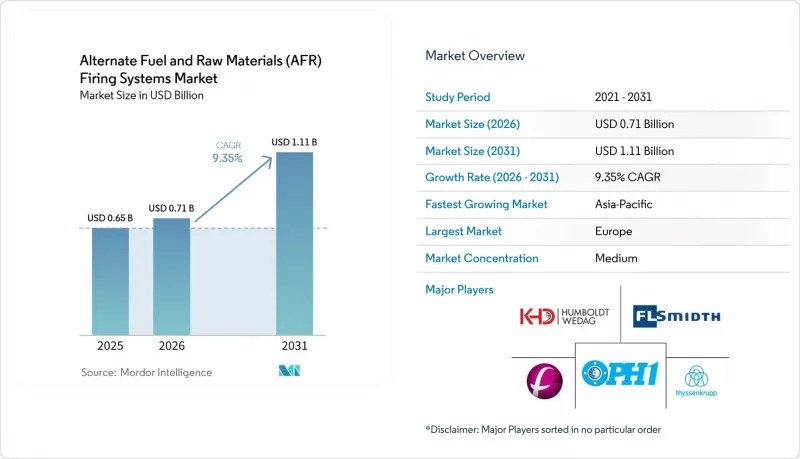
This report is Segmented by AFR System Type (Liquid, Solid Co-Processing), Waste/Fuel Stream (MSW, Industrial, Others), Kiln Injection Point (Precalciner, and More), End-User (Cement, Lime, Wte, and More), Deployment (Greenfield, and More), and Geography (North America, Europe, Asia-Pacific, South America, and Middle East and Africa). The Market Forecasts are Provided in Terms of Value (USD).
Global Alternate Fuel and Raw Materials (AFR) Firing Systems Market Trends and Insights
Industrial Decarbonization and Carbon-Cost Avoidance
Carbon pricing has become a direct operating consideration for cement producers, and AFR systems offer a practical route to reduce fossil fuel use. The supplied evidence states that EU ETS auction prices reached EUR 75 per tonne of CO2 in the first quarter of 2026. Plants operating at high thermal substitution can reduce the emissions associated with coal-based clinker production. A life-cycle assessment covering South Africa and Ethiopia found that 20% RDF substitution reduced global warming potential by 3.3% to 4.2%, with a higher reduction when avoided landfill methane was included. These operating outcomes make AFR equipment relevant to carbon management, fuel procurement, and plant-level emissions reporting. The AFR firing systems market benefits when producers link thermal substitution targets to financing and wider decarbonization commitments.
Landfill Diversion and Circular-Economy Mandates
Landfill restrictions are changing the commercial value of waste-derived fuels. The Global Cement and Concrete Association, the International Solid Waste Association, and the Mission Possible Partnership called in 2026 for co-processing to receive clear recognition in waste policy frameworks . The same policy discussion included recognition of co-processing under a dedicated Basel Convention code. Such rules can improve certainty for waste processors, cement plants, and local authorities that manage municipal material. The result is a more stable basis for RDF supply, gate-fee arrangements, and pre-processing investment. The AFR firing systems market gains when waste policy treats cement kilns as a controlled recovery route rather than a secondary disposal option.
Fuel Quality Variability and Moisture Volatility
Fuel variability remains the most immediate operating constraint for high substitution rates. A 2025 study in Waste and Biomass Valorization found that waste-derived fuel composition affects the environmental and technical performance of cement production. Direct co-processing requires sufficient calorific value and controlled moisture and chlorine levels. Unsegregated municipal solid waste can lead to material build-up, corrosion, and unplanned maintenance when those requirements are not met. Fuller Technologies states that its FUELFLEX Pyrolyzer converts solid alternative fuels into reactive gases and char before calciner injection . This approach can improve fuel flexibility, but it also adds equipment, capital needs, and operating complexity.
Other drivers and restraints analyzed in the detailed report include:
- Local-Fuel Economics Versus Coal and Petcoke
- High-TSR Retrofit Demand in Existing Kilns
- High Retrofit CAPEX and Long Shutdown Windows
For complete list of drivers and restraints, kindly check the Table Of Contents.
Segment Analysis
Solid co-processing systems accounted for 74.3% of the AFR firing systems market share in 2025 and are forecast to grow at a 10.2% CAGR through 2031. Their position reflects the wide availability of municipal solid waste, refuse-derived fuel, tyre-derived fuel, and biomass. These materials can offer volume, local sourcing, and gate-fee advantages that liquid residues do not always provide. Solid systems also fit the fuel mix used by many cement plants that are working toward higher thermal substitution rates. Moving-hearth furnaces, step-combustors, and pyrolysis units have expanded the range of solid fuels that can be introduced without disrupting kiln chemistry. The AFR firing systems market size for solid systems is supported by equipment that can manage drying, particle size, feed consistency, and controlled combustion. Mature European installations showed that solid-fuel configurations can support thermal substitution rates above 50%, while individual plants in Poland exceeded 75% in 2025, according to the supplied draft. These results make solid systems relevant to both retrofit programs and new plant specifications. Their growth also reflects the need to recover energy from waste while returning mineral ash into clinker production. The category remains exposed to feedstock competition and inconsistent municipal waste sorting.
Modern solid systems can also provide benefits beyond fuel replacement. Pyrolysis-stage equipment produces reactive gases before calciner injection and can create a reducing environment. Fuller Technologies identifies its FUELFLEX Pyrolyzer as a solution for processing solid alternative fuels before calciner use. This operating approach can help manage thermal NOx formation and reduce reliance on ammonia injection for SNCR compliance. It also places greater importance on process controls, fuel sampling, and operator capability. Liquid AFR firing systems still serve plants with access to waste solvents and liquid industrial residues. Their dosing accuracy and handling characteristics can suit selected applications. However, liquid systems face a narrower supply base than solid configurations. The segment mix will remain shaped by local waste availability and the investment needed to prepare solid material for kiln use. Vendors with both combustion equipment and fuel-preparation expertise are better placed to address these conditions. The AFR firing systems industry continues to favor solutions that balance fuel flexibility with stable clinker quality.
Municipal solid waste held 39.2% of the AFR firing systems market share by input category in 2025. Its importance comes from large urban volumes, established collection systems, and the potential for gate-fee income. The GCCA stated that cement-kiln co-processing can recover energy while recycling mineral ash into the clinker process without residual waste. This characteristic distinguishes co-processing from routes that leave ash for separate disposal. MSW use still depends on sorting and pre-processing because raw municipal waste does not consistently meet kiln fuel requirements. Moisture, chlorine, and particle-size variation can limit direct use. Plants, therefore, need feeding systems designed around the quality of the available local stream. The AFR firing systems market depends on this upstream preparation as much as on the firing equipment itself. Municipal material is particularly relevant where landfill capacity is constrained, and local authorities support recovery projects. Its scale makes it a central feedstock for solid co-processing configurations.
Biomass and agricultural waste are forecast to grow at a 9.8% CAGR through 2031. Rice husks, sugarcane bagasse, and coconut shells provide examples of streams identified in the supplied draft. These fuels are relevant in cement regions with agricultural activity and suitable collection networks. Their use can reduce the share of fossil heat when reliable volumes are available. Biomass is not a uniform fuel class, and moisture content, seasonal availability, and transport costs can affect plant economics. Industrial waste and other streams also remain part of the fuel portfolio because they can offer high calorific value. The supplied draft cited tyre-derived fuel at 26 to 33 MJ/kg, subject to control of sulfur, zinc, and steel residues. Such materials can support energy-intensive kiln duty, but they also face demand from other industrial users. The AFR firing systems market is therefore moving toward diversified fuel portfolios rather than dependence on a single stream. Long-term supply agreements and quality controls are becoming important operating differentiators.
Complete Report Scope:
- By AFR System Type
- Liquid AFR Firing Systems
- Solid AFR Co-Processing Systems
- By Waste/Fuel Stream (AFR Input Category)
- Municipal Solid Waste
- Biomass & Agricultural Waste
- Industrial Waste
- Others
- By Kiln Point of Injection
- Precalciner Firing Systems
- Main Burner Firing Systems
- Tertiary Air Duct Injection
- By End-User Industry
- Cement Industry
- Lime Industry
- Waste-to-Energy Plants
- Pulp & Paper Industry
- Other Industrial Kilns and Furnaces
- By Deployment Model
- Greenfield Installations
- Brownfield Retrofit
- Turnkey Projects
- By Geography
- North America
- United States
- Canada
- Mexico
- Europe
- Germany
- France
- Italy
- Spain
- United Kingdom
- Poland
- Russia
- Rest of Europe
- Asia-Pacific
- China
- India
- Japan
- South Korea
- Australia
- Indonesia
- Vietnam
- Thailand
- Rest of Asia-Pacific
- South America
- Brazil
- Argentina
- Chile
- Rest of South America
- Middle East and Africa
- Saudi Arabia
- United Arab Emirates
- Egypt
- South Africa
- Morocco
- Rest of Middle East and Africa
- North America
Geography Analysis
Europe held 41.5% of the AFR firing systems market share in 2025. The region has a mature co-processing base supported by carbon pricing, waste policy, and established alternative-fuel suppliers. The supplied draft reported that average thermal substitution in European cement plants exceeded 50% in 2025. It also cited rates above 75% at individual plants in Poland and near-100% at selected facilities in Spain. The GCCA has published guidance on reporting carbon emissions from waste in the cement sector, supporting consistent emissions accounting. This reporting need raises the value of process monitoring and reliable fuel records. Germany, France, Italy, and the United Kingdom provide a large installed base, while Central and Eastern Europe continues to offer retrofit activity.
Asia-Pacific is projected to be the fastest-growing regional segment, at a 10.8% CAGR from 2026 to 2031. China and India are important demand centers because of their large cement sectors and growing need for waste management solutions. KHD reported commissioning its second Pyrorotor system in China in December 2025 at Conch Group's Baoshan plant. The system processed high-moisture biomass and municipal waste at 18 tonnes per hour while maintaining kiln stability. India is also expanding attention to RDF use under the policy framework referenced in the supplied material. The AFR firing systems market size in Asia-Pacific is supported by urban waste volumes, the need to lower imported fuel exposure, and capacity additions in several countries. Regional demand will vary with local collection systems, permits, and the ability to prepare material to consistent fuel specifications.
North American cement plants operated at 15% to 16% thermal substitution in 2025, compared with European averages above 50% in the supplied material. MIT Concrete Sustainability Hub linked the slower scale-up in the United States to economic, regulatory, and social barriers. South America has demonstrated more active investment, particularly in Brazil, according to the supplied draft. Middle East and Africa present a longer-term opportunity because of greenfield construction, urbanizing waste streams, and reliance on imported coal and petcoke. These markets require local fuel logistics, pre-processing capacity, and solutions designed for specific kiln layouts. Geographic growth in the AFR firing systems market will depend on the interaction between waste policy, fuel supply, plant economics, and supplier service coverage.
- Dynamis Ltd.
- FCT Combustion Pty Ltd.
- Fives Group
- FLSmidth & Co. A/S (FLS)
- Fuller Technologies, Inc.
- Greco Combustion Systems, Inc.
- KHD Humboldt Wedag International AG
- PH1 Engineering Solutions Pvt. Ltd.
- Satarem S.A.
- Sinoma International Engineering Co., Ltd.
- thyssenkrupp Polysius GmbH
- Unitherm Cemcon Feuerungsanlagen GmbH
Additional Benefits:
- The market estimate (ME) sheet in Excel format
- 3 months of analyst support
TABLE OF CONTENTS
1 INTRODUCTION
- 1.1 Study Assumptions and Market Definition
- 1.2 Scope of the Study
2 RESEARCH METHODOLOGY
3 EXECUTIVE SUMMARY
4 MARKET LANDSCAPE
- 4.1 Market Overview
- 4.2 Market Drivers
- 4.2.1 Industrial Decarbonization and Carbon-Cost Avoidance
- 4.2.2 Landfill Diversion and Circular-Economy Mandates
- 4.2.3 Local-Fuel Economics Versus Coal and Petcoke
- 4.2.4 High-TSR Retrofit Demand in Existing Kilns
- 4.2.5 Digital Combustion Control for Variable Fuels
- 4.2.6 Waste-Stream Traceability as a Procurement Requirement
- 4.3 Market Restraints
- 4.3.1 Fuel Quality Variability and Moisture Volatility
- 4.3.2 High Retrofit CAPEX and Long Shutdown Windows
- 4.3.3 Permitting, Emissions Liability, and Community Opposition
- 4.3.4 Competition for High-Calorific Waste Streams
- 4.4 Value Chain Analysis
- 4.5 Technology Outlook
- 4.6 Regulatory Landscape
- 4.7 Porter's Five Forces Analysis
- 4.7.1 Bargaining Power of Suppliers
- 4.7.2 Bargaining Power of Buyers
- 4.7.3 Threat of New Entrants
- 4.7.4 Threat of Substitutes
- 4.7.5 Competitive Rivalry
5 MARKET SIZE AND GROWTH FORECASTS
- 5.1 By AFR System Type
- 5.1.1 Liquid AFR Firing Systems
- 5.1.2 Solid AFR Co-Processing Systems
- 5.2 By Waste/Fuel Stream (AFR Input Category)
- 5.2.1 Municipal Solid Waste
- 5.2.2 Biomass & Agricultural Waste
- 5.2.3 Industrial Waste
- 5.2.4 Others
- 5.3 By Kiln Point of Injection
- 5.3.1 Precalciner Firing Systems
- 5.3.2 Main Burner Firing Systems
- 5.3.3 Tertiary Air Duct Injection
- 5.4 By End-User Industry
- 5.4.1 Cement Industry
- 5.4.2 Lime Industry
- 5.4.3 Waste-to-Energy Plants
- 5.4.4 Pulp & Paper Industry
- 5.4.5 Other Industrial Kilns and Furnaces
- 5.5 By Deployment Model
- 5.5.1 Greenfield Installations
- 5.5.2 Brownfield Retrofit
- 5.5.3 Turnkey Projects
- 5.6 By Geography
- 5.6.1 North America
- 5.6.1.1 United States
- 5.6.1.2 Canada
- 5.6.1.3 Mexico
- 5.6.2 Europe
- 5.6.2.1 Germany
- 5.6.2.2 France
- 5.6.2.3 Italy
- 5.6.2.4 Spain
- 5.6.2.5 United Kingdom
- 5.6.2.6 Poland
- 5.6.2.7 Russia
- 5.6.2.8 Rest of Europe
- 5.6.3 Asia-Pacific
- 5.6.3.1 China
- 5.6.3.2 India
- 5.6.3.3 Japan
- 5.6.3.4 South Korea
- 5.6.3.5 Australia
- 5.6.3.6 Indonesia
- 5.6.3.7 Vietnam
- 5.6.3.8 Thailand
- 5.6.3.9 Rest of Asia-Pacific
- 5.6.4 South America
- 5.6.4.1 Brazil
- 5.6.4.2 Argentina
- 5.6.4.3 Chile
- 5.6.4.4 Rest of South America
- 5.6.5 Middle East and Africa
- 5.6.5.1 Saudi Arabia
- 5.6.5.2 United Arab Emirates
- 5.6.5.3 Egypt
- 5.6.5.4 South Africa
- 5.6.5.5 Morocco
- 5.6.5.6 Rest of Middle East and Africa
- 5.6.1 North America
6 COMPETITIVE LANDSCAPE
- 6.1 Market Concentration
- 6.2 Strategic Moves
- 6.3 Market Share Analysis
- 6.4 Company Profiles (includes Global Level Overview, Market Level Overview, Core Segments, Financials as available, Strategic Information, Market Rank/Share, Products and Services, Recent Developments)
- 6.4.1 Dynamis Ltd.
- 6.4.2 FCT Combustion Pty Ltd.
- 6.4.3 Fives Group
- 6.4.4 FLSmidth & Co. A/S (FLS)
- 6.4.5 Fuller Technologies, Inc.
- 6.4.6 Greco Combustion Systems, Inc.
- 6.4.7 KHD Humboldt Wedag International AG
- 6.4.8 PH1 Engineering Solutions Pvt. Ltd.
- 6.4.9 Satarem S.A.
- 6.4.10 Sinoma International Engineering Co., Ltd.
- 6.4.11 thyssenkrupp Polysius GmbH
- 6.4.12 Unitherm Cemcon Feuerungsanlagen GmbH
7 MARKET OPPORTUNITIES AND FUTURE OUTLOOK
- 7.1 White-Space and Unmet-Need Assessment

