PUBLISHER: Mordor Intelligence | PRODUCT CODE: 2119219

PUBLISHER: Mordor Intelligence | PRODUCT CODE: 2119219
Solid Recovered Fuel (SRF) - Market Share Analysis, Industry Trends & Statistics, Growth Forecasts (2026 - 2031)
According to Mordor Intelligence, the solid recovered fuel market size is expected to grow from USD 6.64 billion in 2025 to USD 6.97 billion in 2026 and is forecast to reach USD 9.01 billion by 2031 at 5.26% CAGR over 2026-2031.
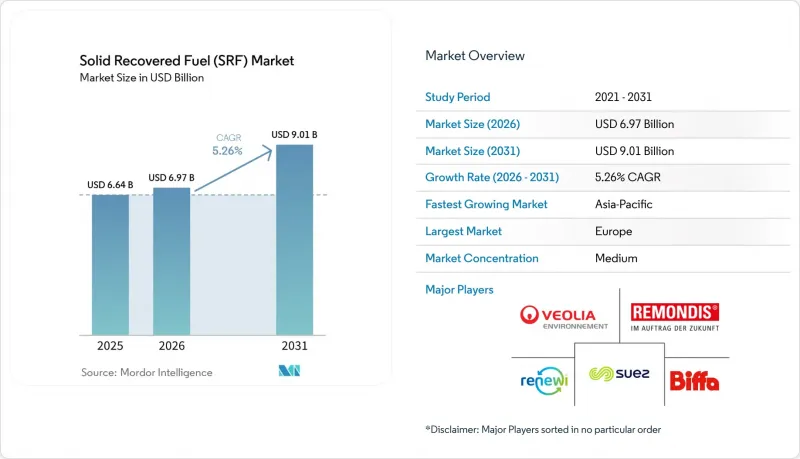
This report is Segmented by Feedstock Source (MSW, C&I Waste, C&D Waste, Other Waste Streams), End User (Cement Industry, CHP Plants, Power Generation Plants, Lime Industry, Steel & Metal Processing, Pulp & Paper, Other Industrial Users), and Geography (North America, Europe, Asia-Pacific, South America, and Middle East and Africa). The Market Forecasts are Provided in Terms of Value (USD).
Global Solid Recovered Fuel (SRF) Market Trends and Insights
Landfill Diversion and Energy-Recovery Mandates
Landfill reduction targets are shifting residual waste toward recovery routes and supporting feedstock availability for the solid recovered fuel market. The EU framework requires member states to limit municipal waste sent to landfill to 10% or less by 2035. A 2024 study for the EU Publications Office found that potential SRF production could exceed the estimated maximum capacity for SRF uptake in several member states. This places greater importance on processing capacity and stable industrial offtake than on waste availability alone. Operators that develop SRF-capable plants before regulatory deadlines tighten can secure access to residual material in their local catchment areas. France's sector produced nearly 1 million tonnes each year and had a target of 2.5 million to 3 million tonnes by 2030, although AFOCO identified a EUR 1 billion investment gap after the cancellation of the ADEME project fund in 2025.
Fossil-Fuel Substitution in Cement Manufacturing
Cement kilns remain a dependable source of demand for the solid recovered fuel market because their high operating temperatures can accommodate qualified waste-derived fuels. Austria's cement industry achieved an alternative fuel rate of 88.8% in 2025, rising from 87.7% in 2024, while conventional fuel inputs fell 6.4% year over year. A 2025 peer-reviewed study found that SRF substitution in cement kilns can reduce process greenhouse gas emissions by 200 kg CO2-equivalent per tonne of cement, with 80% substitution identified as the optimal point for environmental benefit. WASTE AND BIOMASS VALORIZATION The biogenic carbon fraction in MSW-derived SRF can lower fossil-carbon liability for cement operators covered by the EU ETS. Producers therefore have a stronger reason to provide certified fuel rather than lower-grade refuse-derived fuel. France's cement sector raised thermal substitution to 55% in 2024 from 52% in 2023 and stated a target of 80% by 2030. RECY.NET
Feedstock Moisture and Composition Variability
Inconsistent moisture content and composition remain operating challenges for the solid recovered fuel market. EUWID reported in December 2024 that commercial and industrial waste supplied to German facilities delivered calorific values of 11-12 MJ/kg against plant designs of 9.5-10.5 MJ/kg. Such variation can create thermal stress and reduce the suitability of fuel for intended kiln applications. Recycling requirements can also leave difficult fractions, including PVC-rich plastics, composites, and multilayer packaging, in the residual stream. These materials increase contamination risks and make consistent fuel production more difficult. Adaptive optical sorting and real-time calorific monitoring can help plants respond to changing inputs, but they require continuing capital and operating expenditure.
Other drivers and restraints analyzed in the detailed report include:
- EU ETS Fossil-Carbon Traceability and Premium SRF Demand
- Investment in Advanced Sorting and SRF Quality Infrastructure
- Capital, Permitting and Community-Acceptance Requirements
For complete list of drivers and restraints, kindly check the Table Of Contents.
Segment Analysis
Municipal solid waste held 54.8% of the solid recovered fuel market size by feedstock share in 2025. This reflects the scale and relative consistency of household waste collection systems in Europe and North America. The established position of MSW also shows that this feedstock is mature in many European markets. Higher-calorific material can be directed to mechanical-biological treatment and recycling, which can intensify competition for suitable MSW fractions. Commercial and industrial waste is forecast to grow at a 5.9% CAGR from 2026 to 2031.
PreZero's Murcia facility supplies the Cemex Alicante plant, and its Barcelona plant processes 190,000 tonnes of commercial and industrial waste each year. These facilities show how commercial and industrial waste can be used in cement applications when sorting and logistics are integrated. Construction and demolition waste remains underused because mineral inerts, metals, and gypsum can reduce calorific yield. Agricultural and other waste streams remain smaller elements of the solid recovered fuel industry, mainly in South and Southeast Asia, where biomass availability meets developing cement co-processing capacity. German cement companies were reported in 2025 to be increasing their 2030 thermal substitution targets through documented blends of MSW and commercial and industrial fractions.
Complete Report Scope:
- By Feedstock Source
- Municipal Solid Waste (MSW)
- Commercial & Industrial (C&I) Waste
- Construction & Demolition (C&D) Waste
- Agricultural Waste
- Other Waste Streams
- By End User
- Cement Industry
- Combined Heat and Power (CHP) Plants
- Power Generation Plants
- Lime Industry
- Steel & Metal Processing
- Pulp & Paper Industry
- Other Industrial Users
- By Geography
- North America
- United States
- Canada
- Mexico
- Europe
- Germany
- France
- Italy
- Spain
- United Kingdom
- Poland
- Russia
- Rest of Europe
- Asia-Pacific
- China
- India
- Japan
- South Korea
- Australia
- Indonesia
- Vietnam
- Thailand
- Rest of Asia-Pacific
- South America
- Brazil
- Argentina
- Chile
- Rest of South America
- Middle East and Africa
- Saudi Arabia
- United Arab Emirates
- Egypt
- South Africa
- Morocco
- Rest of Middle East and Africa
- North America
Geography Analysis
Europe held 56.9% of the solid recovered fuel market share in 2025. This position reflects long-term investment in waste processing, fuel quality standards, co-processing networks, and logistics. Austria, Germany, Sweden, and the Netherlands have mature utilization systems. Austria's cement industry achieved an 88.8% alternative fuel substitution rate in 2025 through specification-based fuel contracts. The revised EU Waste Shipment Regulation and the Digital Waste Shipment System became applicable in May 2026.
Asia-Pacific is forecast to expand at a 7.2% CAGR from 2026 to 2031, the highest rate among regions in the solid recovered fuel market. China, India, Indonesia, and Vietnam are the main growth areas. China's Zero Waste City initiative has included pilot cities that direct urban waste management toward stronger resource recovery systems. Indonesia initiated more than USD 600 million in waste-to-energy investment in 2026, supporting pretreatment and fuel-preparation infrastructure. India faces moisture and contamination issues in municipal waste, which can reduce calorific yield without drying and advanced pretreatment.
North America remains smaller but has room to develop as cement producers raise substitution rates and landfill costs increase. South America is advancing through Brazil, where the 550,000 tonne-per-year UTM Leste plant in Sao Paulo is scheduled for commissioning in 2027 and is designed to combine RDF production with organic recovery. The Middle East and Africa remain at an earlier stage because co-processing infrastructure is limited. Geminor received a NOK 5 million grant from Norad in February 2026 to assess a plastic-waste-to-SRF hub in West Africa for cement-kiln use.
- A2A S.p.A.
- Andusia Recovered Fuels Limited
- Beauparc Group
- Biffa Limited
- BMH Technology Oy
- Enva Group plc
- FCC Servicios Medio Ambiente Holding, S.A.U.
- Geminor AS
- Geocycle SA
- Indaver NV
- N+P Group Holdings Ltd.
- PreZero International GmbH
- REMONDIS SE & Co. KG
- Renewi plc
- SUEZ S.A.
- Veolia Environnement S.A.
Additional Benefits:
- The market estimate (ME) sheet in Excel format
- 3 months of analyst support
TABLE OF CONTENTS
1 INTRODUCTION
- 1.1 Study Assumptions and Market Definition
- 1.2 Scope of the Study
2 RESEARCH METHODOLOGY
3 EXECUTIVE SUMMARY
4 MARKET LANDSCAPE
- 4.1 Market Overview
- 4.2 Market Drivers
- 4.2.1 Landfill Diversion and Energy-Recovery Mandates
- 4.2.2 Fossil-Fuel Substitution in Cement Manufacturing
- 4.2.3 Investment in Advanced Sorting and SRF Quality Infrastructure
- 4.2.4 Waste Generation and Industrial Heat Demand
- 4.2.5 EU ETS Fossil-Carbon Traceability and Premium SRF Demand
- 4.2.6 Cross-Border Price Arbitrage and Digital Traceability
- 4.3 Market Restraints
- 4.3.1 Feedstock Moisture and Composition Variability
- 4.3.2 Capital, Permitting and Community-Acceptance Requirements
- 4.3.3 Recycling Cannibalization and Negative-Value Plastic Fractions
- 4.3.4 Limited Economical Haul Distance and Contamination Risk
- 4.4 Supply-Chain Analysis
- 4.5 Porter's Five Forces Analysis
- 4.5.1 Bargaining Power of Suppliers
- 4.5.2 Bargaining Power of Buyers
- 4.5.3 Threat of New Entrants
- 4.5.4 Threat of Substitutes
- 4.5.5 Competitive Rivalry
- 4.6 Technology Outlook
- 4.7 Regulatory Landscape
- 4.8 Investment Analysis
5 MARKET SIZE AND GROWTH FORECASTS
- 5.1 By Feedstock Source
- 5.1.1 Municipal Solid Waste (MSW)
- 5.1.2 Commercial & Industrial (C&I) Waste
- 5.1.3 Construction & Demolition (C&D) Waste
- 5.1.4 Agricultural Waste
- 5.1.5 Other Waste Streams
- 5.2 By End User
- 5.2.1 Cement Industry
- 5.2.2 Combined Heat and Power (CHP) Plants
- 5.2.3 Power Generation Plants
- 5.2.4 Lime Industry
- 5.2.5 Steel & Metal Processing
- 5.2.6 Pulp & Paper Industry
- 5.2.7 Other Industrial Users
- 5.3 By Geography
- 5.3.1 North America
- 5.3.1.1 United States
- 5.3.1.2 Canada
- 5.3.1.3 Mexico
- 5.3.2 Europe
- 5.3.2.1 Germany
- 5.3.2.2 France
- 5.3.2.3 Italy
- 5.3.2.4 Spain
- 5.3.2.5 United Kingdom
- 5.3.2.6 Poland
- 5.3.2.7 Russia
- 5.3.2.8 Rest of Europe
- 5.3.3 Asia-Pacific
- 5.3.3.1 China
- 5.3.3.2 India
- 5.3.3.3 Japan
- 5.3.3.4 South Korea
- 5.3.3.5 Australia
- 5.3.3.6 Indonesia
- 5.3.3.7 Vietnam
- 5.3.3.8 Thailand
- 5.3.3.9 Rest of Asia-Pacific
- 5.3.4 South America
- 5.3.4.1 Brazil
- 5.3.4.2 Argentina
- 5.3.4.3 Chile
- 5.3.4.4 Rest of South America
- 5.3.5 Middle East and Africa
- 5.3.5.1 Saudi Arabia
- 5.3.5.2 United Arab Emirates
- 5.3.5.3 Egypt
- 5.3.5.4 South Africa
- 5.3.5.5 Morocco
- 5.3.5.6 Rest of Middle East and Africa
- 5.3.1 North America
6 COMPETITIVE LANDSCAPE
- 6.1 Market Concentration
- 6.2 Strategic Moves
- 6.3 Market Share Analysis
- 6.4 Company Profiles (includes Global Level Overview, Market Level Overview, Core Segments, Financials as available, Strategic Information, Market Rank/Share, Products and Services, Recent Developments)
- 6.4.1 A2A S.p.A.
- 6.4.2 Andusia Recovered Fuels Limited
- 6.4.3 Beauparc Group
- 6.4.4 Biffa Limited
- 6.4.5 BMH Technology Oy
- 6.4.6 Enva Group plc
- 6.4.7 FCC Servicios Medio Ambiente Holding, S.A.U.
- 6.4.8 Geminor AS
- 6.4.9 Geocycle SA
- 6.4.10 Indaver NV
- 6.4.11 N+P Group Holdings Ltd.
- 6.4.12 PreZero International GmbH
- 6.4.13 REMONDIS SE & Co. KG
- 6.4.14 Renewi plc
- 6.4.15 SUEZ S.A.
- 6.4.16 Veolia Environnement S.A.
7 MARKET OPPORTUNITIES AND FUTURE OUTLOOK
- 7.1 White-Space and Unmet-Need Assessment

