PUBLISHER: Mordor Intelligence | PRODUCT CODE: 2119060

PUBLISHER: Mordor Intelligence | PRODUCT CODE: 2119060
First-Party Data Monetization Services - Market Share Analysis, Industry Trends & Statistics, Growth Forecasts (2026 - 2031)
According to Mordor Intelligence, the first-Party data monetization services market size is expected to increase from USD 4.74 billion in 2025 to USD 5.67 billion in 2026 and reach USD 13.51 billion by 2031, growing at a CAGR of 18.96% over 2026-2031.
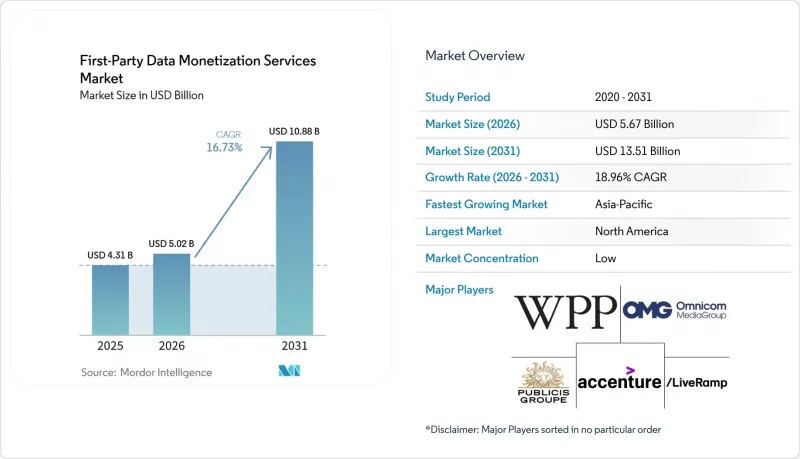
This report is Segmented by Service Type (Strategy and Use-Case Design, Data Engineering and Platform Implementation, and More), Application (Personalized Marketing, Customer Analytics, Advertising and Audience Insights, and More), End-User Industry (Retail and E-Commerce, Healthcare and Lifesciences, and More), and Geography. The Market Forecasts are Provided in Terms of Value (USD).
Global First-Party Data Monetization Services Market Trends and Insights
Retail Media and Commerce Media Expansion Increasing Demand for Audience Monetization
Retail media has become a practical route for companies to generate value from authenticated customer relationships in the First-Party Data Monetization Services Market. Its expansion into non-endemic categories is broadening demand beyond brands sold through retailers. Retail networks are developing audience segments, analytical products, and measurement services that can be offered separately from advertising inventory. This shifts service demand toward data engineering, identity resolution, and the preparation of audience products for partner use. Amperity launched Audience Monetization in January 2026 to help brands create identity-resolved audiences, automate marketplace distribution, and apply governance controls. The First-Party Data Monetization Services Market, therefore, has a growing need for services that connect customer data with compliant activation and measurement workflows.
Third-Party Signal Loss Accelerating Demand for Owned Identity Graphs
The continuing loss of reliable third-party signals is increasing the value of owned identity infrastructure in the First-Party Data Monetization Services Market. Browser settings and mobile privacy controls have reduced the durability of identifiers that companies do not control directly. Authenticated Audiences standards place greater emphasis on hashed email addresses, login identifiers, and authenticated session data as usable activation inputs. Organizations that developed deterministic identity graphs before 2026 have a stronger basis for measurement and customer activation. Many enterprises still need identity resolution and profile unification before their customer data can support monetization programs. The First-Party Data Monetization Services Market is consequently seeing demand for managed identity graph construction, not only for software licenses.
Fragmented Privacy Laws and Consent Enforcement Complexity
Fragmented privacy requirements make it difficult for organizations to use one consent and governance design across all operating regions. The GDPR requires a documented lawful basis for processing, while California rules include opt-out mechanisms and separate requirements for sensitive information. By 2026, 20 U.S. states had enacted comprehensive consumer privacy laws, adding different applicability thresholds and enforcement approaches. China also maintains strict limits on the scope of consent for secondary uses of personal information. Service providers must therefore conduct consent validation, map cross-border data flows, and assess activation eligibility in real time. The First-Party Data Monetization Services Market faces slower activation in some cases, even as this complexity supports demand for privacy, consent, and governance services.
Other drivers and restraints analyzed in the detailed report include:
- Enterprise AI and Personalization Investments Raising the Value of Consent-Rich Customer Data
- Growth in Privacy-Safe Data Collaboration and Clean Room Adoption
- Cloud Egress and Query Costs Compressing Monetization Margins
For complete list of drivers and restraints, kindly check the Table Of Contents.
Segment Analysis
Data Collaboration and Clean Room Services captured 28.12% of service-type revenue in 2025 and led the First-Party Data Monetization Services Market share. Enterprises increasingly treat controlled collaboration as an ongoing capability rather than a temporary project. This creates continuing demand for query design, partner provisioning, measurement governance, access controls, and AI workload management. The Authenticated Audiences standards and Unified ID 2.0 framework provide an identity foundation that can reduce friction between identity resolution and downstream collaboration. Audience Productization and Activation Services are also expanding as retail networks and second-party marketplaces package consented audiences for non-endemic partners and programmatic channels.
The First-Party Data Monetization Services Market size for Data Collaboration and Clean Room Services is projected to grow at a 20.92% CAGR between 2026 and 2031. Strategy and Use-Case Design, together with Data Engineering and Platform Implementation, remain the main entry points for organizations beginning formal monetization programs. These engagements can become multiyear work when organizations move from advisory programs to governed data products and partner workflows. Privacy, Consent, and Governance Services are seeing greater demand because activation can be limited until permissions, use purposes, and cross-jurisdiction controls are established. Measurement and Monetization Optimization Services become more important as brands quantify incremental revenue yield and meet higher closed-loop attribution expectations.
Complete Report Scope:
- By Service Type
- Strategy and Use-Case Design
- Data Engineering and Platform Implementation
- Identity Resolution and Profile Unification
- Privacy, Consent, and Governance Services
- Data Collaboration and Clean Room Services
- Audience Productization and Activation Services
- Measurement and Monetization Optimization Services
- Other Service Types
- By Application
- Personalized Marketing
- Customer Analytics
- Advertising and Audience Insights
- Recommendation Engines
- Business Intelligence
- Customer Experience Management
- Other Applications
- By End-user Industry
- Retail and E-commerce
- BFSI
- Healthcare and Lifesciences
- Media and Entertainment
- Telecommunications
- Travel and Hospitality
- Manufacturing
- Automotive
- Other End User Industries
- By Geography
- North America
- United States
- Canada
- Mexico
- South America
- Brazil
- Argentina
- Chile
- Rest of South America
- Europe
- Germany
- United Kingdom
- France
- Italy
- Spain
- Rest of Europe
- Asia-Pacific
- China
- Japan
- India
- South Korea
- Australia
- Rest of Asia-Pacific
- Middle East
- United Arab Emirates
- Saudi Arabia
- Qatar
- Rest of Middle East
- Africa
- South Africa
- Egypt
- Nigeria
- Rest of Africa
- North America
Geography Analysis
North America held 40.12% of revenue in 2025, representing the largest First-Party Data Monetization Services Market share and reflecting retail media activity, mature customer data platform adoption, and state-level privacy obligations. Amazon and Walmart support substantial retail media activity in the United States, creating demand among brands and agencies for identity resolution, clean room design, audience activation, and measurement optimization. Canada is progressing federal digital privacy discussions, while Mexico's expanding e-commerce and financial technology sectors are creating earlier-stage demand for customer data infrastructure among retailers and financial services organizations.
Asia-Pacific is projected to expand at a 20.56% CAGR between 2026 and 2031, making it the fastest-growing geographic area in the First-Party Data Monetization Services Market. India's Digital Personal Data Protection Rules were notified in November 2025, creating an 18-month phased compliance window. This timing has encouraged enterprises to invest in consent infrastructure, identity resolution, and clearer data-use controls before programs become more complex. China's Personal Information Protection Law and data security framework are shaping more formal approaches to commercial data use, while national data asset rules are adding clarity to commercial data transactions. Japan's Ministry of Economy, Trade, and Industry published its Transparency and Fairness evaluation in December 2025, and Catalina Marketing Japan launched the AOUMI retail media network in August 2025. South Korea and Australia add secondary growth through retail and financial services organizations that are developing audience products and customer data programs.
Europe, South America, the Middle East, and Africa account for the remaining share of the First-Party Data Monetization Services Market. Europe has a regulation-led pattern of demand, with the GDPR supporting continued investment in consent management, governance, identity controls, and clean room programs across Germany, the United Kingdom, and France. South America is at an earlier stage, led by Brazil under the Lei Geral de Protecao de Dados, while retailers, banks, and e-commerce platforms in Argentina and Chile are beginning audience productization programs. The United Arab Emirates and Saudi Arabia are seeing growing interest from telecom operators and financial institutions with large authenticated subscriber bases that may support non-endemic partnership models. Africa remains at an early stage, with fintech platforms in Nigeria and retail groups in South Africa beginning customer data unification programs.
- Publicis Groupe S.A.
- WPP plc
- Dentsu Group Inc.
- Accenture plc
- Acxiom LLC
- Omnicom Group Inc.
- LiveRamp Holdings, Inc.
- Snowflake Inc.
- Adobe Inc.
- Salesforce, Inc.
- Oracle Corporation
- Amazon Web Services, Inc.
- Google LLC
- TransUnion
- Experian plc
- Amperity, Inc.
- BlueConic, Inc.
- Permutive Limited
- Dawex Systems SAS
- Adastra Corporation
Additional Benefits:
- The market estimate (ME) sheet in Excel format
- 3 months of analyst support
TABLE OF CONTENTS
1 INTRODUCTION
- 1.1 Study Assumptions and Market Definition
- 1.2 Scope of the Study
2 RESEARCH METHODOLOGY
3 EXECUTIVE SUMMARY
4 MARKET LANDSCAPE
- 4.1 Market Overview
- 4.2 Market Drivers
- 4.2.1 Third-Party Signal Loss Accelerating Demand for Owned Identity Graphs
- 4.2.2 Retail Media and Commerce Media Expansion Increasing Demand for Audience Monetization
- 4.2.3 Enterprise Artificial Intelligence and Personalization Investments Raising the Value of Consent-Rich Customer Data
- 4.2.4 Growth in Privacy-Safe Data Collaboration and Clean Room Adoption
- 4.2.5 Interoperability Standards Lowering Activation Friction
- 4.2.6 Non-Endemic Data Partnerships Unlocking New Revenue Pools
- 4.3 Market Restraints
- 4.3.1 Fragmented Privacy Laws and Consent Enforcement Complexity
- 4.3.2 Cloud Egress and Query Costs Compressing Monetization Margins
- 4.3.3 Infrastructure Neutrality Concerns Slowing Ecosystem Participation
- 4.3.4 Uneven First-Party Data Maturity Extending Implementation Cycles
- 4.4 Impact of Macroeconomic Factors on the Market
- 4.5 Industry Value-Chain Analysis
- 4.6 Technology Outlook
- 4.7 Regulatory Landscape
- 4.8 Porter's Five Forces Analysis
- 4.8.1 Threat of New Entrants
- 4.8.2 Bargaining Power of Suppliers
- 4.8.3 Bargaining Power of Buyers
- 4.8.4 Threat of Substitutes
- 4.8.5 Intensity of Competitive Rivalry
5 MARKET SIZE AND GROWTH FORECASTS (VALUE)
- 5.1 By Service Type
- 5.1.1 Strategy and Use-Case Design
- 5.1.2 Data Engineering and Platform Implementation
- 5.1.3 Identity Resolution and Profile Unification
- 5.1.4 Privacy, Consent, and Governance Services
- 5.1.5 Data Collaboration and Clean Room Services
- 5.1.6 Audience Productization and Activation Services
- 5.1.7 Measurement and Monetization Optimization Services
- 5.1.8 Other Service Types
- 5.2 By Application
- 5.2.1 Personalized Marketing
- 5.2.2 Customer Analytics
- 5.2.3 Advertising and Audience Insights
- 5.2.4 Recommendation Engines
- 5.2.5 Business Intelligence
- 5.2.6 Customer Experience Management
- 5.2.7 Other Applications
- 5.3 By End-user Industry
- 5.3.1 Retail and E-commerce
- 5.3.2 BFSI
- 5.3.3 Healthcare and Lifesciences
- 5.3.4 Media and Entertainment
- 5.3.5 Telecommunications
- 5.3.6 Travel and Hospitality
- 5.3.7 Manufacturing
- 5.3.8 Automotive
- 5.3.9 Other End User Industries
- 5.4 By Geography
- 5.4.1 North America
- 5.4.1.1 United States
- 5.4.1.2 Canada
- 5.4.1.3 Mexico
- 5.4.2 South America
- 5.4.2.1 Brazil
- 5.4.2.2 Argentina
- 5.4.2.3 Chile
- 5.4.2.4 Rest of South America
- 5.4.3 Europe
- 5.4.3.1 Germany
- 5.4.3.2 United Kingdom
- 5.4.3.3 France
- 5.4.3.4 Italy
- 5.4.3.5 Spain
- 5.4.3.6 Rest of Europe
- 5.4.4 Asia-Pacific
- 5.4.4.1 China
- 5.4.4.2 Japan
- 5.4.4.3 India
- 5.4.4.4 South Korea
- 5.4.4.5 Australia
- 5.4.4.6 Rest of Asia-Pacific
- 5.4.5 Middle East
- 5.4.5.1 United Arab Emirates
- 5.4.5.2 Saudi Arabia
- 5.4.5.3 Qatar
- 5.4.5.4 Rest of Middle East
- 5.4.6 Africa
- 5.4.6.1 South Africa
- 5.4.6.2 Egypt
- 5.4.6.3 Nigeria
- 5.4.6.4 Rest of Africa
- 5.4.1 North America
6 COMPETITIVE LANDSCAPE
- 6.1 Market Concentration
- 6.2 Strategic Moves
- 6.3 Market Share Analysis
- 6.4 Company Profiles (includes Global Level Overview, Market Level Overview, Core Segments, Financials as available, Strategic Information, Market Rank/Share, Products and Services, Recent Developments)
- 6.4.1 Publicis Groupe S.A.
- 6.4.2 WPP plc
- 6.4.3 Dentsu Group Inc.
- 6.4.4 Accenture plc
- 6.4.5 Acxiom LLC
- 6.4.6 Omnicom Group Inc.
- 6.4.7 LiveRamp Holdings, Inc.
- 6.4.8 Snowflake Inc.
- 6.4.9 Adobe Inc.
- 6.4.10 Salesforce, Inc.
- 6.4.11 Oracle Corporation
- 6.4.12 Amazon Web Services, Inc.
- 6.4.13 Google LLC
- 6.4.14 TransUnion
- 6.4.15 Experian plc
- 6.4.16 Amperity, Inc.
- 6.4.17 BlueConic, Inc.
- 6.4.18 Permutive Limited
- 6.4.19 Dawex Systems SAS
- 6.4.20 Adastra Corporation
7 MARKET OPPORTUNITIES AND FUTURE OUTLOOK
- 7.1 White-Space and Unmet-Need Assessment

