PUBLISHER: Mordor Intelligence | PRODUCT CODE: 2124515

PUBLISHER: Mordor Intelligence | PRODUCT CODE: 2124515
Data Monetization - Market Share Analysis, Industry Trends & Statistics, Growth Forecasts (2026 - 2031)
According to Mordor Intelligence, the data monetization market size is USD 5.67 billion in 2026 and is projected to reach USD 12.66 billion in 2031, advancing at a 17.41% CAGR.
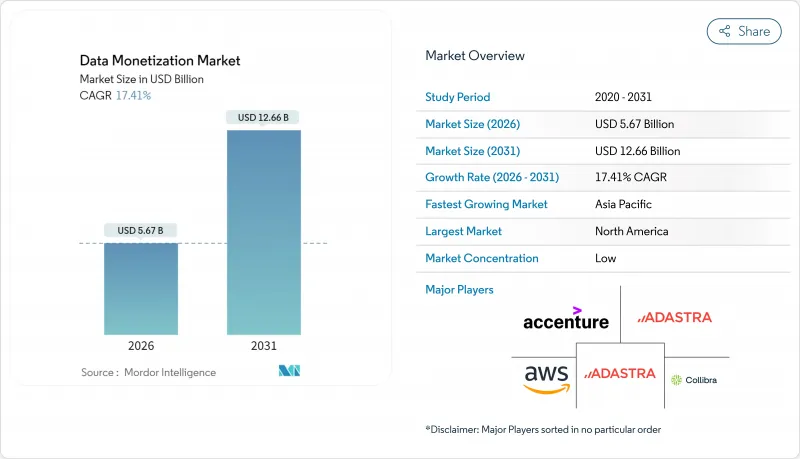
This report is Segmented by Component (Tools/Platforms, and Services), Deployment (On-Premises, and Cloud), Organization Size (Large Enterprises, and Small and Medium Enterprises), End User Industry (Banking, Financial Services, and Insurance (BFSI), Telecom and IT, Manufacturing, Healthcare and Life Sciences, Retail and E-Commerce, and More) and Geography. The Market Forecasts are Provided in Terms of Value (USD).
Global Data Monetization Market Trends and Insights
Rapid Adoption of Advanced Analytics and Visualization
Self-service business-intelligence platforms are collapsing the time from raw data ingestion to monetizable insight, enabling product managers and sales teams to package analytics as standalone offerings without relying on centralized IT. SAP Analytics Cloud and Microsoft Power BI now support embedded analytics that let software vendors white-label dashboards inside their applications, converting telemetry into recurring revenue streams. MicroStrategy's HyperIntelligence overlays contextual metrics on top of enterprise workflows, reducing the friction of switching between operational systems and analytics consoles.
Increasing Volume and Variety of Enterprise Data
IoT sensor deployments, edge-computing arrays, and application-programming-interface ecosystems are generating petabyte-scale datasets that exceed the absorptive capacity of internal analytics teams, pushing enterprises to externalize surplus data through marketplaces or direct licensing. Manufacturing plants now instrument assembly lines with vision systems and vibration sensors that produce real-time quality metrics, which equipment vendors monetize by offering predictive-maintenance subscriptions to peer factories. Telecom operators capture anonymized mobility patterns from cell-tower handoffs, selling aggregated flows to urban planners and retail-site selectors.
Interoperability Hurdles with Legacy Architectures
Enterprises operate a median of 14 distinct data repositories, including relational databases, data lakes, SaaS application silos, and on-premises warehouses, each with proprietary schemas and access protocols that resist federation. Integrating these sources into a unified monetization layer requires extract-transform-load pipelines, API gateways, and semantic harmonization, investments that can exceed USD 5 million for a Fortune 500 firm and take 18 months to operationalize. The strategic risk is that by the time integration completes, the datasets may have lost market relevance or regulatory permissions may have expired.
Other drivers and restraints analyzed in the detailed report include:
- Regulatory Mandates Driving Open-Data Ecosystems
- Enterprise Adoption of Data Marketplaces Enabling B2B Data Trading
- Data Quality Inconsistencies Hindering Monetization Potential
For complete list of drivers and restraints, kindly check the Table Of Contents.
Segment Analysis
Services are forecast to outpace tools, climbing at 19.02% from 2026 to 2031 even though tools commanded 64.58% of 2025 revenue. This variation shows that enterprises buy expertise to translate raw datasets into saleable products. Professional integrators design governance frameworks and negotiate marketplace onboarding, which compresses launch timelines. Within the tooling stack, data-integration platforms dominate because they harmonize disparate schemas, yet analytics front-ends are accelerating as no-code interfaces lower adoption barriers.
Managed services appeal to mid-sized firms that lack in-house data engineers, allowing them to offer subscription-based data products without capital expenditure. The data monetization market size contribution from services is set to rise as confidential computing reduces residency concerns. Partnerships between cloud providers and global systems integrators further expand service catalogs. Microsoft reported that 40% of Azure Synapse revenue flowed through managed-service channels in 2025.
On-premises still held 59.76% share in 2025, largely within finance and healthcare. Confidential-computing enclaves now encrypt data in use, which satisfies auditors and unlocks cloud migration. Cloud installations are projected to advance at 19.66% CAGR, narrowing the historical gap. Hybrid fabrics combine on-premises warehouses with cloud lakes, creating a single logical layer from which sellers expose tables without relocation.
The EU Data Act obliges providers to support data portability, which eases fears of lock-in and boosts cross-border trading. BigQuery Omni and Snowflake cross-cloud replication neutralize egress fees inside the same region, yet replication costs remain a consideration. Vendors that abstract location while preserving governance, such as data-mesh platforms, enjoy rising demand. Overall, the deployment mix is shifting toward flexible fabrics that support monetization at scale.
Complete Report Scope:
- By Component
- Tools / Platforms
- Data Integration and Management Tools
- Analytics and Visualization Tools
- Services
- Professional Services
- Managed Services
- Tools / Platforms
- By Deployment Mode
- On-Premises
- Cloud
- Hybrid
- By Organization Size
- Small and Medium-Sized Enterprises
- Large Enterprises
- By End-User Industry
- Banking, Financial Services, and Insurance (BFSI)
- Telecom and IT
- Manufacturing
- Healthcare and Life Sciences
- Retail and E-Commerce
- Transportation and Logistics
- Energy and Utilities
- Government and Public Sector
- Other End-User Industries
- By Geography
- North America
- United States
- Canada
- Mexico
- South America
- Brazil
- Argentina
- Rest of South America
- Europe
- Germany
- United Kingdom
- France
- Italy
- Spain
- Russia
- Rest of Europe
- Asia Pacific
- China
- Japan
- India
- South Korea
- Australia and New Zealand
- Southeast Asia
- Rest of Asia Pacific
- Middle East
- Saudi Arabia
- United Arab Emirates
- Turkey
- Rest of Middle East
- Africa
- South Africa
- Nigeria
- Rest of Africa
- North America
Geography Analysis
North America delivered 45.26% of 2025 revenue, reflecting mature analytics stacks, dense buyer ecosystems, and the early rollout of enterprise data marketplaces. State-level privacy statutes such as the California Consumer Privacy Act introduce compliance complexity, yet they also encourage investment in governance tools that streamline sharing and thus stimulate monetization. The region's hyperscalers provide bundled marketplace rails, driving favorable network effects for sellers that already store data on the same platforms. Urban planners, hedge funds, and advertising agencies collectively underpin robust demand, making liquidity high relative to other regions.
Asia Pacific is the fastest-growing territory with an 18.24% CAGR through 2031, supported by India's Digital Personal Data Protection Act and China's Personal Information Protection Law, both of which clarify consent protocols for commercial data use. Regulatory certainty has lowered legal risk and encouraged multinationals to base data-exchange hubs in Singapore and Tokyo. Manufacturing telemetry from smart factories in Japan and South Korea comprises a fresh supply pool, while Southeast Asian e-commerce and fintech players create rising demand. Governments across the region are funding data-center capacity, which reduces latency and keeps residency in-country.
Europe exhibits steadier growth because GDPR remains stringent, yet the EU Data Act now obliges connected-device manufacturers to provide user-level data access, expanding B2B trading potential. Industrial IoT datasets, especially automotive and machinery telemetry, stand to benefit from mandated interoperability. However, localization rules can delay cross-border deals, urging vendors to adopt federated learning that leaves data in place. Latin America, the Middle East, and Africa represent nascent markets where digital infrastructure is improving but buyer ecosystems are still forming. Smart-city projects and mobile-money systems present future opportunities once legal frameworks stabilize. Collectively, geographic diversification helps to smooth cyclical variances in individual economies.
- Accenture plc
- Adastra Corporation
- Amazon Web Services Inc.
- Cisco Systems Inc.
- Collibra NV
- Dawex Systems SAS
- Emu Analytics Ltd.
- Equifax Inc.
- Experian plc
- Google LLC (Alphabet Inc.)
- IBM Corporation
- Infosys Limited
- Microsoft Corporation
- Oracle Corporation
- Reltio Inc.
- SAP SE
- SAS Institute Inc.
- Snowflake Inc.
Additional Benefits:
- The market estimate (ME) sheet in Excel format
- 3 months of analyst support
TABLE OF CONTENTS
1 INTRODUCTION
- 1.1 Study Assumptions and Market Definition
- 1.2 Scope of the Study
2 RESEARCH METHODOLOGY
- 2.1 Research Framework
- 2.2 Secondary Research
- 2.3 Primary Research
- 2.4 Data Triangulation and Insight Generation
3 EXECUTIVE SUMMARY
4 MARKET LANDSCAPE
- 4.1 Market Overview
- 4.2 Market Drivers
- 4.2.1 Rapid Adoption of Advanced Analytics and Visualization
- 4.2.2 Increasing Volume and Variety of Enterprise Data
- 4.2.3 Regulatory Mandates Driving Open-Data Ecosystems
- 4.2.4 Enterprise Adoption of Data Marketplaces Enabling B2B Data Trading
- 4.2.5 Generative AI-Enabled Creation of Privacy-Safe Synthetic Data
- 4.2.6 Tokenization of Data Assets Via Blockchain for New Revenue Streams
- 4.3 Market Restraints
- 4.3.1 Interoperability Hurdles with Legacy Architectures
- 4.3.2 Data Quality Inconsistencies Hindering Monetization Potential
- 4.3.3 Fragmented and Evolving Data-Privacy Regulations
- 4.3.4 Escalating Cloud-Egress Fees Undermining Data-Sharing ROI
- 4.4 Industry Value Chain Analysis
- 4.5 Regulatory Landscape
- 4.6 Technological Outlook
- 4.7 Porter's Five Forces Analysis
- 4.7.1 Bargaining Power of Suppliers
- 4.7.2 Bargaining Power of Buyers
- 4.7.3 Threat of New Entrants
- 4.7.4 Threat of Substitutes
- 4.7.5 Intensity of Competitive Rivalry
- 4.8 Impact of Macroeconomic Factors on the Market
5 MARKET SIZE AND GROWTH FORECASTS (VALUE)
- 5.1 By Component
- 5.1.1 Tools / Platforms
- 5.1.1.1 Data Integration and Management Tools
- 5.1.1.2 Analytics and Visualization Tools
- 5.1.2 Services
- 5.1.2.1 Professional Services
- 5.1.2.2 Managed Services
- 5.1.1 Tools / Platforms
- 5.2 By Deployment Mode
- 5.2.1 On-Premises
- 5.2.2 Cloud
- 5.2.3 Hybrid
- 5.3 By Organization Size
- 5.3.1 Small and Medium-Sized Enterprises
- 5.3.2 Large Enterprises
- 5.4 By End-User Industry
- 5.4.1 Banking, Financial Services, and Insurance (BFSI)
- 5.4.2 Telecom and IT
- 5.4.3 Manufacturing
- 5.4.4 Healthcare and Life Sciences
- 5.4.5 Retail and E-Commerce
- 5.4.6 Transportation and Logistics
- 5.4.7 Energy and Utilities
- 5.4.8 Government and Public Sector
- 5.4.9 Other End-User Industries
- 5.5 By Geography
- 5.5.1 North America
- 5.5.1.1 United States
- 5.5.1.2 Canada
- 5.5.1.3 Mexico
- 5.5.2 South America
- 5.5.2.1 Brazil
- 5.5.2.2 Argentina
- 5.5.2.3 Rest of South America
- 5.5.3 Europe
- 5.5.3.1 Germany
- 5.5.3.2 United Kingdom
- 5.5.3.3 France
- 5.5.3.4 Italy
- 5.5.3.5 Spain
- 5.5.3.6 Russia
- 5.5.3.7 Rest of Europe
- 5.5.4 Asia Pacific
- 5.5.4.1 China
- 5.5.4.2 Japan
- 5.5.4.3 India
- 5.5.4.4 South Korea
- 5.5.4.5 Australia and New Zealand
- 5.5.4.6 Southeast Asia
- 5.5.4.7 Rest of Asia Pacific
- 5.5.5 Middle East
- 5.5.5.1 Saudi Arabia
- 5.5.5.2 United Arab Emirates
- 5.5.5.3 Turkey
- 5.5.5.4 Rest of Middle East
- 5.5.6 Africa
- 5.5.6.1 South Africa
- 5.5.6.2 Nigeria
- 5.5.6.3 Rest of Africa
- 5.5.1 North America
6 COMPETITIVE LANDSCAPE
- 6.1 Market Concentration
- 6.2 Strategic Moves
- 6.3 Market Share Analysis
- 6.4 Company Profiles (includes Global Level Overview, Market Level Overview, Core Segments, Financials as Available, Strategic Information, Market Rank/Share for Key Companies, Products and Services, and Recent Developments)
- 6.4.1 Accenture plc
- 6.4.2 Adastra Corporation
- 6.4.3 Amazon Web Services Inc.
- 6.4.4 Cisco Systems Inc.
- 6.4.5 Collibra NV
- 6.4.6 Dawex Systems SAS
- 6.4.7 Emu Analytics Ltd.
- 6.4.8 Equifax Inc.
- 6.4.9 Experian plc
- 6.4.10 Google LLC (Alphabet Inc.)
- 6.4.11 IBM Corporation
- 6.4.12 Infosys Limited
- 6.4.13 Microsoft Corporation
- 6.4.14 Oracle Corporation
- 6.4.15 Reltio Inc.
- 6.4.16 SAP SE
- 6.4.17 SAS Institute Inc.
- 6.4.18 Snowflake Inc.
7 MARKET OPPORTUNITIES AND FUTURE OUTLOOK
- 7.1 White-Space and Unmet-Need Assessment

