PUBLISHER: Mordor Intelligence | PRODUCT CODE: 2154964

PUBLISHER: Mordor Intelligence | PRODUCT CODE: 2154964
North America 5G Core Network - Market Share Analysis, Industry Trends & Statistics, Growth Forecasts (2026 - 2031)
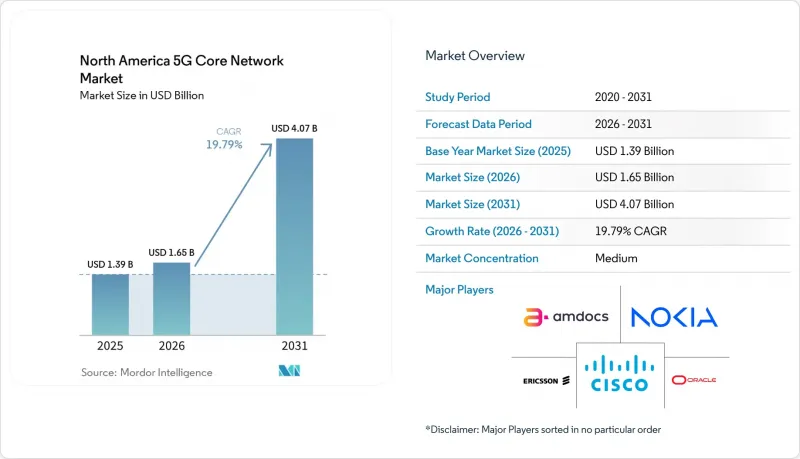
According to Mordor Intelligence, the North America 5G core network market size is expected to grow from USD 1.39 billion in 2025 to USD 1.65 billion in 2026 and is forecast to reach USD 4.07 billion by 2031 at 19.79% CAGR over 2026-2031.
North America 5G Core Network Market Trends and Insights
Standalone 5G Rollouts Reach an Inflection Point
AT&T and Verizon launched standalone cores in late 2025, joining T-Mobile and giving all 3 United States Tier-1 carriers commercially differentiated standalone services. This shift increased pressure to move subscribers and service development onto standalone architectures. AT&T described its platform as an open, virtualized architecture that runs across Microsoft Azure and its own data centers. VTel Wireless selected Ericsson in March 2026 for a dual-mode 5G core and radio access network that supports end-to-end standalone Voice over New Radio roaming with nationwide providers. This demonstrates that the North America 5G core network market is extending beyond large urban carriers. ATIS identified limited dedicated spectrum and the remaining economics of non-standalone upgrades as important barriers for smaller carriers.
Cloud-Native Core Adoption Across North American Operators
Cloud-native core adoption has progressed from a strategic objective to an operating model among major regional operators. Software can be deployed on Kubernetes-compatible infrastructure, which broadens the supplier base to include software vendors, systems integrators, and cloud platform providers. Ericsson launched its On-Demand 5G Core-as-a-Service platform with Google Cloud in June 2025. Boost Mobile deployed Nokia's cloud-native 5G Voice Core on a public cloud in March 2025 and consolidated multiple IMS voice functions into 1 cloud-native network function. Mavenir reported that 82% of surveyed operators either operated cloud-native cores or planned to do so by the end of 2026. The North America 5G core network market, therefore, has a wider range of implementation models, but operators still need the skills to manage them.
High Upfront Core Modernization Costs
Core modernization places pressure on carriers of all sizes to reduce capital and operating costs. Regional and rural carriers often face similar per-site integration costs to those of Tier-1 operators, despite having smaller subscriber bases. Running Evolved Packet Core and 5G core stacks during a multi-year migration can also raise post-migration support costs. Mexico faces further uncertainty because Congress sets spectrum fees annually. AT&T Mexico indicated that it might not participate in the upcoming industrial 5G spectrum auction. Mavenir found that planned standalone adoption depends on vendors providing credible total cost of ownership evidence for cloud-native core migration.
Other drivers and restraints analyzed in the detailed report include:
- Enterprise Private 5G Demand in Manufacturing and Logistics
- Network Slicing Requirements for Mission-Critical Services
- Legacy EPC Integration Complexity
For complete list of drivers and restraints, kindly check the Table Of Contents.
Segment Analysis
Solutions accounted for 63.55% of the North America 5G core network market revenue in 2025. The segment includes packet-core software, network function virtualization infrastructure, and orchestration and management platforms. Its position reflected software-led spending on Tier-1 standalone buildouts by AT&T, Verizon, T-Mobile, Bell, Rogers, and Telus. Packet-core software remained central because operators need cloud-native network functions to replace hardware-based legacy systems.
Services in the North America 5G core network market are projected to expand at a 21.21% CAGR through 2031. The segment covers integration and deployment, consulting and advisory, and support and maintenance. Cloud-native standalone cores require frequent software updates, while operators continue to face a shortage of cloud-native operations skills. Ericsson agreed in April 2025 to deploy and operate a dual-mode 5G core for GCI Communication Corp in Alaska, including cloud-core technology, AI tools, and ongoing network management. Support and maintenance demand is expected to continue as operators retire parallel Evolved Packet Core systems.
On-Premise/Dedicated deployments accounted for 51.95% of North America's 5G core network market revenue in 2025. Operators and enterprises selected this model when they required low latency, data-handling compliance, and infrastructure control. Dedicated deployments are particularly relevant for factory environments with strict service-level requirements. Verizon's Intelligent Edge Network strategy reflects its preference for end-to-end ownership in critical core areas and Level 4 autonomy.
Public Cloud in the North America 5G core network market is projected to expand at a 24.76% CAGR through 2031. AT&T deployed its nationwide standalone core on Microsoft Azure in October 2025, running more than 60 containerized network functions for hundreds of millions of subscribers. This deployment demonstrated that public cloud infrastructure can meet Tier-1-scale and reliability requirements. Ericsson's platform with Google Cloud gives carriers a managed option when internal cloud engineering capacity is limited. Hybrid and Telco Edge Cloud combines local infrastructure with cloud-native orchestration and is relevant to mid-tier Canadian and Mexican operators, helping them replace legacy packet-core systems.
Complete Report Scope:
- By Component
- Solutions
- Packet-Core Software
- NFV Infrastructure
- Orchestration and Management
- Services
- Integration and Deployment
- Consulting and Advisory
- Support and Maintenance
- Solutions
- By Deployment Model
- On-Premise/Dedicated
- Public Cloud
- Hybrid and Telco Edge Cloud
- By End-User
- Telecom Operators
- Enterprises
- Manufacturing
- Energy and Utilities
- Transportation and Logistics
- Public Safety and Emergency
- Smart Cities and Municipalities
- By Network Function
- Network Exposure Function (NEF)
- User Plane Function (UPF)
- Application Function (AF)
- Unified Data Management (UDM)
- Session Management Function (SMF)
- Network Slice Selection Function (NSSF)
- Policy Control Function (PCF)
- Network Repository Function (NRF)
- Authentication Server Function (AUSF)
- Access and Mobility Management Function (AMF)
- By Country
- United States
- Canada
- Mexico
List of Companies Covered in this Report:
- Telefonaktiebolaget LM Ericsson
- Nokia Corporation
- Microsoft Corporation
- Samsung Electronics Co. Ltd.
- Amdocs Limited
- Cisco Systems, Inc.
- Oracle Corporation
- Hewlett Packard Enterprise Company
- Mavenir Systems, Inc.
- NEC Corporation
- VMware, Inc.
- Juniper Networks, Inc.
- Ciena Corporation
- Ribbon Communications Inc.
- Casa Systems, Inc.
- Parallel Wireless, Inc.
- Druid Software Ltd.
- Intel Corporation
- F5, Inc.
Additional Benefits:
- The market estimate (ME) sheet in Excel format
- 3 months of analyst support
TABLE OF CONTENTS
1 INTRODUCTION
- 1.1 Study Assumptions and Market Definition
- 1.2 Scope of the Study
2 RESEARCH METHODOLOGY
3 EXECUTIVE SUMMARY
4 MARKET LANDSCAPE
- 4.1 Market Overview
- 4.2 Market Drivers
- 4.2.1 Standalone 5G Rollouts Reaching Inflection Point
- 4.2.2 Cloud-Native Core Adoption Across North American Operators
- 4.2.3 Enterprise Private 5G Demand in Manufacturing and Logistics
- 4.2.4 Network Slicing Requirements for Mission-Critical Services
- 4.2.5 Open RAN and Interoperability Programs Requiring Flexible Core Architectures
- 4.2.6 AI-Driven Automation and Policy Control Modernization
- 4.3 Market Restraints
- 4.3.1 High Upfront Core Modernization Costs
- 4.3.2 Legacy EPC Integration Complexity
- 4.3.3 Cloud-Native Skills Shortage in Telecom Operations
- 4.3.4 Security, Sovereignty, and Compliance Constraints
- 4.4 Industry Value Chain Analysis
- 4.5 Regulatory Landscape
- 4.6 Technological Outlook
- 4.7 PESTLE Analysis
- 4.8 Porter's Five Forces Analysis
- 4.8.1 Threat of New Entrants
- 4.8.2 Bargaining Power of Buyers
- 4.8.3 Bargaining Power of Suppliers
- 4.8.4 Threat of Substitutes
- 4.8.5 Competitive Rivalry
5 MARKET SIZE AND GROWTH FORECASTS (VALUE)
- 5.1 By Component
- 5.1.1 Solutions
- 5.1.1.1 Packet-Core Software
- 5.1.1.2 NFV Infrastructure
- 5.1.1.3 Orchestration and Management
- 5.1.2 Services
- 5.1.2.1 Integration and Deployment
- 5.1.2.2 Consulting and Advisory
- 5.1.2.3 Support and Maintenance
- 5.1.1 Solutions
- 5.2 By Deployment Model
- 5.2.1 On-Premise/Dedicated
- 5.2.2 Public Cloud
- 5.2.3 Hybrid and Telco Edge Cloud
- 5.3 By End-User
- 5.3.1 Telecom Operators
- 5.3.2 Enterprises
- 5.3.2.1 Manufacturing
- 5.3.2.2 Energy and Utilities
- 5.3.2.3 Transportation and Logistics
- 5.3.2.4 Public Safety and Emergency
- 5.3.2.5 Smart Cities and Municipalities
- 5.4 By Network Function
- 5.4.1 Network Exposure Function (NEF)
- 5.4.2 User Plane Function (UPF)
- 5.4.3 Application Function (AF)
- 5.4.4 Unified Data Management (UDM)
- 5.4.5 Session Management Function (SMF)
- 5.4.6 Network Slice Selection Function (NSSF)
- 5.4.7 Policy Control Function (PCF)
- 5.4.8 Network Repository Function (NRF)
- 5.4.9 Authentication Server Function (AUSF)
- 5.4.10 Access and Mobility Management Function (AMF)
- 5.5 By Country
- 5.5.1 United States
- 5.5.2 Canada
- 5.5.3 Mexico
6 COMPETITIVE LANDSCAPE
- 6.1 Market Concentration
- 6.2 Strategic Moves
- 6.3 Market Share Analysis
- 6.4 Company Profiles (includes Global Level Overview, Market Level Overview, Core Segments, Financials as available, Strategic Information, Market Rank/Share, Products and Services, Recent Developments)
- 6.4.1 Telefonaktiebolaget LM Ericsson
- 6.4.2 Nokia Corporation
- 6.4.3 Microsoft Corporation
- 6.4.4 Samsung Electronics Co. Ltd.
- 6.4.5 Amdocs Limited
- 6.4.6 Cisco Systems, Inc.
- 6.4.7 Oracle Corporation
- 6.4.8 Hewlett Packard Enterprise Company
- 6.4.9 Mavenir Systems, Inc.
- 6.4.10 NEC Corporation
- 6.4.11 VMware, Inc.
- 6.4.12 Juniper Networks, Inc.
- 6.4.13 Ciena Corporation
- 6.4.14 Ribbon Communications Inc.
- 6.4.15 Casa Systems, Inc.
- 6.4.16 Parallel Wireless, Inc.
- 6.4.17 Druid Software Ltd.
- 6.4.18 Intel Corporation
- 6.4.19 F5, Inc.
7 MARKET OPPORTUNITIES AND FUTURE OUTLOOK
- 7.1 White-Space and Unmet-Need Assessment

