PUBLISHER: Mordor Intelligence | PRODUCT CODE: 2119177

PUBLISHER: Mordor Intelligence | PRODUCT CODE: 2119177
Aspergillosis - Market Share Analysis, Industry Trends & Statistics, Growth Forecasts (2026 - 2031)
According to Mordor Intelligence, the aspergillosis market size was valued at USD 6.61 billion in 2025 and is estimated to grow from USD 6.91 billion in 2026 to reach USD 8.86 billion by 2031, at a CAGR of 5.12% during the forecast period (2026-2031).
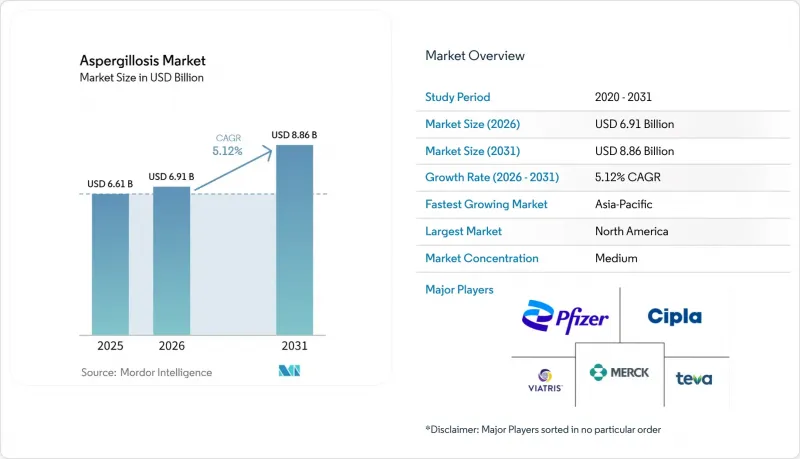
This report is Segmented by Infection Type (Allergic, Chronic Pulmonary, Invasive, Other), Drug Class (Azoles, Polyenes, Echinocandins, Other), Route of Administration (Oral Solid, IV, Inhaled DPI, Other), Distribution Channel (Hospital, Retail, Online Pharmacy), Patient Category (Transplant, ICU, Respiratory, Other), and Geography (North America, Europe, Asia-Pacific, MEA, South America).
Global Aspergillosis Market Trends and Insights
Expanding Immunocompromised Patient Pool
The aspergillosis market is gaining a broader clinical base as more patients receive therapies that suppress immune function. A 2025 systematic review found a pooled invasive fungal infection prevalence of 10% among non-neutropenic critically ill patients, showing that risk extends beyond classical hematology populations. Corticosteroid use, autoimmune disease treatment, advanced HIV, mechanical ventilation, and liver disease can each create conditions that increase susceptibility. A study of patients with liver failure and cirrhosis reported that invasive aspergillosis was frequently diagnosed only after death, indicating that the burden may be underrecognized in this group. This pattern expands the need for testing and targeted therapy in intensive care and hepatology settings. It also makes access to earlier diagnosis important for the aspergillosis market, since delayed recognition can limit the value of available treatment.
Rising Transplantation and Hematologic Cancer Treatment Volumes
The aspergillosis market benefits from sustained demand in transplantation and hematologic cancer care, where prophylaxis and treatment are governed by institutional protocols. A 2025 meta-analysis reported invasive fungal disease in 9.96% of allogeneic hematopoietic stem cell transplant recipients, compared with 3.39% of autologous transplant recipients. Aspergillus represented 44.8% of invasive fungal disease causes in the evaluated cohort, which supports the need for mold-active prevention and rescue therapy. Breakthrough fungal infections during mold-active prophylaxis carried a 46.7% infection-related mortality rate at 1 year in a 2025 study. Global growth in allogeneic, haploidentical, and cellular therapy programs, therefore, increases demand for prolonged prophylaxis and salvage treatment. The high acuity of these patients gives hospitals a strong reason to maintain access to several antifungal classes.
Azole Resistance and Limited Novel Drug Classes
Azole resistance remains a major constraint because azoles are the most widely used drug class in the aspergillosis market. A genomic study of 12,679 isolates in the Netherlands found cyp51A triazole-resistance mutations in 15.6% of isolates. The study also identified phenotypic and genotypic variation in 17.2% of resistant isolates, which can complicate resistance prediction from molecular testing. Belgium reported a near doubling of triazole resistance over 10 years to 9.7%, reinforcing the regional need for surveillance and alternative therapy. Resistant disease can increase the use of combination therapy and amphotericin B, both of which may add clinical complexity and cost. New agents could address this gap, but their adoption will depend on evidence, affordability, and availability.
Other drivers and restraints analyzed in the detailed report include:
- Next-Generation Antifungal Development
- Growing Chronic Pulmonary Disease Burden
- High Total Cost of Therapy and Hospital Care
For complete list of drivers and restraints, kindly check the Table Of Contents.
Segment Analysis
Allergic aspergillosis held 44.6% of the aspergillosis market size in 2025, reflecting the large group of patients with asthma and chronic obstructive pulmonary disease who experience fungal sensitization. These patients can require long courses of azole therapy, which supports recurring outpatient prescriptions. Invasive aspergillosis is forecast to grow at a 5.5% CAGR through 2031 and remains the setting where treatment protocols are changing most quickly. Allogeneic transplant recipients have a 9.96% pooled incidence of invasive fungal disease, a level that supports protocol-led demand for prevention and rescue therapy. The aspergillosis market is therefore shaped by both large, longer-duration allergic disease management and high-acuity invasive disease care.
Chronic pulmonary aspergillosis sits between these categories and is closely linked to past tuberculosis and chronic respiratory disease. A 2025 publication described an estimated annual incidence of 1.84 million cases among patients with a history of tuberculosis, although chronic obstructive pulmonary disease and sarcoidosis further broaden the patient pool. Aspergilloma, cutaneous disease, and Aspergillus sinusitis represent smaller treatment groups, with care that often overlaps with chronic pulmonary regimens. A Phase 2 clinical study of rezafungin in chronic pulmonary aspergillosis patients with limited treatment options was initiated in 2026. This program indicates renewed interest in a disease type that can be difficult to diagnose and manage over long periods. Adherence to oral treatment remains an important practical issue where specialist follow-up is limited.
Azoles accounted for 58.6% of the aspergillosis market size in 2025 because voriconazole and isavuconazole remain established treatments for many patients. Their use is supported by established clinical practice and their suitability for oral prophylaxis or step-down therapy. Basilea reported USD 693 million in global in-market sales of Cresemba for the October 2024 through September 2025 period, with 27% year-on-year growth. Polyenes maintain a role in azole-intolerant or resistant cases, but renal toxicity can constrain broader use. This treatment pattern keeps the azole segment central to the aspergillosis industry while creating room for alternatives.
Echinocandins are forecast to grow at a 5.6% CAGR through 2031, supported by their use in combination regimens and by long-acting development programs. Mundipharma reported positive Phase 3 ReSPECT results for once-weekly rezafungin in April 2026. Fungal-free survival at Day 90 was 60.7% with rezafungin and 59.0% with standard antifungal regimens in allogeneic transplant recipients. The company planned regulatory submissions in the second half of 2026 and the third quarter of 2026. The World Health Organization has classified A. fumigatus as a critical-priority fungal pathogen, which supports continued institutional attention to access and antimicrobial stewardship. A broader evidence base for resistant disease may move echinocandins beyond their traditional candidiasis-focused position.
Complete Report Scope:
- By Infection Type
- Allergic Aspergillosis
- Chronic Pulmonary Aspergillosis
- Invasive Aspergillosis
- Other Aspergillosis Types (e.g., Aspergilloma, Cutaneous Aspergillosis, Aspergillus Sinusitis)
- By Drug Class
- Azoles
- Polyenes
- Echinocandins
- Other Drug Classes
- By Route of Administration
- Oral Solid Dosage
- Intravenous Formulation
- Inhaled Dry-Powder Formulation
- Other Routes
- By Distribution Channel
- Hospital Pharmacy
- Retail Pharmacy
- Online Pharmacy
- By Patient Category
- Transplant Patients
- ICU & Critical-Care Patients
- Respiratory Disease Patients
- Other At-Risk Patients
- By Geography
- North America
- United States
- Canada
- Mexico
- Europe
- Germany
- United Kingdom
- France
- Italy
- Spain
- Rest of Europe
- Asia-Pacific
- China
- Japan
- India
- South Korea
- Australia
- Rest of Asia-Pacific
- Middle East and Africa
- GCC
- South Africa
- Rest of Middle East and Africa
- South America
- Brazil
- Argentina
- Rest of South America
- North America
Geography Analysis
North America held 42% of global revenue in 2025 and has substantial diagnostic, transplant, and reimbursement infrastructure. The United States contributes most regional revenue because hematology-oncology centers and transplant programs use premium antifungal treatments and specialized diagnostics. A national electronic health record study covering 2013 through 2023 found an annual 5% rise in aspergillosis prevalence in U.S. adults. This finding supports continuing demand after the acute COVID-19 period. Canada benefits from publicly funded transplantation, while Mexico has an underserved patient population with uneven access between private and public care.
Europe is the second-largest regional setting in the aspergillosis market, led by Germany, the United Kingdom, France, Italy, and Spain. These countries combine established transplant activity with reimbursement systems that support specialist antifungal use. Resistance is a significant regional challenge because Belgium reported a 9.7% triazole resistance rate, and the Netherlands reported cyp51A mutations in 15.6% of isolates. This burden supports demand for susceptibility testing, combination regimens, and novel-mechanism therapies. Eastern European countries are expanding transplantation capacity from a lower base, which may increase treatment access over time.
Asia-Pacific is forecast to grow at a 5.8% CAGR through 2031, the fastest rate among geographic segments of the aspergillosis market. China has a significant invasive disease burden, while India, Indonesia, and the Philippines have many patients with tuberculosis-related lung damage. This creates a large chronic pulmonary aspergillosis treatment need that differs from the transplant-led demand in Western settings. South Korea, Japan, and Australia remain smaller but high-value markets with strong access to specialized care and growing transplantation programs. Middle East and Africa and South America have opportunities linked to new transplant centers and oncology capacity, but diagnosis gaps, specialist shortages, and limited formularies constrain treatment access. Growth in these regions will depend on diagnostic infrastructure and affordable access to oral and intravenous antifungal therapy.
- Pfizer
- Merck
- Basilea Pharmaceutica
- Astellas Pharma
- Gilead Sciences
- F2G Ltd
- Pulmocide Ltd
- PULMATRiX, Inc.
- Viatris
- Sandoz Group AG
- Teva Pharmaceutical Industries
- Glenmark Pharmaceuticals
- Mayne Pharma
- Hikma Pharmaceuticals
- Aurobindo Pharma
- Cipla
- BDR Pharmaceuticals Internationals Pvt. Ltd.
- Cidara Therapeutics, Inc.
- Scynexis, Inc.
- Biosergen AS
- Thermo Fisher Scientific
- bioM-rieux SA
- IMMY
- Era Biology Technology Co., Ltd.
Additional Benefits:
- The market estimate (ME) sheet in Excel format
- 3 months of analyst support
TABLE OF CONTENTS
1 INTRODUCTION
- 1.1 Study Assumptions and Market Definition
- 1.2 Scope of the Study
2 RESEARCH METHODOLOGY
3 EXECUTIVE SUMMARY
4 MARKET LANDSCAPE
- 4.1 Market Overview
- 4.2 Market Drivers
- 4.2.1 Expanding Immunocompromised Patient Pool
- 4.2.2 Rising Transplantation and Hematologic-Cancer Treatment Volumes
- 4.2.3 Earlier Diagnosis Through Molecular and Biomarker Testing
- 4.2.4 Next-Generation Antifungal Development
- 4.2.5 Growing Chronic Pulmonary Disease Burden
- 4.2.6 Climate-Linked Expansion of Aspergillus Exposure
- 4.3 Market Restraints
- 4.3.1 Azole Resistance and Limited Novel Drug Classes
- 4.3.2 High Total Cost of Therapy and Hospital Care
- 4.3.3 Delayed Diagnosis and Specialist Shortage
- 4.3.4 Fragile Antifungal API and Specialized-Test Supply Chains
- 4.4 Value and Supply-Chain Analysis
- 4.5 Regulatory Landscape
- 4.6 Technological Outlook
- 4.7 Porters Five Forces Analysis
- 4.7.1 Bargaining Power of Suppliers
- 4.7.2 Bargaining Power of Buyers
- 4.7.3 Threat of New Entrants
- 4.7.4 Threat of Substitutes
- 4.7.5 Competitive Rivalry
5 MARKET SIZE AND GROWTH FORECASTS, VALUE
- 5.1 By Infection Type
- 5.1.1 Allergic Aspergillosis
- 5.1.2 Chronic Pulmonary Aspergillosis
- 5.1.3 Invasive Aspergillosis
- 5.1.4 Other Aspergillosis Types (e.g., Aspergilloma, Cutaneous Aspergillosis, Aspergillus Sinusitis)
- 5.2 By Drug Class
- 5.2.1 Azoles
- 5.2.2 Polyenes
- 5.2.3 Echinocandins
- 5.2.4 Other Drug Classes
- 5.3 By Route of Administration
- 5.3.1 Oral Solid Dosage
- 5.3.2 Intravenous Formulation
- 5.3.3 Inhaled Dry-Powder Formulation
- 5.3.4 Other Routes
- 5.4 By Distribution Channel
- 5.4.1 Hospital Pharmacy
- 5.4.2 Retail Pharmacy
- 5.4.3 Online Pharmacy
- 5.5 By Patient Category
- 5.5.1 Transplant Patients
- 5.5.2 ICU & Critical-Care Patients
- 5.5.3 Respiratory Disease Patients
- 5.5.4 Other At-Risk Patients
- 5.6 By Geography
- 5.6.1 North America
- 5.6.1.1 United States
- 5.6.1.2 Canada
- 5.6.1.3 Mexico
- 5.6.2 Europe
- 5.6.2.1 Germany
- 5.6.2.2 United Kingdom
- 5.6.2.3 France
- 5.6.2.4 Italy
- 5.6.2.5 Spain
- 5.6.2.6 Rest of Europe
- 5.6.3 Asia-Pacific
- 5.6.3.1 China
- 5.6.3.2 Japan
- 5.6.3.3 India
- 5.6.3.4 South Korea
- 5.6.3.5 Australia
- 5.6.3.6 Rest of Asia-Pacific
- 5.6.4 Middle East and Africa
- 5.6.4.1 GCC
- 5.6.4.2 South Africa
- 5.6.4.3 Rest of Middle East and Africa
- 5.6.5 South America
- 5.6.5.1 Brazil
- 5.6.5.2 Argentina
- 5.6.5.3 Rest of South America
- 5.6.1 North America
6 COMPETITIVE LANDSCAPE
- 6.1 Market Concentration
- 6.2 Market Share Analysis
- 6.3 Company Profiles (includes Global Level Overview, Market Level Overview, Core Segments, Financials as available, Strategic Information, Market Rank/Share, Products and Services, Recent Developments)
- 6.3.1 Pfizer Inc.
- 6.3.2 Merck & Co., Inc.
- 6.3.3 Basilea Pharmaceutica Ltd
- 6.3.4 Astellas Pharma Inc.
- 6.3.5 Gilead Sciences, Inc.
- 6.3.6 F2G Ltd
- 6.3.7 Pulmocide Ltd
- 6.3.8 PULMATRiX, Inc.
- 6.3.9 Viatris Inc.
- 6.3.10 Sandoz Group AG
- 6.3.11 Teva Pharmaceutical Industries Ltd.
- 6.3.12 Glenmark Pharmaceuticals Ltd.
- 6.3.13 Mayne Pharma Group Limited
- 6.3.14 Hikma Pharmaceuticals plc
- 6.3.15 Aurobindo Pharma Limited
- 6.3.16 Cipla Limited
- 6.3.17 BDR Pharmaceuticals Internationals Pvt. Ltd.
- 6.3.18 Cidara Therapeutics, Inc.
- 6.3.19 Scynexis, Inc.
- 6.3.20 Biosergen AS
- 6.3.21 Thermo Fisher Scientific Inc.
- 6.3.22 bioM-rieux SA
- 6.3.23 IMMY
- 6.3.24 Era Biology Technology Co., Ltd.
7 MARKET OPPORTUNITIES AND FUTURE OUTLOOK
- 7.1 White-Space and Unmet-Need Assessment

