PUBLISHER: Mordor Intelligence | PRODUCT CODE: 2119207

PUBLISHER: Mordor Intelligence | PRODUCT CODE: 2119207
Hyper-Personalization Marketing Services - Market Share Analysis, Industry Trends & Statistics, Growth Forecasts (2026 - 2031)
According to Mordor Intelligence, the hyper-personalization marketing services market size is expected to increase from USD 75.84 billion in 2025 to USD 87.30 billion in 2026 and reach USD 152.80 billion by 2031, registering a CAGR of 11.85% over 2026-2031.
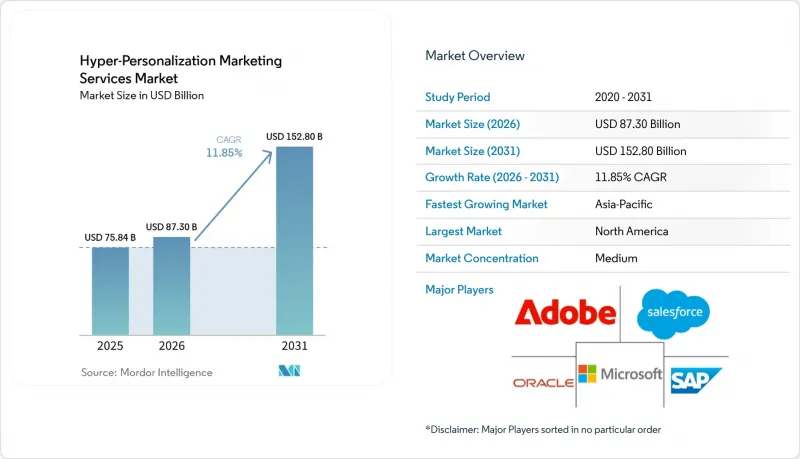
This report is Segmented by Service Type (Real-Time Personalization Services, Customer Journey Orchestration, and More), Organization Size (Large Enterprises, and Small and Medium Enterprises), End User Industry (Retail and E-Commerce, Consumer Goods and Beauty, Media and Entertainment, IT and Telecom, and More), and Geography. The Market Forecasts are Provided in Terms of Value (USD).
Global Hyper-Personalization Marketing Services Market Trends and Insights
AI and Machine Learning Decisioning Adoption
The hyper-personalization marketing services market is moving from rules-based workflows toward machine learning systems that choose the next action for each customer. Salesforce reported in 2026 that 75% of marketers had adopted AI, although many still used it for one-way and generic campaigns. Teams with unified customer data were 42% more likely to respond in real time and 60% more likely to deploy AI agents at scale. This makes data unification a practical requirement for AI-driven personalization rather than a separate information technology project. Each customer interaction also supplies feedback that can improve later recommendations, which can widen the operating gap between firms with mature models and firms using isolated campaigns. The hyper-personalization marketing services industry therefore depends on both model capability and the quality of the customer data supporting it.
Rising Demand for Real-Time Personalization
The hyper-personalization marketing services market is supported by customer expectations for offers and recommendations that change during an active session. Amperity found in 2026 that 53% of surveyed U.S. consumers expected retailers to personalize experiences in real time, while 69% said they were more likely to purchase when offers or recommendations adjusted while they browsed. MoEngage reported that personalized messages delivered a 37.6x conversion lift in 2026, compared with 2.4x in 2024. These results increase the value of decisioning tools that can use immediate behavior rather than periodic audience lists. They also shorten the business case for investments in connected data, content, and delivery systems. Providers that can make real-time functions easier to deploy can address buyers that lack extensive internal engineering resources.
Data Privacy and Consent Complexity
The hyper-personalization marketing services market faces longer deployment cycles when customer data rules vary across jurisdictions. California regulations effective January 1, 2026, introduced requirements covering automated decision-making technology disclosures, cybersecurity audits, and risk assessments for high-risk processing. The European Data Protection Board stated in April 2026 that valid consent requires clear affirmative action and cannot be inferred from silence, pre-ticked boxes, or passive navigation. Organizations working across the European Union, California, India, and Brazil must adapt consent practices to more than one legal framework. This adds coordination work for legal, marketing, and data engineering teams. It can also delay platform deployment by 3 to 6 months when teams do not share a clear approach to consent and data use.
Other drivers and restraints analyzed in the detailed report include:
- First-Party Data Activation After Cookie Loss
- Omnichannel Journey Orchestration Priority
- High Implementation and Integration Cost
For complete list of drivers and restraints, kindly check the Table Of Contents.
Segment Analysis
AI-Driven Recommendations and Decisioning held 24.54% of the hyper-personalization marketing services market share in 2025 and is projected to expand at a 13.24% CAGR from 2026 to 2031. Its position reflects the shift from isolated content delivery toward systems that select offers, messages, and next actions from customer context. The service has moved from trial use to a core operating layer, and its customer feedback can improve later recommendations and raise switching costs. Adobe introduced CX Enterprise Coworker in April 2026 as an agent-enabled workflow layer for customer experience orchestration. Adobe stated that its Experience Platform supports more than 1 trillion personalized experiences each year for over 20,000 global brands.
Within the hyper-personalization marketing services market, Real-Time Personalization Services and Customer Journey Orchestration form the next group of expansion areas because they use the same data assets that support AI decisioning. They address the need to coordinate engagement around current behavior instead of optimizing each channel independently. Dynamic Content Creation and Delivery and Predictive Targeting and Segmentation are increasingly used as parts of multi-service deployments rather than separate purchases, even as their usage volumes increase. Omnichannel Personalization Strategies are gaining demand as firms connect earlier channel-specific investments into integrated customer experiences. Security frameworks such as ISO/IEC 27001 can shape vendor reviews when providers manage behavioral data across several channels.
Complete Report Scope:
- Service Type
- Real-Time Personalization Services
- AI-Driven Recommendations and Decisioning
- Dynamic Content Creation and Delivery
- Customer Journey Orchestration
- Predictive Targeting and Segmentation
- Omnichannel Personalization Strategies
- Other Service Types
- Organization Size
- Large Enterprises
- Small and Medium Enterprises
- End User Industry
- Retail and E-commerce
- Consumer Goods and Beauty
- Media and Entertainment
- IT and Telecom
- BFSI
- Healthcare and Life Sciences
- Fashion and Luxury
- Other End User Industries
- By Geography
- North America
- United States
- Canada
- Mexico
- South America
- Brazil
- Argentina
- Chile
- Rest of South America
- Europe
- Germany
- United Kingdom
- France
- Italy
- Spain
- Rest of Europe
- Asia-Pacific
- China
- Japan
- India
- South Korea
- Australia
- Rest of Asia-Pacific
- Middle East
- United Arab Emirates
- Saudi Arabia
- Qatar
- Rest of Middle East
- Africa
- South Africa
- Egypt
- Nigeria
- Rest of Africa
- North America
Geography Analysis
North America held 38.53% of the hyper-personalization marketing services market share in 2025, supported by vendor concentration, high enterprise data maturity, and broad use of personalization in commerce and digital services. The regional opportunity lies more in deeper deployment than in first-time platform adoption, as organizations extend personalization to shared decisioning across marketing, commerce, service, and sales. Salesforce found that teams with fully unified customer data were 42% more likely to respond in real time and 60% more likely to deploy AI agents at scale. Adobe, Salesforce, Braze, Klaviyo, and MoEngage contribute to a dense vendor environment in the region. This concentration supports frequent product releases and experimentation with new delivery models.
Asia-Pacific is projected to expand at a 12.87% CAGR from 2026 to 2031, making it the fastest-expanding geography in the hyper-personalization marketing services market. Its demand comes from mobile-first commerce, enterprise AI adoption, and developing first-party data systems. Salesforce reported in June 2026 that 81% of Indian marketers had adopted AI and 88% believed generative AI would help their teams identify consumer signals and act in near real time. China adds scale through high-volume digital commerce, while India and Southeast Asia add adoption momentum through data infrastructure development. India's Digital Personal Data Protection Rules entered phased implementation in 2025, increasing the focus on consented customer information and encouraging platforms that combine real-time engagement with governed data management.
Europe is the second-largest geography, where GDPR-based governance has created both a compliance requirement and a quality standard for providers. The emphasis on first-party data has pushed many European enterprises to develop customer data foundations that can remain useful as third-party signals weaken. Braze launched European Union hosting for BrazeAI Decisioning Studio in April 2026 with regional data residency controls. South America, the Middle East, and Africa remain earlier-stage markets, with Brazil, Saudi Arabia, the United Arab Emirates, South Africa, and Nigeria representing the largest near-term opportunities as digital and mobile commerce infrastructure advances.
- Adobe Inc.
- Salesforce, Inc.
- Oracle Corporation
- SAP SE
- Microsoft Corporation
- Amazon Web Services, Inc.
- Google LLC
- SAS Institute Inc.
- Braze, Inc.
- MoEngage, Inc.
- Optimizely, Inc.
- Twilio Inc.
- Criteo S.A.
- Klaviyo, Inc.
- Tealium, Inc.
- Bloomreach, Inc.
- Amperity, Inc.
- Treasure Data, Inc.
- HubSpot, Inc.
- Zeta Global Holdings Corp.
Additional Benefits:
- The market estimate (ME) sheet in Excel format
- 3 months of analyst support
TABLE OF CONTENTS
1 INTRODUCTION
- 1.1 Study Assumptions and Market Definition
- 1.2 Scope of the Study
2 RESEARCH METHODOLOGY
3 EXECUTIVE SUMMARY
4 MARKET LANDSCAPE
- 4.1 Market Overview
- 4.2 Market Drivers
- 4.2.1 Rising Demand for Real-Time Personalization
- 4.2.2 AI and Machine Learning Decisioning Adoption
- 4.2.3 Omnichannel Journey Orchestration Priority
- 4.2.4 First-Party Data Activation After Cookie Loss
- 4.2.5 Composable Martech Integration Demand
- 4.2.6 ROI-Led Experimentation and Measurement Pressure
- 4.3 Market Restraints
- 4.3.1 Data Privacy and Consent Complexity
- 4.3.2 High Implementation and Integration Cost
- 4.3.3 Real-Time Identity Resolution Gaps
- 4.3.4 Model Drift and Creative Fatigue
- 4.4 Industry Value Chain Analysis
- 4.5 Regulatory Landscape
- 4.6 Technological Outlook
- 4.7 Porter's Five Forces Analysis
- 4.7.1 Bargaining Power of Suppliers
- 4.7.2 Bargaining Power of Buyers
- 4.7.3 Threat of New Entrants
- 4.7.4 Threat of Substitutes
- 4.7.5 Intensity of Competitive Rivalry
5 MARKET SIZE AND GROWTH FORECASTS (VALUE)
- 5.1 Service Type
- 5.1.1 Real-Time Personalization Services
- 5.1.2 AI-Driven Recommendations and Decisioning
- 5.1.3 Dynamic Content Creation and Delivery
- 5.1.4 Customer Journey Orchestration
- 5.1.5 Predictive Targeting and Segmentation
- 5.1.6 Omnichannel Personalization Strategies
- 5.1.7 Other Service Types
- 5.2 Organization Size
- 5.2.1 Large Enterprises
- 5.2.2 Small and Medium Enterprises
- 5.3 End User Industry
- 5.3.1 Retail and E-commerce
- 5.3.2 Consumer Goods and Beauty
- 5.3.3 Media and Entertainment
- 5.3.4 IT and Telecom
- 5.3.5 BFSI
- 5.3.6 Healthcare and Life Sciences
- 5.3.7 Fashion and Luxury
- 5.3.8 Other End User Industries
- 5.4 By Geography
- 5.4.1 North America
- 5.4.1.1 United States
- 5.4.1.2 Canada
- 5.4.1.3 Mexico
- 5.4.2 South America
- 5.4.2.1 Brazil
- 5.4.2.2 Argentina
- 5.4.2.3 Chile
- 5.4.2.4 Rest of South America
- 5.4.3 Europe
- 5.4.3.1 Germany
- 5.4.3.2 United Kingdom
- 5.4.3.3 France
- 5.4.3.4 Italy
- 5.4.3.5 Spain
- 5.4.3.6 Rest of Europe
- 5.4.4 Asia-Pacific
- 5.4.4.1 China
- 5.4.4.2 Japan
- 5.4.4.3 India
- 5.4.4.4 South Korea
- 5.4.4.5 Australia
- 5.4.4.6 Rest of Asia-Pacific
- 5.4.5 Middle East
- 5.4.5.1 United Arab Emirates
- 5.4.5.2 Saudi Arabia
- 5.4.5.3 Qatar
- 5.4.5.4 Rest of Middle East
- 5.4.6 Africa
- 5.4.6.1 South Africa
- 5.4.6.2 Egypt
- 5.4.6.3 Nigeria
- 5.4.6.4 Rest of Africa
- 5.4.1 North America
6 COMPETITIVE LANDSCAPE
- 6.1 Market Concentration
- 6.2 Strategic Moves
- 6.3 Market Share Analysis
- 6.4 Company Profiles (includes Global Level Overview, Market Level Overview, Core Segments, Financials as available, Strategic Information, Market Rank/Share, Products and Services, Recent Developments)
- 6.4.1 Adobe Inc.
- 6.4.2 Salesforce, Inc.
- 6.4.3 Oracle Corporation
- 6.4.4 SAP SE
- 6.4.5 Microsoft Corporation
- 6.4.6 Amazon Web Services, Inc.
- 6.4.7 Google LLC
- 6.4.8 SAS Institute Inc.
- 6.4.9 Braze, Inc.
- 6.4.10 MoEngage, Inc.
- 6.4.11 Optimizely, Inc.
- 6.4.12 Twilio Inc.
- 6.4.13 Criteo S.A.
- 6.4.14 Klaviyo, Inc.
- 6.4.15 Tealium, Inc.
- 6.4.16 Bloomreach, Inc.
- 6.4.17 Amperity, Inc.
- 6.4.18 Treasure Data, Inc.
- 6.4.19 HubSpot, Inc.
- 6.4.20 Zeta Global Holdings Corp.
7 MARKET OPPORTUNITIES AND FUTURE OUTLOOK
- 7.1 White-Space and Unmet-Need Assessment

