PUBLISHER: Mordor Intelligence | PRODUCT CODE: 2124346

PUBLISHER: Mordor Intelligence | PRODUCT CODE: 2124346
Account Based Marketing - Market Share Analysis, Industry Trends & Statistics, Growth Forecasts (2026 - 2031)
According to Mordor Intelligence, the account-Based marketing market size is expected to grow from USD 1.03 billion in 2025 to USD 1.15 billion in 2026 and is forecast to reach USD 2.02 billion by 2031 at 11.94% CAGR over 2026-2031.
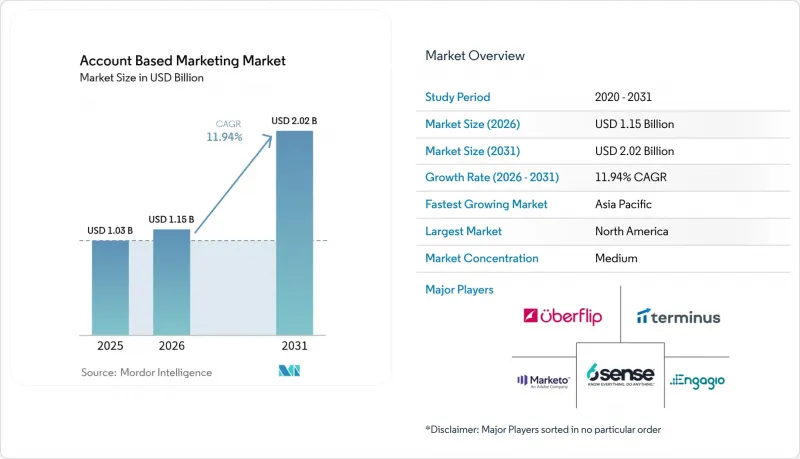
This report is Segmented by Component (Tools, Services), Deployment Model (On-Premise, Cloud), End-User Industry (Retail and E-Commerce, BFSI, IT and Telecommunications, Government, and More), Organization Size (Large Enterprises, Mid-Sized Enterprises, Small Businesses), Channel (Email, Display Advertising, and More), Geography. The Market Forecasts are Provided in Terms of Value (USD).
Global Account Based Marketing Market Trends and Insights
Rising Intent-Data Partnerships Accelerating ABM Platform Effectiveness
Marketers are integrating third-party intent feeds with proprietary first-party data to rank accounts by in-market probability, resulting in sharper audience segmentation and higher win rates. More than nine in ten B2B teams embed purchase-signal data into their scoring models, and reported ROI lifts approach double traditional programs. ABM suites increasingly embed native connectors to feed intent events directly into orchestration engines, enabling same-day activation. Large software vendors are further enriching signals with conversational intelligence that captures qualitative buying context. Because these capabilities shorten sales cycles and increase average deal sizes, they are forecast to add 2.5 percentage points to overall CAGR.
Rapid Uptake of Programmatic ABM in Asia-Pacific Tech Start-Ups
Mobile-first startups across Singapore, India, and Australia are shifting ad spend into programmatic ABM that automatically matches creative, bid, and channel to each intent-rich account. Regional use cases show click-through lifts exceeding 50% and cost-per-opportunity declines of more than 30%. Localized partner ecosystems-DSPs, data providers, and ABM managed-service agencies - are lowering entry barriers, catalyzing broader adoption. The momentum is reinforced by investor pressure on startups to demonstrate efficient growth, turning programmatic ABM into a core acquisition lever. The resulting contribution to the Account-Based Marketing market growth is estimated at 1.8 percentage points over the next two years.
Brand-Side Talent Gap in Multi-Touch Attribution Analytics
Enterprises struggle to find analysts who can stitch online and offline touchpoints into reliable influence models, limiting confidence in ABM ROI calculations. Forty-plus percent of in-house teams admit capability gaps, which delay optimization cycles and constrain budget expansion. Outsourcing to agencies raises costs and slows insight turnaround times. Emerging markets feel the pinch most acutely, as experienced talent commands premium salaries in competitive labor pools. Until training pipelines widen, this shortfall is expected to shave 0.8 percentage points off CAGR.
Other drivers and restraints analyzed in the detailed report include:
- Convergence of Customer Data Platforms with ABM Suites in North America
- Declining Third-Party Cookie Support Elevating ABM Demand for First-Party Data
- High Subscription Costs Limiting Penetration in Emerging Markets
For complete list of drivers and restraints, kindly check the Table Of Contents.
Segment Analysis
Tools retained 64.30% of the Account-Based Marketing market share in 2025, supplying AI-powered account selection, multi-channel orchestration, and pipeline analytics. Yet the Services component is entering a higher-velocity phase, delivering a 14.02% CAGR through 2031 as companies enlist strategic advisory, content development, and managed-campaign support. The transition from technology acquisition to execution excellence fuels this surge because organizations recognize that orchestration rigor, sales alignment, and analytics maturity-not software alone-unlock revenue impact. Services providers now package vertical playbooks, attribution consulting, and first-party data architecture, positioning themselves as indispensable transformation partners.
The Account-Based Marketing market consequently relies on a symbiosis: platforms furnish scalable infrastructure, while service specialists de-risk adoption and accelerate time to value. As privacy shifts compel deeper data engineering, demand for service-led CDP integrations and compliance audits intensifies. This dual-track dynamic is set to continue, with Services capturing incremental share, particularly among industries lacking ABM expertise.
Cloud solutions owned 71.40% of the Account-Based Marketing market size in 2025 and advanced at 13.21% CAGR as buyers favor elastic compute, rapid feature releases, and frictionless API connections. SaaS models streamline data ingestion from CRMs, analytics suites, and ad platforms, letting marketers stand up pilots in weeks rather than quarters. Vendors such as Demandbase and 6sense now offer turnkey connectors to CDPs, marketing automation, and intent feeds, lowering integration hurdles.
On-premise deployments persist in highly regulated sectors such as financial services, where strict data-residency rules apply. Even there, hybrid architectures - local data stores paired with cloud-based orchestration layers-are gaining ground as encryption, zero-trust frameworks, and audit trails assuage security teams. Consequently, cloud's perceived risk has fallen, and its benefits - continuous innovation, lower capex, and easier AI adoption - are widening the deployment gap.
Complete Report Scope:
- By Component
- Tools
- Services
- By Deployment Model
- On-premise
- Cloud
- By End-user Industry
- Retail and E-commerce
- BFSI
- IT and Telecommunications
- Government
- Travel and Tourism
- Healthcare and Life Sciences
- Other End-user Industries
- By Organization Size
- Large Enterprises
- Mid-sized Enterprises
- Small Businesses
- By Channel
- Display Advertising
- Social Media
- Website/Personalization
- Events and Webinars
- Others
- By Geography
- North America
- United States
- Canada
- Mexico
- South America
- Brazil
- Argentina
- Chile
- Peru
- Rest of South America
- Europe
- Germany
- United Kingdom
- France
- Italy
- Spain
- Rest of Europe
- Asia-Pacific
- China
- Japan
- South Korea
- India
- Australia
- New Zealand
- Rest of Asia-Pacific
- Middle East and Africa
- Middle East
- United Arab Emirates
- Saudi Arabia
- Turkey
- Rest of Middle East
- Africa
- South Africa
- Nigeria
- Kenya
- Rest of Africa
- Middle East
- North America
Geography Analysis
North America held 40.60% of the Account-Based Marketing market size in 2025 on the strength of an advanced martech landscape, early adopter technology firms, and a concentration of ABM platform headquarters. United States enterprises pioneer CDP-ABM convergence, cookieless identity innovation, and AI-driven predictive scoring, establishing use-case blueprints for global peers. Data-privacy legislation such as California's CCPA and sector-specific rules add complexity, yet they also spur investments in compliant data architectures, further entrenching ABM as the privacy-ready alternative to broad-target display.
Asia-Pacific is the fastest-growing territory, charting a 14.55% CAGR to 2031. Singapore, Japan, Australia, and India headline adoption, each adapting ABM to local buyer behaviors and regulatory environments. Startups capitalize on programmatic ABM to counter resource constraints and compete against multinational incumbents. Regional ad-spend reports reveal double-digit gains in mobile and social commerce, aligning perfectly with intent-driven, account-focused tactics that thrive on granular first-party engagement data. Europe ranks second by revenue share, propelled by the United Kingdom, Germany, and France, where GDPR compliance frameworks are embedded into platform feature sets. Strict lawful-basis requirements elevate the value of first-party data and authenticated audiences, positioning ABM suites that automate consent management for competitive advantage. South America and the Middle East & Africa are smaller but growing niches; Brazil and the United Arab Emirates lead regional pilots, aided by localized language support and flexible usage-based pricing. Global diffusion shows the Account-Based Marketing market transitioning from an Anglo-American paradigm to a genuinely worldwide discipline.
- Terminus Software, Inc.
- Adobe Inc. (Marketo)
- Uberflip
- Triblio Inc.
- 6sense Insights, Inc.
- Engagio Inc.
- HubSpot, Inc.
- Madison Logic
- Demandbase Inc.
- Salespanel
- Drift.com, Inc.
- RollWorks (NextRoll, Inc.)
- Folloze
- MRP Prelytix (MRP)
- Kwanzoo Inc.
- Lattice Engines
- LeanData
- Bombora
- TechTarget, Inc.
- Insider Inc.
Additional Benefits:
- The market estimate (ME) sheet in Excel format
- 3 months of analyst support
TABLE OF CONTENTS
1 INTRODUCTION
- 1.1 Study Assumptions and Market Definition
- 1.2 Scope of the Study
2 RESEARCH METHODOLOGY
3 EXECUTIVE SUMMARY
4 MARKET LANDSCAPE
- 4.1 Market Overview
- 4.2 Market Drivers
- 4.2.1 Rising Intent-Data Partnerships Accelerating ABM Platform Effectiveness
- 4.2.2 Rapid Uptake of Programmatic ABM in Asia-Pacific Tech Start-Ups
- 4.2.3 Convergence of Customer Data Platforms (CDPs) with ABM Suites in North America
- 4.2.4 Industry-specific Playbooks Driving ABM Adoption in BFSI and Healthcare
- 4.2.5 Declining Third-Party Cookie Support Elevating ABM Demand for First-Party Data
- 4.2.6 Shift Toward Revenue-Based Metrics Among CMOs Boosting ABM Budgets
- 4.3 Market Restraints
- 4.3.1 Brand-Side Talent Gap in Multi-Touch Attribution Analytics
- 4.3.2 High Subscription Costs Limiting Penetration in Emerging Markets
- 4.3.3 Data-Privacy Compliance Complexity (GDPR, LGPD, CCPA)
- 4.3.4 CRM-ABM Integration Challenges for Legacy On-Premise Installations
- 4.4 Regulatory Outlook
- 4.5 Porter's Five Forces Analysis
- 4.5.1 Bargaining Power of Buyers
- 4.5.2 Bargaining Power of Suppliers
- 4.5.3 Threat of New Entrants
- 4.5.4 Threat of Substitute Products
- 4.5.5 Intensity of Competitive Rivalry
- 4.6 Assessment of the Impact of Macroeconomic Factors on the Market
- 4.7 Investment Analysis
5 MARKET SIZE AND GROWTH FORECASTS (VALUE)
- 5.1 By Component
- 5.1.1 Tools
- 5.1.2 Services
- 5.2 By Deployment Model
- 5.2.1 On-premise
- 5.2.2 Cloud
- 5.3 By End-user Industry
- 5.3.1 Retail and E-commerce
- 5.3.2 BFSI
- 5.3.3 IT and Telecommunications
- 5.3.4 Government
- 5.3.5 Travel and Tourism
- 5.3.6 Healthcare and Life Sciences
- 5.3.7 Other End-user Industries
- 5.4 By Organization Size
- 5.4.1 Large Enterprises
- 5.4.2 Mid-sized Enterprises
- 5.4.3 Small Businesses
- 5.5 By Channel
- 5.5.1 Email
- 5.5.2 Display Advertising
- 5.5.3 Social Media
- 5.5.4 Website/Personalization
- 5.5.5 Events and Webinars
- 5.5.6 Others
- 5.6 By Geography
- 5.6.1 North America
- 5.6.1.1 United States
- 5.6.1.2 Canada
- 5.6.1.3 Mexico
- 5.6.2 South America
- 5.6.2.1 Brazil
- 5.6.2.2 Argentina
- 5.6.2.3 Chile
- 5.6.2.4 Peru
- 5.6.2.5 Rest of South America
- 5.6.3 Europe
- 5.6.3.1 Germany
- 5.6.3.2 United Kingdom
- 5.6.3.3 France
- 5.6.3.4 Italy
- 5.6.3.5 Spain
- 5.6.3.6 Rest of Europe
- 5.6.4 Asia-Pacific
- 5.6.4.1 China
- 5.6.4.2 Japan
- 5.6.4.3 South Korea
- 5.6.4.4 India
- 5.6.4.5 Australia
- 5.6.4.6 New Zealand
- 5.6.4.7 Rest of Asia-Pacific
- 5.6.5 Middle East and Africa
- 5.6.5.1 Middle East
- 5.6.5.1.1 United Arab Emirates
- 5.6.5.1.2 Saudi Arabia
- 5.6.5.1.3 Turkey
- 5.6.5.1.4 Rest of Middle East
- 5.6.5.2 Africa
- 5.6.5.2.1 South Africa
- 5.6.5.2.2 Nigeria
- 5.6.5.2.3 Kenya
- 5.6.5.2.4 Rest of Africa
- 5.6.5.1 Middle East
- 5.6.1 North America
6 COMPETITIVE LANDSCAPE
- 6.1 Strategic Developments
- 6.2 Market Share Analysis
- 6.3 Vendor Positioning Analysis
- 6.4 Company Profiles (includes Global level Overview, Market level overview, Core Segments, Financials as available, Strategic Information, Products and Services, and Recent Developments)
- 6.4.1 Terminus Software, Inc.
- 6.4.2 Adobe Inc. (Marketo)
- 6.4.3 Uberflip
- 6.4.4 Triblio Inc.
- 6.4.5 6sense Insights, Inc.
- 6.4.6 Engagio Inc.
- 6.4.7 HubSpot, Inc.
- 6.4.8 Madison Logic
- 6.4.9 Demandbase Inc.
- 6.4.10 Salespanel
- 6.4.11 Drift.com, Inc.
- 6.4.12 RollWorks (NextRoll, Inc.)
- 6.4.13 Folloze
- 6.4.14 MRP Prelytix (MRP)
- 6.4.15 Kwanzoo Inc.
- 6.4.16 Lattice Engines
- 6.4.17 LeanData
- 6.4.18 Bombora
- 6.4.19 TechTarget, Inc.
- 6.4.20 Insider Inc.
7 Market Opportunities and Future Outlook
- 7.1 White-space and Unmet-Need Assessment

