PUBLISHER: Mordor Intelligence | PRODUCT CODE: 2119256

PUBLISHER: Mordor Intelligence | PRODUCT CODE: 2119256
BFSI Marketing Services - Market Share Analysis, Industry Trends & Statistics, Growth Forecasts (2026 - 2031)
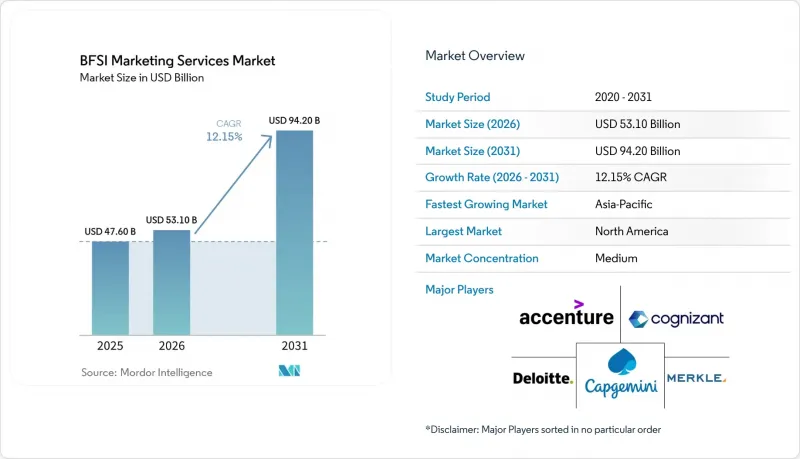
According to Mordor Intelligence, the BFSI marketing services market size is expected to increase from USD 47.6 billion in 2025 to USD 53.1 billion in 2026 and reach USD 94.2 billion by 2031, growing at a CAGR of 12.15% over 2026-2031.
This report is Segmented by Service Type (Digital Acquisition Services, Brand and Trust-Building Services, Compliance-Led Content Services, Lifecycle Engagement and CRM Services, Marketing Technology and Automation Services, and Analytics and Measurement Services), Organization Size (Large Enterprises, and More), and Geography. The Market Forecasts are Provided in Terms of Value (USD).
Global BFSI Marketing Services Market Trends and Insights
Demand For Hyper-Personalized Customer Journeys
Personalized communication has become a practical requirement for banks and card issuers rather than a branding preference. J.D. Power reported in May 2026 that 20% of bank customers and 16% of credit card customers said their provider always personalized the information they received. The same study found that accurate personalization was associated with satisfaction gains of 238 points among bank customers and 219 points among card customers. This gap between customer expectations and delivery creates demand in the BFSI Marketing Services Market for customer-data design, consent management, and journey orchestration. Many institutions adopted relevant tools between 2022 and 2025, but still need help joining product, channel, and customer data. Service providers can therefore earn durable assignments by improving the operating model around personalization rather than simply deploying software.
Shift Toward Measurable Digital Advertising
Financial advertisers are shifting budgets to channels where activity can be more clearly linked to business outcomes. In 2026, Innovid reported planned increases in investment in AI media, digital display, social, and search among financial services marketers. The American Bankers Association reported in 2025 that search engine marketing and search engine optimization had moved ahead of display advertising as a priority among bank marketers. High-intent search is especially relevant when customers compare lending, insurance, or investment products. This change supports the BFSI Marketing Services Market because institutions need one view across search, paid media, owned channels, and emerging AI search interfaces. Providers that unite these activities with clear controls can help clients avoid fragmented measurement and inconsistent messaging.
Lengthy Regulatory Review Cycles And Disclosure Requirements
Regulatory review can limit the speed at which digital campaigns are attractive to financial institutions. The SEC's 2025 alert showed that examiners expect firms to demonstrate how they meet Marketing Rule requirements in practice. The Financial Conduct Authority's guidance requires financial promotions on social media to be fair, clear, and not misleading. These expectations apply to influencer, affiliate, and other third-party communications as well as a firm's own advertising. In the BFSI Marketing Services Market, outsourced teams must support auditable approval paths and accurate disclosures across channels. This adds time and cost to campaign launches, particularly where several regulators apply. Providers that use standardized review steps and maintain clear records are better positioned to maintain speed without weakening controls.
Other drivers and restraints analyzed in the detailed report include:
- Need For Compliance-Embedded Content Workflows
- Expansion of Cross-Channel Lifecycle Engagement
- Legacy Data Silos And Fragmented Martech Stacks
For complete list of drivers and restraints, kindly check the Table Of Contents.
Segment Analysis
Digital acquisition services held 31.68% of the BFSI Marketing Services Market share in 2025. Banks, insurers, and wealth managers continue to invest in paid search, digital display, social advertising, and related channels because these activities can be measured against product applications and account openings. High customer lifetime values can support considerable acquisition spending in lending, insurance, and investment products. The sector also needs specialized support because financial services keywords can be expensive and closely regulated. The BFSI Marketing Services Market offers providers an opportunity to integrate media planning, landing-page design, customer verification, and campaign measurement into a single service model.
Marketing technology and automation services are forecast to record a 12.78% CAGR through 2031. The American Bankers Association reported that adoption of AI-powered marketing tools among bank marketers reached 50.4% in 2026, up from 16.9% in 2024. CRM and marketing automation remain central parts of bank technology environments. Brand and trust-building, compliance-led content, lifecycle and CRM, and analytics and measurement services also become more relevant as institutions seek connected programs. The BFSI Marketing Services Market is increasingly organized around offerings that link acquisition, automation, compliance, and measurement rather than treating them as separate projects.
Complete Report Scope:
- By Service Type
- Digital Acquisition Services
- Brand and Trust-Building Services
- Compliance-Led Content Services
- Lifecycle Engagement and CRM Services
- Marketing Technology and Automation Services
- Analytics and Measurement Services
- By Organization Size
- Large Enterprises
- Mid-Market Institutions
- Small Institutions and Credit Unions
- By Geography
- North America
- United States
- Canada
- Mexico
- South America
- Brazil
- Argentina
- Chile
- Rest of South America
- Europe
- Germany
- United Kingdom
- France
- Italy
- Spain
- Rest of Europe
- Asia-Pacific
- China
- Japan
- India
- South Korea
- Australia
- Rest of Asia-Pacific
- Middle East
- United Arab Emirates
- Saudi Arabia
- Qatar
- Rest of Middle East
- Africa
- South Africa
- Egypt
- Nigeria
- Rest of Africa
- North America
Geography Analysis
North America held 35.91% of the BFSI Marketing Services Market share in 2025. The region combines large financial advertising budgets with a mature technology supplier base and major transformation programs at banks, insurers, and asset managers. In 2025, the American Bankers Association found that 82.1% of U.S. bank marketers planned to increase digital advertising budgets. U.S. providers must also consider FINRA rules, the SEC Marketing Rule, and consumer protection requirements when planning and approving financial promotions. Canada and Mexico contribute to regional demand by developing digital banking and advancing open banking infrastructure.
Asia-Pacific is forecast to grow at a 12.91% CAGR through 2031. The region is formalizing digital engagement programs across China, India, Japan, and Southeast Asia. DBS reported SGD 1 billion (USD 771 million) in AI-attributable economic value in 2025. In 2026, Gunma Bank reported that it had expanded its AI-driven marketing automation scenarios by 1.5 times. Mizuho has also described a platform that connects online and offline customer experience through hyper-personalized marketing. China's new rules on online marketing impose tighter requirements on third-party platforms while supporting demand for regulated delivery models.
South America, the Middle East, and Africa remain smaller regional blocks in the BFSI Marketing Services Market. Brazil and Chile are important South American demand centers, with banks using AI-enabled engagement to improve sales conversion. GCC economic development programs and the United Arab Emirates financial sector agenda support demand for bilingual, digital, and compliance-ready services. In Africa, South Africa, Nigeria, Egypt, and Kenya are at earlier stages of financial marketing technology adoption. The geographical mix gives providers room to adapt services for local languages, regulatory frameworks, and different levels of digital maturity.
- Accenture plc
- Capgemini SE
- Cognizant Technology Solutions Corporation
- Deloitte Touche Tohmatsu Limited
- International Business Machines Corporation
- Infosys Limited
- Merkle Inc.
- Tata Consultancy Services Limited
- Wipro Limited
- Publicis Groupe S.A.
- PricewaterhouseCoopers International Limited
- Concentrix Corporation
- Genpact Limited
- EXL Service Holdings, Inc.
- Omnicom Group Inc
- WPP plc
- HCLTech Limited
- Mphasis Limited
- eClerx Services Limited
- R.R. Donnelley & Sons Company
Additional Benefits:
- The market estimate (ME) sheet in Excel format
- 3 months of analyst support
TABLE OF CONTENTS
1 INTRODUCTION
- 1.1 Study Assumptions and Market Definition
- 1.2 Scope of the Study
2 RESEARCH METHODOLOGY
3 EXECUTIVE SUMMARY
4 MARKET LANDSCAPE
- 4.1 Market Overview
- 4.1.1 Rising Demand for Hyper-Personalized Customer Journeys
- 4.1.2 Shift of Financial Advertising Budgets Toward Measurable Digital Channels
- 4.1.3 Growing Need for Compliance-Embedded Content and Approval Workflows
- 4.1.4 Expansion of Cross-Channel Lifecycle Engagement Programs
- 4.1.5 AI Answer-Engine Discoverability Reshaping Financial Product Shortlisting
- 4.1.6 Open Banking and Permissioned Data Enabling Event-Triggered Marketing
- 4.2 Market Restraints
- 4.2.1 Lengthy Regulatory Review Cycles and Disclosure Requirements
- 4.2.2 Legacy Data Silos and Fragmented Martech Stacks
- 4.2.3 AI Content Oversight Burden Outrunning Human Supervision Capacity
- 4.2.4 Off-Site Misinformation Risk Across Comparison, Affiliate, and AI Channels
- 4.2.5 Synthetic Traffic, Deepfakes, and Brand Safety Risks Distort Performance
- 4.3 Impact of Macroeconomic Factors on the Market
- 4.4 Industry Value-Chain Analysis
- 4.5 Technology Outlook
- 4.6 Regulatory Landscape
- 4.7 Porter's Five Forces Analysis
- 4.7.1 Threat of New Entrants
- 4.7.2 Bargaining Power of Suppliers
- 4.7.3 Bargaining Power of Buyers
- 4.7.4 Threat of Substitutes
- 4.7.5 Intensity of Competitive Rivalry
5 MARKET SIZE AND GROWTH FORECASTS (VALUE)
- 5.1 By Service Type
- 5.1.1 Digital Acquisition Services
- 5.1.2 Brand and Trust-Building Services
- 5.1.3 Compliance-Led Content Services
- 5.1.4 Lifecycle Engagement and CRM Services
- 5.1.5 Marketing Technology and Automation Services
- 5.1.6 Analytics and Measurement Services
- 5.2 By Organization Size
- 5.2.1 Large Enterprises
- 5.2.2 Mid-Market Institutions
- 5.2.3 Small Institutions and Credit Unions
- 5.3 By Geography
- 5.3.1 North America
- 5.3.1.1 United States
- 5.3.1.2 Canada
- 5.3.1.3 Mexico
- 5.3.2 South America
- 5.3.2.1 Brazil
- 5.3.2.2 Argentina
- 5.3.2.3 Chile
- 5.3.2.4 Rest of South America
- 5.3.3 Europe
- 5.3.3.1 Germany
- 5.3.3.2 United Kingdom
- 5.3.3.3 France
- 5.3.3.4 Italy
- 5.3.3.5 Spain
- 5.3.3.6 Rest of Europe
- 5.3.4 Asia-Pacific
- 5.3.4.1 China
- 5.3.4.2 Japan
- 5.3.4.3 India
- 5.3.4.4 South Korea
- 5.3.4.5 Australia
- 5.3.4.6 Rest of Asia-Pacific
- 5.3.5 Middle East
- 5.3.5.1 United Arab Emirates
- 5.3.5.2 Saudi Arabia
- 5.3.5.3 Qatar
- 5.3.5.4 Rest of Middle East
- 5.3.6 Africa
- 5.3.6.1 South Africa
- 5.3.6.2 Egypt
- 5.3.6.3 Nigeria
- 5.3.6.4 Rest of Africa
- 5.3.1 North America
6 COMPETITIVE LANDSCAPE
- 6.1 Market Concentration
- 6.2 Strategic Moves
- 6.3 Market Share Analysis
- 6.4 Company Profiles (includes Global Level Overview, Market Level Overview, Core Segments, Financials as available, Strategic Information, Market Rank/Share, Products and Services, Recent Developments)
- 6.4.1 Accenture plc
- 6.4.2 Capgemini SE
- 6.4.3 Cognizant Technology Solutions Corporation
- 6.4.4 Deloitte Touche Tohmatsu Limited
- 6.4.5 International Business Machines Corporation
- 6.4.6 Infosys Limited
- 6.4.7 Merkle Inc.
- 6.4.8 Tata Consultancy Services Limited
- 6.4.9 Wipro Limited
- 6.4.10 Publicis Groupe S.A.
- 6.4.11 PricewaterhouseCoopers International Limited
- 6.4.12 Concentrix Corporation
- 6.4.13 Genpact Limited
- 6.4.14 EXL Service Holdings, Inc.
- 6.4.15 Omnicom Group Inc
- 6.4.16 WPP plc
- 6.4.17 HCLTech Limited
- 6.4.18 Mphasis Limited
- 6.4.19 eClerx Services Limited
- 6.4.20 R.R. Donnelley & Sons Company
7 MARKET OPPORTUNITIES AND FUTURE OUTLOOK
- 7.1 White-Space and Unmet-Need Assessment

