PUBLISHER: Mordor Intelligence | PRODUCT CODE: 2119257

PUBLISHER: Mordor Intelligence | PRODUCT CODE: 2119257
SaaS Marketing Services - Market Share Analysis, Industry Trends & Statistics, Growth Forecasts (2026 - 2031)
According to Mordor Intelligence, the SaaS marketing services market size was valued at USD 4.85 billion in 2025 and is estimated to grow from USD 5.72 billion in 2026 to reach USD 14.12 billion by 2031, at a CAGR of 19.81% during the forecast period (2026-2031).
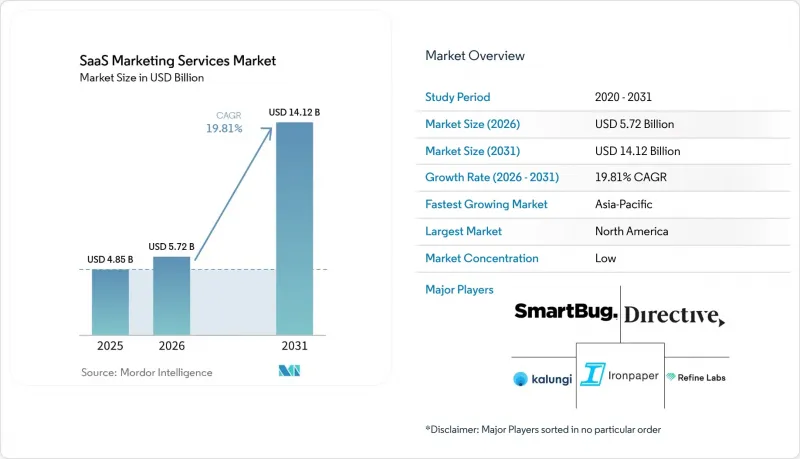
This report is Segmented by Service Type (Strategy and GTM Advisory, Demand Generation and Paid Acquisition, Product-Led Growth and Trial Optimization, Lifecycle Marketing and Customer Expansion, and More), Enterprise Size (Large, and SMEs), End-User Industry (Retail and E-Commerce, Media and Entertainment, and More), and Geography. The Market Forecasts are Provided in Terms of Value (USD).
Global SaaS Marketing Services Market Trends and Insights
Rising Demand for Revenue-Linked Marketing Outcomes
SaaS companies increasingly expect agencies to show CAC payback, pipeline contribution, and influence on net revenue retention rather than activity measures alone. The SaaS marketing services market is therefore shifting toward contracts that connect campaign work with commercial systems and sales outcomes. Gripped reported that 62% of underperforming SaaS providers viewed marketing as a cost center, while weaker alignment between marketing and finance was associated with a higher likelihood of midyear budget cuts. This requirement expands the scope of engagement because agencies must support attribution design, customer relationship management integration, and performance reporting. Providers with revenue operations capabilities can connect campaign activity to account scoring, deal progression, and closed revenue. The SaaS marketing services market is likely to favor fewer providers that can demonstrate measurable returns across these linked activities.
Accelerating Adoption of Account-Based Marketing in B2B SaaS
Account-based marketing is increasing the demand for agencies that can coordinate targeting across several buyers within the same account. The SaaS marketing services market benefits when these programs require specialist technology, content, and journey design. Inflection Group found that 70% of surveyed large-enterprise programs used AI for content creation, while 63% planned investment in AI-supported journey orchestration. The same study reported that nearly 20% of large-enterprise marketing budgets were dedicated to account-based marketing, and only 37% of teams handled activation fully in-house. These programs make agency relationships more integrated because delivery depends on the client's revenue technology and account data. This favors service providers that can operate across strategy, execution, and measurement rather than offering isolated campaign support.
Budget Scrutiny and Longer Vendor Approval Cycles
Budget scrutiny is the most immediate constraint on demand for external SaaS marketing services. Gartner found that 39% of CMOs planned to reduce agency budgets in 2025, including by reducing the number of relationships, renegotiating contracts, and narrowing the scopes of work. This climate makes finance leaders more likely to require proof of revenue impact before approving an engagement. Longer evaluations can weaken the economics of winning new work, especially for smaller specialist providers. The pressure is strongest for recurring retainers that need senior financial approval. The SaaS marketing services market remains exposed to this constraint until providers can demonstrate outcomes that justify their cost relative to in-house alternatives.
Other drivers and restraints analyzed in the detailed report include:
- Artificial Intelligence-Enabled Campaign Optimization and Content Production
- Greater Outsourcing of Martech, Search Engine Optimization, and Paid Media Execution
- In-House Teams and Automation Platforms Replacing Agency Scope
For complete list of drivers and restraints, kindly check the Table Of Contents.
Segment Analysis
Demand generation and paid acquisition accounted for 28.91% of the market in 2025, making it the largest service category in the SaaS marketing services market. Rising acquisition costs sustain demand for agencies that manage paid programs and protect the cost of qualified leads. Product-led growth and trial optimization is the fastest-growing service line, with a 20.75% CAGR projected through 2031. Perspective AI reported that AI onboarding tools increased activation rates by 41%, reduced time to first value by 64%, and improved top-quartile trial-to-paid conversion from 32% in 2024 to 38.2% in 2026. These changes extend agency work beyond campaign acquisition to include onboarding and early customer experience.
Strategy and go-to-market advisory often establishes the basis for later demand generation, lifecycle, and revenue operations work. Lifecycle marketing and customer expansion are gaining importance as mature SaaS providers direct more budget to programs after the initial sale. Revenue operations and attribution are high-value categories in which internal teams cannot connect campaign touchpoints to opportunity and revenue data. LeanData identified attribution architecture as a leading operational gap in enterprise go-to-market maturity in its 2026 survey. Organic growth and website conversion work are also being redesigned around structured data, AI-readable content, and citation visibility.
Complete Report Scope:
- By Service Type
- Strategy and GTM Advisory
- Demand Generation and Paid Acquisition
- Product-Led Growth and Trial Optimization
- Lifecycle Marketing and Customer Expansion
- Organic Growth Marketing
- Revenue Operations and Attribution
- Website and Conversion Optimization
- By Enterprise Size
- Large
- SMEs
- By End-User Industry
- Retail and E-commerce
- Media and Entertainment
- IT and Telecom
- BFSI
- Healthcare and Life Sciences
- Automotive
- Others (Education, Travel and Hospitality, and Industrial Manufacturing amongst others)
- By Geography
- North America
- United States
- Canada
- Mexico
- South America
- Brazil
- Argentina
- Chile
- Rest of South America
- Europe
- Germany
- United Kingdom
- France
- Italy
- Spain
- Rest of Europe
- Asia-Pacific
- China
- Japan
- India
- South Korea
- Australia
- Rest of Asia-Pacific
- Middle East
- United Arab Emirates
- Saudi Arabia
- Qatar
- Rest of Middle East
- Africa
- South Africa
- Egypt
- Nigeria
- Rest of Africa
- North America
Geography Analysis
North America held 40.12% share in 2025 and remains the largest regional base for the SaaS marketing services market. A large concentration of B2B SaaS vendors, enterprise budgets, and account-based marketing specialists supports that position. High acquisition costs and extensive use of marketing technology sustain demand for providers that improve pipeline efficiency. These conditions support broad relationships across paid media, content, lifecycle programs, and revenue operations.
Asia-Pacific is projected to grow at a 20.87% CAGR through 2031, the fastest regional rate. SaaS adoption and a maturing agency base in India and Singapore support regional demand. ISG reported that Asia-Pacific XaaS spending reached USD 556 million in the first quarter of 2025 and was forecast to grow in 2026. India combines a SaaS delivery role with a growing domestic buyer market, while Singapore supports commercialization across Southeast Asia. Japan, South Korea, Australia, and China add demand, although data localization rules shape cross-border delivery in China.
Europe remains meaningful through the United Kingdom, Germany, France, and the Netherlands. Consent architecture, first-party data governance, and AI transparency requirements can create less discretionary agency work. GWA reported that German agency revenue declined 2.7% in 2025, although 60% of agencies expected positive conditions in 2026. South America is smaller, but Brazil shows demand across fintech, health technology, and education technology. The Middle East and Africa are earlier-stage areas where Saudi Arabia, the United Arab Emirates, Israel, South Africa, Nigeria, Egypt, and Kenya are developing SaaS ecosystems.
- SmartBug Media, Inc.
- Kalungi, Inc.
- Directive Consulting, Inc.
- Ironpaper, Inc.
- Refine Labs, LLC
- Bay Leaf Partners, LLC
- Gripped Ltd
- SimpleTiger LLC
- Powered by Search Inc.
- Single Grain LLC
- Omniscient Digital, LLC
- Hey Digital OU
- Growthcurve Ltd
- Enlmtd Group
- Unfoldify Inc.
- SledPull LLC
- Paul Sullivan Marketing Limited
- Queens Digital Agency Inc.
- TimeZ Marketing, Inc.
- Maxiality B.V.
Additional Benefits:
- The market estimate (ME) sheet in Excel format
- 3 months of analyst support
TABLE OF CONTENTS
1 INTRODUCTION
- 1.1 Study Assumptions and Market Definition
- 1.2 Scope of the Study
2 RESEARCH METHODOLOGY
3 EXECUTIVE SUMMARY
4 MARKET LANDSCAPE
- 4.1 Market Drivers
- 4.1.1 Rising Demand for Revenue-Linked Marketing Outcomes
- 4.1.2 Accelerating Adoption of Account-Based Marketing in B2B SaaS
- 4.1.3 Greater Outsourcing of Martech, Search Engine Optimization, and Paid Media Execution
- 4.1.4 Artificial Intelligence-Enabled Campaign Optimization and Content Production
- 4.1.5 Zero-Party and First-Party Data Re-Architecture After Cookie Loss
- 4.1.6 Generative Search Discovery and Artificial Intelligence Citation Optimization Spend
- 4.2 Market Restraints
- 4.2.1 Budget Scrutiny and Longer Vendor Approval Cycles
- 4.2.2 In-House Teams and Automation Platforms Replacing Agency Scope
- 4.2.3 Weak Product Instrumentation Limits Product-Led Growth and Lifecycle Service Return on Investment
- 4.2.4 Attribution Blind Spots Across Dark Social and Multi-Stakeholder Buying
- 4.2.5 Synthetic Traffic, Deepfakes, and Brand Safety Risks Distort Performance
- 4.3 Impact of Macroeconomic Factors on the Market
- 4.4 Industry Value-Chain Analysis
- 4.5 Technology Outlook
- 4.6 Regulatory Landscape
- 4.7 Porter's Five Forces Analysis
- 4.7.1 Threat of New Entrants
- 4.7.2 Bargaining Power of Suppliers
- 4.7.3 Bargaining Power of Buyers
- 4.7.4 Threat of Substitutes
- 4.7.5 Intensity of Competitive Rivalry
5 MARKET SIZE AND GROWTH FORECASTS (VALUE)
- 5.1 By Service Type
- 5.1.1 Strategy and GTM Advisory
- 5.1.2 Demand Generation and Paid Acquisition
- 5.1.3 Product-Led Growth and Trial Optimization
- 5.1.4 Lifecycle Marketing and Customer Expansion
- 5.1.5 Organic Growth Marketing
- 5.1.6 Revenue Operations and Attribution
- 5.1.7 Website and Conversion Optimization
- 5.2 By Enterprise Size
- 5.2.1 Large
- 5.2.2 SMEs
- 5.3 By End-User Industry
- 5.3.1 Retail and E-commerce
- 5.3.2 Media and Entertainment
- 5.3.3 IT and Telecom
- 5.3.4 BFSI
- 5.3.5 Healthcare and Life Sciences
- 5.3.6 Automotive
- 5.3.7 Others (Education, Travel and Hospitality, and Industrial Manufacturing amongst others)
- 5.4 By Geography
- 5.4.1 North America
- 5.4.1.1 United States
- 5.4.1.2 Canada
- 5.4.1.3 Mexico
- 5.4.2 South America
- 5.4.2.1 Brazil
- 5.4.2.2 Argentina
- 5.4.2.3 Chile
- 5.4.2.4 Rest of South America
- 5.4.3 Europe
- 5.4.3.1 Germany
- 5.4.3.2 United Kingdom
- 5.4.3.3 France
- 5.4.3.4 Italy
- 5.4.3.5 Spain
- 5.4.3.6 Rest of Europe
- 5.4.4 Asia-Pacific
- 5.4.4.1 China
- 5.4.4.2 Japan
- 5.4.4.3 India
- 5.4.4.4 South Korea
- 5.4.4.5 Australia
- 5.4.4.6 Rest of Asia-Pacific
- 5.4.5 Middle East
- 5.4.5.1 United Arab Emirates
- 5.4.5.2 Saudi Arabia
- 5.4.5.3 Qatar
- 5.4.5.4 Rest of Middle East
- 5.4.6 Africa
- 5.4.6.1 South Africa
- 5.4.6.2 Egypt
- 5.4.6.3 Nigeria
- 5.4.6.4 Rest of Africa
- 5.4.1 North America
6 COMPETITIVE LANDSCAPE
- 6.1 Market Concentration
- 6.2 Strategic Moves
- 6.3 Market Share Analysis
- 6.4 Company Profiles (includes Global Level Overview, Market Level Overview, Core Segments, Financials as available, Strategic Information, Market Rank/Share, Products and Services, Recent Developments)
- 6.4.1 SmartBug Media, Inc.
- 6.4.2 Kalungi, Inc.
- 6.4.3 Directive Consulting, Inc.
- 6.4.4 Ironpaper, Inc.
- 6.4.5 Refine Labs, LLC
- 6.4.6 Bay Leaf Partners, LLC
- 6.4.7 Gripped Ltd
- 6.4.8 SimpleTiger LLC
- 6.4.9 Powered by Search Inc.
- 6.4.10 Single Grain LLC
- 6.4.11 Omniscient Digital, LLC
- 6.4.12 Hey Digital OU
- 6.4.13 Growthcurve Ltd
- 6.4.14 Enlmtd Group
- 6.4.15 Unfoldify Inc.
- 6.4.16 SledPull LLC
- 6.4.17 Paul Sullivan Marketing Limited
- 6.4.18 Queens Digital Agency Inc.
- 6.4.19 TimeZ Marketing, Inc.
- 6.4.20 Maxiality B.V.
7 MARKET OPPORTUNITIES AND FUTURE OUTLOOK
- 7.1 White-Space and Unmet-Need Assessment

