PUBLISHER: Mordor Intelligence | PRODUCT CODE: 2119351

PUBLISHER: Mordor Intelligence | PRODUCT CODE: 2119351
Solar Inverter Battery - Market Share Analysis, Industry Trends & Statistics, Growth Forecasts (2026 - 2031)
According to Mordor Intelligence, the solar inverter battery market size is projected to expand from USD 2.09 billion in 2025 and USD 2.24 billion in 2026 to USD 3.11 billion by 2031, at a CAGR of 6.78% between 2026 and 2031.
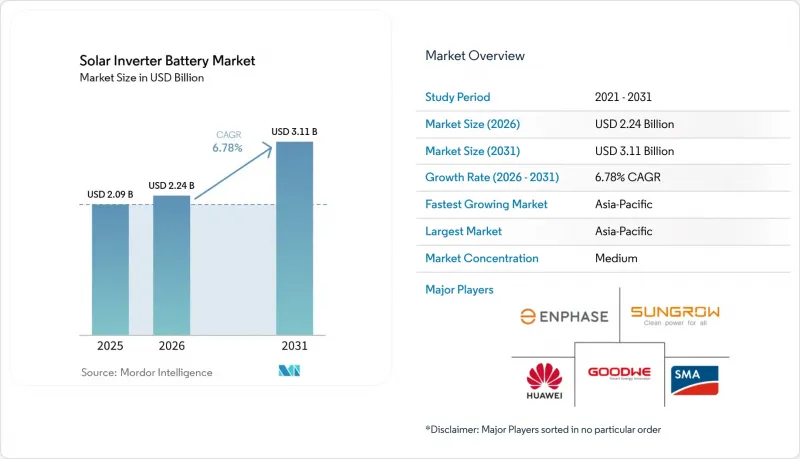
This report is Segmented by Battery Chemistry (Lithium-Ion, Lead-Acid, Sodium-Ion, Flow Batteries, Others), Battery Capacity (Below 5 KWh, 5-10 KWh, 10-20 KWh, Above 20 KWh), End User (Residential, Commercial, Industrial, Utility-Scale), and Geography (North America, Europe, Asia-Pacific, South America, Middle East and Africa). The Market Forecasts are Provided in Terms of Value (USD).
Global Solar Inverter Battery Market Trends and Insights
Solar-Plus-Storage Deployment Lifts Attachment Rates
The solar inverter battery market benefits as storage becomes a standard part of new solar projects. The U.S. residential solar storage attachment rate reached 45% in the first quarter of 2026, compared with 38% in the first quarter of 2025. This change reflected revised net-metering arrangements as well as customer interest in retaining more solar generation for later use in the solar inverter battery market. SEIA reported that the United States added 58 GWh of energy storage capacity in 2025. Paired systems require suppliers to coordinate inverter controls, battery management, and site design. This favors firms that can offer a complete system rather than a separate hardware component.
Falling Lithium-Ion System Costs Support Wider Adoption
The solar inverter battery market has gained from lower lithium iron phosphate, or LFP, cell costs. LFP cell prices were near USD 50/kWh in 2025, helping residential systems compete in high-tariff European and Australian settings. A rise in 314 Ah storage-cell prices during the first half of 2026 did not remove the economic case for commercial projects in the solar inverter battery market. Sungrow introduced PowerHarbor in June 2026 with 314 Ah prismatic cells and module-level DC-DC conversion. The design aims to reduce balance-of-system costs and simplify capacity additions. Certification expenses still limit savings for smaller installers operating under the national grid and safety rules.
High Upfront Costs Limit Access in Emerging Geographies
The solar inverter battery market remains less accessible, where consumer financing and installer capacity are limited. Lower cell prices have not eliminated total equipment, installation, and financing costs. Brazil had more than 500 MWh of behind-the-meter storage installed by January 2026, while the country was expected to add more than 650 MWh during 2026. Brazil's electricity regulator was reviewing Consulta Publica 39 in 2026, which could clarify storage business models. All-in-one equipment can shorten commissioning time in the solar inverter battery market, but this does not fully offset labor costs in markets with limited installer networks. These limits also constrain purchases of larger capacity systems by commercial customers.
Other drivers and restraints analyzed in the detailed report include:
- Grid Reliability and Energy Independence Strengthen Demand
- Renewable-Energy Incentives and Storage Mandates Improve Project Visibility
- Interconnection and Compliance Timelines Slow Deployment
For complete list of drivers and restraints, kindly check the Table Of Contents.
Segment Analysis
Lithium-ion batteries held 72.1% of the solar inverter battery market share in 2025. LFP products formed the main part of this position because they have established supply chains and known performance in residential storage. Their operating range, cell-level safety characteristics, and compatibility with standard battery management systems support use in certified systems. Lead-acid batteries retained a role in cost-sensitive applications. Flow batteries continued to serve a limited set of long-duration commercial and industrial projects, where installation complexity and capital needs constrain wider use.
Sodium-ion batteries are forecast to grow at a 9.1% CAGR from 2026 to 2031. CATL stated that its sodium-ion cells can reach 97% system efficiency and more than 15,000 cycles to 80% capacity. The company's cell design does not use cobalt, nickel, or copper, which supports its cost position at larger production volumes. Alfen and CATL agreed in July 2026 to deploy 5 GWh of sodium-ion storage across Europe. The agreement shows that the solar inverter battery industry is moving beyond pilot-scale interest in this chemistry.
Complete Report Scope:
- By Battery Chemistry
- Lithium-ion Batteries
- Lead-acid Batteries
- Sodium-ion Batteries
- Flow Batteries
- Other Battery Chemistries
- By Battery Capacity
- Below 5 kWh
- 5-10 kWh
- 10-20 kWh
- Above 20 kWh
- By End User
- Residential
- Commercial
- Industrial
- Utility-scale
- By Geography
- North America
- United States
- Canada
- Mexico
- Europe
- Germany
- France
- Italy
- Spain
- United Kingdom
- Poland
- Russia
- Rest of Europe
- Asia-Pacific
- China
- India
- Japan
- South Korea
- Australia
- Indonesia
- Vietnam
- Thailand
- Rest of Asia-Pacific
- South America
- Brazil
- Argentina
- Chile
- Rest of South America
- Middle East and Africa
- Saudi Arabia
- United Arab Emirates
- Egypt
- South Africa
- Morocco
- Rest of Middle East and Africa
- North America
Geography Analysis
Asia-Pacific held 46.4% of the solar inverter battery market share in 2025 and is forecast to grow at an 8.5% CAGR through 2031. China remains the region's largest source of equipment production and a major storage deployment center. National planning supports grid-forming storage and broader use of batteries with renewable generation. India adds demand through distributed solar expansion. Japan, South Korea, and Australia support steady household demand, while Vietnam, Indonesia, and Thailand offer early demand for smaller systems where power reliability matters.
North America remains important to the solar inverter battery market because the United States combines utility-scale deployment with a growing household attachment rate. SEIA reported 58 GWh of new U.S. energy storage capacity in 2025. California, Texas, and Arizona account for a large share of utility-scale activity. Virtual power plant programs in Massachusetts, Texas, New Jersey, and the Mid-Atlantic create an additional route to customer revenue. Canada and Mexico remain earlier-stage markets, but clean electricity rules and distributed generation plans support future demand.
Europe added 36 GWh of storage in the EU-27 during 2025, taking cumulative capacity above 100 GWh. Germany, the United Kingdom, and Italy were the largest national markets. Germany's 2026 installation growth reflects the effect of dynamic tariffs and an established household solar base. South America, the Middle East, and Africa remain earlier-stage regions with clear demand drivers. Brazil combines distributed solar, unreliable grids, and time-of-use tariff opportunities, while Saudi Arabia and the United Arab Emirates draw utility-scale battery investment.
- BYD Company Limited
- Contemporary Amperex Technology Co., Limited (CATL)
- Dyness Digital Energy Technology Co., Ltd.
- Enphase Energy, Inc.
- Fluence Energy, Inc.
- Fronius International GmbH
- Ginlong Technologies Co., Ltd. (Solis)
- GoodWe Technologies Co., Ltd.
- Growatt New Energy Technology Co., Ltd.
- Huawei Digital Power Technologies Co., Ltd.
- LG Energy Solution Ltd.
- Panasonic Holdings Corporation
- Pylon Technologies Co., Ltd.
- Samsung SDI Co., Ltd.
- Schneider Electric SE
- SMA Solar Technology AG
- SolarEdge Technologies, Inc.
- Sungrow Power Supply Co., Ltd.
- Tesla, Inc.
Additional Benefits:
- The market estimate (ME) sheet in Excel format
- 3 months of analyst support
TABLE OF CONTENTS
1 INTRODUCTION
- 1.1 Study Assumptions and Market Definition
- 1.2 Scope of the Study
2 RESEARCH METHODOLOGY
3 EXECUTIVE SUMMARY
4 MARKET LANDSCAPE
- 4.1 Market Overview
- 4.2 Market Drivers
- 4.2.1 Solar-Plus-Storage Deployment
- 4.2.2 Falling Lithium-Ion System Costs
- 4.2.3 Grid Reliability and Energy Independence
- 4.2.4 Renewable-Energy Incentives and Storage Mandates
- 4.2.5 Cybersecurity and Bankability Requirements Elevating Qualified Suppliers
- 4.2.6 Software-Led Virtual Power Plant Monetization
- 4.3 Market Restraints
- 4.3.1 High Upfront System and Installation Cost
- 4.3.2 Interconnection, Permitting, and Safety-Compliance Delays
- 4.3.3 Hybrid-System Interoperability and Warranty Risk
- 4.3.4 Trade Barriers, Local-Content Rules, and Skilled-Labor Shortages
- 4.4 Supply-Chain Analysis
- 4.5 Porter's Five Forces Analysis
- 4.5.1 Bargaining Power of Suppliers
- 4.5.2 Bargaining Power of Buyers
- 4.5.3 Threat of New Entrants
- 4.5.4 Threat of Substitutes
- 4.5.5 Competitive Rivalry
- 4.6 Technology Outlook
- 4.7 Regulatory Landscape
- 4.8 Investment Analysis
5 MARKET SIZE AND GROWTH FORECASTS
- 5.1 By Battery Chemistry
- 5.1.1 Lithium-ion Batteries
- 5.1.2 Lead-acid Batteries
- 5.1.3 Sodium-ion Batteries
- 5.1.4 Flow Batteries
- 5.1.5 Other Battery Chemistries
- 5.2 By Battery Capacity
- 5.2.1 Below 5 kWh
- 5.2.2 5-10 kWh
- 5.2.3 10-20 kWh
- 5.2.4 Above 20 kWh
- 5.3 By End User
- 5.3.1 Residential
- 5.3.2 Commercial
- 5.3.3 Industrial
- 5.3.4 Utility-scale
- 5.4 By Geography
- 5.4.1 North America
- 5.4.1.1 United States
- 5.4.1.2 Canada
- 5.4.1.3 Mexico
- 5.4.2 Europe
- 5.4.2.1 Germany
- 5.4.2.2 France
- 5.4.2.3 Italy
- 5.4.2.4 Spain
- 5.4.2.5 United Kingdom
- 5.4.2.6 Poland
- 5.4.2.7 Russia
- 5.4.2.8 Rest of Europe
- 5.4.3 Asia-Pacific
- 5.4.3.1 China
- 5.4.3.2 India
- 5.4.3.3 Japan
- 5.4.3.4 South Korea
- 5.4.3.5 Australia
- 5.4.3.6 Indonesia
- 5.4.3.7 Vietnam
- 5.4.3.8 Thailand
- 5.4.3.9 Rest of Asia-Pacific
- 5.4.4 South America
- 5.4.4.1 Brazil
- 5.4.4.2 Argentina
- 5.4.4.3 Chile
- 5.4.4.4 Rest of South America
- 5.4.5 Middle East and Africa
- 5.4.5.1 Saudi Arabia
- 5.4.5.2 United Arab Emirates
- 5.4.5.3 Egypt
- 5.4.5.4 South Africa
- 5.4.5.5 Morocco
- 5.4.5.6 Rest of Middle East and Africa
- 5.4.1 North America
6 COMPETITIVE LANDSCAPE
- 6.1 Market Concentration
- 6.2 Strategic Moves
- 6.3 Market Share Analysis
- 6.4 Company Profiles (includes Global Level Overview, Market Level Overview, Core Segments, Financials as available, Strategic Information, Market Rank/Share, Products and Services, Recent Developments)
- 6.4.1 BYD Company Limited
- 6.4.2 Contemporary Amperex Technology Co., Limited (CATL)
- 6.4.3 Dyness Digital Energy Technology Co., Ltd.
- 6.4.4 Enphase Energy, Inc.
- 6.4.5 Fluence Energy, Inc.
- 6.4.6 Fronius International GmbH
- 6.4.7 Ginlong Technologies Co., Ltd. (Solis)
- 6.4.8 GoodWe Technologies Co., Ltd.
- 6.4.9 Growatt New Energy Technology Co., Ltd.
- 6.4.10 Huawei Digital Power Technologies Co., Ltd.
- 6.4.11 LG Energy Solution Ltd.
- 6.4.12 Panasonic Holdings Corporation
- 6.4.13 Pylon Technologies Co., Ltd.
- 6.4.14 Samsung SDI Co., Ltd.
- 6.4.15 Schneider Electric SE
- 6.4.16 SMA Solar Technology AG
- 6.4.17 SolarEdge Technologies, Inc.
- 6.4.18 Sungrow Power Supply Co., Ltd.
- 6.4.19 Tesla, Inc.
7 MARKET OPPORTUNITIES AND FUTURE OUTLOOK
- 7.1 White-Space and Unmet-Need Assessment

