PUBLISHER: Mordor Intelligence | PRODUCT CODE: 2119352

PUBLISHER: Mordor Intelligence | PRODUCT CODE: 2119352
India Solar Inverter Battery - Market Share Analysis, Industry Trends & Statistics, Growth Forecasts (2026 - 2031)
According to Mordor Intelligence, the India solar inverter battery market size is expected to increase from USD 135.85 million in 2025 to USD 150.08 million in 2026 and reach USD 214.59 million by 2031, at a CAGR of 7.41% over 2026-2031.
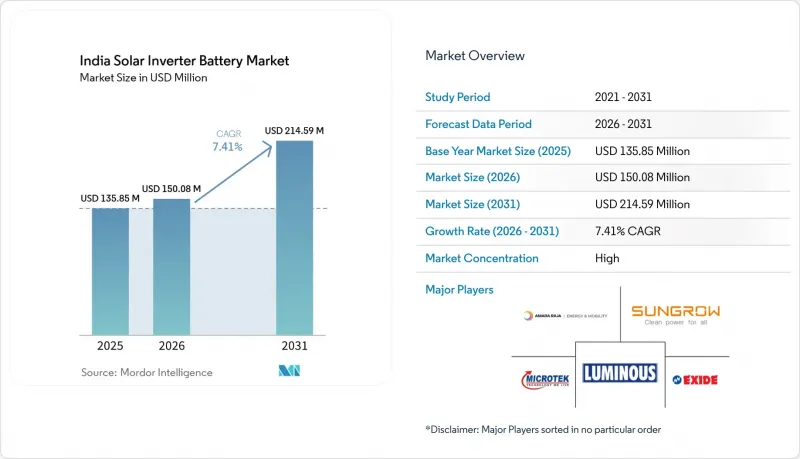
This report is Segmented by Battery Chemistry (Lithium-Ion Batteries, Lead-Acid Batteries, Sodium-Ion Batteries, Flow Batteries, Others), Battery Capacity (Below 5 KWh, 5-10 KWh, 10-20 KWh, Above 20 KWh), End User (Residential, Commercial, Industrial, Utility-Scale), and Geography (India). The Market Forecasts are Provided in Terms of Value (USD).
India Solar Inverter Battery Market Trends and Insights
Accelerating Rooftop Solar and Distributed Generation
India added 7.1 GW of rooftop solar capacity in 2025, compared with 3.2 GW in 2024, and residential consumers contributed 76% of the 2025 additions. PM Surya Ghar crossed 50 lakh beneficiary households by August 2026, which expanded the number of homes with a potential future need for storage. The scheme's current design keeps battery procurement separate from the solar subsidy, so households must still assess the added value of backup power and self-consumption. Assam's rooftop solar capacity reached 344 MW after 463% year-over-year growth, while Uttar Pradesh more than doubled its capacity to 714 MW. These states have more variable grid conditions than the large western markets, which increases the practical value of battery backup. India's behind-the-meter stationary storage demand was 32 GWh in 2025 and is expected to exceed 39 GWh by 2033.
Utility-Scale Solar-Plus-Storage Tendering and DISCOM Support
Standalone battery tenders reached 90.7 GW cumulatively through 2025, and 69 tenders totaling 102 GWh were issued during that year. The 2026 pipeline includes 95 GWh in deployment stages and another 80 GWh in tendering, which points to a larger addressable base for battery suppliers. GUVNL sought 450 MW and 900 MWh in June 2026 under Phase IX viability gap funding. Rajasthan's three distribution companies also tendered 172 MW and 688 MWh of decentralized storage in August 2026. The Energy Storage Obligation requires distribution companies to increase storage to 4% of electricity demand by 2030, supporting longer-term procurement. Tender volumes are substantial, but supplier demand will depend on developers securing finance and completing projects on schedule.
Import Dependence and Cell Supply-Chain Exposure
India's lithium-ion ecosystem relies heavily on imported Chinese cells, creating exposure to supply and pricing movements. China's battery export rebate changes and rupee depreciation added an estimated 11-12% to landed cell prices for Indian buyers. Raw materials represented nearly 65% of the cost of a 314Ah LFP cell, so a rebound could add 15-20% to the bill of materials. Formal channels handled 58.26 lakh tonnes of battery waste by December 2025, while fewer than 5% of end-of-life lithium-ion batteries entered formal recycling. Amara Raja plans bulk lithium-ion cell production in 2027, and Waaree ESS plans capacity additions by FY2027. These projects may ease supply pressure, but imported cells will remain important during the near term.
Other drivers and restraints analyzed in the detailed report include:
- Falling Lithium-Ion and LFP Storage Costs
- PM Surya Ghar, PM-KUSUM and Renewable Capacity Targets
- Aggressive BESS Tender Pricing and Bankability Risk
For complete list of drivers and restraints, kindly check the Table Of Contents.
Segment Analysis
Lithium-ion held 71.1% share in 2025, supported by lower costs and an established installer base. Prices had fallen 30-40% since 2023, making lithium-ion more practical for new hybrid installations. Lead-acid batteries retained demand in tier-2 and rural locations because they have a lower initial cost and work with existing inverter systems. Flow batteries serve limited utility-scale applications where long cycle life and site requirements justify higher capital costs. MNRE requirements under IS 16221 Part II and IS 16169 have raised certification requirements for grid-connected systems.
Sodium-ion is forecast to expand at a 9.1% CAGR through 2031, making it the fastest-growing chemistry in the India solar inverter battery market. Naxion Energy launched sodium-ion energy storage systems from Coimbatore in December 2025 with 1.5 GWh of annual pack capacity. It also announced INR 200 crore for a 500 MWh cell manufacturing pilot by 2027. Sodium-ion cells could be 20-30% more economical than lithium-ion cells at scale because sodium carbonate costs much less than lithium carbonate. Amara Raja's Sodion Energy unit has committed to 1 GWh of sodium-ion capacity in Telangana, indicating continued domestic interest.
Complete Report Scope:
- By Battery Chemistry
- Lithium-ion Batteries
- Lead-acid Batteries
- Sodium-ion Batteries
- Flow Batteries
- Other Battery Chemistries
- By Battery Capacity
- Below 5 kWh
- 5-10 kWh
- 10-20 kWh
- Above 20 kWh
- By End User
- Residential
- Commercial
- Industrial
- Utility-scale
List of Companies Covered in this Report:
- Amara Raja Energy and Mobility Limited
- BYD Company Limited
- Contemporary Amperex Technology Co., Limited (CATL)
- Delta Electronics, Inc.
- Enphase Energy, Inc.
- Exide Energy Solutions Limited
- GoodWe Technologies Co., Ltd.
- Growatt New Energy Technology Co., Ltd.
- Huawei Digital Power Technologies Co., Ltd.
- Jakson Group
- Luminous Power Technologies Private Limited
- Microtek International Private Limited
- Naxion Energy India Pvt. Ltd.
- Sineng Electric Co., Ltd.
- SOFARSOLAR Co., Ltd.
- SolarEdge Technologies, Inc.
- Sungrow Power Supply Co., Ltd.
- Tesla, Inc.
- Waaree Energies Limited
Additional Benefits:
- The market estimate (ME) sheet in Excel format
- 3 months of analyst support
TABLE OF CONTENTS
1 INTRODUCTION
- 1.1 Study Assumptions and Market Definition
- 1.2 Scope of the Study
2 RESEARCH METHODOLOGY
3 EXECUTIVE SUMMARY
4 MARKET LANDSCAPE
- 4.1 Market Overview
- 4.2 Market Drivers
- 4.2.1 Accelerating Rooftop Solar and Distributed Generation
- 4.2.2 Utility-Scale Solar-Plus-Storage Tendering
- 4.2.3 Falling Lithium-Ion and LFP Storage Costs
- 4.2.4 PM Surya Ghar, PM-KUSUM and Renewable Capacity Targets
- 4.2.5 DISCOM Energy Storage Obligations and VGF Support
- 4.2.6 India-Specific Firmware and Installer Localization for Weak-Grid Operation
- 4.3 Market Restraints
- 4.3.1 Import Dependence and Cell Supply-Chain Exposure
- 4.3.2 Aggressive BESS Tender Pricing and Bankability Risk
- 4.3.3 Fragmented DISCOM Interconnection and Installer Approval Workflows
- 4.3.4 Limited End-of-Life Traceability for Distributed Lithium Batteries
- 4.4 Supply-Chain Analysis
- 4.5 Porter's Five Forces Analysis
- 4.5.1 Bargaining Power of Suppliers
- 4.5.2 Bargaining Power of Buyers
- 4.5.3 Threat of New Entrants
- 4.5.4 Threat of Substitutes
- 4.5.5 Competitive Rivalry
- 4.6 Technology Outlook
- 4.7 Regulatory Landscape
- 4.8 Investment Analysis
5 MARKET SIZE AND GROWTH FORECASTS
- 5.1 By Battery Chemistry
- 5.1.1 Lithium-ion Batteries
- 5.1.2 Lead-acid Batteries
- 5.1.3 Sodium-ion Batteries
- 5.1.4 Flow Batteries
- 5.1.5 Other Battery Chemistries
- 5.2 By Battery Capacity
- 5.2.1 Below 5 kWh
- 5.2.2 5-10 kWh
- 5.2.3 10-20 kWh
- 5.2.4 Above 20 kWh
- 5.3 By End User
- 5.3.1 Residential
- 5.3.2 Commercial
- 5.3.3 Industrial
- 5.3.4 Utility-scale
6 COMPETITIVE LANDSCAPE
- 6.1 Market Concentration
- 6.2 Strategic Moves
- 6.3 Market Share Analysis
- 6.4 Company Profiles (includes Global Level Overview, Market Level Overview, Core Segments, Financials as available, Strategic Information, Market Rank/Share, Products and Services, Recent Developments)
- 6.4.1 Amara Raja Energy and Mobility Limited
- 6.4.2 BYD Company Limited
- 6.4.3 Contemporary Amperex Technology Co., Limited (CATL)
- 6.4.4 Delta Electronics, Inc.
- 6.4.5 Enphase Energy, Inc.
- 6.4.6 Exide Energy Solutions Limited
- 6.4.7 GoodWe Technologies Co., Ltd.
- 6.4.8 Growatt New Energy Technology Co., Ltd.
- 6.4.9 Huawei Digital Power Technologies Co., Ltd.
- 6.4.10 Jakson Group
- 6.4.11 Luminous Power Technologies Private Limited
- 6.4.12 Microtek International Private Limited
- 6.4.13 Naxion Energy India Pvt. Ltd.
- 6.4.14 Sineng Electric Co., Ltd.
- 6.4.15 SOFARSOLAR Co., Ltd.
- 6.4.16 SolarEdge Technologies, Inc.
- 6.4.17 Sungrow Power Supply Co., Ltd.
- 6.4.18 Tesla, Inc.
- 6.4.19 Waaree Energies Limited
7 MARKET OPPORTUNITIES AND FUTURE OUTLOOK
- 7.1 White-Space and Unmet-Need Assessment

