PUBLISHER: Mordor Intelligence | PRODUCT CODE: 2119582

PUBLISHER: Mordor Intelligence | PRODUCT CODE: 2119582
Dublin Data Center - Market Share Analysis, Industry Trends & Statistics, Growth Forecasts (2026 - 2031)
According to Mordor Intelligence, dublin data center market size in 2026 is estimated at 0.63 thousand MW, growing from 2025 value of 0.55 thousand MW with 2031 projections showing 1.25 thousand MW, growing at 14.68% CAGR over 2026-2031.
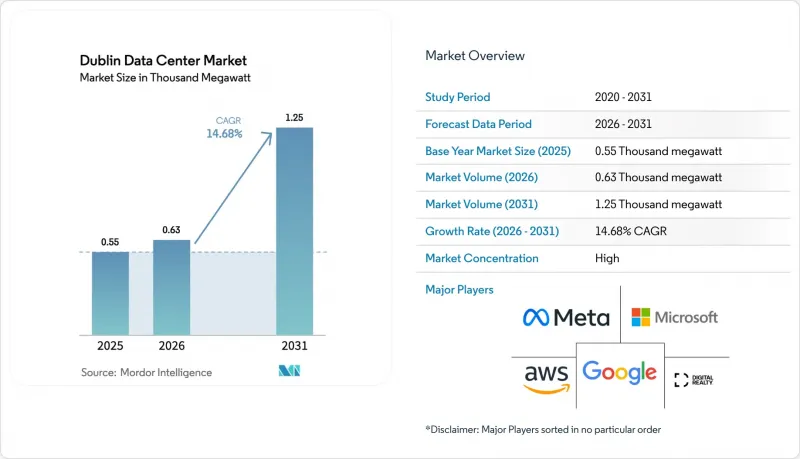
This report is Segmented by Data Center Size (Small, Medium, Large, and More), Tier Type (Tier 1 and 2, Tier 3, Tier 4), Data Center Type (Cloud Service Providers (CSPs), Enterprise, Modular and Edge, Colocation). The Market Forecasts are Provided in Terms of Value (MW).
Dublin Data Center Market Trends and Insights
Hyperscale Cloud Expansion by US Tech Majors
Amazon's USD 150 billion global data-center program reserves significant power blocks in Dublin, while Microsoft's USD 500 million campus extension underscores confidence despite a grid-connection freeze. Google's newly filed EUR 200 million (USD 234.54 million) application signals commitment even after a separate site was denied for sustainability gaps. These investments amplify network effects that attract multi-cloud enterprise migrations, deepen supplier ecosystems, and elevate baseline design specifications such as 400 V power distribution and liquid-cooling loops. Irish component manufacturers, notably Danann Air, now export customized air-handling units worldwide, illustrating how local supply chains scale alongside hyperscaler footprints.
Strategic FLAPD Network Latency Advantage
Situated on the Frankfurt-London-Amsterdam-Paris-Dublin spine, the city leverages the Hibernia Express cable's 59.5 ms New York-to-London round trip-six milliseconds faster than rivals-to entice algorithmic-trading, gaming, and AI-inference workloads. AEConnect's 5,536 km transatlantic span delivers five-nines availability and 100 Gb/s wavelengths that feed Dublin's interconnection campuses. Looking ahead, the EUR 1.1 billion (USD 1.29 billIon) Far North Fiber route via the Arctic Circle will anchor Galway into Asian networks, extending the nation's reach beyond legacy UK pivot points.
Grid-Connection Moratorium and Power-Availability Limits
EirGrid's 2028 freeze on new metropolitan hookups forces operators either to self-generate or to site builds in lesser-loaded counties. Vantage's 52 MW Dublin campus now runs hydrotreated-vegetable-oil (HVO) generators that satisfy power-purchase-agreement (PPA) carbon thresholds and circumvent queue delays. The policy entrenches incumbents, inflates land valuations, and shifts expansion capital toward Galway, Offaly, and Cork.
Other drivers and restraints analyzed in the detailed report include:
- Favourable Irish Tax and EU-Data-Sovereignty Regime
- New Submarine-Cable Landings Boost Bandwidth
- Rising Electricity Costs from EU Carbon Pricing
For complete list of drivers and restraints, kindly check the Table Of Contents.
Segment Analysis
Mega campuses controlled 57.10% of Dublin data center market share in 2025. The Dublin data center market size for massive sites is projected to compound at 16.55% through 2031 as AI GPUs and liquid tanks raise per-rack densities. Incumbents exploit economies in substation build-outs, security, and talent pools that are hard for smaller designs to replicate.
Large and medium footprints retain vital roles for regulated industries and disaster-recovery nodes, yet growth tilts unmistakably toward installations exceeding 50 MW blocks. Edge-tier micro-sites emerge near Cork and Athlone to trim latency for fintech and 5G core slicing, but their aggregate megawatts remain modest relative to hyperscale clusters.
Tier 3 remained the default with 64.10% of the Dublin data center market size in 2025, translating to roughly 353 MW at 1.6 PUE averages. As machine-learning pipelines migrate from research to mission-critical inference, Tier 4's error-budget premiums become justifiable, moving its segment CAGR to 15.90%.
Operators retrofit secondary feeds, 2N+1 switchgear, and concurrently maintainable cooling loops that shrink fail-over intervals to microseconds. The tier schema itself may evolve: hybrid power designs now integrate curtailed wind, behind-the-meter batteries, and grid-interactive response that standard Uptime classifications fail to capture.
Complete Report Scope:
- By Data Center Size
- Small
- Medium
- Large
- Massive
- Mega
- By Tier Type
- Tier 1 and 2
- Tier 3
- Tier 4
- By Data Center Type
- Cloud Service Providers (CSPs)
- Enterprise, Modular and Edge
- Colocation
- Utilized
- Colocation Type
- Retail
- Wholesale
- Hyperscale
- End User
- Cloud and IT
- Telecom
- Media and Entertainment
- Government
- BFSI
- Manufacturing
- E-Commerce
- Other End User
- Colocation Type
- Non-Utilized
- Utilized
List of Companies Covered in this Report:
- Amazon Web Services
- Microsoft Corporation
- Google LLC
- Meta Platforms Inc.
- Digital Realty Trust Inc. (Interxion)
- Equinix Inc.
- Keppel DC REIT
- CyrusOne Inc.
- EdgeConneX Inc.
- Servecentric Ltd
- Web World Ireland
- BT Communications Ltd (BT Group)
- Viatel Ireland Ltd
- Zenlayer Inc.
- Eir evo
- Iron Mountain Data Centers
- Echelon Data Centres
- Dataplex Group
- Vantage Data Centers
- STACK Infrastructure
- T5 Data Centers
- Digital 9 Infrastructure plc
- Akamai Technologies Inc.
- Sidero Data Centres
Additional Benefits:
- The market estimate (ME) sheet in Excel format
- 3 months of analyst support
TABLE OF CONTENTS
1 INTRODUCTION
- 1.1 Study Assumptions and Market Definition
- 1.2 Scope of the Study
2 RESEARCH METHODOLOGY
3 EXECUTIVE SUMMARY
4 MARKET LANDSCAPE
- 4.1 Market Overview
- 4.2 Market Drivers
- 4.2.1 Hyperscale cloud expansion by US tech majors
- 4.2.2 Strategic FLAPD network latency advantage
- 4.2.3 Favourable Irish tax & EU-data-sovereignty regime
- 4.2.4 New submarine cable landings boost bandwidth
- 4.2.5 Grid-decarbonisation commitments lure green tenants
- 4.2.6 AI clusters driving high-density liquid-cooling demand
- 4.3 Market Restraints
- 4.3.1 Grid-connection moratorium & power-availability limits
- 4.3.2 Rising electricity costs from EU carbon pricing
- 4.3.3 Community opposition over water-consumption spikes
- 4.3.4 Specialised-talent shortage in Irish DC operations
- 4.4 Digital Infrastructure Indicators
- 4.4.1 Smartphone Users
- 4.4.2 Data Traffic per Smartphone
- 4.4.3 Mobile Data Speed
- 4.4.4 Broadband Data Speed
- 4.5 Supply-Chain Analysis
- 4.6 Regulatory Landscape
- 4.7 Technological Outlook
- 4.8 Assessment of Macro Economic Trends on the Market
- 4.9 Porter's Five Forces
- 4.9.1 Bargaining Power of Suppliers
- 4.9.2 Bargaining Power of Buyers
- 4.9.3 Threat of New Entrants
- 4.9.4 Threat of Substitutes
- 4.9.5 Competitive Rivalry
5 MARKET SIZE AND GROWTH FORECASTS (MW)
- 5.1 By Data Center Size
- 5.1.1 Small
- 5.1.2 Medium
- 5.1.3 Large
- 5.1.4 Massive
- 5.1.5 Mega
- 5.2 By Tier Type
- 5.2.1 Tier 1 and 2
- 5.2.2 Tier 3
- 5.2.3 Tier 4
- 5.3 By Data Center Type
- 5.3.1 Cloud Service Providers (CSPs)
- 5.3.2 Enterprise, Modular and Edge
- 5.3.3 Colocation
- 5.3.3.1 Utilized
- 5.3.3.1.1 Colocation Type
- 5.3.3.1.1.1 Retail
- 5.3.3.1.1.2 Wholesale
- 5.3.3.1.1.3 Hyperscale
- 5.3.3.1.2 End User
- 5.3.3.1.2.1 Cloud and IT
- 5.3.3.1.2.2 Telecom
- 5.3.3.1.2.3 Media and Entertainment
- 5.3.3.1.2.4 Government
- 5.3.3.1.2.5 BFSI
- 5.3.3.1.2.6 Manufacturing
- 5.3.3.1.2.7 E-Commerce
- 5.3.3.1.2.8 Other End User
- 5.3.3.1.1 Colocation Type
- 5.3.3.2 Non-Utilized
- 5.3.3.1 Utilized
6 COMPETITIVE LANDSCAPE
- 6.1 Market Concentration
- 6.2 Strategic Moves
- 6.3 Market Share Analysis (MW)
- 6.4 Company Profiles (includes Global level Overview, Market level overview, Core Segments, Financials as available, Strategic Information, Market Rank/Share for key companies, Products and Services, and Recent Developments)
- 6.4.1 Amazon Web Services
- 6.4.2 Microsoft Corporation
- 6.4.3 Google LLC
- 6.4.4 Meta Platforms Inc.
- 6.4.5 Digital Realty Trust Inc. (Interxion)
- 6.4.6 Equinix Inc.
- 6.4.7 Keppel DC REIT
- 6.4.8 CyrusOne Inc.
- 6.4.9 EdgeConneX Inc.
- 6.4.10 Servecentric Ltd
- 6.4.11 Web World Ireland
- 6.4.12 BT Communications Ltd (BT Group)
- 6.4.13 Viatel Ireland Ltd
- 6.4.14 Zenlayer Inc.
- 6.4.15 Eir evo
- 6.4.16 Iron Mountain Data Centers
- 6.4.17 Echelon Data Centres
- 6.4.18 Dataplex Group
- 6.4.19 Vantage Data Centers
- 6.4.20 STACK Infrastructure
- 6.4.21 T5 Data Centers
- 6.4.22 Digital 9 Infrastructure plc
- 6.4.23 Akamai Technologies Inc.
- 6.4.24 Sidero Data Centres
7 MARKET OPPORTUNITIES AND FUTURE OUTLOOK
- 7.1 White-space and Unmet-need Assessment

