PUBLISHER: Mordor Intelligence | PRODUCT CODE: 2119590

PUBLISHER: Mordor Intelligence | PRODUCT CODE: 2119590
Jakarta Data Center - Market Share Analysis, Industry Trends & Statistics, Growth Forecasts (2026 - 2032)
According to Mordor Intelligence, jakarta data center market size in 2026 is estimated at 728.91 MW, growing from 2025 value of 658.78 MW with 2032 projections showing 1,336.09 MW, growing at 10.64% CAGR over 2026-2032.
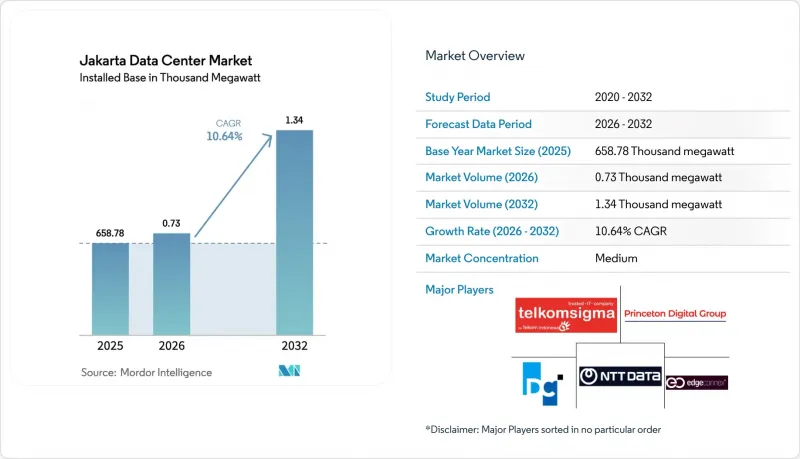
This report is Segmented by Data Center Size (Small, Medium, Large, Mega, Massive), Tier Standard (Tier I and II, Tier III, Tier IV), Absorption (Non-Utilized, Utilized by Colocation Type and End-User Industry) and by Hotspot. The Market Forecasts are Provided in Terms of Volume (MW).
Jakarta Data Center Market Trends and Insights
Exploding mobile-data consumption and 5G roll-out
Indonesia's 5G coverage accelerated in 2024, lifting total mobile data traffic by 9% to 17.9 million TB. The surge forces content and application providers to house workloads closer to end users, which in turn raises demand for low-latency edge nodes across the Jakarta data center market IoT devices tied to Industry 4.0 programs are projected to contribute IDR 1,620 trillion in value by 2025, deepening the requirement for distributed processing capacity that centralized data centers cannot efficiently meet. As latency-sensitive services such as augmented-reality commerce and autonomous logistics mature, operators are prioritizing micro-modules inside dense urban footprints. These deployments improve user experience, reduce network backhaul and underpin sustained rack-fill rates. The trend also drives capital toward liquid-cooling and direct-to-chip technologies that fit high-density 5G edge environments.
E-commerce and fintech boom requiring low-latency hosting
Jakarta remains Southeast Asia's largest e-commerce hub, and the region's transaction-heavy platforms require resilient, latency-optimized data centers. Tokopedia reported a 10X smarter search capability after deploying vector search on AI-ready infrastructure, a result that highlights the commercial upside of high-performance hosting Financial players follow suit: DOKU's disaster-recovery configuration on Alibaba Cloud cut operating costs by 20% while safeguarding compliance with Bank Indonesia regulations. With online-payment velocity rising, colocation providers offering <2 ms round-trip latency can command premium pricing even as the broader Jakarta data center market faces rental compression. The stickiness of fintech workloads, combined with regulatory scrutiny, yields predictable occupancy and serves as a hedge against cyclical demand shifts.
High electricity tariffs and grid congestion in Greater Jakarta
PLN's 2025 tariff schedule ranges from IDR 996.74 to IDR 1,699.53 per kWh for commercial accounts, inflating opex at a time when colocation prices are falling. The 67% share of coal in the power mix complicates renewables procurement, a key requirement for global cloud clients pursuing net-zero mandates. Grid bottlenecks delay energization dates, forcing developers to install larger diesel reserves and on-site battery systems, raising capex by 5%. Cushman & Wakefield ranks Jakarta the fourth most expensive data center construction market in Asia Pacific, evidence of combined power and labor cost pressures. These headwinds are steering future builds toward the Bekasi-Cikarang Corridor, where high-voltage feeders and industrial zoning streamline connections.
Other drivers and restraints analyzed in the detailed report include:
- Making Indonesia 4.0 and the data-sovereignty push
- Influx of hyperscale cloud providers driving campus builds
- Land scarcity and zoning limits for large-footprint campuses
For complete list of drivers and restraints, kindly check the Table Of Contents.
Segment Analysis
Mega facilities are rewriting the Jakarta data center market's economics. While large sites still held the highest 2025 share at 41.35%, mega campuses are sprinting ahead at a 20.35% CAGR. That pace reflects cloud providers' need for contiguous 20 MW blocks, standardized white space and economies of scale that shrink per-MW opex. The Jakarta data center market size attributed to mega builds is poised to more than double from 2026-2032 as AI workloads favor high-density designs.
Automation, integrated liquid-cooling and onsite sub-station builds help mega sites achieve PUE figures below 1.35. Massive facilities remain an emerging niche aligned with sovereign AI projects such as the Cikarang PDN, but the underpinning technology-immersion cooling and 100 GbE fabrics-will filter into mega campuses first. Medium and small formats retain relevance by enabling densified edge nodes for 5G and IoT deployments close to user clusters.
Complete Report Scope:
- By Data Center Size
- Small
- Medium
- Large
- Mega
- Massive
- By Tier Standard
- Tier I and II
- Tier III
- Tier IV
- By Absorption
- Non-Utilised
- Utilised
- By Colocation Type
- Hyperscale
- Retail
- Wholesale
- By End-User Industry
- BFSI
- Cloud Service Providers
- E-Commerce
- Government
- Manufacturing
- Media and Entertainment
- Telecom
- Other End Users
- By Colocation Type
- By Hotspot
- Greater Jakarta
- Bekasi - Cikarang Corridor
- Rest of Jakarta
List of Companies Covered in this Report:
- Telkomsigma (PT Sigma Cipta Caraka)
- DCI Indonesia
- Princeton Digital Group
- NTT Global Data Centers Indonesia
- STT GDC Indonesia
- Indosat Ooredoo Hutchison
- EdgeConneX
- BDx Indonesia
- Biznet Data Center
- Telkomsat
- Tencent Cloud Indonesia
- Alibaba Cloud Indonesia
- Amazon Web Services (AWS)
- Google Cloud
- KDDI Telehouse Indonesia
- NeuCentrIX (Telkom Indonesia)
- Moratelindo D Cube
- NEX Data Center (Multipolar)
- Cyber CSF
- Elitery
- Garuda Cyber Indonesia
- Graha Technosoft Indonesia
- Lintasarta Cloudeka
Additional Benefits:
- The market estimate (ME) sheet in Excel format
- 3 months of analyst support
TABLE OF CONTENTS
1 INTRODUCTION
- 1.1 Study Assumptions and Market Definition
- 1.2 Scope of the Study
- 1.3 Study Methodology
2 RESEARCH METHODOLOGY
3 EXECUTIVE SUMMARY
4 MARKET LANDSCAPE
- 4.1 Market Overview
- 4.2 Market Drivers
- 4.2.1 Exploding mobile-data consumption and 5G roll-out
- 4.2.2 E-commerce and fintech boom requiring low-latency hosting
- 4.2.3 Government "Making Indonesia 4.0" and data-sovereignty push
- 4.2.4 Influx of hyperscale cloud providers driving campus builds
- 4.2.5 Rapid build-out of new submarine-cable landings (e.g., Echo, Apricot)
- 4.2.6 Green-energy PPAs to meet net-zero mandates unlocking permits
- 4.3 Market Restraints
- 4.3.1 High electricity tariffs and grid congestion in Greater Jakarta
- 4.3.2 Land scarcity and zoning limits for large-footprint campuses
- 4.3.3 Seismic and flood-risk premiums raising insurance/financing costs
- 4.3.4 Water-use restrictions for liquid-cooling in urban districts
- 4.4 Value / Supply-Chain Analysis
- 4.5 Regulatory Landscape
- 4.6 Technological Outlook
5 MARKET SIZE and GROWTH FORECASTS (VALUE USD and MW CAPACITY)
- 5.1 By Data Center Size
- 5.1.1 Small
- 5.1.2 Medium
- 5.1.3 Large
- 5.1.4 Mega
- 5.1.5 Massive
- 5.2 By Tier Standard
- 5.2.1 Tier I and II
- 5.2.2 Tier III
- 5.2.3 Tier IV
- 5.3 By Absorption
- 5.3.1 Non-Utilised
- 5.3.2 Utilised
- 5.3.2.1 By Colocation Type
- 5.3.2.1.1 Hyperscale
- 5.3.2.1.2 Retail
- 5.3.2.1.3 Wholesale
- 5.3.2.2 By End-User Industry
- 5.3.2.2.1 BFSI
- 5.3.2.2.2 Cloud Service Providers
- 5.3.2.2.3 E-Commerce
- 5.3.2.2.4 Government
- 5.3.2.2.5 Manufacturing
- 5.3.2.2.6 Media and Entertainment
- 5.3.2.2.7 Telecom
- 5.3.2.2.8 Other End Users
- 5.3.2.1 By Colocation Type
- 5.4 By Hotspot
- 5.4.1 Greater Jakarta
- 5.4.2 Bekasi - Cikarang Corridor
- 5.4.3 Rest of Jakarta
6 COMPETITIVE LANDSCAPE
- 6.1 Market Share Analysis
- 6.2 Company Profiles (includes Global level Overview, Market level overview, Core Segments, Financials as available, Strategic Information, Market Rank/Share for key companies, Products and Services, and Recent Developments)
- 6.2.1 Telkomsigma (PT Sigma Cipta Caraka)
- 6.2.2 DCI Indonesia
- 6.2.3 Princeton Digital Group
- 6.2.4 NTT Global Data Centers Indonesia
- 6.2.5 STT GDC Indonesia
- 6.2.6 Indosat Ooredoo Hutchison
- 6.2.7 EdgeConneX
- 6.2.8 BDx Indonesia
- 6.2.9 Biznet Data Center
- 6.2.10 Telkomsat
- 6.2.11 Tencent Cloud Indonesia
- 6.2.12 Alibaba Cloud Indonesia
- 6.2.13 Amazon Web Services (AWS)
- 6.2.14 Google Cloud
- 6.2.15 KDDI Telehouse Indonesia
- 6.2.16 NeuCentrIX (Telkom Indonesia)
- 6.2.17 Moratelindo D Cube
- 6.2.18 NEX Data Center (Multipolar)
- 6.2.19 Cyber CSF
- 6.2.20 Elitery
- 6.2.21 Garuda Cyber Indonesia
- 6.2.22 Graha Technosoft Indonesia
- 6.2.23 Lintasarta Cloudeka
7 MARKET OPPORTUNITIES and FUTURE OUTLOOK
- 7.1 White-Space and Unmet-Need Assessment

