PUBLISHER: Mordor Intelligence | PRODUCT CODE: 2119641

PUBLISHER: Mordor Intelligence | PRODUCT CODE: 2119641
Middle East Geospatial Analytics - Market Share Analysis, Industry Trends & Statistics, Growth Forecasts (2026 - 2031)
According to Mordor Intelligence, the Middle East geospatial analytics market size was valued at USD 4.97 billion in 2025 and estimated to grow from USD 5.37 billion in 2026 to reach USD 7.87 billion by 2031, at a CAGR of 7.95% during the forecast period (2026-2031).
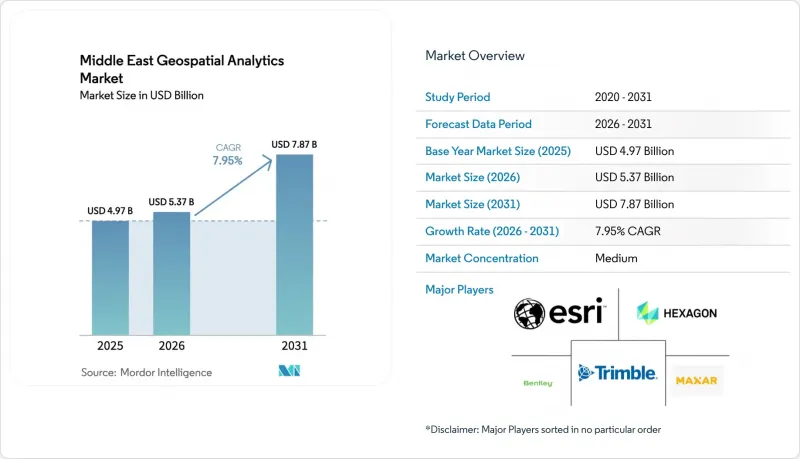
This report is Segmented by Component (Solutions and Services), Analytics Type (Descriptive Analytics, Diagnostic Analytics, and More), Deployment Mode (On-Premise, Cloud, and Edge/Hybrid), Application (Surface and Terrain Analysis, Network and Route Analysis, and More), End-User Industry (Defense and Intelligence, Government and Municipalities, and More), and Country.
Middle East Geospatial Analytics Market Trends and Insights
Surging Smart-City Programs Across GCC
Gulf megaprojects are hard-wiring geospatial analytics into urban-management architectures. Dubai's 2040 Urban Master Plan doubles green areas while targeting a population of 7.8 million, demanding real-time spatial modelling for the "20-minute city" concept. Saudi Arabia's partnership with Naver is delivering 10-cm resolution 3-D twins for Riyadh and four additional cities, enabling flood simulation and infrastructure optimisation. The USD 2.5 billion Aion Sentia platform in the UAE integrates AI-driven spatial data to orchestrate city services end-to-end. These projects create predictable, multi-year demand for high-volume imagery ingestion, advanced routing analytics, and predictive maintenance models inside the Middle East geospatial analytics market.
Mandated Satellite-Based Cadastral Modernization
New land-registration statutes require sub-meter accuracy and audit trails, pushing agencies toward cloud-enabled spatial data infrastructures. Saudi Arabia's draft Global AI Hub Law outlines "Private," "Extended," and "Virtual" hubs, formalising sovereign hosting while enabling cross-border cadastral integration. The UAE's MBZ-SAT will lift domestic earth-observation capacity, accelerating update cycles for parcel databases. Kuwait demonstrates downstream value: its utilities ministry cut service-connection times after embedding cadastral layers into a GIS workflow. Standardised cadastral basemaps unlock richer analytics in taxation, infrastructure planning, and environmental monitoring.
Geospatial-Data Sovereignty Regulations
Fragmented localisation mandates elevate compliance overheads for multinational deployments. Saudi Arabia's draft Global AI Hub Law prescribes three distinct hosting archetypes with divergent audit obligations, complicating regional data-lake architectures. The UAE's localisation rules force foreign providers to build local points of presence or enter joint ventures, lengthening deployment timelines. Intensifying Chinese hyperscaler expansion in the Gulf introduces geopolitical scrutiny over platform selection and encryption standards. These dynamics squeeze smaller vendors and prolong procurement cycles within the Middle East geospatial analytics market.
Other drivers and restraints analyzed in the detailed report include:
- Rapid Cloud-GIS Migration by Utilities
- 5G-Enabled Edge Analytics Roll-Outs
- Skilled-Talent Shortage for Deep-Learning GIS
For complete list of drivers and restraints, kindly check the Table Of Contents.
Segment Analysis
Solutions continued to dominate the Middle East geospatial analytics market with a 68.60% share in 2025, reflecting entrenched investments in software suites and sensor hardware. However, the services segment is expanding at an 11.05% CAGR as ministries and enterprises outsource integration, model training, and 24/7 managed analytics. Regional shortages in deep-learning GIS specialists make vendor-delivered professional services the pragmatic route for rapid roll-out. Governments favour turnkey frameworks that bundle data-ingestion pipelines, sovereign cloud hosting, and Arabic language interfaces.
Service providers leverage strategic alliances to deepen vertical intimacy. Bentley Systems integrated Google geospatial content to deliver richer context within digital-twin workflows, underpinning infrastructure-as-a-service offerings. Managed-service portfolios now include continuous satellite imagery updates, AI model retraining, and cyber-resilience audits. This evolution positions the services cohort to capture rising OPEX budgets as the Middle East geospatial analytics market prioritises speed over in-house capability building.
Descriptive analytics retained 43.25% revenue share in 2025 by providing dashboards and historical pattern recognition across land, asset, and population datasets. Yet prescriptive analytics is growing 10.28% annually, propelled by demand for automated optimisation in traffic orchestration, energy load balancing, and emergency-response routing. Defence conglomerate EDGE unveiled an AI-enabled geospatial platform able to recommend and auto-execute mission-critical manoeuvres, underscoring momentum toward action-oriented engines.
Organisations move through a maturity curve starting with descriptive and evolving to predictive, diagnostic, and finally prescriptive; budget allocations increasingly prioritise the latter stages. Confidence in AI explainability, combined with 5G edge connectivity, allows decision loops to compress from minutes to seconds, boosting market penetration for higher-value analytics tiers within the Middle East geospatial analytics market.
Complete Report Scope:
- By Component
- Solutions
- Services
- By Analytics Type
- Descriptive Analytics
- Diagnostic Analytics
- Predictive Analytics
- Prescriptive Analytics
- By Deployment Mode
- On-premise
- Cloud
- Edge/Hybrid
- By Application
- Surface and Terrain Analysis
- Network and Route Analysis
- Geovisualization and 3-D Modelling
- Imagery and Remote-Sensing Analytics
- By End-user Industry
- Defense and Intelligence
- Government and Municipalities
- Utilities and Energy
- Agriculture and Environment
- Transportation and Logistics
- Real Estate and Construction
- Mining and Natural Resources
- Healthcare and Public Health
- Other End-user Industries
- By Country
- United Arab Emirates
- Saudi Arabia
- Turkey
- Qatar
- Oman
- Rest of Middle East
List of Companies Covered in this Report:
- Esri Inc.
- Hexagon AB
- Trimble Inc.
- Bentley Systems Inc.
- Maxar Technologies
- HERE Technologies
- CARTO
- Planet Labs PBC
- Space Imaging Middle East
- Openware
- MindEarth AI
- Alteryx Inc.
- Oracle Corporation
- Google LLC (Alphabet)
- Microsoft Corp.
- AWS (Amazon Web Services)
- IBM Corporation
- SAP SE
- TomTom N.V.
- Fugro N.V.
- BlackSky Technology Inc.
- Airbus Defence & Space
- Harris Geospatial Solutions
- Eos Data Analytics
- AtkinsRealis
Additional Benefits:
- The market estimate (ME) sheet in Excel format
- 3 months of analyst support
TABLE OF CONTENTS
1 INTRODUCTION
- 1.1 Study Assumptions and Market Definition
- 1.2 Scope of the Study
2 RESEARCH METHODOLOGY
3 EXECUTIVE SUMMARY
4 MARKET LANDSCAPE
- 4.1 Market Overview
- 4.2 Market Drivers
- 4.2.1 Surging smart-city programs across GCC
- 4.2.2 Mandated satellite-based cadastral modernization
- 4.2.3 Rapid cloud-GIS migration by utilities
- 4.2.4 5G-enabled edge analytics roll-outs
- 4.2.5 Rise of geo-AI startups in UAE free zones
- 4.2.6 Oil-to-non-oil economic diversification projects
- 4.3 Market Restraints
- 4.3.1 Geospatial-data sovereignty regulations
- 4.3.2 Skilled-talent shortage for deep-learning GIS
- 4.3.3 Fragmented legacy cadastral datasets
- 4.3.4 High LiDAR and SAR acquisition costs
- 4.4 Industry Value Chain Analysis
- 4.5 Regulatory Landscape
- 4.6 Technological Outlook
- 4.7 Industry Attractiveness - Porter's Five Forces Analysis
- 4.7.1 Bargaining Power of Buyers
- 4.7.2 Bargaining Power of Suppliers
- 4.7.3 Threat of New Entrants
- 4.7.4 Threat of Substitutes
- 4.7.5 Intensity of Competitive Rivalry
- 4.8 Impact of Macroeconomic Factors on the Market
5 MARKET SIZE AND GROWTH FORECASTS (VALUES)
- 5.1 By Component
- 5.1.1 Solutions
- 5.1.2 Services
- 5.2 By Analytics Type
- 5.2.1 Descriptive Analytics
- 5.2.2 Diagnostic Analytics
- 5.2.3 Predictive Analytics
- 5.2.4 Prescriptive Analytics
- 5.3 By Deployment Mode
- 5.3.1 On-premise
- 5.3.2 Cloud
- 5.3.3 Edge/Hybrid
- 5.4 By Application
- 5.4.1 Surface and Terrain Analysis
- 5.4.2 Network and Route Analysis
- 5.4.3 Geovisualization and 3-D Modelling
- 5.4.4 Imagery and Remote-Sensing Analytics
- 5.5 By End-user Industry
- 5.5.1 Defense and Intelligence
- 5.5.2 Government and Municipalities
- 5.5.3 Utilities and Energy
- 5.5.4 Agriculture and Environment
- 5.5.5 Transportation and Logistics
- 5.5.6 Real Estate and Construction
- 5.5.7 Mining and Natural Resources
- 5.5.8 Healthcare and Public Health
- 5.5.9 Other End-user Industries
- 5.6 By Country
- 5.6.1 United Arab Emirates
- 5.6.2 Saudi Arabia
- 5.6.3 Turkey
- 5.6.4 Qatar
- 5.6.5 Oman
- 5.6.6 Rest of Middle East
6 COMPETITIVE LANDSCAPE
- 6.1 Market Concentration
- 6.2 Strategic Moves
- 6.3 Market Share Analysis
- 6.4 Company Profiles (includes Global level Overview, Market level overview, Core Segments, Financials as available, Strategic Information, Market Rank/Share for key companies, Products and Services, and Recent Developments)
- 6.4.1 Esri Inc.
- 6.4.2 Hexagon AB
- 6.4.3 Trimble Inc.
- 6.4.4 Bentley Systems Inc.
- 6.4.5 Maxar Technologies
- 6.4.6 HERE Technologies
- 6.4.7 CARTO
- 6.4.8 Planet Labs PBC
- 6.4.9 Space Imaging Middle East
- 6.4.10 Openware
- 6.4.11 MindEarth AI
- 6.4.12 Alteryx Inc.
- 6.4.13 Oracle Corporation
- 6.4.14 Google LLC (Alphabet)
- 6.4.15 Microsoft Corp.
- 6.4.16 AWS (Amazon Web Services)
- 6.4.17 IBM Corporation
- 6.4.18 SAP SE
- 6.4.19 TomTom N.V.
- 6.4.20 Fugro N.V.
- 6.4.21 BlackSky Technology Inc.
- 6.4.22 Airbus Defence & Space
- 6.4.23 Harris Geospatial Solutions
- 6.4.24 Eos Data Analytics
- 6.4.25 AtkinsRealis
7 MARKET OPPORTUNITIES AND FUTURE TRENDS
- 7.1 White-Space and Unmet-Need Assessment

