PUBLISHER: Mordor Intelligence | PRODUCT CODE: 2119658

PUBLISHER: Mordor Intelligence | PRODUCT CODE: 2119658
United Kingdom Data Center Construction - Market Share Analysis, Industry Trends & Statistics, Growth Forecasts (2026 - 2031)
According to Mordor Intelligence, the United Kingdom data center construction market size reached USD 2.25 billion in 2026 and is projected to climb to USD 4.92 billion by 2031, reflecting a 16.94% CAGR over the period.
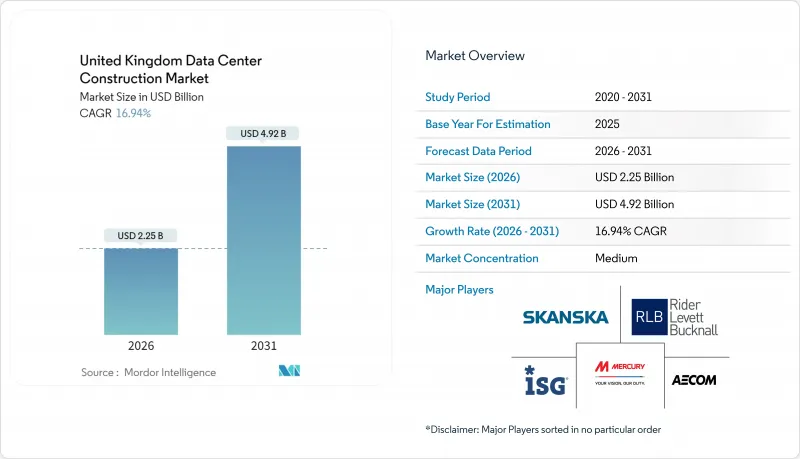
This report is Segmented by Tier Type (Tier 1 and 2, and More), Data Center Size (Small, Medium, Large, and Hyperscale), Data Center Type (Colocation Data Center, Hyperscalers/Cloud Service Provider (CSPs), and Enterprise and Edge Data Center), and Infrastructure (Electrical Infrastructure, Mechanical Infrastructure, and More). The Market Forecasts are Provided in Terms of Value (USD).
United Kingdom Data Center Construction Market Trends and Insights
Hyperscaler Pre-Leasing and AI-GPU Demand Wave
Microsoft's GBP 30 billion pledge bundled owned halls with long-term pre-leases that guarantee occupancy as soon as power is switched on. Google followed with a GBP 5 billion (USD 6.12 billion) program that locks in tenant status for GPU-dense space across multiple campuses. Nvidia then committed GBP 11 billion (USD 13.6 Billion) to inference-optimized capacity, further validating the anchor-tenant model. Developers such as CyrusOne secured 90 MW in Enfield before breaking ground, compressing financing spreads by 150-200 basis points. The government's critical-infrastructure designation reinforced investor confidence by signaling regulatory stability.
5G / 6G Roll-Out Accelerates Edge and Core Build-Outs
BT and AWS activated Wavelength Zones in London and Manchester, embedding cloud compute inside carrier networks to hit sub-10 millisecond latency for augmented-reality and autonomous-vehicle workloads. Vodafone paired with Google Cloud to deploy edge nodes across 15 cities by 2026, spreading demand beyond traditional hubs. The private 5G grid at Thames Freeport shows industrial clusters bypassing public carriers for dedicated edge infrastructure. A GBP 1 billion diversification fund is subsidizing domestic equipment supply, shortening procurement cycles for new micro-data centers. These initiatives fragment capacity additions into dozens of 1-5 MW sites, extending the construction opportunity set nationwide.
Grid Congestion in South-East, 132 kV Connection Moratoriums
National Grid ESO paused new 132 kV offers in parts of Greater London and surrounding counties, creating seven-to-ten-year delays unless developers bankroll costly upstream upgrades. Project budgets can rise by GBP 150 million (USD 186 million) for a 100 MW campus under such self-funded reinforcement. Equinix chose a bespoke 400 kV feed for its GBP 3.9 billion (USD 4.84 billion) Hertfordshire campus, but the workaround added 18 months to the pre-construction timeline. Developers are therefore pivoting to Manchester and Scotland, where SP Energy Networks and SSE Networks still offer three-year energization slots.
Other drivers and restraints analyzed in the detailed report include:
- Government AI Growth Zones and £14 Billion CNI Program
- Nationally Significant Infrastructure Fast-Track Permits
- Construction-Grade Labor and MEP Cost Inflation
For complete list of drivers and restraints, kindly check the Table Of Contents.
Segment Analysis
Tier 3 sites captured 57.84% of revenue in 2025, underscoring their suitability for general enterprise workloads that tolerate planned maintenance windows. The Financial Conduct Authority's operational-resilience mandate, effective March 2025, requires banks to withstand infrastructure failures, nudging critical applications toward Tier 4 halls that duplicate every power and cooling path. Although Tier 4 designs demand 30-40% more capital, they remove downtime risk, appealing to financial services and healthcare operators. Over 2026-2031, Tier 4 is forecast to register a 17.32% CAGR, outpacing the broader United Kingdom data center construction market.
Demand for Tier 3 remains healthy among price-sensitive colocation customers. Operators such as Digital Realty recently expanded London campuses with Tier 3, N+1 redundancy to balance uptime guarantees against competitive rent. Tier 1 and Tier 2 footprints continue to shrink as legacy enterprise sites are decommissioned. The net effect is a gradual migration toward higher redundancy, aligning with government rhetoric on critical infrastructure and supporting the United Kingdom data center construction market's premium-driven growth profile.
Hyperscale campuses exceeded 50 MW and accounted for 62.65% of revenue in 2025. Power-purchase leverage, cooling economies, and labor utilization drive power usage effectiveness (PUE) below 1.15, compared with 1.4-1.6 for smaller builds. Equinix's Hertfordshire expansion and QTS's GBP 10 billion (USD 12.4 billion) Blyth plan exemplify modular phasing, allowing supply to track tenant ramps. Over the forecast period, hyperscale is expected to record a 17.43% CAGR, reinforcing its dominance in the United Kingdom data center construction market.
Large (10-50 MW) and medium (5-10 MW) facilities together attract regional enterprises that need proximate compute but lack hyperscale budgets. Kao Data's 30 MW Manchester campus typifies this cohort. Small edge sites under 5 MW are declining as compute shifts into telecom street furniture. Overall, scale remains the single-largest predictor of capital efficiency, ensuring hyperscale's structural advantage persists.
Complete Report Scope:
- By Tier Type
- Tier 1 and 2
- Tier 3
- Tier 4
- By Data Center Size
- Small
- Medium
- Large
- Hyperscale
- By Data Center Type
- Colocation Data Center
- Hyperscalers/Cloud Service Provider (CSPs)
- Enterprise and Edge Data Center
- By Infrastructure
- Electrical Infrastructure
- Power Distribution Solution
- Power Backup Solutions
- Mechanical Infrastructure
- Cooling Systems
- Racks and Cabinets
- Servers and Storage
- Other Mechanical Infrastructure
- General Construction
- Services - Design and Consulting, Integration, Support and Maintenance
- Electrical Infrastructure
List of Companies Covered in this Report:
- Skanska UK plc
- ISG Ltd
- AECOM
- Rider Levett Bucknall
- Mercury Engineering
- Mace Group
- Laing O'Rourke
- Goodman Group
- JCA Engineering
- Bouygues Energies and Services (Equans)
- 2bm Limited (Keysource Group)
- CBRE Data Centre Solutions
- Turner and Townsend plc
- Schneider Electric UK
- Kier Group
- Vinci Energies UK (Actemium)
- Fluor Ltd
- Balfour Beatty plc
- Equinix UK Services Ltd
Additional Benefits:
- The market estimate (ME) sheet in Excel format
- 3 months of analyst support
TABLE OF CONTENTS
1 INTRODUCTION
- 1.1 Study Assumptions and Market Definition
- 1.2 Scope of the Study
2 RESEARCH METHODOLOGY
3 EXECUTIVE SUMMARY
4 MARKET LANDSCAPE
- 4.1 Market Overview
- 4.2 Market Drivers
- 4.2.1 5G / 6G Roll-Out Accelerates Edge and Core Build-Outs
- 4.2.2 Hyperscaler Pre-Leasing and AI-GPU Demand Wave
- 4.2.3 Government AI Growth Zones and GBP 14 Billion CNI Programme
- 4.2.4 Data-Center-as-Critical-Infrastructure Tax Incentives
- 4.2.5 Nationally Significant Infrastructure Fast-Track Permits
- 4.2.6 On-Site Small-Modular-Reactor Pilots for Green Power
- 4.3 Market Restraints
- 4.3.1 Grid Congestion in South-East, 132 kV Connection Moratoriums
- 4.3.2 Construction-Grade Labour and MEP Cost Inflation
- 4.3.3 Local Opposition over Water and Visual Footprint
- 4.3.4 Tight EU / UK Scope-3 Carbon-Reporting Compliance Costs
- 4.4 Industry Supply-Chain Analysis
- 4.5 Regulatory Landscape
- 4.6 Technological Outlook
- 4.7 Porter's Five Forces Analysis
- 4.7.1 Bargaining Power of Suppliers
- 4.7.2 Bargaining Power of Consumers
- 4.7.3 Threat of New Entrants
- 4.7.4 Threat of Substitutes
- 4.7.5 Intensity of Competitive Rivalry
- 4.8 Key Data Center Statistics
- 4.8.1 Exhaustive Data Center Operators in United Kingdom (in MW)
- 4.8.2 List of Major Upcoming Data Center Projects in United Kingdom (2025-2030)
- 4.8.3 CAPEX and OPEX For United Kingdom Data Center Construction
- 4.8.4 Data Center Power Capacity Absorption In MW,United Kingdom, 2023 and 2024
- 4.9 Artificial Intelligence (AI) Inclusion in Data Center Construction in United Kingdom
- 4.10 Regulatory and Compliance Framework
- 4.11 Impact of Macroeconomic Factors on the Market
5 MARKET SIZE AND GROWTH FORECASTS (VALUE)
- 5.1 By Tier Type
- 5.1.1 Tier 1 and 2
- 5.1.2 Tier 3
- 5.1.3 Tier 4
- 5.2 By Data Center Size
- 5.2.1 Small
- 5.2.2 Medium
- 5.2.3 Large
- 5.2.4 Hyperscale
- 5.3 By Data Center Type
- 5.3.1 Colocation Data Center
- 5.3.2 Hyperscalers/Cloud Service Provider (CSPs)
- 5.3.3 Enterprise and Edge Data Center
- 5.4 By Infrastructure
- 5.4.1 Electrical Infrastructure
- 5.4.1.1 Power Distribution Solution
- 5.4.1.2 Power Backup Solutions
- 5.4.2 Mechanical Infrastructure
- 5.4.2.1 Cooling Systems
- 5.4.2.2 Racks and Cabinets
- 5.4.2.3 Servers and Storage
- 5.4.2.4 Other Mechanical Infrastructure
- 5.4.3 General Construction
- 5.4.4 Services - Design and Consulting, Integration, Support and Maintenance
- 5.4.1 Electrical Infrastructure
6 COMPETITIVE LANDSCAPE
- 6.1 Market Concentration
- 6.2 Strategic Moves
- 6.3 Market Share Analysis
- 6.4 Data Center Infrastructure Investment Based on Megawatt (MW) Capacity, 2024 vs 2030
- 6.5 Data Center Construction Landscape (Key Vendors Listings)
- 6.6 Company Profiles (includes Global Level Overview, Market Level Overview, Core Segments, Financials as Available, Strategic Information, Market Rank / Share for Key Companies, Products and Services, Recent Developments)
- 6.6.1 Skanska UK plc
- 6.6.2 ISG Ltd
- 6.6.3 AECOM
- 6.6.4 Rider Levett Bucknall
- 6.6.5 Mercury Engineering
- 6.6.6 Mace Group
- 6.6.7 Laing O'Rourke
- 6.6.8 Goodman Group
- 6.6.9 JCA Engineering
- 6.6.10 Bouygues Energies and Services (Equans)
- 6.6.11 2bm Limited (Keysource Group)
- 6.6.12 CBRE Data Centre Solutions
- 6.6.13 Turner and Townsend plc
- 6.6.14 Schneider Electric UK
- 6.6.15 Kier Group
- 6.6.16 Vinci Energies UK (Actemium)
- 6.6.17 Fluor Ltd
- 6.6.18 Balfour Beatty plc
- 6.6.19 Equinix UK Services Ltd
- 6.7 List of Data Center Construction Companies
7 MARKET OPPORTUNITIES AND FUTURE OUTLOOK
- 7.1 White-Space and Unmet-Need Assessment

