PUBLISHER: Mordor Intelligence | PRODUCT CODE: 2119657

PUBLISHER: Mordor Intelligence | PRODUCT CODE: 2119657
France Data Center Construction - Market Share Analysis, Industry Trends & Statistics, Growth Forecasts (2026 - 2031)
According to Mordor Intelligence, the France data center construction market size is expected to grow from USD 5.20 billion in 2025 to USD 5.59 billion in 2026 and is forecast to reach USD 8.01 billion by 2031 at 7.49% CAGR over 2026-2031.
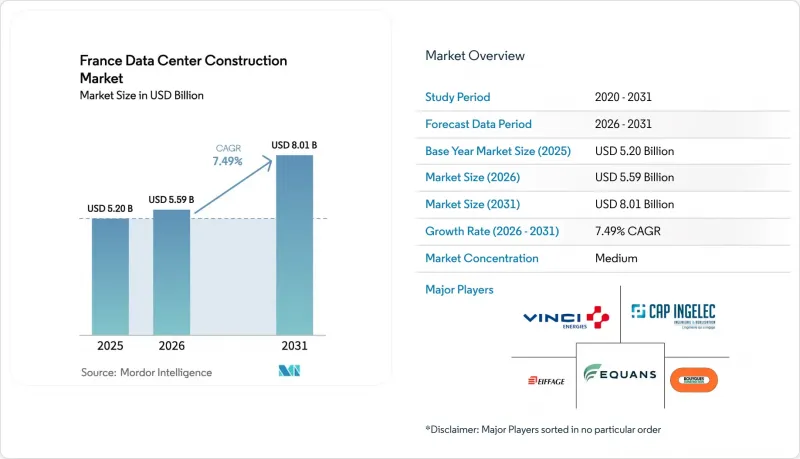
This report is Segmented by Tier Type (Tier 1 and 2, Tier 3 and Tier 4), Data Center Type(Colocation, Self-Built Hyperscalers (CSPs), Enterprise, and Edge), Infrastructure (Electrical Infrastructure, Mechanical Infrastructure). The Market Forecasts are Provided in Terms of Value (USD).
France Data Center Construction Market Trends and Insights
Digital Transformation and Managed-Cloud Demand
Enterprises are replacing on-premises hardware with hybrid-cloud architectures that need low-latency links to public-cloud regions and specialised colocation halls. Sector-specific compliance is reshaping specifications; healthcare operators seek ISO 13485 halls, while gaming and lottery operators commission multi-site audits before moving workloads. The managed-services layer compels builders to integrate staging space for edge appliances and AI inference clusters. Demand for sovereign-hosted environments is anchoring capacity inside national borders to meet European data-protection rules.
5G Roll-Out and Edge-Computing Densification
Widespread 5G coverage is pushing computing clusters closer to streets and factory floors. Municipal projects, such as the Istres private 5G rollout, embed micro-data centers into civic infrastructure to support real-time video analytics, creating opportunities for contractors versed in high-density electrical layouts that fit inside refurbished utility rooms. Manufacturers deploying 5G on production lines are requesting ruggedised edge enclosures paired with liquid cooling that withstand industrial heat and vibration.
Escalating Paris-Region Land and Build-Cost Inflation
Limited industrial plots inside the A86 ring road have pushed average site prices beyond EUR 300(USD 345.51) per square meter, while steel and switchgear costs continue to rise at 5-7% annually. Hourly labour rates advanced from EUR 112.80 (USD 129.88) to EUR 121.02 (USD 139.34) during 2025, squeezing contractor margins. Developers are diverting pipelines to Lyon, Bordeaux and Marseille, where land is cheaper and municipal incentives are available. To offset cost pressures, builders are adopting factory-prefabricated modules that cut on-site labour hours and reduce exposure to price-volatile commodities.
Other drivers and restraints analyzed in the detailed report include:
- Government AI and Digital-Sovereignty Investment Surge
- Availability of Low-Carbon Nuclear-Backed Electricity
- Stringent 2025 Energy-Efficiency Disclosure Law (ICPE)
For complete list of drivers and restraints, kindly check the Table Of Contents.
Segment Analysis
Tier 3 halls retained 52.15% of France data center construction market share in 2025 because most enterprise applications require high but not fault-tolerant uptime. The France data center construction market size for Tier 3 builds is forecast to continue expanding steadily yet below the overall industry CAGR. Tier 4, by contrast, is projected to grow 7.87% annually through 2031 as AI model training, fintech clearing and critical national infrastructure workloads need 99.995% availability.
Tier 4 projects entail 2N power trains, dual fibre paths and concurrent maintainability across mechanical subsystems, prompting larger electrical rooms and more sophisticated building-management software. The Thesee DataCenter campus, recognised as the nation's first Uptime Tier IV colocation site, integrates AI-based cooling optimisation that trims energy consumption without compromising redundancy. Suppliers are therefore seeing heightened demand for AI-driven environmental controls, arc-flash-resistant switchgear and predictive-maintenance sensors that feed reliability dashboards.
Colocation operators commanded 56.60% of France data center construction market share in 2025, since enterprises prefer an opex-based capacity that can be contracted flexibly. Self-built hyperscaler halls, however, will record a 9.65% CAGR to 2031 as public-cloud providers seek cost control and guaranteed rack availability.
Hyperscaler campuses employ template-based designs with 54-60 MW blocks that replicate across regions, letting constructors gain repeatability benefits on materials and timelines. Microsoft's EUR 4 billion (USD 4.61 billion) pledge is channelled into such cookie-cutter shells that accelerate commissioning. Enterprise and edge projects remain relevant where data-sovereignty rules or millisecond latency targets override economies of scale, prompting construction of micro-facilities inside factories, hospitals, and smart-city districts.
Complete Report Scope:
- By Tier Type
- Tier 1 and 2
- Tier 3
- Tier 4
- By Data Center Type
- Colocation
- Self-build Hyperscalers (CSPs)
- Enterprise and Edge
- By Infrastructure
- By Electrical Infrastructure
- Power Distribution Solution
- Power Backup Solutions
- By Mechanical Infrastructure
- Cooling Systems
- Racks and Cabinets
- Servers and Storage
- Other Mechanical Infrastructure
- General Construction
- Service (Design and Consulting, Integration, Support and Maintenance)
- By Electrical Infrastructure
List of Companies Covered in this Report:
- Bouygues Construction
- Eiffage
- Vinci Energies
- Equans (formerly Engie Solutions)
- CAP INGELEC
- Artelia Group
- APL Data Center
- LPI Group
- Mercury Engineering
- TPF Ingenierie
- M+W Group (Exyte)
- JERLAURE
- Data4 Group
- Interxion (Digital Realty)
- Telehouse France
- OVHcloud
- Etix Everywhere
- Colt Data Centre Services
- Thesee DataCenter
- Euclyde Data Centers
Additional Benefits:
- The market estimate (ME) sheet in Excel format
- 3 months of analyst support
TABLE OF CONTENTS
1 INTRODUCTION
- 1.1 Study Assumptions and Market Definition
- 1.2 Scope of the Study
2 RESEARCH METHODOLOGY
- 2.1 Research Framework
- 2.2 Secondary Research
- 2.3 Primary Research
- 2.4 Data Triangulation and Insight Generation
3 EXECUTIVE SUMMARY
4 MARKET LANDSCAPE
- 4.1 Market Overview
- 4.2 Market Drivers
- 4.2.1 Digital transformation and managed-cloud demand
- 4.2.2 5G roll-out and edge-computing densification
- 4.2.3 Government AI and digital-sovereignty investment surge
- 4.2.4 Availability of low-carbon nuclear-backed electricity
- 4.2.5 Fast-track national-interest permit regime (2025)
- 4.2.6 Edge data-center growth for AI/IoT low-latency workloads
- 4.3 Market Restraints
- 4.3.1 Escalating Paris-region land and build-cost inflation
- 4.3.2 Stringent 2025 energy-efficiency disclosure law (ICPE)
- 4.3.3 Localised grid-capacity bottlenecks in FLAP sub-markets
- 4.3.4 Tightening water-usage regulations for cooling systems
- 4.4 Supply-Chain Analysis
- 4.5 Regulatory Landscape
- 4.6 Technological Outlook Liquid and immersion cooling, AI-ops
- 4.7 Porters Five Forces Analysis
- 4.7.1 Bargaining Power of Suppliers
- 4.7.2 Bargaining Power of Buyers
- 4.7.3 Threat of New Entrants
- 4.7.4 Threat of Substitutes
- 4.7.5 Intensity of Competitive Rivalry
- 4.8 Key Data Center Statistics
- 4.8.1 Exhaustive Data Center Operators in France(in MW)
- 4.8.2 List of Major Upcoming Data Center Projects in France (2025-2030)
- 4.8.3 CAPEX and OPEX For France Data Center Construction
- 4.8.4 Data Center Power Capacity Absorption In MW, Selected Cities, France, 2023 and 2024
- 4.9 Artificial Intelligence (AI) Inclusion in Data Center Construction in France
- 4.10 Regulatory and Compliance Framework
5 MARKET SIZE and GROWTH FORECASTS (VALUE)
- 5.1 By Tier Type
- 5.1.1 Tier 1 and 2
- 5.1.2 Tier 3
- 5.1.3 Tier 4
- 5.2 By Data Center Type
- 5.2.1 Colocation
- 5.2.2 Self-build Hyperscalers (CSPs)
- 5.2.3 Enterprise and Edge
- 5.3 By Infrastructure
- 5.3.1 By Electrical Infrastructure
- 5.3.1.1 Power Distribution Solution
- 5.3.1.2 Power Backup Solutions
- 5.3.2 By Mechanical Infrastructure
- 5.3.2.1 Cooling Systems
- 5.3.2.2 Racks and Cabinets
- 5.3.2.3 Servers and Storage
- 5.3.2.4 Other Mechanical Infrastructure
- 5.3.3 General Construction
- 5.3.4 Service (Design and Consulting, Integration, Support and Maintenance)
- 5.3.1 By Electrical Infrastructure
6 COMPETITIVE LANDSCAPE
- 6.1 Market Concentration
- 6.2 Strategic Moves
- 6.3 Market Share Analysis
- 6.4 Data Center Infrastructure Investment Based on Megawatt (MW) Capacity, 2024 vs 2030
- 6.5 Data Center Construction Landscape (Key Vendors Listings)
- 6.6 Company Profiles (includes Global level Overview, Market level overview, Core Segments, Financials as available, Strategic Information, Market Rank/Share for key companies, Products and Services, Recent Developments)
- 6.6.1 Bouygues Construction
- 6.6.2 Eiffage
- 6.6.3 Vinci Energies
- 6.6.4 Equans (formerly Engie Solutions)
- 6.6.5 CAP INGELEC
- 6.6.6 Artelia Group
- 6.6.7 APL Data Center
- 6.6.8 LPI Group
- 6.6.9 Mercury Engineering
- 6.6.10 TPF Ingenierie
- 6.6.11 M+W Group (Exyte)
- 6.6.12 JERLAURE
- 6.6.13 Data4 Group
- 6.6.14 Interxion (Digital Realty)
- 6.6.15 Telehouse France
- 6.6.16 OVHcloud
- 6.6.17 Etix Everywhere
- 6.6.18 Colt Data Centre Services
- 6.6.19 Thesee DataCenter
- 6.6.20 Euclyde Data Centers
- 6.7 List of Data Center Construction Companies
7 MARKET OPPORTUNITIES and FUTURE OUTLOOK
- 7.1 White-space and Unmet-need Assessment

