PUBLISHER: Mordor Intelligence | PRODUCT CODE: 2119659

PUBLISHER: Mordor Intelligence | PRODUCT CODE: 2119659
Italy Data Center Construction - Market Share Analysis, Industry Trends & Statistics, Growth Forecasts (2026 - 2031)
According to Mordor Intelligence, Italy data center construction market size in 2026 is estimated at USD 4.38 billion, growing from 2025 value of USD 3.82 billion with 2031 projections showing USD 8.63 billion, growing at 14.55% CAGR over 2026-2031.
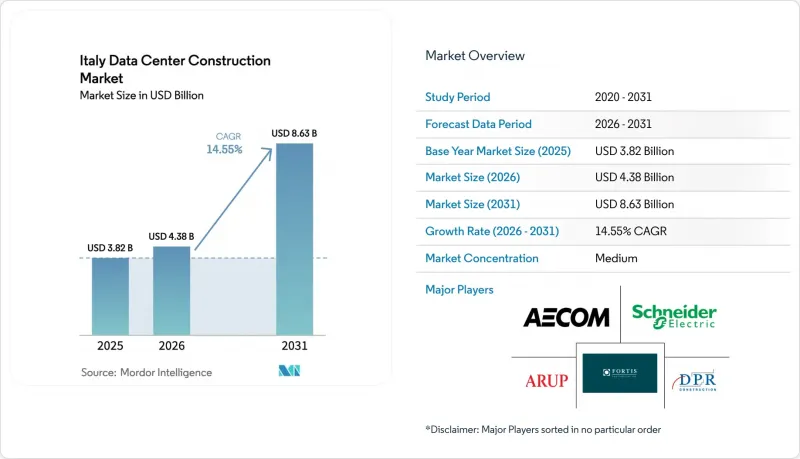
This report Segments the Industry Into Tier Type (Tier 1 and 2, Tier 3, Tier 4), Data Center Type (Colocation, Self-Build Hyperscalers (CSPs), Enterprise and Edge), Infrastructure (Electrical Infrastructure, Mechanical Infrastructure, General Construction, and More). The Market Forecasts are Provided in Terms of Value (USD).
Italy Data Center Construction Market Trends and Insights
5G rollout accelerating edge and core builds
WindTre's EUR 485 million purchase of OpNet's standalone 5G assets unlocked 3,000 base stations serving 75% of Italy's population, spurring immediate demand for micro-edge sites that reinforce traditional cores. TIM's 2024-2026 plan maps 16 new data centers that dovetail with this national 5G push, and Phoenix Tower International's 1,900-site program further underlines the need for low-latency capacity. Because 5G splits workloads between radio, edge, and core, facility planners now prioritize smaller footprints near population clusters, advanced liquid-assisted cooling, and resilient distribution paths to meet stringent latency targets.
Surging cloud and hyperscale demand
Google Cloud, Microsoft, AWS, and Oracle continue to earmark multi-billion-euro budgets for Italian expansion, often in partnership with TIM or other local carriers. The Milan-Turin corridor has become the epicenter, yet secondary cities are quickly absorbing projects as prime sites tighten. Hyperscale investment not only enlarges the Italy data center construction market but also boosts local employment, with University of Turin research projecting 65,000 jobs by 2025 from the Google ecosystem alone. Partnerships shorten permitting cycles, ensure compliance with digital-sovereignty rules, and allow carriers to cross-sell edge services.
Grid-power scarcity and volatile energy prices
Connection requests topped 42 GW in March 2025-almost triple available headroom-forcing operators to queue as long as three years for new feeds. Terna's EUR 23 billion grid plan will ease congestion but not before late decade. Meanwhile, some hyperscalers buy retired Enel power assets to avoid delays. Rising spot prices complicate budgeting, and construction cost indices have risen 20% since the pandemic, squeezing margins for developers across the Italy data center construction market.
Other drivers and restraints analyzed in the detailed report include:
- Government "PNRR" digital grants
- Rising sustainability mandates and green energy sourcing
- Shortage of specialised data-center construction labour
For complete list of drivers and restraints, kindly check the Table Of Contents.
Segment Analysis
Tier 3 facilities controlled 53.86% of the Italy data center construction market share in 2025 as enterprises sought balanced uptime and cost. Nevertheless Tier 4 sites, required by finance, government, and AI workloads, expand 17.48% each year to 2031. This segment commands higher CAPEX due to dual power paths, concurrent maintainability, and seismic hardening. Vertiv's CoolLoop Trim Cooler, compliant with impending EU F-GAS rules, cuts cooling energy 70%, making it attractive to Tier 4 builders seeking compliance and savings. Aruba's IT4 in Rome exemplifies this trend with five duplicate buildings, 30 MW IT load, and renewable power.
Growth momentum also ripples down to Tier 1 and Tier 2 for edge or cost-sensitive projects. Yet as business continuity rises on boardroom agendas, these lower tiers are yielding share to fault-tolerant designs. The Italy data center construction market therefore shows a clear shift toward premium reliability, with operators positioning modular Tier 4 capacity along seismic lines to minimize disruption risk.
Despite colocation's 55.94% 2025 base, self-build hyperscaler projects rise 18.98% per year. Microsoft's EUR 4.3 billion investment in Northern Italy, paired with AI-ready architecture, typifies this pivot. Google Cloud blends self-build and outsource by leasing space from TIM in Milan and Turin, illustrating hybrid forms that optimize speed and compliance. This wave enlarges the Italy data center construction market size for hyperscale to an estimated USD 2.39 billion by 2031, equal to 27.65% of total value.
Edge and enterprise builds grow moderately but still anchor regional diversification. The build-to-lease model lowers capital-heavy lifting for hyperscalers: Oracle's Turin region runs inside a TIM campus, meeting uptime and sovereignty goals without direct land ownership. Pension and infrastructure funds are eager landlords, turning predictable 20-year hyperscale leases into bond-like returns, and thereby injecting new capital into the Italy data center construction industry.
Complete Report Scope:
- By Tier Type
- Tier 1 and 2
- Tier 3
- Tier 4
- By Data Center Type
- Colocation
- Self-build Hyperscalers (CSPs)
- Enterprise and Edge
- By Infrastructure
- By Electrical Infrastructure
- Power Distribution Solution
- Power Backup Solutions
- By Mechanical Infrastructure
- Cooling Systems
- Racks and Cabinets
- Servers and Storage
- Other Mechanical Infrastructure
- General Construction
- Service - Design and Consulting, Integration, Support and Maintenance
- By Electrical Infrastructure
List of Companies Covered in this Report:
- AECOM S.r.l.
- Arup Group Limited
- DPR Construction, Inc.
- Schneider Electric SE
- Fortis Construction, Inc.
- IBM Italia S.p.A.
- Airedale International Air Conditioning Ltd.
- Legrand S.p.A.
- Datacentre UK Ltd.
- Castrol Limited
- Honeywell International Inc.
- Johnson Controls International plc
- Datadome Group S.r.l.
- STULZ GmbH
- Daikin Industries Ltd.
Additional Benefits:
- The market estimate (ME) sheet in Excel format
- 3 months of analyst support
TABLE OF CONTENTS
1 INTRODUCTION
- 1.1 Study Assumptions and Market Definition
- 1.2 Scope of the Study
2 RESEARCH METHODOLOGY
3 EXECUTIVE SUMMARY
4 MARKET LANDSCAPE
- 4.1 Market Overview
- 4.2 Market Drivers
- 4.2.1 5G rollout accelerating edge and core builds
- 4.2.2 Surging cloud and hyperscale demand
- 4.2.3 Government "Piano Nazionale di Ripresa e Resilienza (PNRR)" digital grants
- 4.2.4 Rising sustainability mandates and green energy sourcing
- 4.2.5 New subsea cable landings boosting Italy's connectivity hub status
- 4.2.6 Build-to-lease model favoured by hyperscalers to bypass permitting delays
- 4.3 Market Restraints
- 4.3.1 Grid-power scarcity and volatile energy prices
- 4.3.2 Shortage of specialised data-center construction labour
- 4.3.3 Seismic-zone engineering costs raising capex
- 4.3.4 Limited reclaimed-water access for advanced cooling
- 4.4 Value / Supply-Chain Analysis
- 4.5 Regulatory Landscape
- 4.6 Technological Outlook
- 4.7 Porter's Five Forces
- 4.7.1 Threat of New Entrants
- 4.7.2 Bargaining Power of Buyers
- 4.7.3 Bargaining Power of Suppliers
- 4.7.4 Threat of Substitutes
- 4.7.5 Competitive Rivalry
5 KEY DATA CENTER STATISTICS
- 5.1 Exhaustive Data Center Operators in Italy (in MW)
- 5.2 List of Major Upcoming Data Center Projects in Italy (2025-2030)
- 5.3 CAPEX and OPEX For Italy Data Center Construction
- 5.4 Data Center Power Capacity Absorption In MW, Selected Cities, Italy, 2023 and 2024
6 ARTIFICIAL INTELLIGENCE (AI) INCLUSION IN DATA CENTER CONSTRUCTION IN ITALY
7 REGULATORY and COMPLIANCE FRAMEWORK
8 MARKET SIZE and GROWTH FORECASTS (VALUE)
- 8.1 By Tier Type
- 8.1.1 Tier 1 and 2
- 8.1.2 Tier 3
- 8.1.3 Tier 4
- 8.2 By Data Center Type
- 8.2.1 Colocation
- 8.2.2 Self-build Hyperscalers (CSPs)
- 8.2.3 Enterprise and Edge
- 8.3 By Infrastructure
- 8.3.1 By Electrical Infrastructure
- 8.3.1.1 Power Distribution Solution
- 8.3.1.2 Power Backup Solutions
- 8.3.2 By Mechanical Infrastructure
- 8.3.2.1 Cooling Systems
- 8.3.2.2 Racks and Cabinets
- 8.3.2.3 Servers and Storage
- 8.3.2.4 Other Mechanical Infrastructure
- 8.3.3 General Construction
- 8.3.4 Service - Design and Consulting, Integration, Support and Maintenance
- 8.3.1 By Electrical Infrastructure
9 COMPETITIVE LANDSCAPE
- 9.1 Market Concentration
- 9.2 Strategic Moves
- 9.3 Market Share Analysis
- 9.4 Data Center Infrastructure Investment Based on Megawatt (MW) Capacity, 2024 vs 2030
- 9.5 Data Center Construction Landscape (Key Vendors Listings)
- 9.6 Company Profiles (includes Global level Overview, Market level overview, Core Segments, Financials as available, Strategic Information, Market Rank/Share for key companies, Products and Services, Recent Developments)
- 9.6.1 AECOM S.r.l.
- 9.6.2 Arup Group Limited
- 9.6.3 DPR Construction, Inc.
- 9.6.4 Schneider Electric SE
- 9.6.5 Fortis Construction, Inc.
- 9.6.6 IBM Italia S.p.A.
- 9.6.7 Airedale International Air Conditioning Ltd.
- 9.6.8 Legrand S.p.A.
- 9.6.9 Datacentre UK Ltd.
- 9.6.10 Castrol Limited
- 9.6.11 Honeywell International Inc.
- 9.6.12 Johnson Controls International plc
- 9.6.13 Datadome Group S.r.l.
- 9.6.14 STULZ GmbH
- 9.6.15 Daikin Industries Ltd.
- 9.7 List of Data Center Construction Companies
10 MARKET OPPORTUNITIES and FUTURE OUTLOOK
- 10.1 White-space and Unmet-Need Assessment

