PUBLISHER: Mordor Intelligence | PRODUCT CODE: 2119710

PUBLISHER: Mordor Intelligence | PRODUCT CODE: 2119710
Asia-Pacific Spectator Sports - Market Share Analysis, Industry Trends & Statistics, Growth Forecasts (2026 - 2031)
According to Mordor Intelligence, the Asia-Pacific spectator sports market size is expected to grow from USD 17.36 billion in 2025 to USD 18.38 billion in 2026 and is forecast to reach USD 24.47 billion by 2031 at 5.87% CAGR over 2026-2031.
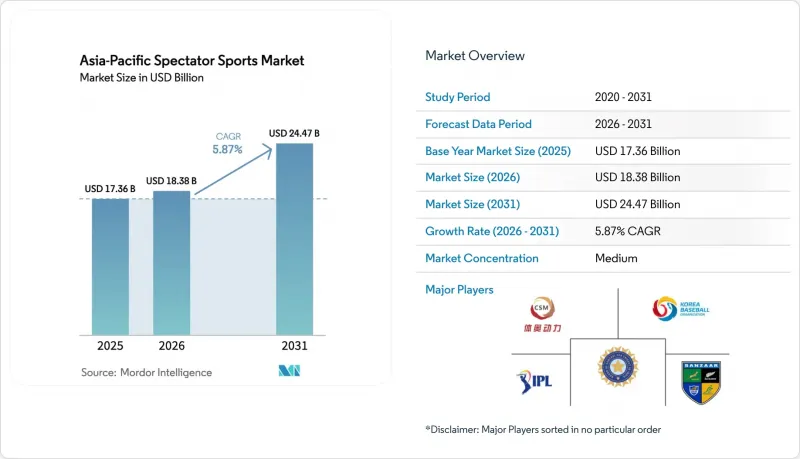
This report is Segmented by Type (Sports Team and Clubs, Racing, Individual Sports), Revenue Source (Media Rights, Merchandising, Tickets, Sponsorship), Type of Sport (Soccer, Cricket, Rugby/Football, Tennis, Other Types of Sports), Geography (China, India, Japan, Australia, South Korea, and Rest of Asia-Pacific). The Market Forecasts are Provided in Terms of Value (USD).
Asia-Pacific Spectator Sports Market Trends and Insights
Surge in Streaming and OTT Sports Consumption Post-5G Rollout
Asia-Pacific passed 1.6 billion 5G subscriptions in 2024, enabling low-latency live streaming that re-creates stadium-level immediacy for mobile viewers . Operators in South Korea already cover 97% of the population, and China has deployed more than 3.92 million 5G base stations. OTT platforms leverage these networks to deliver multi-angle feeds, real-time statistics, and integrated micro-wagering features that deepen fan engagement. The ability to personalize viewing experiences drives a higher average revenue per user than legacy broadcast. As telcos bundle sports content with data plans, they effectively subsidize subscription costs, broadening access to premium events and accelerating the adoption of the Asia-Pacific spectator sports market's digital tier.
Rise of Women's Professional Leagues: Unlocking New Fan Segments
Inaugural women's franchise leagues across cricket, football, and basketball demonstrate commercial viability through robust media-rights auctions and double-digit year-one attendance. India's Women's Premier League sold its first-cycle rights for more than USD 100 million, setting a new regional benchmark . Consumer surveys conducted in 2024 indicate a notable increase in intent to attend women's events, reflecting untapped market potential when compared to historical attendance trends. Younger demographics, particularly individuals aged 18-34, are demonstrating heightened engagement with women's sports content. This shift is attracting consumer brands focused on aligning with values such as authenticity and social impact. Additionally, corporate sponsors are increasingly allocating dedicated budgets to women's sports properties, signaling a structural change that is driving higher sponsorship returns across the Asia-Pacific spectator sports market. The interplay of increased visibility, strategic investments, and grassroots participation is positioning women's leagues as a key driver of long-term market growth.
High Piracy Rates Eroding Media-Rights Value
Unauthorized IPTV and streaming mirror sites siphon audiences from legitimate broadcasters, particularly in Indonesia, where AVIA estimates 87% of premium sports viewers accessed pirated feeds in 2024 . Illegal operators often deliver superior user interfaces at a fraction of the price, forcing rights-holders to discount. Social platforms struggle to remove infringing live streams in real time, allowing pirates to capture peak traffic during marquee events. Lost revenue constrains broadcasters' ability to bid aggressively in future auctions, indirectly curbing the Asia-Pacific spectator sports market size obtainable from media rights. Governments have begun coordinating site-blocking and payment-gateway disruptions, yet enforcement gaps persist across fragmented jurisdictions.
Other drivers and restraints analyzed in the detailed report include:
- Government-Backed Mega-Events Pipeline
- Digital Collectibles & Fan-Token Monetization Accelerating Revenue
- Fragmented Regulatory Landscape for Sports Betting & Sponsorship
For complete list of drivers and restraints, kindly check the Table Of Contents.
Segment Analysis
Individual Sports contributed a smaller share but posted the fastest 13.89% CAGR, reflecting athletes' ability to commercialize personal brands through direct-to-fan digital channels. Tennis and golf stars negotiate their own NFT drops and exclusive streaming clinics, generating revenue uncapped by team salary structures. Sports Teams & Clubs still commanded 45.78% of 2025 revenue, benefiting from entrenched loyalties, season-ticket bases, and venue monetization. Racing maintains a niche audience, leveraging immersive broadcast technology and VR simulators to offset high operating costs, but remains supply-constrained by limited circuits.
Consumer appetite for athlete-centric storytelling parallels the broader creator-economy trend, making Individual Sports attractive to sponsors seeking authentic engagement. Start-up platforms allow golfers to sell fractional ownership in future prize money, while tennis pros live-stream training sessions behind membership paywalls. Clubs respond by doubling down on community initiatives and mixed-use stadium developments to preserve their share of the wallet. Racing's future hinges on electric and autonomous formats that promise sustainable, tech-forward narratives. Overall, rising individual monetization coexists with team-based fandom, expanding the Asia-Pacific spectator sports market rather than cannibalizing incumbent segments.
Complete Report Scope:
- By Type
- Sports Team and Clubs
- Racing
- Individual Sports
- By Revenue Source
- Media Rights
- Merchandising
- Tickets
- Sponsorship
- By Type of Sport
- Soccer
- Cricket
- Rugby/Football
- Tennis
- Other Types of Sports
- By Geography
- India
- China
- Japan
- Australia
- South Korea
- South East Asia
- Singapore
- Malaysia
- Thailand
- Indonesia
- Vietnam
- Philippines
- Rest of Asia-Pacific
List of Companies Covered in this Report:
- Board of Control for Cricket in India (BCCI)
- Chinese Super League Company Limited
- Nippon Professional Baseball Organization (NPB)
- Japan Professional Football League (J.League)
- Korea Baseball Organization (KBO)
- Australian Football League Commission (AFL)
- Cricket Australia
- Rugby Australia
- New Japan Pro-Wrestling Co., Ltd.
- City Football Group Asia Pacific (Melbourne City FC)
- China Media Capital - Super Sports Media
- K-League Federation
- Football Sports Development Ltd (Indian Super League)
- Philippine Basketball Association
- Thai League Co., Ltd.
- Badminton World Federation
- Singapore SportsHub Pte Ltd
- IMG Reliance
- Tencent Sports
- CJ ENM (Sports & Media)
Additional Benefits:
- The market estimate (ME) sheet in Excel format
- 3 months of analyst support
TABLE OF CONTENTS
1 Introduction
- 1.1 Study Assumptions & Market Definition
- 1.2 Scope of the Study
2 Research Methodology
3 Executive Summary
4 Market Landscape
- 4.1 Market Overview
- 4.2 Market Drivers
- 4.2.1 Surge in streaming and OTT sports consumption post-5G rollout
- 4.2.2 Rise of women's professional leagues unlocking new fan segments
- 4.2.3 Government-backed mega-events pipeline
- 4.2.4 Digital collectibles & fan token monetization accelerating revenue
- 4.2.5 Rapid stadium modernization & mixed-use venue investments
- 4.2.6 Cross-border media-rights inflation driven by pan-Asian platforms
- 4.3 Market Restraints
- 4.3.1 High piracy rates eroding media-rights value
- 4.3.2 Fragmented regulatory landscape for sports betting & sponsorship
- 4.3.3 Rising athlete salary inflation squeezing smaller leagues
- 4.3.4 Event scheduling congestion causing fan fatigue
- 4.4 Value / Supply-Chain Analysis
- 4.5 Regulatory Landscape
- 4.6 Technological Outlook
- 4.7 Porter's Five Forces
- 4.7.1 Bargaining Power of Buyers
- 4.7.2 Bargaining Power of Suppliers
- 4.7.3 Threat of New Entrants
- 4.7.4 Threat of Substitutes
- 4.7.5 Competitive Rivalry
5 Market Size & Growth Forecasts
- 5.1 By Type
- 5.1.1 Sports Team and Clubs
- 5.1.2 Racing
- 5.1.3 Individual Sports
- 5.2 By Revenue Source
- 5.2.1 Media Rights
- 5.2.2 Merchandising
- 5.2.3 Tickets
- 5.2.4 Sponsorship
- 5.3 By Type of Sport
- 5.3.1 Soccer
- 5.3.2 Cricket
- 5.3.3 Rugby/Football
- 5.3.4 Tennis
- 5.3.5 Other Types of Sports
- 5.4 By Geography
- 5.4.1 India
- 5.4.2 China
- 5.4.3 Japan
- 5.4.4 Australia
- 5.4.5 South Korea
- 5.4.6 South East Asia
- 5.4.6.1 Singapore
- 5.4.6.2 Malaysia
- 5.4.6.3 Thailand
- 5.4.6.4 Indonesia
- 5.4.6.5 Vietnam
- 5.4.6.6 Philippines
- 5.4.7 Rest of Asia-Pacific
6 Competitive Landscape
- 6.1 Market Concentration
- 6.2 Strategic Moves
- 6.3 Market Share Analysis
- 6.4 Company Profiles (includes Global level Overview, Market level overview, Core Segments, Financials as available, Strategic Information, Market Rank/Share for key companies, Products & Services, and Recent Developments)
- 6.4.1 Board of Control for Cricket in India (BCCI)
- 6.4.2 Chinese Super League Company Limited
- 6.4.3 Nippon Professional Baseball Organization (NPB)
- 6.4.4 Japan Professional Football League (J.League)
- 6.4.5 Korea Baseball Organization (KBO)
- 6.4.6 Australian Football League Commission (AFL)
- 6.4.7 Cricket Australia
- 6.4.8 Rugby Australia
- 6.4.9 New Japan Pro-Wrestling Co., Ltd.
- 6.4.10 City Football Group Asia Pacific (Melbourne City FC)
- 6.4.11 China Media Capital - Super Sports Media
- 6.4.12 K-League Federation
- 6.4.13 Football Sports Development Ltd (Indian Super League)
- 6.4.14 Philippine Basketball Association
- 6.4.15 Thai League Co., Ltd.
- 6.4.16 Badminton World Federation
- 6.4.17 Singapore SportsHub Pte Ltd
- 6.4.18 IMG Reliance
- 6.4.19 Tencent Sports
- 6.4.20 CJ ENM (Sports & Media)
7 Market Opportunities & Future Outlook
- 7.1 Immersive fan experiences via AR/VR-enabled remote attendance
- 7.2 Monetizing tier-2 regional sports (kabaddi, esports) across Southeast Asia

