PUBLISHER: Mordor Intelligence | PRODUCT CODE: 2119766

PUBLISHER: Mordor Intelligence | PRODUCT CODE: 2119766
Europe Spectator Sports - Market Share Analysis, Industry Trends & Statistics, Growth Forecasts (2026 - 2031)
According to Mordor Intelligence, the European spectator sports market size was valued at USD 71.90 billion in 2025 and estimated to grow from USD 75.64 billion in 2026 to reach USD 97.45 billion by 2031, at a CAGR of 5.2% during the forecast period (2026-2031).
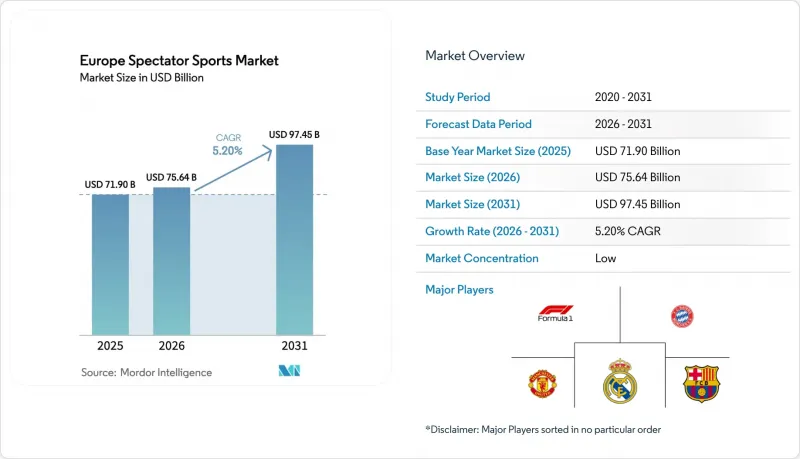
This report Segments the Industry Into by Type (Sports Team and Clubs, Racing, Individual Sports), by Revenue Source (Media Rights, Merchandising, Tickets, Sponsorship), by Type of Sport (Soccer, Cricket, Rugby/Football, Tennis, Other Types of Sports), and by Countries (Germany, United Kingdom, France, Italy, Russia, Spain, Rest of Europe).
Europe Spectator Sports Market Trends and Insights
Surging OTT Platform Investments
Streaming entrants reshaped European sports economics by bidding aggressively for marquee rights to secure subscriber growth, even at compressed near-term margins. DAZN's winning of Belgian Pro League packages at USD 87.5 million (EUR 84.2 million) annually through 2030, despite trailing the prior USD 107 million (EUR 103 million) contract, illustrates the strategic willingness to trade profitability for scale. Global actors such as Amazon and Disney exploit vast customer ecosystems to position sport as a loyalty anchor, not a standalone profit silo. As legacy broadcasters adjust, many must either raise rights spend or diversify content slates, catalysing new bidding cycles that continue to elevate asset values. The power shift ultimately accelerates the convergence of media, commerce, and data analytics across the European spectator sports market.
Expansion of Pan-European Sponsorship Deals
Multinational brands increasingly prefer continent-spanning partnerships that streamline activation costs while guaranteeing cohesive storytelling across borders. PepsiCo's comprehensive renewal with UEFA Women's Football embodies this strategic pivot by bundling multiple beverage brands across all women's competitions through 2030. Such broad agreements grant rights holders predictable, inflation-indexed cash flows that support long-range planning. Economies of scale in creative production and media buying deliver measurable return on investment for sponsors even amid economic volatility. Adidas secured a multi-year exclusive kit supply agreement with Liverpool FC, demonstrating the strategic value of leveraging a single contract to address both domestic and international markets. This approach reinforces competitive barriers, providing an advantage to sports organizations capable of monetizing their assets on a pan-regional scale.
Heightened Concussion-Related Litigation Risk
Legal actions initiated by former rugby and soccer athletes in the United Kingdom, alleging negligence in head-injury protocols, represent a significant potential liability for governing bodies. These lawsuits highlight concerns over historical practices and the adequacy of measures implemented to address player safety. In response, governing organizations have introduced extended substitution rules and mandatory pitch-side concussion assessments. However, the plaintiffs argue that these measures fail to address past shortcomings, calling for retrospective accountability. The rising cost of insurance premiums further compounds the issue, particularly for smaller organizations with limited or undiversified revenue streams, which may struggle to absorb the increasing expenses associated with risk management. Additionally, advancements in scientific research related to head injuries could broaden the scope of potential claimants, creating further financial strain. This scenario poses a risk to the long-term cash flows required to sustain grassroots investments, potentially impacting the development and growth of these sports at foundational levels.
Other drivers and restraints analyzed in the detailed report include:
- Stadium Modernization & Premium Seating Upgrades
- Growing Popularity of Women's Professional Leagues
- Stricter State-Aid & Financial Fair Play Enforcement
For complete list of drivers and restraints, kindly check the Table Of Contents.
Segment Analysis
Sports Teams and Clubs captured 56.12% of Europe's spectator sports market share in 2025, reflecting their unrivalled capacity to generate year-round content and monetize omni-channel fan touchpoints. Their licensing control over athlete IP, stadium access, and historical branding forms entry barriers unattainable for individual sports collectives. Europe's spectator sports market is poised for a steady ascent, fuelled by the rise of subscription OTT channels, dynamic ticketing strategies, and global merchandise releases. Simultaneously, Racing entities register a 9.38% CAGR as Formula 1 exploits Netflix-era storytelling and introduces Las Vegas-style destination grands prix that appeal to tourists and corporate hospitality buyers.
Teams exploit transfer windows, off-season tours, and academy content to sustain engagement outside competition calendars, underpinning sponsorship renewals and data-driven upselling. Racing's acceleration invites cross-industry partnerships-Adidas' entrance with Mercedes-AMG PETRONAS F1 grants brand exposure to an affluent, tech-savvy audience. Individual Sports sustain steady cash flow via lower cost structures and niche fan loyalty but lack the leverage to command super-premium rights fees, capping their relative expansion within the European spectator sports market.
Complete Report Scope:
- By Type
- Sports Team and Clubs
- Racing
- Individual Sports
- By Revenue Source
- Media Rights
- Merchandising
- Tickets
- Sponsorship
- By Type of Sport
- Soccer
- Cricket
- Rugby/Football
- Tennis
- Other Types of Sports
- By Geography
- United Kingdom
- Germany
- France
- Spain
- Italy
- BENELUX
- NORDICS
- Rest of Europe
List of Companies Covered in this Report:
- Manchester United plc
- FC Barcelona
- Real Madrid CF
- FC Bayern Munich AG
- Juventus FC
- Borussia Dortmund GmbH
- Liverpool FC
- Arsenal FC
- Tottenham Hotspur Ltd
- Paris Saint-Germain FC
- AC Milan
- Inter Milan
- Atletico de Madrid
- Formula One Group
- LaLiga Group Intl.
- Premier League Ltd
- Six Nations Rugby
- European Professional Club Rugby
- AELTC (Wimbledon)
- UEFA Events SA
Additional Benefits:
- The market estimate (ME) sheet in Excel format
- 3 months of analyst support
TABLE OF CONTENTS
1 Introduction
- 1.1 Study Assumptions & Market Definition
- 1.2 Scope of the Study
2 Research Methodology
3 Executive Summary
4 Market Landscape
- 4.1 Market Overview
- 4.2 Market Drivers
- 4.2.1 Surging OTT platform investments
- 4.2.2 Expansion of pan-European sponsorship deals
- 4.2.3 Stadium modernization & premium seating upgrades
- 4.2.4 Growing popularity of women's professional leagues
- 4.2.5 Emergence of micro-betting & in-play wagering
- 4.2.6 Carbon-neutral event mandates by EU regulators
- 4.3 Market Restraints
- 4.3.1 Escalating player salary inflation
- 4.3.2 Saturation of traditional broadcast slots
- 4.3.3 Heightened concussion-related litigation risk
- 4.3.4 Stricter state-aid & Financial Fair-Play enforcement
- 4.4 Value / Supply-Chain Analysis
- 4.5 Regulatory Landscape
- 4.6 Technological Outlook
- 4.7 Porter's Five Forces
- 4.7.1 Threat of New Entrants
- 4.7.2 Bargaining Power of Suppliers
- 4.7.3 Bargaining Power of Buyers
- 4.7.4 Threat of Substitutes
- 4.7.5 Competitive Rivalry
5 Market Size & Growth Forecasts
- 5.1 By Type
- 5.1.1 Sports Team and Clubs
- 5.1.2 Racing
- 5.1.3 Individual Sports
- 5.2 By Revenue Source
- 5.2.1 Media Rights
- 5.2.2 Merchandising
- 5.2.3 Tickets
- 5.2.4 Sponsorship
- 5.3 By Type of Sport
- 5.3.1 Soccer
- 5.3.2 Cricket
- 5.3.3 Rugby/Football
- 5.3.4 Tennis
- 5.3.5 Other Types of Sports
- 5.4 By Geography
- 5.4.1 United Kingdom
- 5.4.2 Germany
- 5.4.3 France
- 5.4.4 Spain
- 5.4.5 Italy
- 5.4.6 BENELUX
- 5.4.7 NORDICS
- 5.4.8 Rest of Europe
6 Competitive Landscape
- 6.1 Market Concentration
- 6.2 Strategic Moves
- 6.3 Market Share Analysis
- 6.4 Company Profiles (includes Global level Overview, Market level overview, Core Segments, Financials as available, Strategic Information, Market Rank/Share for key companies, Products & Services, and Recent Developments)
- 6.4.1 Manchester United plc
- 6.4.2 FC Barcelona
- 6.4.3 Real Madrid CF
- 6.4.4 FC Bayern Munich AG
- 6.4.5 Juventus FC
- 6.4.6 Borussia Dortmund GmbH
- 6.4.7 Liverpool FC
- 6.4.8 Arsenal FC
- 6.4.9 Tottenham Hotspur Ltd
- 6.4.10 Paris Saint-Germain FC
- 6.4.11 AC Milan
- 6.4.12 Inter Milan
- 6.4.13 Atletico de Madrid
- 6.4.14 Formula One Group
- 6.4.15 LaLiga Group Intl.
- 6.4.16 Premier League Ltd
- 6.4.17 Six Nations Rugby
- 6.4.18 European Professional Club Rugby
- 6.4.19 AELTC (Wimbledon)
- 6.4.20 UEFA Events SA
7 Market Opportunities & Future Outlook
- 7.1 Monetisation of women's sports media rights packages
- 7.2 Adoption of dynamic ticket-pricing powered by AI

