PUBLISHER: Mordor Intelligence | PRODUCT CODE: 2119789

PUBLISHER: Mordor Intelligence | PRODUCT CODE: 2119789
Spectator Sports - Market Share Analysis, Industry Trends & Statistics, Growth Forecasts (2026 - 2031)
According to Mordor Intelligence, the spectator sports market size was valued at USD 184.41 billion in 2025 and estimated to grow from USD 196.8 billion in 2026 to reach USD 272.43 billion by 2031, at a CAGR of 6.72% during the forecast period (2026-2031).
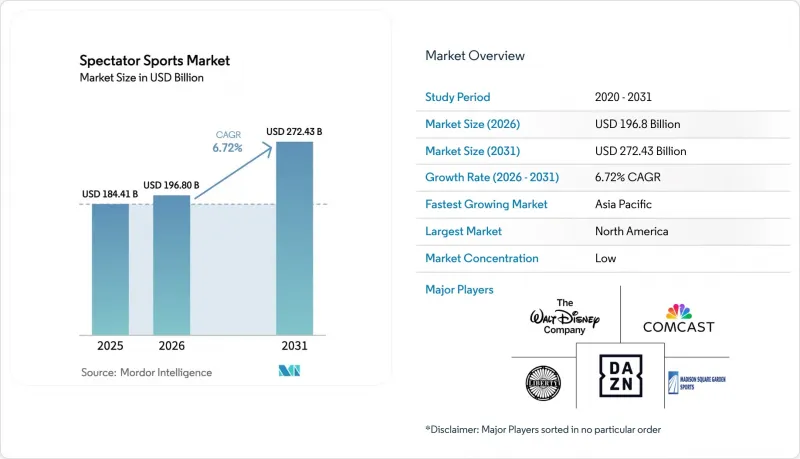
This report Segments the Industry Into by Revenue Stream (Ticket Sales, Media Rights, Sponsorship & Advertising, Merchandising & Licensing, and Other Ancillary Revenues), by Sport Type (Football / Soccer, Basketball, Baseball, Cricket, Motorsports, Tennis, and More), and by Geography (North America, South America, Europe, Asia-Pacific, and More). The Market Forecasts are Provided in Terms of Value (USD).
Global Spectator Sports Market Trends and Insights
Rising media-rights valuations from streaming competition
Global sports-rights fees surpassed USD 60 billion in 2024, underscoring platforms' willingness to pay premiums for live content that anchors subscriber retention . Netflix moved into live National Football League inventory, while Amazon secured additional National Basketball Association packages, illustrating how tech giants treat sports as must-have engagement engines. YouTube TV's NFL Sunday Ticket deal, valued at about USD 2 billion per season, signaled the end of single-platform exclusivity and raised bid floors for other marquee properties. Rights owners now stagger packages to extract multiple income streams, though viewers navigate an increasingly fragmented landscape.
Legalization of sports betting boosts engagement
The Supreme Court's 2018 ruling accelerated wagering adoption; by early 2025, 38 U.S. states and the District of Columbia had legalized sports betting, generating handles that materially lift game-day viewership. Internal league analyses indicate that bettors exhibit higher engagement by watching games for longer durations compared to non-bettors. Additionally, gaming integrations, such as live odds tickers, are driving higher advertising premiums. The American Gaming Association estimates the NBA and MLB together could add USD 1.7 billion in annual revenue from regulated betting ecosystems . Early data also reveal downside risk: losing wagers on a home team can dampen long-term engagement, prompting clubs to embed responsible-gaming prompts in apps.
Escalating player salary inflation is compressing margins
The National Basketball Association's salary cap for the 2024-25 season rose to USD 140.6 million, reflecting the league's sustained revenue growth and financial expansion . Collective-bargaining agreements mandate that approximately 50% of basketball-related income is allocated to players, which imposes financial pressures on team ownership due to escalating fixed costs. In parallel, the Premier League experienced a 10% year-over-year increase in wage bills in 2024, driven by higher revenues from Champions League broadcasting rights. To address the challenges of shrinking operating margins, clubs are strategically channeling resources into youth academy development to cultivate homegrown talent and reduce reliance on expensive transfers. Furthermore, they are focusing on expanding premium hospitality offerings to diversify income streams and improve overall profitability.
Other drivers and restraints analyzed in the detailed report include:
- Commercialization of emerging Asia-Pacific leagues
- Climate-adaptive stadium designs mitigating weather risk
- Cybersecurity threats to live-stream stability
For complete list of drivers and restraints, kindly check the Table Of Contents.
Segment Analysis
In 2025, media-rights revenues contributed 37.35% to the overall spectator sports market income, solidifying their position as a critical revenue driver. This growth is attributed to the increasing shift of cord-cutters toward platform bundles that prioritize live sports as high-value content. Sponsorship and advertising are projected to achieve a compound annual growth rate (CAGR) of 6.68% through 2031, supported by advancements in granular fan-data targeting and the integration of augmented-reality features within applications. In contrast, ticketing revenue growth is expected to lag behind inflation, as consumers increasingly favor premium, one-time experiences over frequent attendance. These trends highlight the evolving consumer preferences and the strategic focus on maximizing revenue streams within the spectator sports market.Merchandising is witnessing renewed momentum, driven by the adoption of rapid-print fulfillment centers that enable the on-demand production of customized jerseys within stadium premises.
This approach minimizes inventory risks and enhances operational efficiency by reducing stock obsolescence. Ancillary digital revenue streams, such as fan tokens and AI-powered content personalization subscriptions, are emerging as significant contributors to the market's growth. These innovations reflect the increasing monetization of data and the integration of technology to enhance fan engagement. Collectively, these developments underscore the expanding role of digital transformation in shaping the future trajectory of the spectator sports market.
Complete Report Scope:
- By Revenue Stream
- Ticket Sales
- Media Rights
- Sponsorship & Advertising
- Merchandising & Licensing
- Other Ancillary Revenues
- By Sport Type
- Football / Soccer
- Basketball
- Baseball
- Cricket
- Motorsports
- Tennis
- Golf
- Other Sports
- By Geography (Value)
- North America
- United States
- Canada
- Mexico
- South America
- Brazil
- Peru
- Chile
- Argentina
- Rest of South America
- Europe
- United Kingdom
- Germany
- France
- Spain
- Italy
- BENELUX
- NORDICS
- Rest of Europe
- Asia-Pacific
- India
- China
- Japan
- Australia
- South Korea
- South-East Asia
- Rest of Asia-Pacific
- Middle East and Africa
- United Arab Emirates
- Saudi Arabia
- South Africa
- Nigeria
- Rest of Middle East and Africa
- North America
Geography Analysis
North America, accounting for 42.55% spectator sports market share in 2025, benefits from entrenched franchise structures, high media-rights baselines, and mature stadium ecosystems. Streaming competition intensified when YouTube TV secured NFL Sunday Ticket, prompting incumbents to bundle multi-sport packages and parity-price mobile-only passes. Climate-neutral retrofits, including solar canopies and waste-heat recovery systems, attract municipal co-funding and ESG-minded sponsors, adding resilience to the spectator sports market.
Asia-Pacific registers the fastest 7.39% CAGR through 2031, led by India's target to scale its sports sector to USD 100 billion by 2027. The IPL streamed in eight languages and generated peak concurrency records on JioCinema, validating segmented-audience strategies. Japan pioneers mixed-reality signage and elder-friendly amenities, while South Korea's esports heritage feeds cross-promotion into traditional leagues. Australia's proposed ad ban presses broadcasters to diversify partner portfolios, but domestic women's football successes drive grassroots participation. Southeast Asian federations leverage modular venues and public-private partnerships to host multisport events with lower capital risk, broadening spectator sports market penetration.
Europe delivers consistent revenue through legacy football, rugby, and cycling, though regulatory shifts on gambling ads create short-term sponsorship gaps. Cross-border over-the-top subscriptions hedge domestic saturation; Bundesliga's new match windows add Asia-Pacific prime-time slots, widening audience reach. Africa remains an expansion frontier: Nigeria's youth population, mobile-first payments, and diaspora networks create a test bed for low-bandwidth live-stream models that bypass traditional infrastructure.
- The Walt Disney Company (ESPN)
- Comcast Corp (NBC Sports & Sky Sports)
- Liberty Media Corp (Formula 1)
- DAZN Group Ltd
- Madison Square Garden Sports Corp
- Manchester United PLC
- Real Madrid CF
- FC Barcelona
- Yankees Global Enterprises
- Dallas Cowboys Football Club Ltd
- Kroenke Sports & Entertainment
- City Football Group
- New England Patriots LP
- Tencent Holdings Ltd (Tencent Sports)
- Electronic Arts Inc (EA Sports Events)
- ESL FACEIT Group
- WWE - TKO Group
- UFC - TKO Group
- Board of Control for Cricket in India (IPL)
- Endeavor Group Holdings Inc
Additional Benefits:
- The market estimate (ME) sheet in Excel format
- 3 months of analyst support
TABLE OF CONTENTS
1 Introduction
- 1.1 Study Assumptions & Market Definition
- 1.2 Scope of the Study
2 Research Methodology
3 Executive Summary
4 Market Landscape
- 4.1 Market Overview
- 4.2 Market Drivers
- 4.2.1 Rising media rights valuations from streaming competition
- 4.2.2 Legalization of sports betting boosting engagement
- 4.2.3 Commercialization of emerging Asia Pacific leagues
- 4.2.4 Blockchain-based fan tokens as revenue streams
- 4.2.5 Climate-adaptive stadium designs mitigating weather risk
- 4.2.6 AI-personalized viewing experiences increasing ARPU
- 4.3 Market Restraints
- 4.3.1 Escalating player salary inflation compressing margins
- 4.3.2 Macroeconomic pressure on discretionary event spend
- 4.3.3 Cyber-security threats to live-streaming stability
- 4.3.4 Regulatory curbs on gambling advertisements
- 4.4 Value / Supply-Chain Analysis
- 4.5 Regulatory Landscape
- 4.6 Technological Outlook
- 4.7 Porter's Five Forces
- 4.7.1 Threat of New Entrants
- 4.7.2 Bargaining Power of Suppliers
- 4.7.3 Bargaining Power of Buyers
- 4.7.4 Threat of Substitutes
- 4.7.5 Industry Rivalry
5 Market Size & Growth Forecasts
- 5.1 By Revenue Stream
- 5.1.1 Ticket Sales
- 5.1.2 Media Rights
- 5.1.3 Sponsorship & Advertising
- 5.1.4 Merchandising & Licensing
- 5.1.5 Other Ancillary Revenues
- 5.2 By Sport Type
- 5.2.1 Football / Soccer
- 5.2.2 Basketball
- 5.2.3 Baseball
- 5.2.4 Cricket
- 5.2.5 Motorsports
- 5.2.6 Tennis
- 5.2.7 Golf
- 5.2.8 Other Sports
- 5.3 By Geography (Value)
- 5.3.1 North America
- 5.3.1.1 United States
- 5.3.1.2 Canada
- 5.3.1.3 Mexico
- 5.3.2 South America
- 5.3.2.1 Brazil
- 5.3.2.2 Peru
- 5.3.2.3 Chile
- 5.3.2.4 Argentina
- 5.3.2.5 Rest of South America
- 5.3.3 Europe
- 5.3.3.1 United Kingdom
- 5.3.3.2 Germany
- 5.3.3.3 France
- 5.3.3.4 Spain
- 5.3.3.5 Italy
- 5.3.3.6 BENELUX
- 5.3.3.7 NORDICS
- 5.3.3.8 Rest of Europe
- 5.3.4 Asia-Pacific
- 5.3.4.1 India
- 5.3.4.2 China
- 5.3.4.3 Japan
- 5.3.4.4 Australia
- 5.3.4.5 South Korea
- 5.3.4.6 South-East Asia
- 5.3.4.7 Rest of Asia-Pacific
- 5.3.5 Middle East and Africa
- 5.3.5.1 United Arab Emirates
- 5.3.5.2 Saudi Arabia
- 5.3.5.3 South Africa
- 5.3.5.4 Nigeria
- 5.3.5.5 Rest of Middle East and Africa
- 5.3.1 North America
6 Competitive Landscape
- 6.1 Market Concentration
- 6.2 Strategic Moves
- 6.3 Market Share Analysis
- 6.4 Company Profiles (includes Global level Overview, Market level overview, Core Segments, Financials as available, Strategic Information, Market Rank/Share for key companies, Products & Services, and Recent Developments)
- 6.4.1 The Walt Disney Company (ESPN)
- 6.4.2 Comcast Corp (NBC Sports & Sky Sports)
- 6.4.3 Liberty Media Corp (Formula 1)
- 6.4.4 DAZN Group Ltd
- 6.4.5 Madison Square Garden Sports Corp
- 6.4.6 Manchester United PLC
- 6.4.7 Real Madrid CF
- 6.4.8 FC Barcelona
- 6.4.9 Yankees Global Enterprises
- 6.4.10 Dallas Cowboys Football Club Ltd
- 6.4.11 Kroenke Sports & Entertainment
- 6.4.12 City Football Group
- 6.4.13 New England Patriots LP
- 6.4.14 Tencent Holdings Ltd (Tencent Sports)
- 6.4.15 Electronic Arts Inc (EA Sports Events)
- 6.4.16 ESL FACEIT Group
- 6.4.17 WWE - TKO Group
- 6.4.18 UFC - TKO Group
- 6.4.19 Board of Control for Cricket in India (IPL)
- 6.4.20 Endeavor Group Holdings Inc
7 Market Opportunities & Future Outlook
- 7.1 White-space & Unmet-Need Assessment

