PUBLISHER: Mordor Intelligence | PRODUCT CODE: 2119801

PUBLISHER: Mordor Intelligence | PRODUCT CODE: 2119801
India Auto Loan - Market Share Analysis, Industry Trends & Statistics, Growth Forecasts (2026 - 2031)
According to Mordor Intelligence, the India auto loan market size was valued at USD 43.45 billion in 2025 and estimated to grow from USD 46.33 billion in 2026 to reach USD 63.82 billion by 2031, at a CAGR of 6.62% during the forecast period (2026-2031).
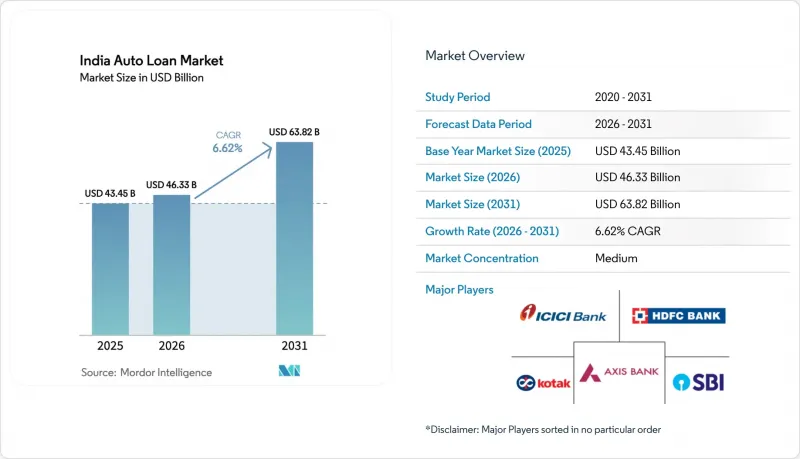
This report is Segmented by Loan Provider Type (Non-Captive Banks, Non-Banking Financial Companies, OEM-Captive Finance Arms, and More), Vehicle Type (Passenger Vehicles, Commercial Vehicles), Ownership (New Vehicles, Used Vehicles), Distribution Channel (Dealership Point-Of-Sale, Online Direct Lending, and More), and Geography (India). The Market Forecasts are Provided in Terms of Value (USD).
India Auto Loan Market Trends and Insights
Rising Vehicle-Ownership Aspirations & GDP Growth
A steady elevation in per-capita GDP fortifies consumer confidence, encouraging first-time buyers to migrate from two-wheelers to entry-segment cars or from cars to utility vehicles. Tier-2 and tier-3 agglomerations post the fastest credit off-take as road-network upgrades make private mobility more practical. Micro-enterprise owners also pivot toward small commercial vans, harnessing credit for last-mile logistics contracts that mushroom amid e-commerce penetration. Lenders respond with longer tenors and step-up EMIs, enabling alignment between monthly obligations and anticipated income growth. These trends ensure resilient origination volumes within the India auto loan market even during fuel-price volatility.
RBI Account-Aggregator Enabling Alternative Data Scoring
The consent-based model gives lenders real-time visibility into current-account cash flows, mutual-fund SIPs, and insurance premiums. Thin-file borrowers in semi-urban areas who lacked bureau depth now qualify through cash-surplus analytics. Banks deploying the framework observe double-digit improvements in underwriting accuracy, translating to lower provisional buffers. Early adoption in Karnataka and Maharashtra demonstrates that integrating GST-return feeds further enriches SME credit models, particularly for commercial-vehicle loans. The architecture is poised to become the default underwriting backbone, elevating data granularity across the India auto loan market.
Rising Vehicle Prices Pressuring Affordability
Between 2024 and 2025, ex-showroom prices rose by 15-18%, driven by supply-chain disruptions and regulatory safety mandates, significantly outpacing median wage growth. In several states, monthly EMIs for entry-level hatchbacks have crossed INR 10,000 (USD 120), discouraging first-time buyers. Lenders are extending loan tenors to seven years as a countermeasure. However, this approach results in a higher total interest payout and amplifies residual-value risk. Additionally, users of shared mobility are postponing their purchases, leading to a decline in incremental demand and hindering the short-term growth of India's auto loan market.
Other drivers and restraints analyzed in the detailed report include:
- Captive EV-Finance Subsidy Programs by OEMs
- Co-lending Model Unlocking Tier-3/4 Distribution
- Asset-Quality Concerns Among NBFCs
For complete list of drivers and restraints, kindly check the Table Of Contents.
Segment Analysis
Non-captive banks retained dominance with a 51.72% India auto loan market share in 2025, yet NBFC disbursements are compounding at a 7.34% CAGR, signaling a redistribution of power. OEM-captive finance arms exploit manufacturer insights to innovate bespoke schemes such as battery subscriptions, while fintech aggregators orchestrate digital co-lending pools. NBFC outreach in tier-3/4 locations capitalizes on informal income assessment and flexible repayment calendars, extending credit inclusion beyond traditional footprints.
The India auto loan market benefits from symbiotic bank-NBFC ties: banks supply low-cost capital and regulatory credibility, whereas NBFCs deliver origination throughput and nuanced borrower vetting. Co-lending APIs synchronize underwriting in real time, lowering operational friction. A more granular risk-pricing regime emerges, rewarding data-rich NBFCs with superior cost-of-funds and elevating competitive benchmarks across the India auto loan industry.
In 2025, passenger cars dominated the Indian auto loan market, holding a significant 71.55% share. However, commercial vehicle (CV) loans are growing at a faster rate, with a 7.69% CAGR. This growth is driven by the increasing demand for e-commerce deliveries and the ongoing expansion of highways across the country. To manage risks, CV lenders are using telematics systems to monitor vehicle usage and ensure repayments are tied to how the vehicles are utilized. This strategy helps reduce the impact of fluctuating freight rates, which can otherwise lead to higher default risks.
Electrification of vehicle fleets is opening up new opportunities in the market. Light commercial electric vehicles (EVs) used for urban deliveries follow predictable schedules, making them suitable for overnight charging at depots. This predictability lowers operating costs and makes these vehicles more affordable in the long run. Lenders are also testing tools to monitor battery health, which helps them better predict potential defaults. These advancements are making CV loans more attractive and strengthening their position in the Indian auto loan market over time.
Complete Report Scope:
- By Loan Provider Type
- Non-Captive Banks
- Non-Banking Financial Companies (NBFCs)
- OEM-Captive Finance Arms
- Other Providers (Co-lending & FinTech Platforms)
- By Vehicle Type
- Passenger Vehicles
- Commercial Vehicles
- By Ownership
- New Vehicles
- Used Vehicles
- By Distribution Channel
- Dealership Point-of-Sale
- Online Direct Lending
- Brokers & Marketplaces
List of Companies Covered in this Report:
- State Bank of India
- HDFC Bank
- ICICI Bank
- Axis Bank
- Kotak Mahindra Bank
- Shriram Finance
- Mahindra & Mahindra Financial Services
- Bajaj Finance
- Cholamandalam Investments & Finance
- Tata Motors Finance
- Hyundai Motor India Captive Finance
- Maruti Suzuki Smart Finance
- Toyota Financial Services India
- Volkswagen Financial Services India
- Sundaram Finance
- Hero FinCorp
- Muthoot Capital Services
- L&T Finance
- RevFin Services
- Rupyy (CarDekho)
- Paytm Loans (Clix Capital partnership)
- KreditBee Auto
Additional Benefits:
- The market estimate (ME) sheet in Excel format
- 3 months of analyst support
TABLE OF CONTENTS
1 Table of Contents - India Auto Loan Market
2 Introduction
- 2.1 Study Assumptions & Market Definition
- 2.2 Scope of the Study
3 Research Methodology
4 Executive Summary
5 Market Landscape
- 5.1 Market Overview
- 5.2 Market Drivers
- 5.2.1 Rising vehicle-ownership aspirations & GDP growth
- 5.2.2 Increasing penetration of used-car financing
- 5.2.3 Expanding digital lending & e-KYC adoption
- 5.2.4 RBI Account-Aggregator enabling alternative data scoring
- 5.2.5 Captive EV-finance subsidy programmes by OEMs
- 5.2.6 Co-lending model unlocking Tier-3/4 distribution
- 5.3 Market Restraints
- 5.3.1 Rising vehicle prices pressuring affordability
- 5.3.2 Asset-quality concerns among NBFCs
- 5.3.3 Scarcity of reliable EV-battery residual-value data
- 5.3.4 Possible tightening of bank risk-weights on NBFC exposure
- 5.4 Value / Supply-Chain Analysis
- 5.5 Regulatory Landscape
- 5.6 Technological Outlook
- 5.7 Porter's Five Forces
- 5.7.1 Threat of New Entrants
- 5.7.2 Bargaining Power of Suppliers
- 5.7.3 Bargaining Power of Buyers
- 5.7.4 Threat of Substitutes
- 5.7.5 Competitive Rivalry
6 Market Size & Growth Forecasts (Value)
- 6.1 By Loan Provider Type
- 6.1.1 Non-Captive Banks
- 6.1.2 Non-Banking Financial Companies (NBFCs)
- 6.1.3 OEM-Captive Finance Arms
- 6.1.4 Other Providers (Co-lending & FinTech Platforms)
- 6.2 By Vehicle Type
- 6.2.1 Passenger Vehicles
- 6.2.2 Commercial Vehicles
- 6.3 By Ownership
- 6.3.1 New Vehicles
- 6.3.2 Used Vehicles
- 6.4 By Distribution Channel
- 6.4.1 Dealership Point-of-Sale
- 6.4.2 Online Direct Lending
- 6.4.3 Brokers & Marketplaces
7 Competitive Landscape
- 7.1 Market Concentration
- 7.2 Strategic Moves
- 7.3 Market Share Analysis
- 7.4 Company Profiles (includes Global level Overview, Market level overview, Core Segments, Financials as available, Strategic Information, Market Rank/Share for key companies, Products & Services, and Recent Developments)
- 7.4.1 State Bank of India
- 7.4.2 HDFC Bank
- 7.4.3 ICICI Bank
- 7.4.4 Axis Bank
- 7.4.5 Kotak Mahindra Bank
- 7.4.6 Shriram Finance
- 7.4.7 Mahindra & Mahindra Financial Services
- 7.4.8 Bajaj Finance
- 7.4.9 Cholamandalam Investments & Finance
- 7.4.10 Tata Motors Finance
- 7.4.11 Hyundai Motor India Captive Finance
- 7.4.12 Maruti Suzuki Smart Finance
- 7.4.13 Toyota Financial Services India
- 7.4.14 Volkswagen Financial Services India
- 7.4.15 Sundaram Finance
- 7.4.16 Hero FinCorp
- 7.4.17 Muthoot Capital Services
- 7.4.18 L&T Finance
- 7.4.19 RevFin Services
- 7.4.20 Rupyy (CarDekho)
- 7.4.21 Paytm Loans (Clix Capital partnership)
- 7.4.22 KreditBee Auto
8 Market Opportunities & Future Outlook
- 8.1 White-space & Unmet-Need Assessment

