PUBLISHER: Mordor Intelligence | PRODUCT CODE: 2120272

PUBLISHER: Mordor Intelligence | PRODUCT CODE: 2120272
China Solar Energy - Market Share Analysis, Industry Trends & Statistics, Growth Forecasts (2026 - 2031)
According to Mordor Intelligence, China solar energy market size in 2026 is estimated at 1.41 Thousand gigawatt, growing from 2025 value of 1.23 Thousand gigawatt with 2031 projections showing 2.85 Thousand gigawatt, growing at 15.03% CAGR over 2026-2031.
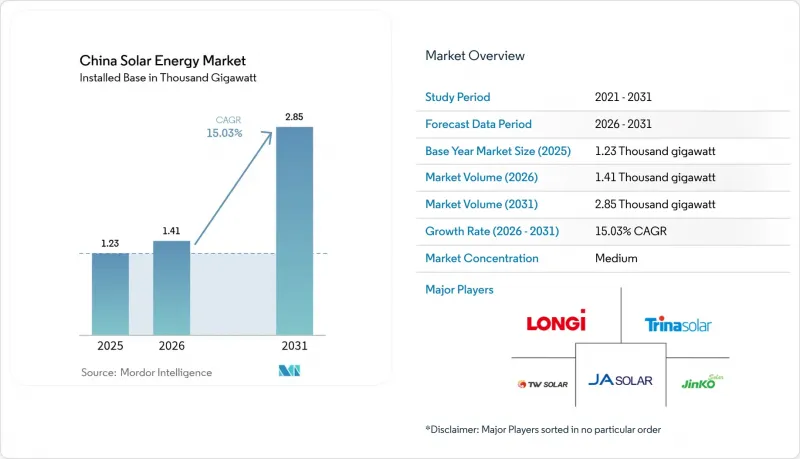
This report is Segmented by Technology (Solar Photovoltaic and Concentrated Solar Power), Grid Type (On-Grid and Off-Grid), and End-User (Utility-Scale, Commercial and Industrial, and Residential). The Market Sizes and Forecasts are Provided in Terms of Installed Capacity (GW).
China Solar Energy Market Trends and Insights
Record-Low Module Prices Drive LCOE Competitiveness
Module prices fell to RMB 0.75/W in early 2024 after China's manufacturing capacity ballooned to 861 GW against global demand of 600 GW. Cost leadership pushed solar LCOE below coal in more than 25 provinces, prompting developers to accelerate gigawatt-scale projects without subsidies. Industry consolidation is inevitable, yet leading firms such as LONGi and JinkoSolar benefit from N-type TOPCon lines that preserve margins.
14th Five-Year Plan Targets Accelerate Capacity Expansion
The 14th Five-Year Plan set a 1,200 GW renewable goal by 2025, with solar expected to add more than 600 GW, spurring provincial quotas of 50 GW in Shandong, 40 GW in Henan, and 35 GW in Jiangsu. Bundling mandates that pair every 1 GW of solar with 200 MW of coal or 100 MW of storage raise project capital costs by up to 20%, channeling market share toward vertically integrated developers able to internalize key inputs.
Grid Congestion Constrains Northwestern Capacity Utilization
Curtailment has subsided nationally but remains above 5% in parts of Xinjiang and Gansu. The Qinghai-Henan +-800 kV UHVDC corridor evacuated 8 GW of clean power in its first year but averaged only 60% utilization because receiving grids saturate during off-peak demand. Mandatory two-hour storage for every 10 MW of new capacity adds USD 0.015 per kWh, squeezing project returns in regions where midday wholesale prices drop below USD 0.03 per kWh.
Other drivers and restraints analyzed in the detailed report include:
- Corporate PPA Market Transforms Energy Procurement
- Mandatory Rooftop PV Policies Drive Distributed Growth
- Overseas Trade Barriers to Chinese Modules
For complete list of drivers and restraints, kindly check the Table Of Contents.
Segment Analysis
China's solar energy market size for photovoltaic technology stood at 1,223.24 GW in 2025, equaling 99.45% of total installed capacity, while CSP reached 6,760.76 MW. N-type variants, TOPCon, and heterojunction expanded their domestic shipment share from 25% in 2023 to 45% in 2024, encouraged by LONGi's world-leading 27.09% cell efficiency and Trina's 26.5% milestone. CSP is slated to grow at a 18.95% CAGR, buoyed by a feed-in premium of CNY 1.5 (USD 0.21) per kWh that cushions its three-times-higher capex compared with.
Perovskite-silicon tandems touched 33.9% laboratory efficiency in 2024, and pilot lines targeting mass production by 2027 suggest future cost parity with current mono-crystalline units. Hybrid CSP-PV projects under construction in Qinghai, pairing 200 MW of thermal storage with 1 GW of PV, promise four-hour post-sunset dispatch and 2 percentage-point higher IRRs versus standalone PV. Off-grid PV remains below 9% of yearly additions but serves strategic niches such as telecom base stations and border surveillance, where diesel displacement justifies premium pricing
Complete Report Scope:
- By Technology
- Solar Photovoltaic (PV)
- Concentrated Solar Power (CSP)
- By Connection Type
- On-Grid
- Off-Grid
- By End-User
- Utility-Scale
- Commercial and Industrial (C&I)
- Residential
- By Component (Qualitative Analysis)
- Solar Modules/Panels
- Inverters (String, Central, Micro)
- Mounting and Tracking Systems
- Balance-of-System and Electricals
- Energy Storage and Hybrid Integration
List of Companies Covered in this Report:
- LONGi Green Energy Technology Co Ltd
- Trina Solar Co Ltd
- JA Solar Technology Co Ltd
- JinkoSolar Holding Co Ltd
- Tongwei Solar Co Ltd
- Zhejiang Chint Electrics Co Ltd
- Hanwha Q CELLS Co Ltd
- Yingli Green Energy Holding Co Ltd
- Huasun Energy Co Ltd
- Drinda New Energy Technology Co Ltd
- GCL-Poly Energy Holdings Ltd
- Risen Energy Co Ltd
- Suntech Power Co Ltd
- Seraphim Solar System Co Ltd
- GoodWe Technologies Co Ltd
- Sungrow Power Supply Co Ltd
- Huawei Digital Power Technologies Co Ltd
- Tianjin Zhonghuan Semiconductor Co Ltd
- Aiko Solar Energy Co Ltd
- Shunfeng International Clean Energy Ltd
- Envision Energy Ltd
Additional Benefits:
- The market estimate (ME) sheet in Excel format
- 3 months of analyst support
TABLE OF CONTENTS
1 Introduction
- 1.1 Study Assumptions & Market Definition
- 1.2 Scope of the Study
2 Research Methodology
3 Executive Summary
4 Market Landscape
- 4.1 Market Overview
- 4.2 Market Drivers
- 4.2.1 Record-low module prices cut LCOE
- 4.2.2 14th Five-Year Plan capacity targets
- 4.2.3 Corporate PPAs/green-power trading boom
- 4.2.4 Mandatory rooftop PV on new public buildings
- 4.2.5 Grid-friendly inverter retrofits policy
- 4.2.6 CSP-plus-storage subsidy scheme
- 4.3 Market Restraints
- 4.3.1 Grid congestion & curtailment in NW China
- 4.3.2 Feed-in-tariff phase-out & low auction prices
- 4.3.3 Overseas trade barriers to Chinese modules
- 4.3.4 ESG scrutiny of Xinjiang polysilicon supply
- 4.4 Supply-Chain Analysis
- 4.5 Regulatory Landscape
- 4.6 Technological Outlook
- 4.7 Porter's Five Forces
- 4.7.1 Competitive Rivalry
- 4.7.2 Bargaining Power of Suppliers
- 4.7.3 Bargaining Power of Buyers
- 4.7.4 Threat of Substitutes
- 4.7.5 Threat of New Entrants
- 4.8 PESTLE Analysis
5 Market Size & Growth Forecasts
- 5.1 By Technology
- 5.1.1 Solar Photovoltaic (PV)
- 5.1.2 Concentrated Solar Power (CSP)
- 5.2 By Connection Type
- 5.2.1 On-Grid
- 5.2.2 Off-Grid
- 5.3 By End-User
- 5.3.1 Utility-Scale
- 5.3.2 Commercial and Industrial (C&I)
- 5.3.3 Residential
- 5.4 By Component (Qualitative Analysis)
- 5.4.1 Solar Modules/Panels
- 5.4.2 Inverters (String, Central, Micro)
- 5.4.3 Mounting and Tracking Systems
- 5.4.4 Balance-of-System and Electricals
- 5.4.5 Energy Storage and Hybrid Integration
6 Competitive Landscape
- 6.1 Market Concentration
- 6.2 Strategic Moves (M&A, Partnerships, PPAs)
- 6.3 Market Share Analysis (Market Rank/Share for key companies)
- 6.4 Company Profiles (includes Global level Overview, Market level overview, Core Segments, Financials as available, Strategic Information, Products & Services, and Recent Developments)
- 6.4.1 LONGi Green Energy Technology Co Ltd
- 6.4.2 Trina Solar Co Ltd
- 6.4.3 JA Solar Technology Co Ltd
- 6.4.4 JinkoSolar Holding Co Ltd
- 6.4.5 Tongwei Solar Co Ltd
- 6.4.6 Zhejiang Chint Electrics Co Ltd
- 6.4.7 Hanwha Q CELLS Co Ltd
- 6.4.8 Yingli Green Energy Holding Co Ltd
- 6.4.9 Huasun Energy Co Ltd
- 6.4.10 Drinda New Energy Technology Co Ltd
- 6.4.11 GCL-Poly Energy Holdings Ltd
- 6.4.12 Risen Energy Co Ltd
- 6.4.13 Suntech Power Co Ltd
- 6.4.14 Seraphim Solar System Co Ltd
- 6.4.15 GoodWe Technologies Co Ltd
- 6.4.16 Sungrow Power Supply Co Ltd
- 6.4.17 Huawei Digital Power Technologies Co Ltd
- 6.4.18 Tianjin Zhonghuan Semiconductor Co Ltd
- 6.4.19 Aiko Solar Energy Co Ltd
- 6.4.20 Shunfeng International Clean Energy Ltd
- 6.4.21 Envision Energy Ltd
7 Market Opportunities & Future Outlook
- 7.1 White-space & Unmet-Need Assessment

