PUBLISHER: Mordor Intelligence | PRODUCT CODE: 2121340

PUBLISHER: Mordor Intelligence | PRODUCT CODE: 2121340
India Solar Energy - Market Share Analysis, Industry Trends & Statistics, Growth Forecasts (2026 - 2031)
According to Mordor Intelligence, the India solar energy market size was valued at 122.5 gigawatt in 2025 and estimated to grow from 145.83 gigawatt in 2026 to reach 348.57 gigawatt by 2031, at a CAGR of 19.05% during the forecast period (2026-2031).
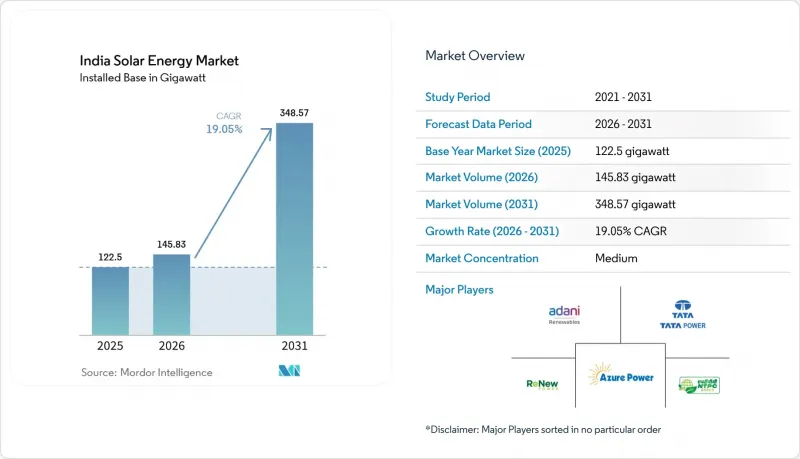
This report is Segmented by Technology (Solar Photovoltaic and Concentrated Solar Power), Grid Type (On-Grid and Off-Grid), and End-User (Utility-Scale, Commercial and Industrial, and Residential). The Market Sizes and Forecasts are Provided in Terms of Installed Capacity (GW).
India Solar Energy Market Trends and Insights
Supportive Federal and State Incentives Accelerate Localization
India's Solar Energy market expansion is underwritten by regulations that reward domestic value addition. The Approved List of Models and Manufacturers (ALMM) favors locally produced modules, while two PLI tranches are underwriting more than 48 GW of integrated cell-to-module capacity scheduled to go online by 2026. Tata Power, Waaree Energies, and Goldi Solar commissioned large plants in 2025, keeping domestic module margins in the 12-14% range despite import duties. Developers face 6-8% higher upfront costs in the short run, yet long-term supply security and potential tax credits offset the burden. Expansion of ALMM to cover cells from June 2026 is projected to triple exports to 8-9 GW in FY 2025, bolstering balance-of-payments resilience and deepening India's Solar Energy market competitiveness.
Rapid Decline in Module-Levelized Cost Unlocks Distributed Segments
Average utility-scale project capex fell 28% year-on-year in 2024, pushing discovered tariffs to INR 2/kWh, a new national floor. Cost compression stems from global oversupply, technology shifts toward TOPCon, and widening domestic supply chains. Intermittent spikes due to logistics bottlenecks and basic customs duties occasionally disrupt bids; still, most developers model energy at <= INR 2.4/kWh over project life. Sustaining that benchmark depends on continued efficiency gains, accelerated polysilicon-to-module build-out, and moderated freight rates. If manufacturers achieve advertised cell efficiencies above 25%, the India Solar Energy market could see sub-INR 2 tariffs by 2027, reinforcing demand across utility, C&I, and residential applications.
Weak Grid Flexibility and Curtailment Risk Threatens Project Returns
Solar penetration in leading states now exceeds 25% of peak demand, exposing grids to frequent curtailment events. Limited ancillary services, delayed battery-storage rollouts, and network congestion erode plant load factors by up to 4 percentage points. The Green Energy Corridor program and the commissioning of India's largest BESS factory in Karnataka improve flexibility yet lag capacity-addition velocity. Developers incorporate generation forecasts, but unpredictable curtailment complicates financing, especially for medium-sized independent power producers. Faster adoption of market-based economic dispatch and real-time ancillary markets is essential to preserve investor confidence in the India Solar Energy market.
Other drivers and restraints analyzed in the detailed report include:
- 500 GW National Target Sustains Utility-Scale Tender Pipeline
- Green-Hydrogen-Linked Solar Demand Creates Dedicated Off-Take Channels
- Land-Acquisition Bottlenecks in High-Irradiance States Delay Commissioning
For complete list of drivers and restraints, kindly check the Table Of Contents.
Segment Analysis
Solar photovoltaic accounted for 99.58% of the India solar energy market in 2025 and is on track for a 19.08% CAGR through 2031. Within PV, TOPCon modules already form 35% of domestic output after Waaree, Adani, and Premier ramped 18 GW combined capacity. BIS-mandated quality rules removed low-grade imports, nudging developers toward bifacial designs that raise yields 10-20%. Concentrated solar power, although below 1 GW, re-entered the tender pipeline via hybrid bids that bundle six-hour thermal storage. NTPC's 50 MW Ladakh CSP plant logs a 42% capacity factor, showing dispatchable value in high-altitude sites.
Developers weigh CSP's higher capital intensity against superior evening output when evaluating mixed portfolios. Meanwhile, Reliance's planned 10 GW HJT line targets 25-26% cell efficiency by 2027, which could narrow LCOE differences with CSP. As cost spreads tighten, technology choice will hinge on project-specific land and storage constraints. The India solar energy market, therefore, remains PV-heavy yet technologically fluid, with niche CSP and next-gen PV formats carving differentiated roles over the decade.
Complete Report Scope:
- By Technology
- Solar Photovoltaic (PV)
- Concentrated Solar Power (CSP)
- By Grid Type
- On-Grid
- Off-Grid
- By End-User
- Utility-Scale
- Commercial and Industrial (C&I)
- Residential
- By Component (Qualitative Analysis)
- Solar Modules/Panels
- Inverters (String, Central, Micro)
- Mounting and Tracking Systems
- Balance-of-System and Electricals
- Energy Storage and Hybrid Integration
List of Companies Covered in this Report:
- Domestic Players
- Foreign Players
Additional Benefits:
- The market estimate (ME) sheet in Excel format
- 3 months of analyst support
TABLE OF CONTENTS
1 Introduction
- 1.1 Study Assumptions & Market Definition
- 1.2 Scope of the Study
2 Research Methodology
3 Executive Summary
4 Market Landscape
- 4.1 Market Overview
- 4.2 Market Drivers
- 4.2.1 Supportive federal & state incentives (e.g., ALMM, PLI)
- 4.2.2 Rapid decline in module-levelised cost (<= INR 2.4 /kWh)
- 4.2.3 500 GW national RE target driving tender pipeline
- 4.2.4 Green-hydrogen-linked solar demand pipelines
- 4.2.5 Domestic polysilicon-to-module build-out via PLI-2
- 4.2.6 State-led agrivoltaic & canal-top programmes
- 4.3 Market Restraints
- 4.3.1 Weak grid flexibility & curtailment risk
- 4.3.2 Land-acquisition bottlenecks in high-irradiance states
- 4.3.3 Cell/wafer import dependency facing >=40 % duties
- 4.3.4 Limited credit access for MSME rooftop projects
- 4.4 Supply-Chain Analysis
- 4.5 Regulatory Landscape
- 4.6 Technological Outlook
- 4.7 Porter's Five Forces
- 4.7.1 Threat of New Entrants
- 4.7.2 Bargaining Power of Buyers
- 4.7.3 Bargaining Power of Suppliers
- 4.7.4 Threat of Substitutes
- 4.7.5 Competitive Rivalry
- 4.8 PESTLE Analysis
5 Market Size & Growth Forecasts
- 5.1 By Technology
- 5.1.1 Solar Photovoltaic (PV)
- 5.1.2 Concentrated Solar Power (CSP)
- 5.2 By Grid Type
- 5.2.1 On-Grid
- 5.2.2 Off-Grid
- 5.3 By End-User
- 5.3.1 Utility-Scale
- 5.3.2 Commercial and Industrial (C&I)
- 5.3.3 Residential
- 5.4 By Component (Qualitative Analysis)
- 5.4.1 Solar Modules/Panels
- 5.4.2 Inverters (String, Central, Micro)
- 5.4.3 Mounting and Tracking Systems
- 5.4.4 Balance-of-System and Electricals
- 5.4.5 Energy Storage and Hybrid Integration
6 Competitive Landscape
- 6.1 Market Concentration
- 6.2 Strategic Moves (M&A, Partnerships, PPAs)
- 6.3 Market Share Analysis (Market Rank/Share for key companies)
- 6.4 Company Profiles (includes Global level Overview, Market level overview, Core Segments, Financials as available, Strategic Information, Products & Services, and Recent Developments)
- 6.4.1 Domestic Players
- 6.4.1.1 Adani Solar
- 6.4.1.2 Adani Green Energy Ltd.
- 6.4.1.3 Tata Power Solar Systems Ltd.
- 6.4.1.4 NTPC Renewable Energy Ltd.
- 6.4.1.5 ReNew Power Pvt. Ltd.
- 6.4.1.6 Azure Power Global Ltd.
- 6.4.1.7 Mahindra Susten Pvt. Ltd.
- 6.4.1.8 Sterling & Wilson Renewable Energy Ltd.
- 6.4.1.9 Vikram Solar Ltd.
- 6.4.1.10 Emmvee Solar
- 6.4.1.11 Waaree Energies Ltd.
- 6.4.1.12 JSW Energy - Solar
- 6.4.2 Foreign Players
- 6.4.2.1 JinkoSolar Holding Co. Ltd.
- 6.4.2.2 LONGi Green Energy Technology Co. Ltd.
- 6.4.2.3 First Solar Inc.
- 6.4.2.4 Trina Solar Co. Ltd.
- 6.4.2.5 Canadian Solar Inc.
- 6.4.2.6 Hanwha Q Cells Co. Ltd.
- 6.4.2.7 SMA Solar Technology AG
- 6.4.1 Domestic Players
7 Market Opportunities & Future Outlook
- 7.1 White-space & Unmet-Need Assessment

