PUBLISHER: Mordor Intelligence | PRODUCT CODE: 2120658

PUBLISHER: Mordor Intelligence | PRODUCT CODE: 2120658
Germany Solar Energy - Market Share Analysis, Industry Trends & Statistics, Growth Forecasts (2026 - 2031)
According to Mordor Intelligence, the Germany solar energy market size in terms of installed base is expected to grow from 132.25 gigawatt in 2026 to 235.5 gigawatt by 2031, at a CAGR of 12.23% during the forecast period (2026-2031).
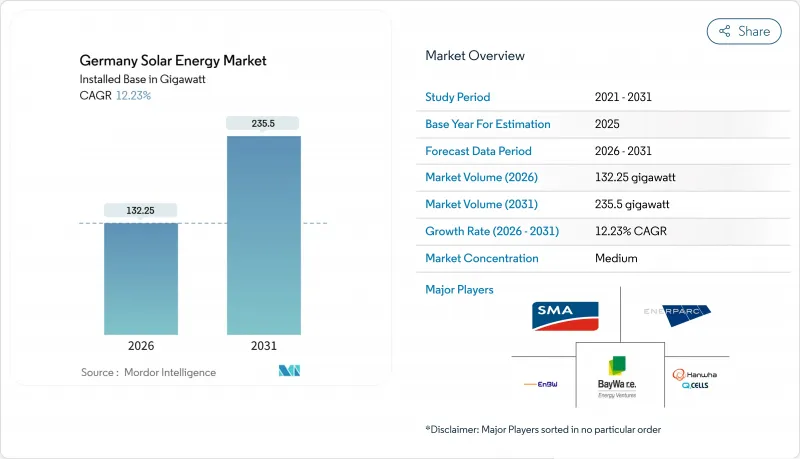
This report is Segmented by Technology (Solar Photovoltaic and Concentrated Solar Power), Grid Type (On-Grid and Off-Grid), and End-User (Utility-Scale, Commercial and Industrial, and Residential). The Market Sizes and Forecasts are Provided in Terms of Installed Capacity (GW).
Germany Solar Energy Market Trends and Insights
Solar Package I & Rooftop Mandates Accelerating Approvals
The 2024 Solar Package I simplified registrations and raised the balcony-PV inverter limit to 800 W, allowing tenants to self-install systems without landlord consent. Registrations reached about 780,000 units by year-end 2024, adding 435,000 systems in a single year and equaling 2.6% of national solar additions. State-level mandates now require solar on new roofs in Baden-Wurttemberg and Bavaria, cutting average permitting times from 18 months to under six and adding roughly 2.1 percentage points to forecast growth. Rooftop auction volumes ticked up in October 2025, with 281 MW awarded at 9.66 cents/kWh, confirming early traction. The driver is strongest in southern states, but uptake is expected to broaden as other regions align with the revised Energy Performance of Buildings Directive.
Corporate PPA Boom Lifting Unsubsidised Utility Projects
Long-term corporate PPAs are increasingly displacing subsidy auctions. Energiekontor's 2024 deal with Currenta to power a chemical park shows industrial buyers locking in fixed-price solar to hedge wholesale volatility. Unsubsidised projects already propel growth because developers can finance plants outside capped auction volumes. North Rhine-Westphalia and Lower Saxony lead activity thanks to large industrial loads, lower curtailment risk, and quicker grid connections. Falling module prices let developers offer PPA rates below 5 cents/kWh, supporting pipeline acceleration through 2028.
Distribution-Grid Congestion & 24-Month Queue Times
Connection backlogs near 24 months in Bavaria and Baden-Wurttemberg delay project cashflow and shave 1.9 percentage points off the baseline CAGR. Redispatch costs above EUR 4 billion in 2022 and onshore solar curtailment topping 13% on peak 2024 days illustrate the grid's limited headroom. Developers are redirecting pipelines toward Lower Saxony and North Rhine-Westphalia, yet even there, transformer slots fill fast, forcing bids to price in lower capture rates. Bundesnetzagentur still issued around 3,800 connection commitments in 2024, but the gap between commitment and energization widens every quarter. Unless accelerated cable upgrades materialize, the German solar energy market faces staggered commissioning schedules that dampen near-term additions.
Other drivers and restraints analyzed in the detailed report include:
- Rising Grid-Fee Inflation Driving Behind-the-Meter PV + Storage
- Mass Adoption of Balcony-Plug-in PV by Renters
- Skilled-Labour Shortages in Licensed Electricians & Installers
For complete list of drivers and restraints, kindly check the Table Of Contents.
Segment Analysis
Solar PV held 100% of Germany's solar energy market share in 2025 and is forecast to expand at 12.2% annually through 2031. Efficiency leaps matter more than raw silicon volume now that Fraunhofer ISE and Hanwha Q CELLS certified a 30.8% perovskite-silicon tandem cell in 2024, hinting at commercial modules by 2028. Higher power density can cut racking and land costs up to 15%, a vital lever as permitting favors brownfield sites. Agrivoltaic pilots in Bavaria show crops and panels co-existing under elevated bifacial trackers, easing land-use opposition and broadening farmer income. Concentrated solar power remains absent because diffuse irradiation weakens its thermodynamic advantage.
Perovskite durability is the remaining hurdle, but German research spending represented 64% of EU private PV R&D during 2010-2020, positioning domestic labs to solve it. Once bankability proofs emerge, utility developers can fit more megawatts per kilometer of feeder line, alleviating some curtailment. The German solar energy market, therefore, embeds a technology upside optionality that could temper future grid constraints by delivering more output per site footprint.
Complete Report Scope:
- By Technology
- Solar Photovoltaic (PV)
- Concentrated Solar Power (CSP)
- By Grid Type
- On-Grid
- Off-Grid
- By End-User
- Utility-Scale
- Commercial and Industrial (C&I)
- Residential
- By Component (Qualitative Analysis)
- Solar Modules/Panels
- Inverters (String, Central, Micro)
- Mounting and Tracking Systems
- Balance-of-System and Electricals
- Energy Storage and Hybrid Integration
List of Companies Covered in this Report:
- BayWa r.e. AG
- SMA Solar Technology AG
- EnBW Energie Baden-Wurttemberg AG
- Hanwha Q CELLS GmbH
- IBC Solar AG
- Enerparc AG
- RWE Renewables GmbH
- Encavis AG
- juwi GmbH
- ABO Wind AG
- Vattenfall GmbH
- BayWa r.e. Power Solutions GmbH
- Next2Sun GmbH
- Solnet Green Energy OY
- Axitec Energy GmbH & Co. KG
- Solarwatt GmbH
- Meyer Burger Technology AG (Freiberg)
- Tesla Germany GmbH (Powerwall & Roof)
- 1KOMMA5° GmbH
- Centrotherm International AG
Additional Benefits:
- The market estimate (ME) sheet in Excel format
- 3 months of analyst support
TABLE OF CONTENTS
1 Introduction
- 1.1 Study Assumptions & Market Definition
- 1.2 Scope of the Study
2 Research Methodology
3 Executive Summary
4 Market Landscape
- 4.1 Market Overview
- 4.2 Market Drivers
- 4.2.1 Solar Package I & Rooftop Mandates Accelerating Approvals
- 4.2.2 Corporate PPA Boom Lifting Unsubsidised Utility Projects
- 4.2.3 Rising Grid-Fee Inflation Driving Behind-the-Meter PV + Storage
- 4.2.4 Mass Adoption of Balcony-Plug-in PV by Renters
- 4.2.5 87 % Module-Price Collapse Enables Cost-Parity vs. Wholesale
- 4.2.6 Integrated BIPV Requirements in New-Build Codes (from 2026)
- 4.3 Market Restraints
- 4.3.1 Distribution-Grid Congestion & 24-Month Queue Times
- 4.3.2 Skilled-Labour Shortages in Licensed Electricians & Installers
- 4.3.3 60 % Cost Gap on EU-vs-China Modules Creating Supply-Risk
- 4.3.4 Declining FiTs & Sudden Subsidy Tweaks Eroding Residential ROI
- 4.4 Supply-Chain Analysis
- 4.5 Regulatory Outlook (EEG 2023, Solar-Paket I, State Rooftop Mandates)
- 4.6 Technological Outlook (Perovskite Tandems, Agrivoltaics, Vehicle-Integrated PV)
- 4.7 Porter's Five Forces
- 4.7.1 Competitive Rivalry
- 4.7.2 Threat of New Entrants
- 4.7.3 Bargaining Power of Buyers
- 4.7.4 Bargaining Power of Suppliers
- 4.7.5 Threat of Substitutes (Wind, Heat-Pumps, Demand Response)
- 4.8 PESTLE Analysis
5 Market Size & Growth Forecasts
- 5.1 By Technology
- 5.1.1 Solar Photovoltaic (PV)
- 5.1.2 Concentrated Solar Power (CSP)
- 5.2 By Grid Type
- 5.2.1 On-Grid
- 5.2.2 Off-Grid
- 5.3 By End-User
- 5.3.1 Utility-Scale
- 5.3.2 Commercial and Industrial (C&I)
- 5.3.3 Residential
- 5.4 By Component (Qualitative Analysis)
- 5.4.1 Solar Modules/Panels
- 5.4.2 Inverters (String, Central, Micro)
- 5.4.3 Mounting and Tracking Systems
- 5.4.4 Balance-of-System and Electricals
- 5.4.5 Energy Storage and Hybrid Integration
6 Competitive Landscape
- 6.1 Market Concentration
- 6.2 Strategic Moves (M&A, Partnerships, PPAs)
- 6.3 Market Share Analysis (Market Rank/Share for key companies)
- 6.4 Company Profiles (includes Global level Overview, Market level overview, Core Segments, Financials as available, Strategic Information, Products & Services, and Recent Developments)
- 6.4.1 BayWa r.e. AG
- 6.4.2 SMA Solar Technology AG
- 6.4.3 EnBW Energie Baden-Wurttemberg AG
- 6.4.4 Hanwha Q CELLS GmbH
- 6.4.5 IBC Solar AG
- 6.4.6 Enerparc AG
- 6.4.7 RWE Renewables GmbH
- 6.4.8 Encavis AG
- 6.4.9 juwi GmbH
- 6.4.10 ABO Wind AG
- 6.4.11 Vattenfall GmbH
- 6.4.12 BayWa r.e. Power Solutions GmbH
- 6.4.13 Next2Sun GmbH
- 6.4.14 Solnet Green Energy OY
- 6.4.15 Axitec Energy GmbH & Co. KG
- 6.4.16 Solarwatt GmbH
- 6.4.17 Meyer Burger Technology AG (Freiberg)
- 6.4.18 Tesla Germany GmbH (Powerwall & Roof)
- 6.4.19 1KOMMA5° GmbH
- 6.4.20 Centrotherm International AG
7 Market Opportunities & Future Outlook
- 7.1 White-Space & Unmet-Need Assessment (e.g., Vehicle-to-Grid PV, Industrial Heat-via-PV-Electrolysis)

