PUBLISHER: Mordor Intelligence | PRODUCT CODE: 2120274

PUBLISHER: Mordor Intelligence | PRODUCT CODE: 2120274
Pigments - Market Share Analysis, Industry Trends & Statistics, Growth Forecasts (2026 - 2031)
According to Mordor Intelligence, the pigments market size is projected to be USD 33.32 billion in 2025, USD 34.73 billion in 2026, and reach USD 42.70 billion by 2031, growing at a CAGR of 4.22% from 2026 to 2031.
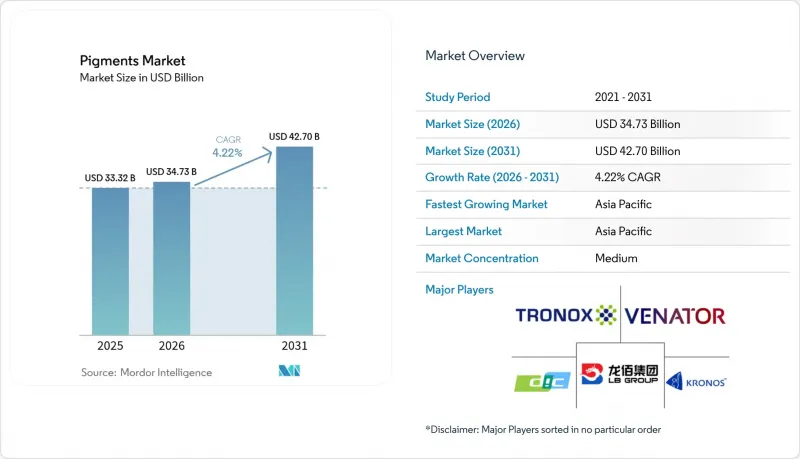
This report is Segmented by Product Type (Inorganic Pigments [Titanium Dioxide, Zinc Oxide, and Other Product Types], Organic Pigments, and Specialty Pigments and Other Product Types), Application (Paints and Coatings, Textiles, Printing Inks, Plastics, Leather, and Other Applications), and Geography (Asia-Pacific, North America, Europe, and More). The Market Forecasts are Provided in Terms of Value (USD).
Global Pigments Market Trends and Insights
Surging Paints and Coatings Demand in Emerging Economies
Strong infrastructure outlays in India and Southeast Asia are scaling architectural-coating volumes that require high-hiding rutile TiO2 and iron-oxide tints. India's public capital expenditure pipeline continues to run ahead of GDP, and government stimulus in Chinese urban-renewal programs is cushioning the residential slowdown. Tier-2 and tier-3 Chinese cities are additionally shifting toward low-VOC emulsions, elevating organic pigment loading in tinting systems. Vietnam's construction-sector momentum feeds similar demand for water-based latex paints that observe volatile-organic-compound ceilings. Collectively, these developments reinforce a sturdy consumption base for both commodity and specialty grades, bolstering the pigments market across Asia-Pacific.
Regulatory Push Toward Eco-Friendly/Bio-Based Pigments
The European Food Safety Authority's 2022 enforcement of the TiO2 (E171) food ban is cascading into cosmetics and personal-care reformulations. Brands are piloting microalgal and fungal colorants despite unresolved scaling hurdles. In the United States, nanomaterial-specific reporting under TSCA intensifies compliance costs. The dual pressure is bifurcating strategies: commodity producers double down on rutile TiO2 for construction paints, while specialty houses channel research and development toward bio-fermentation routes that can command premium pricing once commercialized.
Stringent Environmental and Toxicology Regulations
Mid-tier producers, lacking dedicated regulatory teams, find their margins pinched as compliance with REACH and TSCA can push dossier costs to significant levels per pigment. In the U.S., PMN reviews for nanomaterials have extended to 12 months, causing delays in new-product launches and shifting procurement focus to pre-approved pigments. Meanwhile, larger suppliers, with their diversified portfolios, seamlessly absorb these costs, further fueling consolidation trends in the pigments market.
Other drivers and restraints analyzed in the detailed report include:
- Rising Adoption of High-Performance and Effect Pigments
- Nano-Enabled Digital and 3D Printing Applications
- Raw-Material Price Volatility (TiO2, Iron-Oxide Feedstocks)
For complete list of drivers and restraints, kindly check the Table Of Contents.
Segment Analysis
Inorganic pigments held 75.45% of 2025 revenue, illustrating the entrenched role of TiO2 in architectural and industrial coatings, the largest sub-segment within the pigments market share. Organic pigments, however, are advancing 5.21% annually, driven by plastics and packaging applications that demand lightfastness and regulatory compliance. Electric vehicles and consumer electronics are driving a premium for specialty sub-categories like infrared-reflective complex inorganic color pigments over commodity TiO2. While the market size for these specialty-grade pigments is relatively modest, their significant value contribution fuels robust research and development efforts across the industry.
Regulatory fragmentation is spurring rapid substitution trends. Cosmetics brands are now experimenting with iron-oxide blends and bio-derived colorants. Meanwhile, while carbon black has long dominated printing inks and automotive underbodies, it is now facing competition from graphene dispersions and recycled alternatives, which aim to reduce furnace-black particulate emissions. Earth-based siennas and ultramarine blues, though still cherished in artistic circles, make up a small portion of the overall pigments market.
Complete Report Scope:
- By Product Type
- Inorganic Pigments
- Titanium Dioxide
- Zinc Oxide
- Other Product Types (Carbon Pigments, Dry Earth, Ultramarine Pigments, Cadmium, Lead Chromate, and Others)
- Organic Pigments
- Specialty Pigments and Other Product Types (Functional Pigments, Magnetic Pigments, and Others)
- Inorganic Pigments
- By Application
- Paints and Coatings
- Textiles
- Printing Inks
- Plastics
- Leather
- Other Applications
- By Geography
- Asia-Pacific
- China
- India
- Japan
- South Korea
- ASEAN Countries
- Rest of Asia-Pacific
- North America
- United States
- Canada
- Mexico
- Europe
- Germany
- United Kingdom
- Italy
- France
- Spain
- Russia
- Rest of Europe
- South America
- Brazil
- Argentina
- Rest of South America
- Middle-East and Africa
- Saudi Arabia
- South Africa
- Rest of Middle-East and Africa
- Asia-Pacific
Geography Analysis
Asia-Pacific accounted for 45.68% of revenue in 2025 and will outpace all other regions at a 5.36% CAGR through 2031. China's stimulus programs in urban-renewal projects offset softness in new-build construction, sustaining mid-single-digit gains in interior emulsions. India's infrastructure agenda spurs demand for high-performance epoxy and polyurethane coatings requiring specialty iron-oxide and organic pigments. Japan's incremental innovations in thermochromic and photochromic chemistries and South Korea's automotive and shipbuilding specifications for infrared-reflective and anti-corrosive grades enhance specialty-pigment penetration. ASEAN manufacturing expansions further pull volume through maintenance coatings and plastics.
North America and Europe are mature yet premiumizing markets. The Inflation Reduction Act's production credits entice U.S. TiO2 capacity restarts, while Europe's CBAM and anti-dumping levies on Chinese inputs drive localized sourcing, albeit at higher costs. Germany, the United Kingdom, Italy, France, and Spain anchor European demand across automotive refinish, architectural renovation, and industrial maintenance. Russia, isolated by sanctions, remains reliant on local iron-oxide and carbon-black supply.
South America's pigments demand centers on Brazil's construction and automotive production, with infrastructure concessions sustaining protective-coating needs. Argentina and Chile add smaller yet rising contributions. The Middle-East and Africa hold the smallest share but see episodic spikes tied to mega-projects such as NEOM in Saudi Arabia and mining ventures in South Africa. Regulatory regimes in these regions remain less stringent, allowing continued use of lead chromate and cadmium pigments in select industrial niches, although multinational brands are voluntarily phasing them out.
- ALTANA
- Cathay Industries
- DIC Corporation
- Heubach GmbH
- Kronos Worldwide, Inc.
- Lanxess
- LB Group
- Shepherd Color
- Sudarshan Chemical Industries Limited (Heubach GmbH)
- The Chemours Company
- Tronox Holdings Plc
- Trust Chem Co., Ltd.
- Venator Materials PLC
Additional Benefits:
- The market estimate (ME) sheet in Excel format
- 3 months of analyst support
TABLE OF CONTENTS
1 Introduction
- 1.1 Study Assumptions and Market Definition
- 1.2 Scope of the Study
2 Research Methodology
3 Executive Summary
4 Market Landscape
- 4.1 Market Overview
- 4.2 Market Drivers
- 4.2.1 Surging paints and coatings demand in emerging economies
- 4.2.2 Regulatory push toward eco-friendly/bio-based pigments
- 4.2.3 Rising adoption of high-performance and effect pigments
- 4.2.4 Nano-enabled digital and 3-D printing applications
- 4.2.5 Supply-chain localization incentives in US-EU
- 4.3 Market Restraints
- 4.3.1 Stringent environmental and toxicology regulations
- 4.3.2 Raw-material price volatility (TiO2, iron-oxide feedstocks)
- 4.3.3 Nano-particle food-grade bans (E171, cosmetics limits)
- 4.4 Value Chain Analysis
- 4.5 Porter's Five Forces
- 4.5.1 Bargaining Power of Suppliers
- 4.5.2 Bargaining Power of Buyers
- 4.5.3 Threat of New Entrants
- 4.5.4 Threat of Substitutes
- 4.5.5 Degree of Competition
5 Market Size and Growth Forecasts (Value)
- 5.1 By Product Type
- 5.1.1 Inorganic Pigments
- 5.1.1.1 Titanium Dioxide
- 5.1.1.2 Zinc Oxide
- 5.1.1.3 Other Product Types (Carbon Pigments, Dry Earth, Ultramarine Pigments, Cadmium, Lead Chromate, and Others)
- 5.1.2 Organic Pigments
- 5.1.3 Specialty Pigments and Other Product Types (Functional Pigments, Magnetic Pigments, and Others)
- 5.1.1 Inorganic Pigments
- 5.2 By Application
- 5.2.1 Paints and Coatings
- 5.2.2 Textiles
- 5.2.3 Printing Inks
- 5.2.4 Plastics
- 5.2.5 Leather
- 5.2.6 Other Applications
- 5.3 By Geography
- 5.3.1 Asia-Pacific
- 5.3.1.1 China
- 5.3.1.2 India
- 5.3.1.3 Japan
- 5.3.1.4 South Korea
- 5.3.1.5 ASEAN Countries
- 5.3.1.6 Rest of Asia-Pacific
- 5.3.2 North America
- 5.3.2.1 United States
- 5.3.2.2 Canada
- 5.3.2.3 Mexico
- 5.3.3 Europe
- 5.3.3.1 Germany
- 5.3.3.2 United Kingdom
- 5.3.3.3 Italy
- 5.3.3.4 France
- 5.3.3.5 Spain
- 5.3.3.6 Russia
- 5.3.3.7 Rest of Europe
- 5.3.4 South America
- 5.3.4.1 Brazil
- 5.3.4.2 Argentina
- 5.3.4.3 Rest of South America
- 5.3.5 Middle-East and Africa
- 5.3.5.1 Saudi Arabia
- 5.3.5.2 South Africa
- 5.3.5.3 Rest of Middle-East and Africa
- 5.3.1 Asia-Pacific
6 Competitive Landscape
- 6.1 Market Concentration
- 6.2 Strategic Moves
- 6.3 Market Share (%)/Ranking Analysis
- 6.4 Company Profiles (includes Global Level Overview, Market Level Overview, Core Segments, Financials as available, Strategic Information, Products and Services, Recent Developments)
- 6.4.1 ALTANA
- 6.4.2 Cathay Industries
- 6.4.3 DIC Corporation
- 6.4.4 Heubach GmbH
- 6.4.5 Kronos Worldwide, Inc.
- 6.4.6 Lanxess
- 6.4.7 LB Group
- 6.4.8 Shepherd Color
- 6.4.9 Sudarshan Chemical Industries Limited (Heubach GmbH)
- 6.4.10 The Chemours Company
- 6.4.11 Tronox Holdings Plc
- 6.4.12 Trust Chem Co., Ltd.
- 6.4.13 Venator Materials PLC
7 Market Opportunities and Future Outlook
- 7.1 White-space and Unmet-Need Assessment

