PUBLISHER: Mordor Intelligence | PRODUCT CODE: 2120720

PUBLISHER: Mordor Intelligence | PRODUCT CODE: 2120720
Asia-Pacific Carbon Black - Market Share Analysis, Industry Trends & Statistics, Growth Forecasts (2026 - 2031)
According to Mordor Intelligence, the Asia-Pacific carbon black market size is estimated at USD 16.17 billion in 2026, and is expected to reach USD 20.56 billion by 2031, at a CAGR of 4.92% during the forecast period (2026-2031).
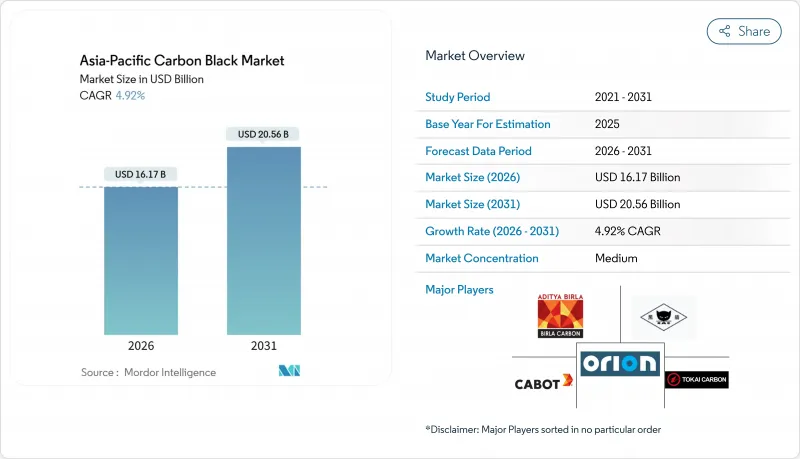
This report is Segmented by Process Type (Furnace Black, Gas Black, Lamp Black, and Thermal Black), Application (Tires and Industrial Rubber Products, Plastics, Toners and Printing Inks, Paints and Coatings, Textile Fibers, and Other Applications), and Geography (China, India, Japan, South Korea, ASEAN Countries, and Rest of Asia-Pacific). The Market Forecasts are Provided in Terms of Value (USD).
Asia-Pacific Carbon Black Market Trends and Insights
Rising Tire-Replacement Demand Across China and India
China and India together consume over 60% of regional tires, yet their replacement cycles differ. China's mature passenger-car fleet generates steady aftermarket pull for high-abrasion grades, while India's expanding commercial-vehicle and two-wheeler base underpins faster incremental volume. CRISIL projects India's tire-replacement demand to rise 7-8% in fiscal 2026, supported by infrastructure spending and higher freight tonnage. The International Monetary Fund expects Asia-Pacific GDP to grow 4.6% in 2025, adding road-travel demand and tire wear. Phillips Carbon Black Limited is enlarging its Mundra facility to capture this growth and coastal export opportunities, evidencing producer confidence in sustained aftermarket momentum.
Specialty Black Uptake in High-Performance EV Tires
Electric vehicles need tires that balance low rolling resistance with greater load-bearing capacity. Cabot's 2024 PROPEL E8 grade lowers hysteresis by 15% relative to traditional N200 series blacks, enabling tire makers to reduce silica content without compromising wet traction. Goodyear's supply agreement with Monolith Materials, also announced in 2024, sources methane-pyrolysis carbon black that cuts production emissions by 90%, aligning with OEM Scope 3 carbon accounting. Tokai Carbon reported JPY 37.4 billion in segment sales during Q3 2024 and is co-developing a recovered-carbon-black line with Bridgestone, showing that specialty grades lift average selling prices by 20-30% even though they represent less than 5% of volume.
Volatile Crude-Derived Feedstock Prices
Carbon black relies on fluid catalytic-cracking tar and coal-tar pitch whose prices track Brent benchmarks with a 2-3-month lag. The World Bank projects Brent at USD 64 per barrel in 2025 and USD 60 in 2026. A USD 10 swing moves feedstock costs 8-10%, compressing producer margins by up to 300 basis points when pass-through lags OEM contracts. Himadri Specialty Chemical disclosed that coal-tar-pitch volatility shaved 150 basis points off gross margin in Q2 2024. ASEAN producers that import 70-80% of tar feedstock saw landed costs surge 12% in H1 2024 due to freight spikes and currency depreciation, underlining how crude swings destabilize smaller, non-integrated players.
Other drivers and restraints analyzed in the detailed report include:
- Regulations Phasing Out Low-Grade Wet-Granulation Units
- Recovered Carbon Black Mandates in Japan and South Korea
- Growing Silica Substitution in Green Tread Compounds
For complete list of drivers and restraints, kindly check the Table Of Contents.
Segment Analysis
Furnace Black accounted for 77.74% of Asia-Pacific carbon black market share in 2025 and continues to anchor bulk demand among tire and industrial-rubber users. Lamp Black, though smaller in tonnage, is forecast to expand at 5.21% CAGR through 2031 as ink and coating formulators value its ultra-fine particle size and lower polycyclic-aromatic content. Thermal and Gas Blacks, together below 5% of volume, serve high-purity plastics and conductive coatings where large or ultra-fine particles are critical.
Major producers are investing in oxidation and encapsulation to widen the performance envelope of furnace grades, yet the capital cost limits widespread adoption. China's GB 29449-2024 energy cap is accelerating the retirement of inefficient wet-granulation lines, which consumed 20-30% more power, thereby shifting volume to integrated firms with dry-pellet technology. Birla Carbon's 2024 Raven 1185 Ultra launch shows how Lamp Black can secure premium niches in digital printing. Meanwhile, Orion's PRINTEX 3 gas black dominates magnetic toner applications, demonstrating specialty demand resilience despite its small share.
Complete Report Scope:
- By Process Type
- Furnace Black
- Gas Black
- Lamp Black
- Thermal Black
- By Application
- Tires and Industrial Rubber Products
- Plastics
- Toners and Printing Inks
- Paints and Coatings
- Textile Fibers
- Other Applications
- By Geography
- China
- India
- Japan
- South Korea
- ASEAN Countries
- Rest of Asia-Pacific
List of Companies Covered in this Report:
- Birla Carbon
- Bridgestone Corporation
- Cabot Corporation
- Cancarb Limited
- Continental Carbon Company
- Denka Company Limited.
- Epsilon Carbon Private Limited
- Himadri Specialty Chemical Ltd.
- Jiangxi Black Cat Carbon Black Co., Ltd.
- Jinghai Carbon Black
- JINNENG Chemical (Qingdao) Co., Ltd
- Longxing Chemical Stock Co. Ltd
- Mitsubishi Chemical Group Corporation
- OCI COMPANY Ltd.
- Omsk Carbon Group
- Orion Engineered Carbons
- Phillips Carbon Black Limited (PCBL)
- Shandong Huadong Rubber Materials Co., Ltd.
- Tokai Carbon Co. Ltd.
Additional Benefits:
- The market estimate (ME) sheet in Excel format
- 3 months of analyst support
TABLE OF CONTENTS
1 Introduction
- 1.1 Study Assumptions and Market Definition
- 1.2 Scope of the Study
2 Research Methodology
3 Executive Summary
4 Market Landscape
- 4.1 Market Overview
- 4.2 Market Drivers
- 4.2.1 Rising tire-replacement demand across China and India
- 4.2.2 Specialty black uptake in high-performance EV tires
- 4.2.3 Regulations phasing-out low-grade wet-granulation units (China)
- 4.2.4 Recovered carbon black (RCB) mandates in Japan and South Korea
- 4.2.5 OEM shift to conductive blacks for Li-ion battery casings
- 4.3 Market Restraints
- 4.3.1 Volatile crude-derived feedstock prices
- 4.3.2 Growing silica substitution in green tread compounds
- 4.3.3 Stricter SOx/NOx emission caps on furnace black plants
- 4.4 Value Chain Analysis
- 4.5 Porter's Five Forces
- 4.5.1 Threat of New Entrants
- 4.5.2 Bargaining Power of Buyers
- 4.5.3 Bargaining Power of Suppliers
- 4.5.4 Threat of Substitutes
- 4.5.5 Degree of Competition
5 Market Size and Growth Forecasts (Value)
- 5.1 By Process Type
- 5.1.1 Furnace Black
- 5.1.2 Gas Black
- 5.1.3 Lamp Black
- 5.1.4 Thermal Black
- 5.2 By Application
- 5.2.1 Tires and Industrial Rubber Products
- 5.2.2 Plastics
- 5.2.3 Toners and Printing Inks
- 5.2.4 Paints and Coatings
- 5.2.5 Textile Fibers
- 5.2.6 Other Applications
- 5.3 By Geography
- 5.3.1 China
- 5.3.2 India
- 5.3.3 Japan
- 5.3.4 South Korea
- 5.3.5 ASEAN Countries
- 5.3.6 Rest of Asia-Pacific
6 Competitive Landscape
- 6.1 Market Concentration
- 6.2 Strategic Moves
- 6.3 Market Share/Ranking Analysis
- 6.4 Company Profiles (includes Global level Overview, Market level overview, Core Segments, Financials as available, Strategic Information, Market Rank/Share for key companies, Products and Services, and Recent Developments)
- 6.4.1 Birla Carbon
- 6.4.2 Bridgestone Corporation
- 6.4.3 Cabot Corporation
- 6.4.4 Cancarb Limited
- 6.4.5 Continental Carbon Company
- 6.4.6 Denka Company Limited.
- 6.4.7 Epsilon Carbon Private Limited
- 6.4.8 Himadri Specialty Chemical Ltd.
- 6.4.9 Jiangxi Black Cat Carbon Black Co., Ltd.
- 6.4.10 Jinghai Carbon Black
- 6.4.11 JINNENG Chemical (Qingdao) Co., Ltd
- 6.4.12 Longxing Chemical Stock Co. Ltd
- 6.4.13 Mitsubishi Chemical Group Corporation
- 6.4.14 OCI COMPANY Ltd.
- 6.4.15 Omsk Carbon Group
- 6.4.16 Orion Engineered Carbons
- 6.4.17 Phillips Carbon Black Limited (PCBL)
- 6.4.18 Shandong Huadong Rubber Materials Co., Ltd.
- 6.4.19 Tokai Carbon Co. Ltd.
7 Market Opportunities and Future Outlook
- 7.1 White-space and Unmet-Need Assessment

