PUBLISHER: Mordor Intelligence | PRODUCT CODE: 2121260

PUBLISHER: Mordor Intelligence | PRODUCT CODE: 2121260
India Online Travel - Market Share Analysis, Industry Trends & Statistics, Growth Forecasts (2026 - 2031)
According to Mordor Intelligence, the India online travel market size is expected to grow from USD 23.34 billion in 2025 to USD 25.38 billion in 2026 and is forecast to reach USD 38.58 billion by 2031 at 8.74% CAGR over 2026-2031.
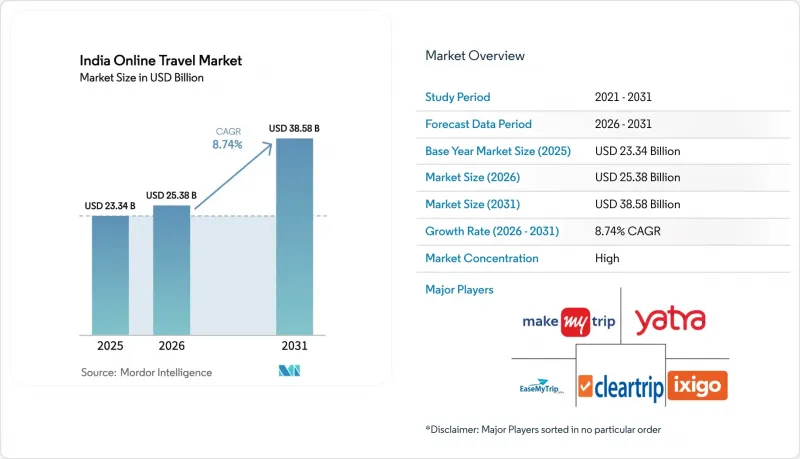
This report is Segmented by Service Type (Transportation, Travel Accommodation, and More), Booking Device (Desktop, and Mobile), Business Model (Online Travel Agencies, and More), Traveler Type (Leisure, Business, and Bleisure), Age Group (18-30 Years, 31-45 Years, and More), and Geography (North India, South India, and More). The Market Forecasts are Provided in Terms of Value (USD Billion).
India Online Travel Market Trends and Insights
Rising Adoption of UPI & Digital Wallets Accelerating Seamless Bookings
Digital payment adoption has aligned with a step-up in internet access and mobile usage, which reduces checkout friction and helps convert browsing into confirmed bookings across flights, rail, bus, hotels, and packages. Widespread 4G availability in towns and villages under national connectivity programs has created a broader base of online-ready travellers who increasingly transact through instant payment rails within OTA and supplier apps. High-frequency mobile data consumption supports richer in-app content such as reviews, videos, and chat-assisted support that shorten decision cycles and improve funnel conversion for the India online travel market. At the platform end, integrated payment experiences are becoming table stakes, as large players invest in scale, safety tooling, and compliance to sustain repeat usage without adding visible friction for consumers. The net effect is a more reliable and faster checkout layer that encourages first-time online bookers in smaller cities to remain digital across future trips, which supports steady penetration gains in the India online travel market.
Government's UDAN Scheme Expanding Regional Air Connectivity
The UDAN regional connectivity scheme has operationalized hundreds of routes and connected dozens of airports since launch, which opens new point-to-point air options and shortens journeys that previously required long road or rail connections. This connectivity scale-up, coupled with a doubling of the broader airport network over the last decade, expands the addressable pool of first-time and occasional fliers who increasingly discover and book seats online. OTAs and direct supplier platforms benefit as travellers in newly connected cities consider bundled packages and last-mile add-ons, which lift attach rates and improve monetization per booking in the India online travel market. As new air corridors stabilize, platform players can pre-negotiate inventory, refine dynamic pricing rules, and use targeted marketing to nurture steady demand along nascent routes. Over time, improved access also encourages hospitality investments in secondary and tertiary cities, which adds quality rooms into digital channels and deepens the inventory available to online travellers.
Fragmented, Unorganized Accommodation Supply Limiting Digitization
A large share of lodging inventory remains unregistered and offline, which constrains digital availability and reduces pricing transparency in smaller towns and pilgrimage circuits where demand is rising. Government initiatives such as sector databases and classification programs aim to standardize quality and improve discoverability, yet adoption by small operators takes time without stronger incentives and sustained outreach. In practice, platforms continue to rely more on branded chains in high-traffic destinations while scaling field onboarding teams where awareness and digital readiness are low. Over the medium term, better registration, uniform identifiers, and simpler compliance pathways can reduce duplicate listings and improve trust, which would allow more small properties to enter online channels. Closing these gaps is central to unlocking new inventory pools that the India online travel market needs in tier-2 and tier-3 catchments as demand scales beyond metros.
Other drivers and restraints analyzed in the detailed report include:
- Domestic Tourism Surge Fuelled by Social-Media Influence
- Rapid Growth of Middle-Income Millennials' Discretionary Spending
- Cybersecurity Breaches Undermining Consumer Trust
For complete list of drivers and restraints, kindly check the Table Of Contents.
Segment Analysis
Transportation accounted for 36.24% in 2025, while vacation packages are projected to grow at 11.24% CAGR through 2031 as travellers shift from self-assembly to bundled experiences. This shift favours platforms that can pre-negotiate hotel blocks, local activities, and transfers, since packaged itineraries deliver better take rates than commoditized air. Leading players reported higher adjusted margins in hotels-and-packages relative to air, which underscores that curated combinations, not only volume throughput, drive profitability in the India online travel market. Corporate travel specialists also use pre-negotiated inventory to serve group demand, which demonstrates the scalability of contract-based supply when paired with software-driven workflows. Platforms that expand activities marketplaces and local experiences can capture more of the destination wallet, reinforcing their package-led value proposition in the India online travel market.
Air within transportation remains a core funnel driver, yet take rates are structurally lower than in hotels, which keeps the strategic focus on monetizing ancillary services and cross-selling higher-margin components. Rail and bus add scale and frequency, and their digital penetration lifts as app interfaces improve reliability from search to post-booking support across routes that serve both commuters and leisure travellers. The India online travel market share tends to concentrate in service lines where inventory depth and service-level predictability are strongest, which is why branded hotels and standardized packages gain prominence as the base of repeat users grows. On the supply side, the gradual expansion of chain hotels and registered homestays adds reliable rooms that platforms can present with clear service standards, reviews, and prices. As regional connectivity opens new short-break circuits, packaged escapes that combine flights, stays, and on-ground experiences will likely remain the fastest-growing service type in the India online travel market.
Mobile captured 65.37% of bookings in 2025 and is forecast to grow at 14.39% CAGR through 2031, which cements app-first planning and checkout as the default consumer path. Smartphone-led access is underpinned by high data usage per subscriber and the growing ubiquity of 4G coverage, which together enable richer content and faster purchase flows. The India online travel market size for mobile bookings is projected to expand at a 14.39% CAGR between 2026 and 2031 as platforms continue to optimize for speed, personalization, and reliability on smaller screens. App ecosystems integrate fare alerts, real-time chat, and one-tap payments that reduce abandonment and increase repeat usage, especially among millennials and Gen Z, who prefer bite-sized, on-the-go planning. While desktop channels still serve complex multi-leg or corporate itineraries, the centre of gravity for leisure and short-haul booking is decisively mobile in the India online travel market.
Mobile's dominance also shifts how platforms design onboarding, verification, and support as users expect real-time updates and service continuity from pre-trip to in-trip. Push notifications pair with contextual offers that match departure patterns, loyalty benefits, and weather windows, which improves conversion in the India online travel market without relying on heavy discounting. Over time, more inventory and services become app-native, from seat selection and meal preferences to in-destination activities, which raises the share of revenue captured post-booking. As data localization and security practices strengthen, leading apps standardize secure flows that protect user data and payment credentials while keeping the experience simple for repeat travellers. The net impact is a durable advantage for platforms that invest ahead of the curve on app performance and trust-building, reinforcing mobile-led growth in the India online travel market.
Complete Report Scope:
- Segmentation by Service Type
- Transportation
- Air Travel
- Bus & Coach Travel
- Rail Travel
- Car Rental
- Cruise
- Travel Accommodation
- Hotels & Resorts
- Alternative Lodging/Rentals
- Vacation Packages
- Others
- Transportation
- Segmentation by Booking Device
- Desktop / Laptop
- Mobile
- Segmentation by Business Model
- Online Travel Agencies
- Direct Supplier Online Platforms
- Segmentation by Traveler Type
- Leisure
- Business
- Bleisure
- Segmentation by Age Group
- 18-30 Years
- 31-45 Years
- 46-60 Years
- Greater than 60 Years
- Segmentation by Region
- North India
- South India
- West India
- East India
- Central India
List of Companies Covered in this Report:
- MakeMyTrip Ltd.
- Yatra Online Ltd.
- EaseMyTrip
- Cleartrip Pvt. Ltd.
- Ixigo
- Airbnb Inc.
- Booking Holdings Inc.
- OYO Rooms
- Thomas Cook (India) Ltd.
- IRCTC Ltd.
- Paytm Travel (One 97 Communications)
- Ixigo (Le Travenues Technology Ltd.)
- SOTC Travel Ltd.
- FabHotels
- Treebo Hotels
- RailYatri
- TBO Tek Limited
- Holiday Triangle Travel Private Limited
- Zoomcar India Pvt. Ltd.
- Revv Self-Drive Cars
Additional Benefits:
- The market estimate (ME) sheet in Excel format
- 3 months of analyst support
TABLE OF CONTENTS
1 Introduction
- 1.1 Study Assumptions & Market Definition
- 1.2 Scope of the Study
2 Research Methodology
3 Executive Summary
4 Market Landscape
- 4.1 Market Overview
- 4.2 Market Drivers
- 4.2.1 Rising Adoption of UPI & Digital Wallets Accelerating Seamless Bookings
- 4.2.2 Government's UDAN Scheme Expanding Regional Air Connectivity
- 4.2.3 Domestic Tourism Surge Fueled by Social-Media Influence
- 4.2.4 Rapid Growth of Middle-Income Millennials Discretionary Spending
- 4.2.5 Smartphone Penetration in Tier-II & III Cities Boosting App Usage
- 4.2.6 Dynamic Pricing Algorithms Enhancing Conversion & Yield
- 4.3 Market Restraints
- 4.3.1 Fragmented Unorganized Accommodation Supply Limiting Digitization
- 4.3.2 Regulatory Uncertainty on Convenience Fees & Refund Norms
- 4.3.3 Cyber-security Breaches Undermining Consumer Trust
- 4.3.4 Escalating Customer-Acquisition Costs Amid Price Wars
- 4.4 Value-Chain Analysis
- 4.5 Regulatory & Technological Outlook
- 4.6 Porter's Five Forces Analysis
- 4.6.1 Threat of New Entrants
- 4.6.2 Bargaining Power of Suppliers
- 4.6.3 Bargaining Power of Buyers
- 4.6.4 Threat of Substitutes
- 4.6.5 Competitive Rivalry
- 4.7 Consumer Booking-Journey Analysis
5 Market Size & Growth Forecasts (Value, INR Billion)
- 5.1 Segmentation by Service Type
- 5.1.1 Transportation
- 5.1.1.1 Air Travel
- 5.1.1.2 Bus & Coach Travel
- 5.1.1.3 Rail Travel
- 5.1.1.4 Car Rental
- 5.1.1.5 Cruise
- 5.1.2 Travel Accommodation
- 5.1.2.1 Hotels & Resorts
- 5.1.2.2 Alternative Lodging/Rentals
- 5.1.2.3 Vacation Packages
- 5.1.2.4 Others
- 5.1.1 Transportation
- 5.2 Segmentation by Booking Device
- 5.2.1 Desktop / Laptop
- 5.2.2 Mobile
- 5.3 Segmentation by Business Model
- 5.3.1 Online Travel Agencies
- 5.3.2 Direct Supplier Online Platforms
- 5.4 Segmentation by Traveler Type
- 5.4.1 Leisure
- 5.4.2 Business
- 5.4.3 Bleisure
- 5.5 Segmentation by Age Group
- 5.5.1 18-30 Years
- 5.5.2 31-45 Years
- 5.5.3 46-60 Years
- 5.5.4 Greater than 60 Years
- 5.6 Segmentation by Region
- 5.6.1 North India
- 5.6.2 South India
- 5.6.3 West India
- 5.6.4 East India
- 5.6.5 Central India
6 Competitive Landscape
- 6.1 Market Concentration
- 6.2 Strategic Moves
- 6.3 Market Share Analysis
- 6.4 Company Profiles (includes Global-level Overview, Market-level Overview, Core Segments, Financials as available, Strategic Information, Market Rank/Share, Products & Services, Recent Developments)
- 6.4.1 MakeMyTrip Ltd.
- 6.4.2 Yatra Online Ltd.
- 6.4.3 EaseMyTrip
- 6.4.4 Cleartrip Pvt. Ltd.
- 6.4.5 Ixigo
- 6.4.6 Airbnb Inc.
- 6.4.7 Booking Holdings Inc.
- 6.4.8 OYO Rooms
- 6.4.9 Thomas Cook (India) Ltd.
- 6.4.10 IRCTC Ltd.
- 6.4.11 Paytm Travel (One 97 Communications)
- 6.4.12 Ixigo (Le Travenues Technology Ltd.)
- 6.4.13 SOTC Travel Ltd.
- 6.4.14 FabHotels
- 6.4.15 Treebo Hotels
- 6.4.16 RailYatri
- 6.4.17 TBO Tek Limited
- 6.4.18 Holiday Triangle Travel Private Limited
- 6.4.19 Zoomcar India Pvt. Ltd.
- 6.4.20 Revv Self-Drive Cars
7 Market Opportunities & Future Outlook
- 7.1 Broader Mobility & Multi-Modal Travel Integration
- 7.2 Medical & Wellness Tourism Integration

