PUBLISHER: Mordor Intelligence | PRODUCT CODE: 2121455

PUBLISHER: Mordor Intelligence | PRODUCT CODE: 2121455
Specialty Food Ingredients - Market Share Analysis, Industry Trends & Statistics, Growth Forecasts (2026 - 2031)
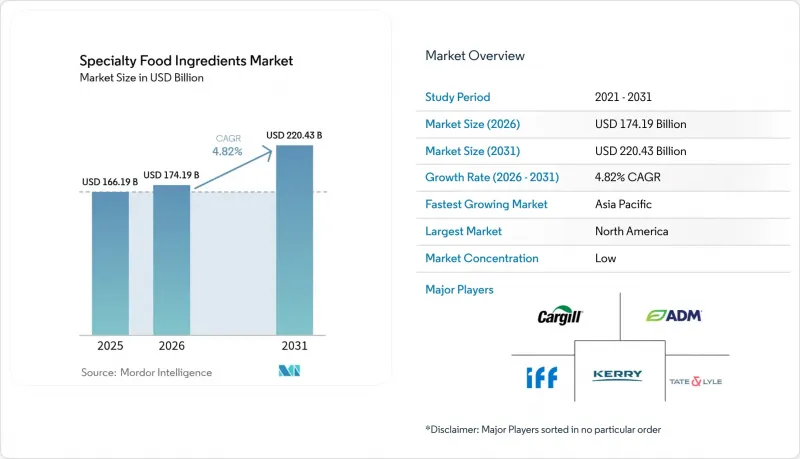
According to Mordor Intelligence, the global specialty food ingredients market size is steadily expanding, growing from USD 166.19 billion in 2025 to USD 174.19 billion in 2026, and is projected to reach USD 220.43 billion by 2031, with a CAGR of 4.82% during 2026-2031.
This report is Segmented by Product Type (Functional Food Ingredient, Sweetener, Food Flavors and Enhancers, Acidulants, and More), Application (Bakery Products, Beverages, Confectionery, Fats and Oils, and More), and Geography (North America, Europe, Asia-Pacific, and More). Market Forecasts are Provided in Terms of Value (USD) and Volume (Tons).
Global Specialty Food Ingredients Market Trends and Insights
Health and wellness awareness
Health and wellness awareness is a key driver of the specialty food ingredients market, as the increasing prevalence of chronic diseases influences consumer expectations regarding everyday foods. Consumers are progressively linking diet to long-term health outcomes and are opting for products designed to support metabolic balance, weight management, digestive health, and immunity. This trend is prompting manufacturers to reformulate products using functional fibers, low-glycemic sweeteners, plant proteins, probiotics, omega fatty acids, and micronutrient fortification. For example, the International Diabetes Federation reports that as of 2024, approximately 589 million adults aged 20-79 are living with diabetes globally, highlighting growing concerns about blood sugar management and dietary quality . As a result, food manufacturers are increasingly relying on specialty ingredients to reduce sugar content, enhance nutritional functionality, and align with health-focused product positioning, thereby driving significant growth in the specialty food ingredients market.
Consumer demand for clean-label ingredients
Increasing consumer demand for clean-label products is driving growth in the global specialty food ingredients market. Shoppers are prioritizing foods with recognizable, minimally processed, and transparent ingredient lists. This trend has led to a decline in the use of artificial preservatives, synthetic colors, and chemical-sounding additives, prompting manufacturers to reformulate products with natural flavors, plant-based colorants, fermentation-derived preservatives, and functional fibers. However, this shift presents technical challenges, as removing traditional additives can impact product stability, taste, texture, and shelf life. To address these issues, food producers rely on specialty ingredients such as natural antioxidants, enzyme systems, hydrocolloids, and botanical extracts to replicate the functionality of conventional additives while maintaining clean-label standards. Additionally, clean-label demands emphasize shorter ingredient lists and allergen-free formulations, increasing the need for advanced ingredient solutions that provide preservation, emulsification, and sensory quality simultaneously.
High production costs for natural and organic specialty ingredients
High production costs associated with natural and organic specialty ingredients serve as a significant restraint on the global specialty food ingredients market. Unlike conventional additives, naturally derived ingredients often require controlled cultivation, certified farming practices, selective harvesting, and complex extraction or purification processes, all of which contribute to higher manufacturing expenses. Additionally, organic certification standards impose compliance, traceability, and auditing requirements, further increasing operational costs and limiting scalability. Natural ingredients also tend to have lower yields, greater seasonal variability, and stricter storage conditions, which drive up processing and quality-assurance costs. These elevated input costs are passed on to food manufacturers, making clean-label or organic products more expensive to produce and challenging to price competitively in cost-sensitive market segments.
Other drivers and restraints analyzed in the detailed report include:
- Expansion of vegan, vegetarian, and plant-forward diets
- Ethical sourcing and sustainable farming practices
- Varying food safety and labeling standards
For complete list of drivers and restraints, kindly check the Table Of Contents.
Segment Analysis
The food flavors and enhancers segment is projected to account for 23.26% of the specialty food ingredients market in 2025, making it a significant contributor. Modern food innovation increasingly emphasizes sensory experiences over traditional focuses like nutrition or preservation. In packaged foods, beverages, plant-based products, and reformulated better-for-you offerings, manufacturers depend on flavors and taste-modulating ingredients to maintain consumer acceptance. As food companies reduce sugar, salt, and fat to align with clean-label and health trends, products often lose palatability. Flavor enhancers play a critical role in restoring mouthfeel and overall taste, enabling reformulation without compromising consumer satisfaction.
The functional food ingredients segment is expected to grow at a CAGR of 4.91% during 2026-2031, significantly driving the specialty food ingredients market. This growth is fueled by a structural shift in consumer perception of food, moving from basic nourishment to a focus on preventive health and daily wellness management. Rising awareness of immunity, digestive health, metabolic balance, and long-term disease prevention has led consumers to scrutinize ingredient lists and prefer products containing scientifically validated bioactive components. Consequently, manufacturers are incorporating nutrients such as probiotics, prebiotics, dietary fibers, plant sterols, omega fatty acids, protein isolates, vitamins, and mineral fortifiers to enhance nutritional value and support credible health claims.
Complete Report Scope:
- By Product Type
- Functional Food Ingredient
- Speciality Starch and Texturants
- Sweetener
- Food Flavors and Enhancers
- Acidulants
- Preservatives
- Emulsifiers
- Colorants
- Enzymes
- Proteins
- Speciality Fats and Oils
- Food Hydrocolloids and Polysaccharides
- Anti-Caking Agents
- Others
- ByApplication
- Bakery Products
- Beverages
- Meat, Poultry, and Seafood
- Dairy Products
- Confectionery
- Fats and Oils
- Dressings/Condiments/Sauces/Marinade
- Pasta, Soup and Noodles
- Prepared Food
- Plant-based Food and Beverage
- Other Applications
- By Geography
- North America
- United States
- Canada
- Mexico
- Rest of North America
- Europe
- Germany
- United Kingdom
- Italy
- France
- Spain
- Netherlands
- Poland
- Belgium
- Sweden
- Rest of Europe
- Asia-Pacific
- China
- India
- Japan
- Australia
- Indonesia
- South Korea
- Thailand
- Singapore
- Rest of Asia-Pacific
- South America
- Brazil
- Argentina
- Colombia
- Chile
- Peru
- Rest of South America
- Middle East and Africa
- South Africa
- Saudi Arabia
- United Arab Emirates
- Nigeria
- Egypt
- Morocco
- Turkey
- Rest of Middle East and Africa
- North America
Geography Analysis
In 2025, North America accounted for 31.04% of the global specialty food ingredients market share, driven by its mature and innovation-focused food manufacturing sector. The region benefits from strong consumer demand for premium, clean-label, and functionally enhanced formulations, prompting food companies to adopt advanced ingredient systems instead of basic commodity additives. Manufacturers are actively reformulating products to reduce artificial components, enhance nutritional profiles, and introduce differentiated sensory characteristics. This has increased reliance on enzymes, natural flavors, bioactive fortification ingredients, and texture modifiers. Clear labeling, product differentiation, and the presence of large multinational ingredient suppliers support ongoing research and commercialization of novel specialty ingredients, strengthening the region's leading market position.
The Asia-Pacific region is projected to grow at a CAGR of 5.61% during 2026-2031, emerging as the fastest-expanding market for specialty food ingredients. Factors such as rising middle-class incomes, rapid urbanization, and the gradual Westernization of dietary habits are driving increased consumption of packaged, processed, and convenience foods that require stabilization, preservation, and sensory optimization. Simultaneously, growing health awareness is encouraging manufacturers to fortify foods and enhance ingredient quality, leading to greater adoption of functional additives, natural colorants, and clean-label solutions. The expansion of domestic food processing industries and the rapid pace of product innovation in developing economies are further pushing ingredient suppliers to scale operations, positioning the region as a key growth driver for the specialty food ingredients market.
Europe, South America, and the Middle East and Africa represent significant but structurally distinct markets for specialty food ingredients. Europe's stringent regulatory standards and detailed ingredient approval processes shape product formulations toward high-quality, safe, and traceable specialty ingredients. This encourages the adoption of certified natural additives and advanced enzyme systems. In South America, led by Brazil, Argentina, and Colombia, the modernization of the processed food sector is driving steady uptake of specialty ingredients, as manufacturers seek improved shelf stability and product consistency across expanding retail channels. Meanwhile, the Middle East and Africa are experiencing growing demand driven by expanding food manufacturing capacity, enhanced retail infrastructure, and rising interest in packaged foods with longer shelf lives and stable quality. This has led to increased use of preservation, texture, and flavor-enhancing ingredient solutions across the region.
- Archer Daniels Midland Company
- Cargill, Incorporated
- Kerry Group plc
- DSM-Firmenich AG
- International Flavors & Fragrances Inc.
- Tate & Lyle PLC
- Ingredion Incorporated
- Givaudan SA
- Associated British Foods plc
- Sensient Technologies Corporation
- Symrise AG
- Novozymes A/S
- AAK AB
- Corbion N.V.
- Lonza Group AG
- Glanbia plc
- Roquette Freres S.A.
- Sudzucker AG
- Celanese Corporation
- Tereos Group
Additional Benefits:
- The market estimate (ME) sheet in Excel format
- 3 months of analyst support
TABLE OF CONTENTS
1 INTRODUCTION
- 1.1 Study Assumptions and Market Definition
- 1.2 Scope of the Study
2 RESEARCH METHODOLOGY
3 EXECUTIVE SUMMARY
4 MARKET LANDSCAPE
- 4.1 Market Overview
- 4.2 Market Drivers
- 4.2.1 Health and wellness awareness
- 4.2.2 Consumer demand for clean-label ingredients
- 4.2.3 Expansion of vegan, vegetarian, and plant-forward diets
- 4.2.4 Ethical sourcing and sustainable farming practices
- 4.2.5 Technological advancements in food processing
- 4.2.6 Growth in processed and packaged foods
- 4.3 Market Restraints
- 4.3.1 High production costs for natural and organic specialty ingredients
- 4.3.2 Varying food safety and labeling standards
- 4.3.3 Ingredient stability and limited shelf life
- 4.3.4 Technical challenges in formulation
- 4.4 Supply Chain Analysis
- 4.5 Regulatory Landscape
- 4.6 Technological Outlook
- 4.7 Porter's Five Forces Analysis
- 4.7.1 Threat of New Entrants
- 4.7.2 Bargaining Power of Buyers
- 4.7.3 Bargaining Power of Suppliers
- 4.7.4 Threat of Substitutes
- 4.7.5 Intensity of Competitive Rivalry
5 MARKET SIZE AND GROWTH FORECASTS (VALUE AND VOLUME)
- 5.1 By Product Type
- 5.1.1 Functional Food Ingredient
- 5.1.2 Speciality Starch and Texturants
- 5.1.3 Sweetener
- 5.1.4 Food Flavors and Enhancers
- 5.1.5 Acidulants
- 5.1.6 Preservatives
- 5.1.7 Emulsifiers
- 5.1.8 Colorants
- 5.1.9 Enzymes
- 5.1.10 Proteins
- 5.1.11 Speciality Fats and Oils
- 5.1.12 Food Hydrocolloids and Polysaccharides
- 5.1.13 Anti-Caking Agents
- 5.1.14 Others
- 5.2 ByApplication
- 5.2.1 Bakery Products
- 5.2.2 Beverages
- 5.2.3 Meat, Poultry, and Seafood
- 5.2.4 Dairy Products
- 5.2.5 Confectionery
- 5.2.6 Fats and Oils
- 5.2.7 Dressings/Condiments/Sauces/Marinade
- 5.2.8 Pasta, Soup and Noodles
- 5.2.9 Prepared Food
- 5.2.10 Plant-based Food and Beverage
- 5.2.11 Other Applications
- 5.3 By Geography
- 5.3.1 North America
- 5.3.1.1 United States
- 5.3.1.2 Canada
- 5.3.1.3 Mexico
- 5.3.1.4 Rest of North America
- 5.3.2 Europe
- 5.3.2.1 Germany
- 5.3.2.2 United Kingdom
- 5.3.2.3 Italy
- 5.3.2.4 France
- 5.3.2.5 Spain
- 5.3.2.6 Netherlands
- 5.3.2.7 Poland
- 5.3.2.8 Belgium
- 5.3.2.9 Sweden
- 5.3.2.10 Rest of Europe
- 5.3.3 Asia-Pacific
- 5.3.3.1 China
- 5.3.3.2 India
- 5.3.3.3 Japan
- 5.3.3.4 Australia
- 5.3.3.5 Indonesia
- 5.3.3.6 South Korea
- 5.3.3.7 Thailand
- 5.3.3.8 Singapore
- 5.3.3.9 Rest of Asia-Pacific
- 5.3.4 South America
- 5.3.4.1 Brazil
- 5.3.4.2 Argentina
- 5.3.4.3 Colombia
- 5.3.4.4 Chile
- 5.3.4.5 Peru
- 5.3.4.6 Rest of South America
- 5.3.5 Middle East and Africa
- 5.3.5.1 South Africa
- 5.3.5.2 Saudi Arabia
- 5.3.5.3 United Arab Emirates
- 5.3.5.4 Nigeria
- 5.3.5.5 Egypt
- 5.3.5.6 Morocco
- 5.3.5.7 Turkey
- 5.3.5.8 Rest of Middle East and Africa
- 5.3.1 North America
6 COMPETITIVE LANDSCAPE
- 6.1 Market Concentration
- 6.2 Strategic Moves
- 6.3 Market Positioning Analysis
- 6.4 Company Profiles (includes Global level Overview, Market level overview, Core Segments, Financials as available, Strategic Information, Market Rank/Share for key companies, Products and Services, and Recent Developments)
- 6.4.1 Archer Daniels Midland Company
- 6.4.2 Cargill, Incorporated
- 6.4.3 Kerry Group plc
- 6.4.4 DSM-Firmenich AG
- 6.4.5 International Flavors & Fragrances Inc.
- 6.4.6 Tate & Lyle PLC
- 6.4.7 Ingredion Incorporated
- 6.4.8 Givaudan SA
- 6.4.9 Associated British Foods plc
- 6.4.10 Sensient Technologies Corporation
- 6.4.11 Symrise AG
- 6.4.12 Novozymes A/S
- 6.4.13 AAK AB
- 6.4.14 Corbion N.V.
- 6.4.15 Lonza Group AG
- 6.4.16 Glanbia plc
- 6.4.17 Roquette Freres S.A.
- 6.4.18 Sudzucker AG
- 6.4.19 Celanese Corporation
- 6.4.20 Tereos Group
7 MARKET OPPORTUNITIES AND FUTURE OUTLOOK

