PUBLISHER: Mordor Intelligence | PRODUCT CODE: 2114109

PUBLISHER: Mordor Intelligence | PRODUCT CODE: 2114109
Asia-Pacific Specialty Food Ingredient - Market Share Analysis, Industry Trends & Statistics, Growth Forecasts (2026 - 2031)
According to Mordor Intelligence, the Asia-Pacific specialty food ingredients market size is expected to grow from USD 31.93 billion in 2025 to USD 33.86 billion in 2026 and is forecast to reach USD 45.46 billion by 2031 at 6.04% CAGR over 2026-2031.
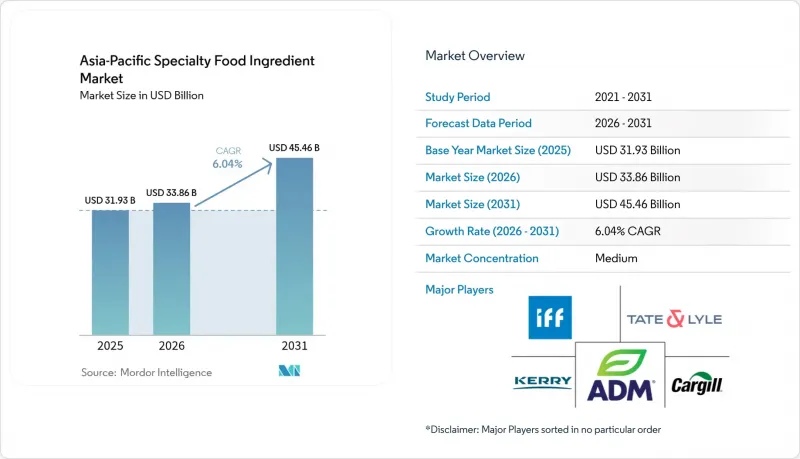
This report is Segmented by Product Type (Functional Food Ingredient, Speciality Starch and Texturants, and More), Application (Meat, Poultry, and Seafood, Dairy Products, and More), and Geography (China, India, Japan, and More). The Market Forecasts are Provided in Terms of Value and Volume (USD/Tons).
Asia-Pacific Specialty Food Ingredient Market Trends and Insights
Increased Health and Wellness Awareness Among Consumers
Rising health consciousness among consumers is driving changes in ingredient demand across Asia-Pacific markets, with functional ingredients gaining wider adoption in food applications. The Japanese functional foods market demonstrates this trend, particularly in women's health and cognitive supplements, where ingredients targeting brain function and hormonal balance maintain premium pricing despite economic challenges. Japan's regulatory framework for functional claims enables manufacturers to differentiate products through evidence-based ingredient benefits, creating competitive advantages for specialty ingredient suppliers. Singapore's expansion of Nutri-Grade labeling to sauces and seasonings by 2027 increases demand for sugar and sodium reduction solutions, making enzyme-based technologies and natural flavor enhancers essential for product formulation. These regulatory changes shift ingredient selection priorities from cost to functionality, favoring suppliers with strong research capabilities and regulatory knowledge.
Surge in Demand for Functional Foods and Beverages
The functional foods market is transforming as manufacturers integrate bioactive compounds that deliver quantifiable health benefits beyond basic nutrition. In February 2025, Vivici obtained EUR 32.5 million in Series A funding to expand its production of animal-free lactoferrin and beta-lactoglobulin proteins for sports nutrition through precision fermentation. This advancement allows ingredient suppliers to improve margins by producing specialized fermentation-derived proteins that offer both environmental and functional advantages. MOA Foodtech's EUR 14.8 million European Innovation Council funding highlights the importance of AI-enhanced fermentation in expediting functional ingredient development from agricultural byproducts . The regulatory frameworks in Singapore and Japan favor functional ingredients with established safety records, benefiting companies that prioritize regulatory documentation and clinical studies. The functional beverages market in India is expanding, driven by health-conscious consumers seeking drinks with natural ingredients, gut-health benefits, and energy-enhancing properties, incorporating Ayurvedic components and practical wellness solutions .
Sourcing and Raw Material Supply Chain Disruptions
Supply chain vulnerabilities expose ingredient manufacturers to cost volatility and availability constraints, particularly in import-dependent Southeast Asian markets. The 70% increase in cocoa prices in 2024 illustrates how climate-related commodity disruptions affect specialty ingredient supply chains, compelling manufacturers to modify formulations or accept reduced margins. Rice production fluctuations in key Asia-Pacific markets create supply constraints for starch-based ingredients, while extreme weather events disrupt raw material flows from traditional sourcing regions. Companies that diversify their supply chains and adopt alternative sourcing technologies gain advantages, as precision fermentation and cellular agriculture offer ways to reduce dependence on climate-sensitive agricultural inputs. The industry's move toward localized ingredient production, demonstrated by significant investments in regional manufacturing facilities, indicates a shift from incremental improvements to fundamental supply chain restructuring.
Other drivers and restraints analyzed in the detailed report include:
- Rising Trend of Plant-Based Diets and Veganism
- Popularity of Natural, Clean-Label, and Organic Products
- Food Safety and Quality Assurance Complexities
For complete list of drivers and restraints, kindly check the Table Of Contents.
Segment Analysis
Food flavors and enhancers maintain a significant presence in the market with a 14.82% share in 2025, demonstrating their fundamental importance in differentiating food products across various applications. The Specialty Fats and Oils segment has emerged as the market's growth leader, advancing at a 7.09% CAGR through 2031. This notable growth trajectory reflects the industry's increasing focus on functional lipids that enable plant-based formulations and clean-label products. A prime example of this innovation is NoPalm Ingredients' introduction of REVOLEO(TM), their fermentation-based alternative to traditional ingredients like palm oil, shea butter, and cocoa butter, scheduled for launch in April 2025.
The functional food ingredients segment, which encompasses essential components such as vitamins, minerals, amino acids, omega-3 ingredients, and probiotic cultures, continues to benefit from increasing consumer health consciousness and favorable regulatory frameworks supporting functional claims throughout key Asia-Pacific markets. Within this category, the protein ingredients subsegment demonstrates particularly robust growth, with plant-based proteins gaining substantial market acceptance through technological improvements in taste masking and texture enhancement. The market is also witnessing emerging opportunities in alternative protein sources, including animal, insect, and microbial proteins. This diversification is exemplified by significant industry developments, such as Nutrition Technologies' USD 100 million MOU with Sumitomo for insect protein development and Pawsible Foods' securing a USD 25,000 grant for their innovative fermentation-derived mycoprotein production.
Complete Report Scope:
- By Product Type
- Functional Food Ingredient
- Vitamins
- Minerals
- Amino Acids
- Omega-3 Ingredients
- Probiotic Cultures
- Other Functional Food Ingredients
- Speciality Starch and Texturants
- Sweetener (Sugar Substitutes)
- Sucralose
- Xylitol
- Stevia
- Aspartame
- Saccharin
- Other Sugar Substitutes
- Food Flavors and Enhancers
- Acidulants
- Preservatives
- Emulsifiers
- Colorants
- Enzymes
- Proteins
- Plant Protein Ingredients
- Soy Protein
- Wheat Protein
- Rice Protein
- Pea Protein
- Other Plant Protein
- Animal, Insect and Microbial Protein Ingredients
- Plant Protein Ingredients
- Speciality Fats and Oils
- Food Hydrocolloids and Polysaccharides
- Anti-Caking Agents
- Yeast
- Food-Grade Glycerin
- Functional Food Ingredient
- By Application
- Bakery Products
- Beverages
- Meat, Poultry, and Seafood
- Dairy Products
- Confectionery
- Fats and Oils
- Dressings/Condiments/Sauces/Marinade
- Pasta, Soup and Noodles
- Plant-based Food and Beverage
- Other Applications
- By Geography
- China
- India
- Japan
- Australia
- Indonesia
- South Korea
- Thailand
- Singapore
- Rest of Asia-Pacific
List of Companies Covered in this Report:
- Cargill, Inc.
- Kerry Group plc
- Tate & Lyle plc
- ADM
- International Flavors & Fragrances Inc.
- DSM-Firmenich
- Sensient Technologies
- Ingredion Inc.
- Givaudan
- Fuji Oil
- CJ CheilJedang
- Roquette Freres
- Wilmar International
- Angel Yeast
- Ajinomoto Co.
- BASF Nutrition & Health
- AAK AB
- Novozymes
- Taiyo Kagaku
- Foodchem International
Additional Benefits:
- The market estimate (ME) sheet in Excel format
- 3 months of analyst support
TABLE OF CONTENTS
1 INTRODUCTION
- 1.1 Study Assumptions and Market Definition
- 1.2 Scope of the Study
2 RESEARCH METHODOLOGY
3 EXECUTIVE SUMMARY
4 MARKET LANDSCAPE
- 4.1 Market Overview
- 4.2 Market Drivers
- 4.2.1 Increased health and wellness awareness among consumers
- 4.2.2 Surge in demand for functional foods and beverages
- 4.2.3 Rising trend of plant-based diets and veganism
- 4.2.4 Popularity of natural, clean-label, and organic products
- 4.2.5 Expanding premium snacking and confectionery segment
- 4.2.6 Adoption of convenience and ready-to-eat/packaged foods
- 4.3 Market Restraints
- 4.3.1 Sourcing and raw material supply chain disruptions
- 4.3.2 Lack of consumer awareness about new or novel ingredients
- 4.3.3 Limited shelf life and instability of some specialty ingredients
- 4.3.4 Food safety and quality assurance complexities
- 4.4 Technology Outlook
- 4.5 Regulatory Outlook
- 4.6 Porter's Five Forces
- 4.6.1 Threat of New Entrants
- 4.6.2 Bargaining Power of Buyers/Consumers
- 4.6.3 Bargaining Power of Suppliers
- 4.6.4 Threat of Substitute Products
- 4.6.5 Intensity of Competitive Rivalry
5 MARKET SIZE AND GROWTH FORECASTS (VALUE AND VOLUME)
- 5.1 By Product Type
- 5.1.1 Functional Food Ingredient
- 5.1.1.1 Vitamins
- 5.1.1.2 Minerals
- 5.1.1.3 Amino Acids
- 5.1.1.4 Omega-3 Ingredients
- 5.1.1.5 Probiotic Cultures
- 5.1.1.6 Other Functional Food Ingredients
- 5.1.2 Speciality Starch and Texturants
- 5.1.3 Sweetener (Sugar Substitutes)
- 5.1.3.1 Sucralose
- 5.1.3.2 Xylitol
- 5.1.3.3 Stevia
- 5.1.3.4 Aspartame
- 5.1.3.5 Saccharin
- 5.1.3.6 Other Sugar Substitutes
- 5.1.4 Food Flavors and Enhancers
- 5.1.5 Acidulants
- 5.1.6 Preservatives
- 5.1.7 Emulsifiers
- 5.1.8 Colorants
- 5.1.9 Enzymes
- 5.1.10 Proteins
- 5.1.10.1 Plant Protein Ingredients
- 5.1.10.1.1 Soy Protein
- 5.1.10.1.2 Wheat Protein
- 5.1.10.1.3 Rice Protein
- 5.1.10.1.4 Pea Protein
- 5.1.10.1.5 Other Plant Protein
- 5.1.10.2 Animal, Insect and Microbial Protein Ingredients
- 5.1.10.1 Plant Protein Ingredients
- 5.1.11 Speciality Fats and Oils
- 5.1.12 Food Hydrocolloids and Polysaccharides
- 5.1.13 Anti-Caking Agents
- 5.1.14 Yeast
- 5.1.15 Food-Grade Glycerin
- 5.1.1 Functional Food Ingredient
- 5.2 By Application
- 5.2.1 Bakery Products
- 5.2.2 Beverages
- 5.2.3 Meat, Poultry, and Seafood
- 5.2.4 Dairy Products
- 5.2.5 Confectionery
- 5.2.6 Fats and Oils
- 5.2.7 Dressings/Condiments/Sauces/Marinade
- 5.2.8 Pasta, Soup and Noodles
- 5.2.9 Plant-based Food and Beverage
- 5.2.10 Other Applications
- 5.3 By Geography
- 5.3.1 China
- 5.3.2 India
- 5.3.3 Japan
- 5.3.4 Australia
- 5.3.5 Indonesia
- 5.3.6 South Korea
- 5.3.7 Thailand
- 5.3.8 Singapore
- 5.3.9 Rest of Asia-Pacific
6 COMPETITIVE LANDSCAPE
- 6.1 Market Concentration
- 6.2 Strategic Moves
- 6.3 Market Ranking Analysis
- 6.4 Company Profiles (includes Global-level Overview, Market-level Overview, Core Segments, Financials (if available), Strategic Information, Market Rank/Share, Products and Services, Recent Developments)
- 6.4.1 Cargill, Inc.
- 6.4.2 Kerry Group plc
- 6.4.3 Tate & Lyle plc
- 6.4.4 ADM
- 6.4.5 International Flavors & Fragrances Inc.
- 6.4.6 DSM-Firmenich
- 6.4.7 Sensient Technologies
- 6.4.8 Ingredion Inc.
- 6.4.9 Givaudan
- 6.4.10 Fuji Oil
- 6.4.11 CJ CheilJedang
- 6.4.12 Roquette Freres
- 6.4.13 Wilmar International
- 6.4.14 Angel Yeast
- 6.4.15 Ajinomoto Co.
- 6.4.16 BASF Nutrition & Health
- 6.4.17 AAK AB
- 6.4.18 Novozymes
- 6.4.19 Taiyo Kagaku
- 6.4.20 Foodchem International
7 MARKET OPPORTUNITIES AND FUTURE OUTLOOK

