PUBLISHER: Mordor Intelligence | PRODUCT CODE: 2114108

PUBLISHER: Mordor Intelligence | PRODUCT CODE: 2114108
Middle East And Africa Specialty Food Ingredients - Market Share Analysis, Industry Trends & Statistics, Growth Forecasts (2026 - 2031)
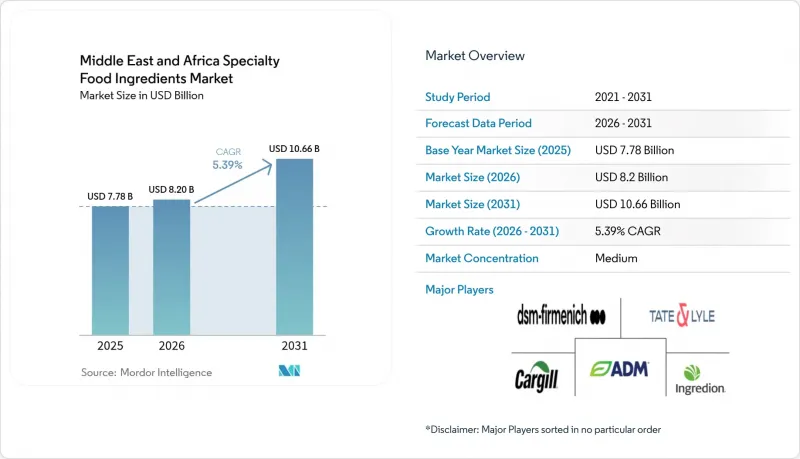
According to Mordor Intelligence, the middle east and Africa specialty food ingredients market size was valued at USD 7.78 billion in 2025 and estimated to grow from USD 8.2 billion in 2026 to reach USD 10.66 billion by 2031, at a CAGR of 5.39% during the forecast period (2026-2031).
This report is Segmented by Ingredient Type (Sweeteners, Food Flavors and Enhancers, Emulsifiers, and More), Form (Powder/Granular and Liquid), Category (Synthetic Specialty Ingredients and More), Application (Bakery and Confectionery, Beverages, Meat, and More), and Geography (South Africa, Saudi Arabia, and More). The Market Forecasts are Provided in Terms of Value (USD).
Middle East And Africa Specialty Food Ingredients Market Trends and Insights
Rising Consumer Demand for Healthier, Functional Food Options
Urban populations in Saudi Arabia and the UAE are driving demand for fortified dairy, probiotic beverages, and omega-3-enriched products as chronic disease prevalence rises. The Saudi Ministry of Health reported in 2024 that 35.4% of adults are obese, prompting consumers to seek functional ingredients that deliver tangible health outcomes beyond basic nutrition . DSM-Firmenich's vitamin premix sales in the Middle East grew 18% year-over-year in 2024, reflecting manufacturers' shift toward fortification as a competitive differentiator. Probiotic cultures, particularly Lactobacillus and Bifidobacterium strains, are being incorporated into yogurt and fermented milk drinks, with South Africa's dairy sector mandating vitamin A and D fortification to address micronutrient deficiencies. This trend is creating premium pricing opportunities for ingredient suppliers who can demonstrate clinical efficacy through peer-reviewed studies.
Local Flavor Traditions Plus Globalization
Date syrup and date sugar are gaining traction as natural sweeteners in Saudi Arabia and the UAE, leveraging regional agricultural heritage while meeting clean-label demands. A 2024 study published in the Journal of Food Science documented date syrup's lower glycemic index compared to sucrose, positioning it as a functional sweetener for diabetic consumers. South African rooibos extract is being adopted in functional beverages across the Gulf Cooperation Council for its antioxidant properties, while Nigerian manufacturers are exploring Bambara nuts and cowpea as protein sources for fortified snacks. Ingredion's launch of FIBERTEX citrus fiber in EMEA in May 2024 exemplifies how global suppliers are adapting formulations to accommodate regional taste preferences while delivering functional benefits like improved satiety. This fusion of local and global flavors is expanding the addressable market for specialty ingredients beyond commodity sweeteners and preservatives.
High Production Cost of Specialty Food Ingredients
Raw material price volatility is compressing margins for ingredient manufacturers and limiting adoption of premium functional ingredients. Cocoa prices surged to USD 10,000 per ton in April 2024, driven by crop failures in Cote d'Ivoire and Ghana, forcing confectionery manufacturers to reduce cocoa content or switch to compound coatings. Vanilla extract prices climbed 25-30% in 2024 due to cyclone damage in Madagascar, prompting flavor houses to develop synthetic vanillin blends that sacrifice clean-label positioning for cost control. Palm oil price fluctuations directly impact emulsifier costs, with Malaysian palm oil futures averaging 15% higher in 2024 compared to 2023. Currency depreciation in Nigeria and Kenya is amplifying import costs for specialty ingredients, with the naira losing 42% against the dollar in 2024, making locally produced alternatives increasingly competitive despite quality gaps.
Other drivers and restraints analyzed in the detailed report include:
- Demand for Fortified Staples and Affordable Nutrition
- Rise in Demand for Processed/Packaged Food
- Stringent Regulatory Compliance Requirements Hinders Growth
For complete list of drivers and restraints, kindly check the Table Of Contents.
Segment Analysis
Functional food ingredients will expand at 6.48% CAGR through 2031, outpacing the overall market as governments mandate micronutrient enrichment and consumers seek health benefits beyond basic nutrition. Vitamins and minerals dominate this segment, driven by Saudi Arabia's requirement for vitamin D in all milk products and Tanzania's fortification of wheat and maize flour with iron and folic acid. Omega-3 ingredients are gaining traction in premium dairy and bakery products, with encapsulation technology improving oxidative stability in high-temperature climates. Probiotic cultures, particularly Lactobacillus and Bifidobacterium strains, are being incorporated into yogurt and fermented beverages, though cold chain limitations constrain adoption in rural markets. Amino acids like lysine and methionine are finding application in fortified porridges and infant nutrition products across Sub-Saharan Africa.
Sweeteners commanded 31.02% market share in 2025, reflecting their ubiquity in beverages, confectionery, and bakery applications, but growth is moderating as sugar taxes reshape consumption patterns. Saudi Arabia's 50% tax on sweetened beverages and 100% levy on energy drinks, implemented in 2024, is accelerating substitution toward natural sweeteners like stevia, monk fruit, and date syrup. Food flavors and enhancers are experiencing steady demand as manufacturers reformulate to mask off-flavors from fortification minerals and natural preservatives. Preservatives face headwinds as clean-label preferences drive substitution toward natural alternatives like rosemary extract and fermented ingredients, with Corbion's Verdad line capturing share from sodium benzoate. Emulsifiers, colorants, and enzymes serve specialized applications, with Novonesis reporting 22% growth in bakery enzyme sales in Africa during 2024 as artisanal bakers adopt clean-label dough conditioners.
Liquid formats will grow at 6.82% CAGR through 2031, driven by beverage reformulation and enzyme applications in dairy processing, yet powder and granular forms held 66.78% market share in 2025 due to superior shelf stability in high-temperature distribution networks. The Middle East and Africa's ambient temperatures, often exceeding 40°C during summer months, accelerate degradation of liquid ingredients, making powder formats the default choice for vitamins, minerals, and flavor compounds. Microencapsulation technology is enabling powder formats for previously liquid-only ingredients like omega-3 oils and probiotics, with DuPont's Danisco HOLDBAC YM-C culture offering improved heat tolerance in powder form. Reconstitution challenges in hard water regions are driving innovation in instant-dispersible powders that maintain functionality across varying water quality.
Liquid ingredients are gaining share in applications where immediate solubility and uniform dispersion are critical, particularly enzyme solutions for dairy and bakery processing. Kerry Group's taste and nutrition center in Dubai is formulating liquid flavor systems optimized for beverage reformulation, where powder formats can cause sedimentation or cloudiness. Liquid emulsifiers and stabilizers are preferred in industrial bakery applications for consistent dough handling properties. The beverage sector's 29.72% market share in 2025 is supporting liquid ingredient growth, as manufacturers adopt liquid sweetener blends and flavor systems that integrate seamlessly into production lines. Cold chain expansion in urban centers is gradually reducing the shelf-life disadvantage of liquid formats, though rural distribution remains powder-dominated.
Complete Report Scope:
- By Ingredient Type
- Functional Food Ingredient
- Vitamins
- Minerals
- Amino Acids
- Omega-3 Ingredients
- Probiotic Cultures
- Other Functional Food Ingredients
- Sweetener
- Food Flavors and Enhancers
- Preservatives
- Emulsifiers
- Colorants
- Enzymes
- Other Product Types
- Functional Food Ingredient
- By Form
- Powder/Granular
- Liquid
- By Category
- Synthetic Specialty Ingredients
- Natural Specialty Ingredients
- By Application
- Bakery and Confectionery
- Beverages
- Meat, Poultry, and Seafood
- Dairy Products
- Other Applications
- By Geography
- South Africa
- Saudi Arabia
- United Arab Emirates
- Nigeria
- Rest of Middle East and Africa
List of Companies Covered in this Report:
- Cargill, Incorporated
- Archer Daniels Midland Company
- DuPont
- Ingredion
- Tate & Lyle PLC
- DSM-Firmenich
- Kerry Group PLC
- Givaudan SA
- Sensient Technologies Corporation
- Chr. Hansen Holding A/S
- BASF SE
- Symrise AG
- Corbion N.V.
- Novozymes A/S
- Roquette Freres
- International Flavors & Fragrances Inc. (IFF)
- Firmenich (part of DSM-Firmenich)
- Ashland Global Holdings Inc.
- Lonza Group AG
- Ajinomoto Co., Inc.
Additional Benefits:
- The market estimate (ME) sheet in Excel format
- 3 months of analyst support
TABLE OF CONTENTS
1 INTRODUCTION
- 1.1 Study Assumptions and Market Definition
- 1.2 Scope of the Study
2 RESEARCH METHODOLOGY
3 EXECUTIVE SUMMARY
4 MARKET LANDSCAPE
- 4.1 Market Overview
- 4.2 Market Drivers
- 4.2.1 Rising consumer demand for healthier, functional food options
- 4.2.2 Local flavour traditions plus globalisation
- 4.2.3 Strong bakery and bread culture
- 4.2.4 Demand for fortified staples and affordable nutrition
- 4.2.5 Food manufacturers reformulating with bioactive ingredients
- 4.2.6 Rise in demand for processed/packaged food
- 4.3 Market Restraints
- 4.3.1 High production cost of specialty food ingredients
- 4.3.2 Stringent regulatory compliance requirements hinders growth
- 4.3.3 Supply chain complexities for niche ingredient sourcing
- 4.3.4 Short shelf life and stability challenges of ingredients
- 4.4 Supply-Chain Analysis
- 4.5 Regulatory Landscape
- 4.6 Porter's Five Forces
- 4.6.1 Threat of New Entrants
- 4.6.2 Bargaining Power of Buyers
- 4.6.3 Bargaining Power of Suppliers
- 4.6.4 Threat of Substitute Products
- 4.6.5 Intensity of Competitive Rivalry
5 MARKET SIZE AND GROWTH FORECASTS (VALUE, USD)
- 5.1 By Ingredient Type
- 5.1.1 Functional Food Ingredient
- 5.1.1.1 Vitamins
- 5.1.1.2 Minerals
- 5.1.1.3 Amino Acids
- 5.1.1.4 Omega-3 Ingredients
- 5.1.1.5 Probiotic Cultures
- 5.1.1.6 Other Functional Food Ingredients
- 5.1.2 Sweetener
- 5.1.3 Food Flavors and Enhancers
- 5.1.4 Preservatives
- 5.1.5 Emulsifiers
- 5.1.6 Colorants
- 5.1.7 Enzymes
- 5.1.8 Other Product Types
- 5.1.1 Functional Food Ingredient
- 5.2 By Form
- 5.2.1 Powder/Granular
- 5.2.2 Liquid
- 5.3 By Category
- 5.3.1 Synthetic Specialty Ingredients
- 5.3.2 Natural Specialty Ingredients
- 5.4 By Application
- 5.4.1 Bakery and Confectionery
- 5.4.2 Beverages
- 5.4.3 Meat, Poultry, and Seafood
- 5.4.4 Dairy Products
- 5.4.5 Other Applications
- 5.5 By Geography
- 5.5.1 South Africa
- 5.5.2 Saudi Arabia
- 5.5.3 United Arab Emirates
- 5.5.4 Nigeria
- 5.5.5 Rest of Middle East and Africa
6 COMPETITIVE LANDSCAPE
- 6.1 Market Concentration
- 6.2 Strategic Moves
- 6.3 Market Share Analysis
- 6.4 Company Profiles (includes Global level Overview, Market level overview, Core Segments, Financials as available, Strategic Information, Market Rank/Share for key companies, Products and Services, and Recent Developments)
- 6.4.1 Cargill, Incorporated
- 6.4.2 Archer Daniels Midland Company
- 6.4.3 DuPont
- 6.4.4 Ingredion
- 6.4.5 Tate & Lyle PLC
- 6.4.6 DSM-Firmenich
- 6.4.7 Kerry Group PLC
- 6.4.8 Givaudan SA
- 6.4.9 Sensient Technologies Corporation
- 6.4.10 Chr. Hansen Holding A/S
- 6.4.11 BASF SE
- 6.4.12 Symrise AG
- 6.4.13 Corbion N.V.
- 6.4.14 Novozymes A/S
- 6.4.15 Roquette Freres
- 6.4.16 International Flavors & Fragrances Inc. (IFF)
- 6.4.17 Firmenich (part of DSM-Firmenich)
- 6.4.18 Ashland Global Holdings Inc.
- 6.4.19 Lonza Group AG
- 6.4.20 Ajinomoto Co., Inc.
7 MARKET OPPORTUNITIES AND FUTURE OUTLOOK

