PUBLISHER: Mordor Intelligence | PRODUCT CODE: 2113914

PUBLISHER: Mordor Intelligence | PRODUCT CODE: 2113914
Microencapsulated Food Ingredient - Market Share Analysis, Industry Trends & Statistics, Growth Forecasts (2026 - 2031)
According to Mordor Intelligence, the microencapsulated food ingredient market size is expected to grow from USD 8.42 billion in 2025 to USD 9.21 billion in 2026 and is forecast to reach USD 14.46 billion by 2031 at 9.43% CAGR over 2026-2031.
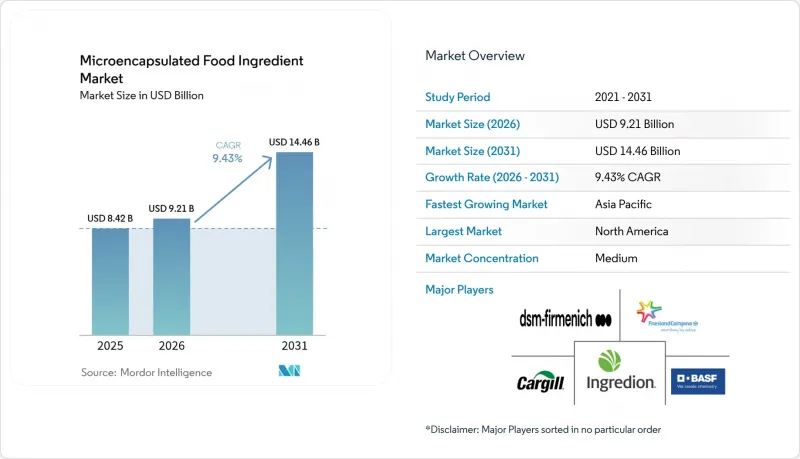
This report is Segmented Into Type (Vitamins, Minerals, Enzymes, and More), Form (Liquid and Solid), Encapsulation Technology (Spray Technologies, Emulsion Technologies, and More), Application (Functional Foods, Dietary Supplements, and More), and Geography. The Report Offers the Market Size in Value Terms in USD for all the Abovementioned Segments.
Global Microencapsulated Food Ingredient Market Trends and Insights
Increasing Demand for Controlled Release of Flavors and Nutrients
The increasing demand for enhanced sensory experiences is significantly expanding microencapsulation applications beyond conventional taste masking methods. Food manufacturers extensively use microencapsulation technology to develop sophisticated time-released flavor profiles that activate during specific consumption phases, enabling substantial product differentiation in competitive categories such as functional beverages and snack foods. The technology effectively protects volatile compounds from degradation during processing while ensuring comprehensive targeted release in the digestive system, addressing both manufacturing efficiency requirements and bioavailability optimization needs. This precise control of nutrient delivery timing has become increasingly crucial as regulatory authorities implement stringent requirements for documented bioavailability data to validate functional food claims in the market.
Rising Demand for Functional and Fortified Foods
The growth of the functional foods market is changing ingredient sourcing practices as manufacturers aim to enhance nutritional content while maintaining product taste and texture. This transformation is particularly evident in developed markets where consumers increasingly demand foods that combine health benefits with traditional sensory appeal. Microencapsulation technology allows the integration of ingredients such as omega-3 fatty acids, plant-based proteins, and botanical extracts into food products that previously faced consumer resistance due to flavor issues or processing limitations. This technical advancement has enabled manufacturers to create products that meet both nutritional and organoleptic requirements. The combination of an aging population and increased focus on preventive healthcare continues to drive demand for fortified products that provide proven health benefits through effective delivery systems. This trend is further supported by growing consumer awareness of the relationship between diet and long-term health outcomes, leading to increased adoption of functional foods across various demographic segments.
High Initial Investment Costs for Encapsulation Equipment and Technology
High initial investment costs remain a significant restraint in the microencapsulated ingredients market. Implementing advanced encapsulation technologies, such as spray drying, fluid bed coating, and coacervation, requires not only specialized equipment but also precision-engineered systems, which substantially increase capital expenditures. These financial challenges often prevent small and medium-scale manufacturers from adopting these technologies, creating a notable barrier to entry. Additionally, the ongoing costs associated with maintenance, the requirement for skilled technical expertise, and the need for rigorous process validation further compound operational expenses. As a result, the elevated setup and operational costs restrict new entrants and slow down capacity expansion, particularly in developing regions where financial resources and infrastructure may be limited.
Other drivers and restraints analyzed in the detailed report include:
- Growing Focus on Extended Shelf Life and Stability of Food Products
- Increasing Applications in Sports Nutrition and Dietary Supplements
- Technical Challenges in Maintaining Stability During Food Processing
For complete list of drivers and restraints, kindly check the Table Of Contents.
Segment Analysis
Vitamins maintain 28.85% market share in 2025, reflecting their established role in food fortification programs and consumer familiarity with nutritional benefits, yet probiotics and prebiotics are emerging as the fastest-growing segment with 12.02% CAGR through 2031 as gut health awareness reshapes functional food development priorities. The vitamin segment's dominance stems from regulatory clarity around health claims and well-established manufacturing processes that enable cost-effective encapsulation at commercial scales.
Minerals represent a stable but mature segment focused on bioavailability enhancement through chelation and microencapsulation technologies that reduce metallic off-tastes in fortified products. Enzymes are gaining traction in specialized applications where targeted release timing is crucial for functional benefits, particularly in digestive health formulations. Amino acids benefit from encapsulation's taste-masking capabilities, enabling incorporation into mainstream food products without compromising palatability.
Solid encapsulation forms a command 67.76% market share in 2025 due to manufacturing simplicity and storage stability advantages, while liquid encapsulation technologies are advancing at 11.11% CAGR as manufacturers overcome historical stability limitations through innovations in emulsion science and protective coating systems. The solid form's market leadership reflects established spray-drying infrastructure and consumer acceptance of powder-based functional ingredients in applications ranging from infant formula to sports nutrition products.
Recent advances in microfluidic encapsulation technologies are enabling precise control over particle size distribution and release characteristics in liquid systems, addressing previous limitations around batch-to-batch consistency. The liquid segment's expansion is particularly notable in beverage applications where encapsulation enables incorporation of traditionally incompatible ingredients like probiotics and plant proteins without compromising product clarity or mouthfeel. Solid forms retain advantages in shelf-stable applications and cost-sensitive markets where processing simplicity and storage economics favor powder-based delivery systems over more complex liquid formulations.
Complete Report Scope:
- By Ingredient Type
- Vitamins
- Minerals
- Enzymes
- Amino Acids
- Probiotics and Prebiotics
- Essential Oils
- Others
- By Form
- Solid
- Liquid
- By Encapsulation Technology
- Spray Technologies
- Emulsion Technologies
- Dripping Technologies
- Others
- By Application
- Functional Foods
- Dietary Supplements
- Bakey and Confectionary
- Dairy Products
- Others
- By Geography
- North America
- United States
- Canada
- Mexico
- Rest of North America
- Europe
- Germany
- United Kingdom
- Italy
- France
- Spain
- Netherlands
- Rest of Europe
- Asia Pacific
- China
- India
- Japan
- Australia
- South Korea
- Rest of Asia Pacific
- South America
- Brazil
- Argentina
- Rest of South America
- Middle East and Africa
- South Africa
- Saudi Arabia
- United Arab Emirates
- Rest of Middle East and Africa
- North America
Geography Analysis
North America accounted for 36.60% of global revenue in 2025 due to its transparent regulatory framework, robust R&D infrastructure, and consumers seeking verified health benefits. The FDA's Generally Recognized as Safe (GRAS) notifications accelerate innovation cycles and provide competitive advantages to companies with regulatory expertise. The market maintains consistent demand through meal-replacement shakes, fortified snacks, and natural color systems. Well-developed cold chain networks reduce stability concerns, enabling suppliers to focus on release-profile innovation rather than basic protection measures.
Asia Pacific exhibits the highest growth potential with 10.52% CAGR through 2031, reflecting rapid urbanization, expanding middle-class purchasing power, and increasing health consciousness that is driving demand for functional foods and dietary supplements across diverse cultural contexts. The region's growth trajectory is supported by government initiatives promoting food fortification to address nutritional deficiencies, particularly in developing markets where microencapsulation enables stable vitamin and mineral delivery in challenging distribution environments.
Europe represents a mature but innovation-driven market where sustainability concerns and clean label trends are influencing encapsulation technology selection toward natural wall materials and environmentally responsible processing methods. The region's stringent regulatory environment, exemplified by EFSA's updated novel foods guidance effective February 2025, creates barriers to entry but also ensures market stability for approved technologies and ingredients .
- BASF SE
- Cargill, Incorporated
- DSM-Firmenich AG
- Ingredion Incorporated
- Royal FrieslandCampina N.V.
- Balchem Inc.
- Lycored
- GAT Food Essentials GmbH
- Givaudan SA
- Kerry Group
- Symrise AG
- Sensient Technologies
- Aveka Group
- Coating Place Inc.
- Reed Pacific
- Lipo Technologies
- Southwest Research Institute
- International Flavors & Fragrances Inc
- Encapsys LLC
- Glatt Ingenieurtechnik GmbH
Additional Benefits:
- The market estimate (ME) sheet in Excel format
- 3 months of analyst support
TABLE OF CONTENTS
1 INTRODUCTION
- 1.1 Study Assumptions and Market Definition
- 1.2 Scope of the Study
2 RESEARCH METHODOLOGY
3 EXECUTIVE SUMMARY
4 MARKET LANDSCAPE
- 4.1 Market Overview
- 4.2 Market Drivers
- 4.2.1 Increasing demand for controlled release of flavors and nutrients
- 4.2.2 Rising demand for functional and fortified foods
- 4.2.3 Growing focus on extended shelf life and stability of food products
- 4.2.4 Increasing Applications in Sports Nutrition and Dietary Supplements
- 4.2.5 Expanding applications in bakery and confectionery products
- 4.2.6 Development of innovative delivery systems for sensitive ingredients
- 4.3 Market Restraints
- 4.3.1 High initial investment costs for encapsulation equipment and technology
- 4.3.2 Limited shelf life of certain encapsulated ingredients
- 4.3.3 Elevated production costs compared to non-encapsulated ingredients
- 4.3.4 Technical challenges in maintaining stability during food processing
- 4.4 Supply Chain Analysis
- 4.5 Regulatory Landscape
- 4.6 Technological Outlook
- 4.7 Porter's Five Forces
- 4.7.1 Threat of New Entrants
- 4.7.2 Bargaining Power of Buyers
- 4.7.3 Bargaining Power of Suppliers
- 4.7.4 Threat of Substitutes
- 4.7.5 Intensity of Competitive Rivalry
5 MARKET SIZE AND GROWTH FORECASTS
- 5.1 By Ingredient Type
- 5.1.1 Vitamins
- 5.1.2 Minerals
- 5.1.3 Enzymes
- 5.1.4 Amino Acids
- 5.1.5 Probiotics and Prebiotics
- 5.1.6 Essential Oils
- 5.1.7 Others
- 5.2 By Form
- 5.2.1 Solid
- 5.2.2 Liquid
- 5.3 By Encapsulation Technology
- 5.3.1 Spray Technologies
- 5.3.2 Emulsion Technologies
- 5.3.3 Dripping Technologies
- 5.3.4 Others
- 5.4 By Application
- 5.4.1 Functional Foods
- 5.4.2 Dietary Supplements
- 5.4.3 Bakey and Confectionary
- 5.4.4 Dairy Products
- 5.4.5 Others
- 5.5 By Geography
- 5.5.1 North America
- 5.5.1.1 United States
- 5.5.1.2 Canada
- 5.5.1.3 Mexico
- 5.5.1.4 Rest of North America
- 5.5.2 Europe
- 5.5.2.1 Germany
- 5.5.2.2 United Kingdom
- 5.5.2.3 Italy
- 5.5.2.4 France
- 5.5.2.5 Spain
- 5.5.2.6 Netherlands
- 5.5.2.7 Rest of Europe
- 5.5.3 Asia Pacific
- 5.5.3.1 China
- 5.5.3.2 India
- 5.5.3.3 Japan
- 5.5.3.4 Australia
- 5.5.3.5 South Korea
- 5.5.3.6 Rest of Asia Pacific
- 5.5.4 South America
- 5.5.4.1 Brazil
- 5.5.4.2 Argentina
- 5.5.4.3 Rest of South America
- 5.5.5 Middle East and Africa
- 5.5.5.1 South Africa
- 5.5.5.2 Saudi Arabia
- 5.5.5.3 United Arab Emirates
- 5.5.5.4 Rest of Middle East and Africa
- 5.5.1 North America
6 COMPETITIVE LANDSCAPE
- 6.1 Market Concentration
- 6.2 Strategic Moves
- 6.3 Market Ranking Analysis
- 6.4 Company Profiles {(includes Global level Overview, Market level overview, Core Segments, Financials as available, Strategic Information, Market Rank/Share for key companies, Products and Services, and Recent Developments)}
- 6.4.1 BASF SE
- 6.4.2 Cargill, Incorporated
- 6.4.3 DSM-Firmenich AG
- 6.4.4 Ingredion Incorporated
- 6.4.5 Royal FrieslandCampina N.V.
- 6.4.6 Balchem Inc.
- 6.4.7 Lycored
- 6.4.8 GAT Food Essentials GmbH
- 6.4.9 Givaudan SA
- 6.4.10 Kerry Group
- 6.4.11 Symrise AG
- 6.4.12 Sensient Technologies
- 6.4.13 Aveka Group
- 6.4.14 Coating Place Inc.
- 6.4.15 Reed Pacific
- 6.4.16 Lipo Technologies
- 6.4.17 Southwest Research Institute
- 6.4.18 International Flavors & Fragrances Inc
- 6.4.19 Encapsys LLC
- 6.4.20 Glatt Ingenieurtechnik GmbH
7 MARKET OPPORTUNITIES AND FUTURE OUTLOOK

