PUBLISHER: Mordor Intelligence | PRODUCT CODE: 2121553

PUBLISHER: Mordor Intelligence | PRODUCT CODE: 2121553
Thermoplastics - Market Share Analysis, Industry Trends & Statistics, Growth Forecasts (2026 - 2031)
According to Mordor Intelligence, the thermoplastics market size is expected to grow from USD 22.34 billion in 2025 to USD 23.25 billion in 2026 and is forecast to reach USD 28.38 billion by 2031 at 4.07% CAGR over 2026-2031.
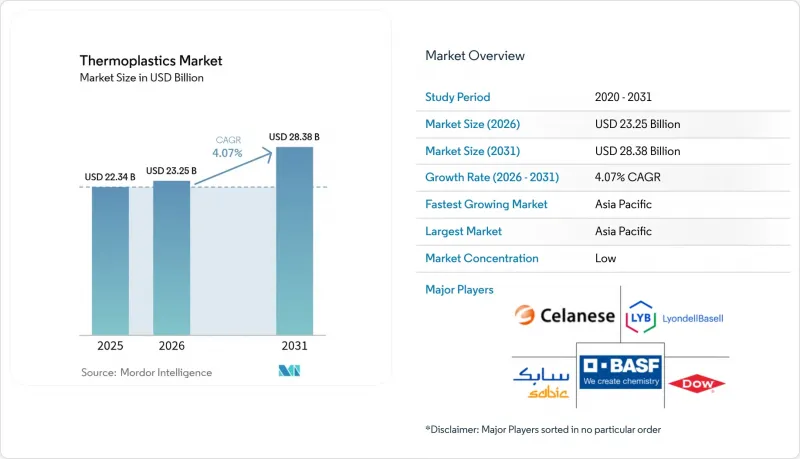
This report is Segmented by Product Type (Commodity, Engineering, High-Performance, and Other Product Types), End-User Industry (Packaging, Building and Construction, Automotive and Transportation, Electrical and Electronics, Sports and Leisure, and More), and Geography (Asia-Pacific, North America, Europe, South America, Middle-East and Africa). Market Forecasts are Provided in Terms of Value (USD).
Global Thermoplastics Market Trends and Insights
Capacity Additions in Downstream Processing Hubs
Integrated complexes in Gujarat, Jubail, and the U.S. Gulf Coast now co-locate cracking, polymerization, and compounding within a 10-kilometer radius, trimming logistics costs and enabling just-in-time resin delivery. Reliance Industries' Jamnagar site produces polyethylene and polypropylene alongside masterbatch lines, a setup that cuts working capital. Co-sited operations also shield processors from port congestion and container shortages that inflated freight rates in 2024. Nevertheless, in Zhejiang, polypropylene plants are running at near capacity. This comes as domestic auto production levels off, underscoring that new supply additions are surpassing China's internal demand. Consequently, long-term offtake contracts are becoming the preferred risk hedge for both resin makers and converters.
Accelerating E-Commerce and Fresh-Food Delivery Packaging Demand
Online grocery penetration has increased in North America and urban China during 2024, spurring demand for multi-layer polyethylene films with water-vapor transmission rates below 2 g/m2-day. Dow's ELITE enhanced polyethylene enables downgauging films while meeting Amazon drop-test standards, thereby reducing material usage. Meal-kit providers, meanwhile, specify microwave-safe polypropylene trays certified to ISO 22000, a niche that has expanded. Divergent recycled-content mandates-California's by 2032 versus the European Union's by 2030-are prompting converters to secure certified post-consumer resin streams that command premiums over virgin grades. Smaller firms unable to secure such a supply are merging or exiting.
Escalating Plastic-Waste Regulation and Bans
Single-use plastic restrictions are now in place in many countries, yet enforcement varies and exemptions are widespread. Canada's prohibition on polystyrene food-service items removed a significant annual outlet for foam extruders. The European Union's tethered-cap rule forces injection molders to retool, often at considerable costs per cavity. France and Germany levy Extended Producer Responsibility fees, prompting brand owners to accelerate lightweighting programs that curb absolute resin use. Mid-sized converters with limited capital for mold changes and compliance with legal requirements tend to become acquisition targets for larger peers.
Other drivers and restraints analyzed in the detailed report include:
- Automotive Lightweighting and EV Adoption Surge
- Scale-Up of Advanced Chemical-Recycling Feedstock Supply
- Crude-Linked Feedstock Price Volatility
For complete list of drivers and restraints, kindly check the Table Of Contents.
Segment Analysis
Commodity resins retained 61.05% of the thermoplastics market in 2025, but high-performance polymers are projected to grow at a 6.05% CAGR, underscoring the premium buyers place on heat resistance and chemical stability. Polyethylene and polypropylene dominate the volume, yet polyvinyl chloride continues to anchor rigid construction items due to its inherent flame retardancy. Polystyrene demand contracted as food service bans expanded. Engineering resins-polyamide, polycarbonate, polyethylene terephthalate, and acrylonitrile-butadiene-styrene-benefit from electric-vehicle underhood components and electronics housings that require service temperatures of up to 120 °C.
Liquid-crystal polymers expand in 5G antenna modules, where a low dielectric constant is crucial for preserving signal integrity above 28 GHz. Supply risk remains in fluoropolymers, where few producers hold a major portion of capacity, a fact highlighted by a force majeure at a major U.S. site earlier in the year.
Complete Report Scope:
- By Product Type
- Commodity Thermoplastics
- Polyethylene (PE)
- Polypropylene (PP)
- Polyvinyl Chloride (PVC)
- Polystyrene (PS)
- Engineering Thermoplastics
- Polyamide (PA)
- Polycarbonate (PC)
- Polymethyl Methacrylate (PMMA)
- Polyoxymethylene (POM)
- Polyethylene Terephthalate (PET)
- Polybutylene Terephthalate (PBT)
- Acrylonitrile-Butadiene-Styrene (ABS) / SAN
- High-Performance Thermoplastics
- Polyether Ether Ketone (PEEK)
- Liquid Crystal Polymer (LCP)
- Polytetrafluoroethylene (PTFE)
- Polyimide (PI)
- Other Product Types (PPE, PSU, PEI, PPS, ETFE, PFA, FEP, PBI)
- Commodity Thermoplastics
- By End-user Industry
- Packaging
- Building and Construction
- Automotive and Transportation
- Electrical and Electronics
- Sports and Leisure
- Furniture and Bedding
- Agriculture
- Medical
- Other End-user Industries
- By Geography
- Asia-Pacific
- China
- India
- Japan
- South Korea
- ASEAN Countries
- Rest of Asia-Pacific
- North America
- United States
- Canada
- Mexico
- Europe
- Germany
- United Kingdom
- France
- Italy
- Spain
- Russia
- Rest of Europe
- South America
- Brazil
- Argentina
- Rest of South America
- Middle-East and Africa
- Saudi Arabia
- South Africa
- Rest of Middle-East and Africa
- Asia-Pacific
Geography Analysis
The Asia-Pacific region commanded 50.76% of global demand in 2025 and is projected to grow at a 5.12% CAGR through 2031, maintaining the thermoplastics market's focus firmly on the region. Integrated value chains in China and India reduce delivered costs and enable rapid capacity rollouts. Reliance's greenfield line in Gujarat and SABIC's Tianjin polycarbonate debottlenecking project exemplify the push to locate resin production close to electronics and automotive hubs.
North America maintained a significant share in 2025. Shale-gas economics still give U.S. producers a propane cost advantage; yet, coastal exporters struggle with longer transit times to Asia compared with Middle East suppliers. Canadian automotive plants standardized glass-fiber-reinforced polyamide battery casings, lifting engineering-resin uptake even as single-use bans curbed polystyrene demand. Mexico's near-shoring trend bolstered polypropylene consumption in border maquiladoras, aided by favorable USMCA rules.
Europe faces aggressive circular-economy mandates. The Carbon Border Adjustment Mechanism places a shadow carbon cost on imported resins, incentivizing compounding moves to Poland and Romania. The United Kingdom's plastic-packaging tax drove a double-digit increase in post-consumer resin demand, but it strained supply, widening the price gap with virgin grades.
Brazil's agriculture-driven polyethylene demand gained despite currency headwinds, while Argentina's economic turmoil kept growth flat. Saudi Arabia's latest polyethylene expansion has increased regional export capacity, providing buyers with a freight advantage in East Africa and South Asia.
- 3M
- Arkema
- Asahi Kasei Corporation
- BASF
- Celanese Corporation
- Chevron Phillips Chemical Company
- Covestro AG
- Daicel Corporation
- Dow
- DSM
- DuPont
- Eastman Chemical Company
- Evonik Industries AG
- INEOS
- LANXESS
- LG Chem
- LyondellBasell Industries Holdings BV
- Mitsubishi Engineering-Plastics Corporation
- Polyplastics Co. Ltd
- SABIC
- Solvay
- TEIJIN LIMITED
Additional Benefits:
- The market estimate (ME) sheet in Excel format
- 3 months of analyst support
TABLE OF CONTENTS
1 Introduction
- 1.1 Study Assumptions and Market Definition
- 1.2 Scope of the Study
2 Research Methodology
3 Executive Summary
4 Market Landscape
- 4.1 Market Overview
- 4.2 Market Drivers
- 4.2.1 Capacity additions in downstream processing hubs
- 4.2.2 Accelerating e-commerce and fresh-food delivery packaging demand
- 4.2.3 Automotive lightweighting and EV adoption surge
- 4.2.4 Rapid industrial expansion in Asia-pacific construction value chains
- 4.2.5 Scale-up of advanced chemical-recycling feedstock supply
- 4.3 Market Restraints
- 4.3.1 Escalating plastic-waste regulation and bans
- 4.3.2 Crude-linked feedstock price volatility
- 4.3.3 EU Carbon Border Adjustment cost pass-through
- 4.4 Value Chain Analysis
- 4.5 Porter's Five Forces
- 4.5.1 Bargaining Power of Suppliers
- 4.5.2 Bargaining Power of Buyers
- 4.5.3 Threat of New Entrants
- 4.5.4 Threat of Substitutes
- 4.5.5 Industry Rivalry
5 Market Size and Growth Forecasts (Value)
- 5.1 By Product Type
- 5.1.1 Commodity Thermoplastics
- 5.1.1.1 Polyethylene (PE)
- 5.1.1.2 Polypropylene (PP)
- 5.1.1.3 Polyvinyl Chloride (PVC)
- 5.1.1.4 Polystyrene (PS)
- 5.1.2 Engineering Thermoplastics
- 5.1.2.1 Polyamide (PA)
- 5.1.2.2 Polycarbonate (PC)
- 5.1.2.3 Polymethyl Methacrylate (PMMA)
- 5.1.2.4 Polyoxymethylene (POM)
- 5.1.2.5 Polyethylene Terephthalate (PET)
- 5.1.2.6 Polybutylene Terephthalate (PBT)
- 5.1.2.7 Acrylonitrile-Butadiene-Styrene (ABS) / SAN
- 5.1.3 High-Performance Thermoplastics
- 5.1.3.1 Polyether Ether Ketone (PEEK)
- 5.1.3.2 Liquid Crystal Polymer (LCP)
- 5.1.3.3 Polytetrafluoroethylene (PTFE)
- 5.1.3.4 Polyimide (PI)
- 5.1.4 Other Product Types (PPE, PSU, PEI, PPS, ETFE, PFA, FEP, PBI)
- 5.1.1 Commodity Thermoplastics
- 5.2 By End-user Industry
- 5.2.1 Packaging
- 5.2.2 Building and Construction
- 5.2.3 Automotive and Transportation
- 5.2.4 Electrical and Electronics
- 5.2.5 Sports and Leisure
- 5.2.6 Furniture and Bedding
- 5.2.7 Agriculture
- 5.2.8 Medical
- 5.2.9 Other End-user Industries
- 5.3 By Geography
- 5.3.1 Asia-Pacific
- 5.3.1.1 China
- 5.3.1.2 India
- 5.3.1.3 Japan
- 5.3.1.4 South Korea
- 5.3.1.5 ASEAN Countries
- 5.3.1.6 Rest of Asia-Pacific
- 5.3.2 North America
- 5.3.2.1 United States
- 5.3.2.2 Canada
- 5.3.2.3 Mexico
- 5.3.3 Europe
- 5.3.3.1 Germany
- 5.3.3.2 United Kingdom
- 5.3.3.3 France
- 5.3.3.4 Italy
- 5.3.3.5 Spain
- 5.3.3.6 Russia
- 5.3.3.7 Rest of Europe
- 5.3.4 South America
- 5.3.4.1 Brazil
- 5.3.4.2 Argentina
- 5.3.4.3 Rest of South America
- 5.3.5 Middle-East and Africa
- 5.3.5.1 Saudi Arabia
- 5.3.5.2 South Africa
- 5.3.5.3 Rest of Middle-East and Africa
- 5.3.1 Asia-Pacific
6 Competitive Landscape
- 6.1 Market Concentration Analysis
- 6.2 Strategic Moves
- 6.3 Market Share (%)/Ranking Analysis
- 6.4 Company Profiles (includes Global level Overview, Market level overview, Core Segments, Financials as available, Strategic Information, Market Rank/Share for key companies, Products and Services, and Recent Developments)
- 6.4.1 3M
- 6.4.2 Arkema
- 6.4.3 Asahi Kasei Corporation
- 6.4.4 BASF
- 6.4.5 Celanese Corporation
- 6.4.6 Chevron Phillips Chemical Company
- 6.4.7 Covestro AG
- 6.4.8 Daicel Corporation
- 6.4.9 Dow
- 6.4.10 DSM
- 6.4.11 DuPont
- 6.4.12 Eastman Chemical Company
- 6.4.13 Evonik Industries AG
- 6.4.14 INEOS
- 6.4.15 LANXESS
- 6.4.16 LG Chem
- 6.4.17 LyondellBasell Industries Holdings BV
- 6.4.18 Mitsubishi Engineering-Plastics Corporation
- 6.4.19 Polyplastics Co. Ltd
- 6.4.20 SABIC
- 6.4.21 Solvay
- 6.4.22 TEIJIN LIMITED
7 Market Opportunities and Future Outlook
- 7.1 White-space and Unmet-Need Assessment

