PUBLISHER: Mordor Intelligence | PRODUCT CODE: 2124025

PUBLISHER: Mordor Intelligence | PRODUCT CODE: 2124025
Thermoplastic Starch (TPS) - Market Share Analysis, Industry Trends & Statistics, Growth Forecasts (2026 - 2031)
According to Mordor Intelligence, the thermoplastic starch market size is expected to increase from 184.52 kilotons in 2025 to 197.29 kilotons in 2026 and reach 282.05 kilotons by 2031, growing at a CAGR of 7.41% over 2026-2031.
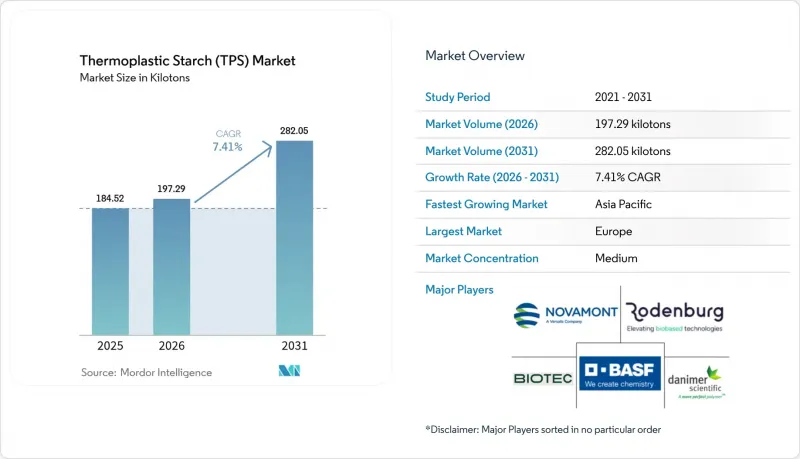
This report is Segmented by Manufacturing Type (Extrusion Molding and Injection Molding), Application (Bags, Films, 3-D Printing, and Other Applications), End-User Industry (Packaging, Agriculture and Horticulture, Consumer Goods, Medical and Pharmaceuticals, and Other End-User Industries), and Geography (Asia-Pacific, and More). The Market Forecasts are Provided in Terms of Volume (Tons).
Global Thermoplastic Starch (TPS) Market Trends and Insights
Rising Demand for Biodegradable Packaging
Under the PPWR 2025/40 regulation, converters are racing against the clock to meet the 2030 deadlines for recyclability or compostability. This urgency is compressing research and development cycles and accelerating material substitutions. By blending TPS with PLA or PBAT, manufacturers can meet EN 13432 and ASTM D6400 standards, allowing brand owners to upgrade their materials without overhauling major equipment. In Germany, France, and the Netherlands, municipal organics-collection initiatives have begun accepting certified TPS films, smoothing the path for wider adoption. Major FMCG companies are on track to eliminate non-recyclable plastics by 2028, shifting their procurement focus to pouches and sachets with higher renewable content. Collectively, these developments are driving up the baseline demand for TPS packaging grades across both consumer and industrial sectors.
Ban on Single-Use Plastics in Major Economies
National prohibitions on polyethylene checkout bags, straws, and food-service items compel rapid TPS substitutions. Canada's regulations entered full enforcement in December 2024, sweeping food-service operators into compliance overnight. India tightened penalties in 2025, prompting domestic converters to switch to starch blends that meet local compostability norms. China's revised Solid Waste Law levies fees on non-degradable packaging, pushing leading e-commerce firms toward TPS mailers for urban deliveries. Because starch resins can be certified under multiple regional standards, suppliers capture demand across jurisdictions that previously required separate formulations.
Moisture Sensitivity Limiting Shelf-Life
Unmodified TPS can absorb significant water within two days at high relative humidity, causing swelling and early tearing in tropical logistics chains. PBAT-rich blends lower water uptake but dilute renewable-content claims and raise cost. Surface coatings, while helpful, must remain under a small percentage of total weight to keep EN 13432 certification, adding process complexity. Consequently, TPS remains preferred for short-lived produce bags and mulch films rather than multi-month shelf-stable goods.
Other drivers and restraints analyzed in the detailed report include:
- Brand-Owner Sustainability Pledges Beyond Regulatory Mandates
- Shift Toward Home-Compostable E-Commerce Mailers
- Inferior Mechanical Strength vs. Petro-Plastics
For complete list of drivers and restraints, kindly check the Table Of Contents.
Segment Analysis
Extrusion molding held 58.17% volume in 2025, reflecting its compatibility with existing polyethylene blown-film lines and the high-throughput economics prized by converters. This route lets regional processors retrofit rather than retool, speeding market entry and anchoring standard-grade volumes that reinforce the thermoplastic starch market. Injection molding captured a smaller base but is projected to outpace at 7.89% CAGR as medical-device makers adopt TPS composites for blister packs, trays, and diagnostic housings. The willingness of hospitals to pay a quality premium insulates injection grades from the cost pressures felt in commodity film markets.
Extrusion's cost leadership spurs capacity additions in China and India that may temper average selling prices worldwide. Yet medical-grade injection compounds demand ISO 13485 certification and tight tolerances that shield margins. Suppliers that master both processing routes can tier their portfolios, positioning standard grades for retail bags while reserving high-amylose or nanoclay-reinforced grades for healthcare. This dual strategy allows producers to defend their share as petrochemical incumbents leverage compounding assets to challenge the thermoplastic starch market.
Complete Report Scope:
- By Manufacturing Type
- Extrusion Molding
- Injection Molding
- By Application
- Bags
- Films
- 3-D Printing
- Other Applications
- By End-User Industry
- Packaging
- Agriculture and Horticulture
- Consumer Goods
- Medical and Pharmaceuticals
- Other End-user Industries
- By Geography
- Asia-Pacific
- China
- India
- Japan
- South Korea
- ASEAN Countries
- Rest of Asia-Pacific
- North America
- United States
- Canada
- Mexico
- Europe
- Germany
- United Kingdom
- Italy
- France
- Nordic Countries
- Rest of Europe
- South America
- Brazil
- Argentina
- Rest of South America
- Middle-East and Africa
- Saudi Arabia
- South Africa
- Rest of Middle-East and Africa
- Asia-Pacific
Geography Analysis
Europe kept 39.82% global volume leadership in 2025 as PPWR 2025/40 and country-level levies made non-compostable packaging economically unattractive. Germany, France, and Italy pooled more than half of continental demand, underpinned by mature composting infrastructure that validates the thermoplastic starch market size leadership. The United Kingdom's 2024 plastic packaging tax, although outside the EU, further expanded certified-compostable demand. Nordic pilots that accept TPS films in municipal organics bins remove a historic barrier and promise steady incremental growth across Scandinavia.
Asia-Pacific is the fastest-growing region at an 8.54% CAGR to 2031. China's extended producer responsibility fees target non-degradable cartons, while India's regulations on bag thickness are steering major retail chains towards starch blends. Japan's Plastic Resource Circulation Act sets a reduction target for single-use plastics by 2030, urging retailers to adopt compostable display and produce bags. In ASEAN, harmonized standards introduced in 2024 are slashing certification costs for exporters, facilitating smoother cross-border trade in TPS packaging.
North America's adoption of these trends is uneven. States like California, Washington, and Oregon have mandated compostable food serviceware, but many interior states have yet to catch up. In Canada, a nationwide ban on polyethylene checkout bags set for 2024 has spurred TPS demand among fast-food chains. Meanwhile, Mexican states initiated their own rolling bans in 2025. A notable surge in certification volume at BPI in 2025 underscores a growing acknowledgment of starch-based compliance. However, South America and the Middle-East and Africa lag, hindered by a lack of composting infrastructure and a policy emphasis on mechanical recycling rather than organic diversion.
- AGRANA
- BASF
- BioLogiQ Inc.
- Biome Bioplastics
- BIOTEC Biologische Naturverpackungen GmbH & Co. KG.
- Danimer Scientific
- Great Wrap
- Grupa Azoty
- Kuraray Co., Ltd
- Novamont S.p.A (Versalis S.p.A.)
- Rodenburg Biopolymers
Additional Benefits:
- The market estimate (ME) sheet in Excel format
- 3 months of analyst support
TABLE OF CONTENTS
1 Introduction
- 1.1 Study Assumptions and Market Definition
- 1.2 Scope of the Study
2 Research Methodology
3 Executive Summary
4 Market Landscape
- 4.1 Market Overview
- 4.2 Market Drivers
- 4.2.1 Rising demand for biodegradable packaging
- 4.2.2 Ban on single-use plastics in major economies
- 4.2.3 Brand-owner sustainability pledges beyond regulatory mandates
- 4.2.4 Shift toward home-compostable e-commerce mailers
- 4.2.5 Pharma blister-pack replacement trials with TPS composites
- 4.3 Market Restraints
- 4.3.1 Moisture sensitivity limiting shelf-life
- 4.3.2 Inferior mechanical strength vs. petro-plastics
- 4.3.3 Food-versus-materials debate around starch feedstock
- 4.4 Value Chain Analysis
- 4.5 Porter's Five Forces
- 4.5.1 Bargaining Power of Suppliers
- 4.5.2 Bargaining Power of Buyers
- 4.5.3 Threat of New Entrants
- 4.5.4 Threat of Substitutes
- 4.5.5 Degree of Competition
5 Market Size and Growth Forecasts (Volume)
- 5.1 By Manufacturing Type
- 5.1.1 Extrusion Molding
- 5.1.2 Injection Molding
- 5.2 By Application
- 5.2.1 Bags
- 5.2.2 Films
- 5.2.3 3-D Printing
- 5.2.4 Other Applications
- 5.3 By End-User Industry
- 5.3.1 Packaging
- 5.3.2 Agriculture and Horticulture
- 5.3.3 Consumer Goods
- 5.3.4 Medical and Pharmaceuticals
- 5.3.5 Other End-user Industries
- 5.4 By Geography
- 5.4.1 Asia-Pacific
- 5.4.1.1 China
- 5.4.1.2 India
- 5.4.1.3 Japan
- 5.4.1.4 South Korea
- 5.4.1.5 ASEAN Countries
- 5.4.1.6 Rest of Asia-Pacific
- 5.4.2 North America
- 5.4.2.1 United States
- 5.4.2.2 Canada
- 5.4.2.3 Mexico
- 5.4.3 Europe
- 5.4.3.1 Germany
- 5.4.3.2 United Kingdom
- 5.4.3.3 Italy
- 5.4.3.4 France
- 5.4.3.5 Nordic Countries
- 5.4.3.6 Rest of Europe
- 5.4.4 South America
- 5.4.4.1 Brazil
- 5.4.4.2 Argentina
- 5.4.4.3 Rest of South America
- 5.4.5 Middle-East and Africa
- 5.4.5.1 Saudi Arabia
- 5.4.5.2 South Africa
- 5.4.5.3 Rest of Middle-East and Africa
- 5.4.1 Asia-Pacific
6 Competitive Landscape
- 6.1 Market Concentration
- 6.2 Strategic Moves
- 6.3 Market Share (%)/Ranking Analysis
- 6.4 Company Profiles (includes Global level Overview, Market level overview, Core Segments, Financials as available, Strategic Information, Products and Services, and Recent Developments)
- 6.4.1 AGRANA
- 6.4.2 BASF
- 6.4.3 BioLogiQ Inc.
- 6.4.4 Biome Bioplastics
- 6.4.5 BIOTEC Biologische Naturverpackungen GmbH & Co. KG.
- 6.4.6 Danimer Scientific
- 6.4.7 Great Wrap
- 6.4.8 Grupa Azoty
- 6.4.9 Kuraray Co., Ltd
- 6.4.10 Novamont S.p.A (Versalis S.p.A.)
- 6.4.11 Rodenburg Biopolymers
7 Market Opportunities and Future Outlook
- 7.1 White-space and Unmet-Need Assessment

