PUBLISHER: Mordor Intelligence | PRODUCT CODE: 2121602

PUBLISHER: Mordor Intelligence | PRODUCT CODE: 2121602
Germany Factory Automation And Industrial Controls - Market Share Analysis, Industry Trends & Statistics, Growth Forecasts (2026 - 2031)
According to Mordor Intelligence, the Germany factory automation and industrial controls market size is expected to grow from USD 10.76 billion in 2025 to USD 11.3 billion in 2026 and is forecast to reach USD 14.45 billion by 2031 at 5.05% CAGR over 2026-2031.
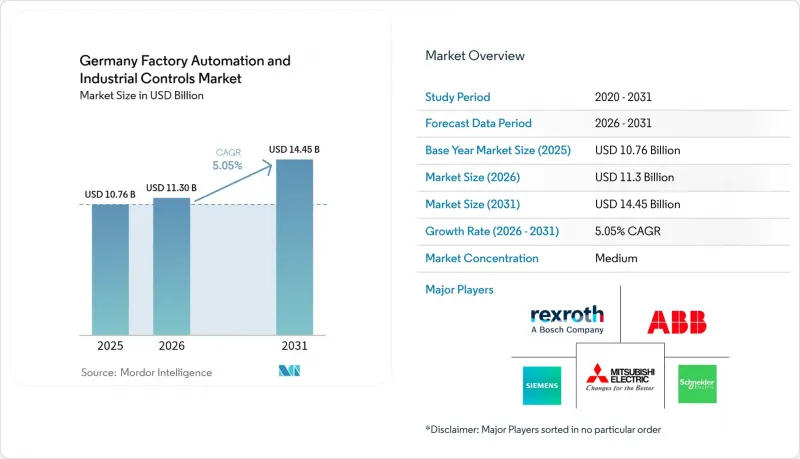
This report is Segmented by Component (Controllers, and Drives), Control System Type (Discrete Control Systems, Process Control Systems, and More), End-User Industry (Automotive, Machinery and Equipment, and More), Deployment Model (On-Premises Control Systems, Hybrid Architectures, and More), and Geography. The Market Forecasts are Provided in Terms of Value (USD).
Germany Factory Automation And Industrial Controls Market Trends and Insights
Industry 4.0 Adoption Across German Manufacturing
Plattform Industrie 4.0 reported that by end-2024, 78% of large plants and 54% of SMEs had implemented at least one digital use case, up from 41% in 2020. Asset Administration Shell and OPC UA standards now underpin machine-to-machine data exchange, letting heterogeneous fleets interoperate without vendor lock-in. Tier-one automotive suppliers embed digital twins inside programmable logic controller code to test changeovers virtually, shrinking downtime from days to hours. Machinery builders have standardized on plug-and-produce modules that reduce engineering effort by up to 40%, enabling line re-configuration within a single shift. Demand for industrial PCs with multi-core processors and FPGAs is rising as manufacturers run machine-learning inference at the edge, bypassing latency and safeguarding intellectual property on-premises.
Rising Labor Costs and Skilled Labor Shortage Driving Automation
Median hourly manufacturing wages climbed to EUR 47.30 (USD 53.45) in 2024, the highest in the European Union. Germany faces a projected 1.2 million technical-worker shortfall by 2030. Collaborative robots without safety cages shipped 22% more units in 2024, especially to food and beverage packagers that handle variable-size products. Pharmaceutical contractors integrated automated guided vehicles with warehouse-management software, boosting throughput 18% and cutting injuries 35%. Automation offsets spiraling onboarding costs as apprenticeship completion rates declined 9% since 2020 and operator turnover averages 14% annually.
High Initial Capital Expenditure for SMEs
SMEs employ 60% of Germany's manufacturing workforce yet face upfront retrofit costs of EUR 800,000 to 1.5 million (USD 904,000 to 1.70 million) per plant, extending payback to five years in low-margin segments. The Digital Now subsidy covers half the spend, but applicants must supply energy audits and cybersecurity plans that small firms often outsource, delaying disbursements six to nine months. Leasing and automation-as-a-service models spread expenses over monthly fees, though concerns about data ownership and vendor lock-in temper adoption VDMA.
Other drivers and restraints analyzed in the detailed report include:
- Government Incentives for Energy-Efficient Smart Factories
- Increasing Demand for Mass Customization and Flexible Production
- Integration Complexity With Legacy Brownfield Equipment
For complete list of drivers and restraints, kindly check the Table Of Contents.
Segment Analysis
Controllers held the largest slice of the Germany factory automation and industrial controls market size at 66.31% in 2025 and will grow at a 5.55% CAGR to 2031. Programmable logic controllers remain indispensable for discrete tasks, while distributed control systems lead in process environments that demand validated audit trails. Industrial PCs are seizing high-speed vision and AI workloads, particularly in electronics assembly, where shipments jumped 19% in 2024.
Drives, motors, sensors and robotics comprise the balance of spending and track controller growth. Servo motors with integrated encoders replace steppers in packaging, offering 0.01 millimeter precision. IO-Link sensors reduce commissioning by 25%, and embedded deep-learning cameras deliver 99.5% defect detection in automotive final inspection. Collaborative robots with wash-down ratings are gaining share in beverage palletizing lines.
Discrete control systems secured 39.46% of 2025 revenue as automotive and machinery customers prioritize high-speed logic. Process control dominates chemicals and pharmaceuticals by regulating temperature, pressure and flow.
SCADA provides historian and visualization functions but lags at 4.05% CAGR. IoT-enabled edge platforms, integrating PLCs, PCs and gateways, advance at 5.9%, establishing a responsive layer for predictive maintenance without exposing proprietary data to public clouds. Demand for time-sensitive networking switches that guarantee sub-1 millisecond latency underscores the architectural transition.
Complete Report Scope:
- By Component
- Controllers
- Programmable Logic Controllers (PLCs)
- Distributed Control Systems (DCS)
- Industrial PCs (IPCs)
- Drives
- Motors
- Sensors
- Machine Vision
- Robotics
- Other Drives
- Controllers
- By Control System Type
- Discrete Control Systems
- Process Control Systems
- Supervisory Control and Data Acquisition (SCADA)
- IoT-Enabled Edge Control Platforms
- By End-User Industry
- Automotive
- Machinery and Equipment
- Electronics and Semiconductors
- Food and Beverage
- Pharmaceuticals and Chemicals
- Metals and Mining
- Other End-User Industries
- By Deployment Model
- On-Premises Control Systems
- Cloud-Based Control Platforms
- Hybrid (Edge + Cloud) Architectures
List of Companies Covered in this Report:
- Siemens AG
- Bosch Rexroth AG
- ABB Ltd
- Schneider Electric SE
- Mitsubishi Electric Corporation
- Rockwell Automation Inc.
- Honeywell International Inc.
- Emerson Electric Co.
- Omron Corporation
- Fanuc Corporation
- Yaskawa Electric Corporation
- KUKA AG
- Beckhoff Automation GmbH and Co. KG
- B and R Industrial Automation GmbH
- Festo SE and Co. KG
- Phoenix Contact GmbH and Co. KG
- WAGO Kontakttechnik GmbH and Co. KG
- Lenze SE
- SEW-Eurodrive GmbH and Co. KG
- Danfoss A/S
Additional Benefits:
- The market estimate (ME) sheet in Excel format
- 3 months of analyst support
TABLE OF CONTENTS
1 INTRODUCTION
- 1.1 Study Assumptions and Market Definition
- 1.2 Scope of the Study
2 RESEARCH METHODOLOGY
3 EXECUTIVE SUMMARY
4 MARKET LANDSCAPE
- 4.1 Market Overview
- 4.2 Market Drivers
- 4.2.1 Industry 4.0 Adoption Across German Manufacturing
- 4.2.2 Rising Labor Costs and Skilled Labor Shortage Driving Automation
- 4.2.3 Government Incentives for Energy-Efficient Smart Factories
- 4.2.4 Increasing Demand for Mass Customization and Flexible Production
- 4.2.5 Emphasis on Cyber-Physical Security Standards Boosting Control System Upgrades
- 4.2.6 Reshoring of Critical Supply Chains Stimulating Domestic Automation Capex
- 4.3 Market Restraints
- 4.3.1 High Initial Capital Expenditure for SMEs
- 4.3.2 Integration Complexity with Legacy Brownfield Equipment
- 4.3.3 Semiconductor Supply Chain Volatility Delaying Controller Deliveries
- 4.3.4 Stringent Data Sovereignty Regulations Hindering Cloud-Based Control Platforms
- 4.4 Impact of Macroeconomic Factors
- 4.5 Industry Value Chain Analysis
- 4.6 Regulatory Landscape
- 4.7 Technological Outlook
- 4.8 Porter's Five Forces Analysis
- 4.8.1 Threat of New Entrants
- 4.8.2 Threat of Substitutes
- 4.8.3 Bargaining Power of Buyers
- 4.8.4 Bargaining Power of Suppliers
- 4.8.5 Competitive Rivalry
5 MARKET SIZE AND GROWTH FORECASTS (VALUE)
- 5.1 By Component
- 5.1.1 Controllers
- 5.1.1.1 Programmable Logic Controllers (PLCs)
- 5.1.1.2 Distributed Control Systems (DCS)
- 5.1.1.3 Industrial PCs (IPCs)
- 5.1.2 Drives
- 5.1.2.1 Motors
- 5.1.2.2 Sensors
- 5.1.2.3 Machine Vision
- 5.1.2.4 Robotics
- 5.1.2.5 Other Drives
- 5.1.1 Controllers
- 5.2 By Control System Type
- 5.2.1 Discrete Control Systems
- 5.2.2 Process Control Systems
- 5.2.3 Supervisory Control and Data Acquisition (SCADA)
- 5.2.4 IoT-Enabled Edge Control Platforms
- 5.3 By End-User Industry
- 5.3.1 Automotive
- 5.3.2 Machinery and Equipment
- 5.3.3 Electronics and Semiconductors
- 5.3.4 Food and Beverage
- 5.3.5 Pharmaceuticals and Chemicals
- 5.3.6 Metals and Mining
- 5.3.7 Other End-User Industries
- 5.4 By Deployment Model
- 5.4.1 On-Premises Control Systems
- 5.4.2 Cloud-Based Control Platforms
- 5.4.3 Hybrid (Edge + Cloud) Architectures
6 COMPETITIVE LANDSCAPE
- 6.1 Market Concentration
- 6.2 Strategic Moves
- 6.3 Market Share Analysis
- 6.4 Company Profiles (includes Global Level Overview, Market Level Overview, Core Segments, Financials as available, Strategic Information, Market Rank/Share for Key Companies, Products and Services, and Recent Developments)
- 6.4.1 Siemens AG
- 6.4.2 Bosch Rexroth AG
- 6.4.3 ABB Ltd
- 6.4.4 Schneider Electric SE
- 6.4.5 Mitsubishi Electric Corporation
- 6.4.6 Rockwell Automation Inc.
- 6.4.7 Honeywell International Inc.
- 6.4.8 Emerson Electric Co.
- 6.4.9 Omron Corporation
- 6.4.10 Fanuc Corporation
- 6.4.11 Yaskawa Electric Corporation
- 6.4.12 KUKA AG
- 6.4.13 Beckhoff Automation GmbH and Co. KG
- 6.4.14 B and R Industrial Automation GmbH
- 6.4.15 Festo SE and Co. KG
- 6.4.16 Phoenix Contact GmbH and Co. KG
- 6.4.17 WAGO Kontakttechnik GmbH and Co. KG
- 6.4.18 Lenze SE
- 6.4.19 SEW-Eurodrive GmbH and Co. KG
- 6.4.20 Danfoss A/S
7 MARKET OPPORTUNITIES AND FUTURE OUTLOOK
- 7.1 White-Space and Unmet-Need Assessment

