PUBLISHER: Mordor Intelligence | PRODUCT CODE: 2113582

PUBLISHER: Mordor Intelligence | PRODUCT CODE: 2113582
Factory Automation And Industrial Controls - Market Share Analysis, Industry Trends & Statistics, Growth Forecasts (2026 - 2031)
According to Mordor Intelligence, the factory automation and industrial controls market size is expected to increase from USD 312.33 billion in 2025 to USD 338.46 billion in 2026 and reach USD 505.88 billion by 2031, growing at a CAGR of 8.37% over 2026-2031.
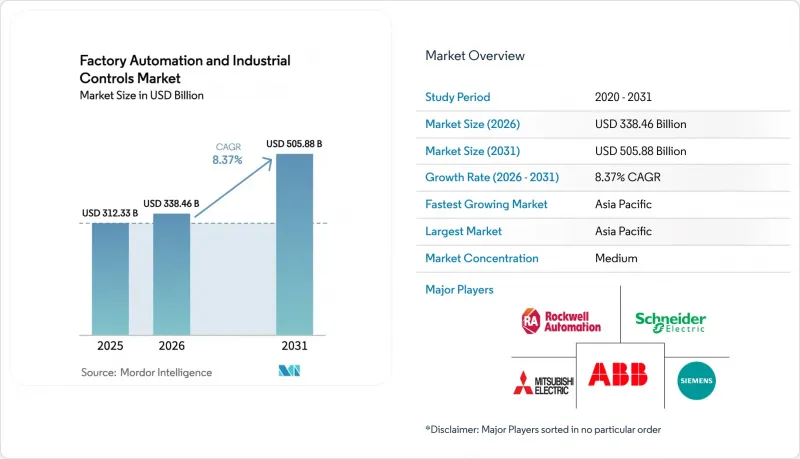
This report is Segmented by Product (Industrial Control Systems, Field Devices), Component (Hardware, Software, and Services), End-User Industry (Automotive, Chemical, Utility, and More), Control System Architecture (Proprietary, Open, and Hybrid), and Geography (North America, South America, and More). The Market Forecasts are Provided in Terms of Value (USD).
Global Factory Automation And Industrial Controls Market Trends and Insights
Industry 4.0 Adoption Acceleration
Manufacturers are converting legacy "automation islands" into synchronized cyber-physical ecosystems that link machines, logistics, and quality loops in real time, yielding shorter changeovers and higher overall equipment effectiveness. Digital-twin deployments jumped to 68% of surveyed German plants in 2025, up from 41% two years earlier, with typical payback falling below 18 months. Japan budgeted JPY 120 billion (USD 800 million) in grants for small and midsized enterprises to install collaborative robots and IoT sensors, expanding automation beyond mega-plants. The emphasis on retrofit projects is stimulating demand for modular edge gateways, time-sensitive networking, and protocol-agnostic controllers capable of coexisting with 20-year-old equipment. As a result, capital spending is spreading across thousands of mid-tier facilities, cementing a broad, sustainable growth path for the factory automation and industrial controls market.
Energy-Efficiency Mandates and Cost Pressure
The European Union's Ecodesign Regulation 2024/1781 and updated United States motor standards are pressing manufacturers to adopt IE4-IE5 motors, variable-frequency drives, and advanced power analytics, reducing electricity use by 15-25%. Average industrial power prices in Europe reached EUR 0.28 per kWh (USD 0.30 per kWh) in 2024, more than double pre-2022 levels, putting energy optimization at the center of board-level discussions. Automation vendors are translating the regulations into commercial traction; Schneider Electric reported a 22% rise in EcoStruxure-enabled drives in 2025 as customers raced to certify plants under ISO 50001. The replacement wave is especially strong in energy-intensive segments such as chemicals and metals, lifting recurring software revenue tied to energy dashboards and AI-based load balancing. These factors add durable lift to the factory automation and industrial controls market.
High Upfront CAPEX of Automation Projects
Integrated MES-SCADA deployments often require USD 2-8 million per site, with paybacks exceeding three years in thin-margin sectors such as food processing. Access to low-cost financing is uneven, particularly in South America and parts of Southeast Asia where interest rates remain above 12%. Although leasing and automation-as-a-service models promise lower entry hurdles, customers remain wary of data ownership and long lifecycle dependencies. ABB disclosed that subscription-based robotics accounted for only 9% of its 2025 robotics revenue, underscoring the early stage of alternative financing. Consequently, capital constraints could dampen near-term adoption across smaller manufacturers, trimming growth of the factory automation and industrial controls market.
Other drivers and restraints analyzed in the detailed report include:
- Rising Labor Shortages in Manufacturing
- Government Stimulus for Digital Factories
- Cyber-Security Vulnerabilities in OT Networks
For complete list of drivers and restraints, kindly check the Table Of Contents.
Segment Analysis
Field devices are expected to be the fastest-growing product category over the forecast period and are set to expand at 9.71% through 2031, outpacing industrial control systems that held 54.31% of the factory automation and industrial controls market share in 2025. Robot installations reached 553,000 units in 2024, with automotive and electronics buyers taking 62% of shipments. Machine-vision revenue climbed 18% at Cognex during 2024 on the strength of AI-powered defect detection. These investments illustrate an industry pivot from programmable logic controllers toward intelligent endpoints that carry local analytics and 5G or IO-Link Wireless connectivity.
This transition reshapes value propositions. Controller differentiation now turns on ecosystem compatibility and software toolchains rather than scan-time benchmarks. Human-machine interfaces add augmented-reality overlays that cut batch changeovers by up to 30% in mid-volume lines. Hybrid control architectures mix deterministic PLC loops with cloud analytics, sidestepping full rip-and-replace costs. As older SCADA systems approach obsolescence, upgrade discussions increasingly center on seamless migration paths instead of pure hardware refresh, anchoring multi-cycle revenue for the factory automation and industrial controls market.
Hardware still represented 68.17% of revenue in 2025, yet software is projected to rise at a 10.93% clip, the highest among components. Subscription models now dominate rollouts, illustrated by Siemens, whose MindSphere and Xcelerator portfolios drove 16% software growth in 2025 while hardware rose only 4%. Emerson's recurring software topped 22% of automation sales in 2024, delivering gross margins above 70%, versus the mid-30% range for hardware.
Low-code configuration tools such as EcoStruxure Automation Expert 2.0 reduce engineering hours by up to half, broadening user bases to process engineers and operations managers. Services revenue, long dominated by on-site commissioning, is shifting toward remote diagnostics and AI-assisted troubleshooting, which lowers travel costs and carbon footprints. Collectively, these dynamics deepen software's pull-through effect on controllers and drives, reinforcing hybrid platform strategies across the factory automation and industrial controls market.
Complete Report Scope:
- By Product
- Industrial Control Systems
- Distributed Control System (DCS)
- Programmable Logic Controller (PLC)
- Supervisory Control and Data Acquisition (SCADA)
- Product Lifecycle Management (PLM)
- Human-Machine Interface (HMI)
- Manufacturing Execution System (MES)
- Enterprise Resource Planning (ERP)
- Other Industrial Control Systems
- Field Devices
- Machine Vision Systems
- Industrial Robotics
- Sensors and Transmitters
- Motors and Drives
- Other Field Devices
- Industrial Control Systems
- By Component
- Hardware
- Software
- Services
- By End-User Industry
- Automotive
- Chemical and Petrochemical
- Utility
- Pharmaceutical
- Food and Beverage
- Oil and Gas
- Electronics and Semiconductor
- Aerospace and Defense
- Other End-User Industries
- By Control System Architecture
- Proprietary / Vendor-Specific
- Open / Interoperable
- Hybrid Architecture
- By Geography
- North America
- United States
- Canada
- Mexico
- South America
- Brazil
- Rest of South America
- Europe
- Germany
- United Kingdom
- France
- Italy
- Spain
- Nordics
- Rest of Europe
- Middle East
- Saudi Arabia
- United Arab Emirates
- Rest of Middle East
- Africa
- South Africa
- Nigeria
- Rest of Africa
- Asia-Pacific
- China
- Japan
- South Korea
- India
- Singapore
- Australia
- Rest of Asia-Pacific
- North America
Geography Analysis
Asia Pacific accounted for 37.68% of the factory automation and industrial controls market in 2025 and is projected to post a 9.56% CAGR through 2031, underscoring its dual role as a manufacturing hub and policy engine. China's dual-circulation push triggered a 28% rise in domestic PLC and drive shipments in 2024 as producers localized supply chains. India disbursed INR 120 billion (USD 1.44 billion) in production-linked incentives for electronics, pharmaceuticals, and auto components, subject to minimum automation thresholds. Japan granted JPY 120 billion (USD 800 million) to small and mid-sized enterprises to support robot adoption, extending automation beyond the automotive nucleus. South Korea sponsored 3,200 smart-factory projects in 2024, spanning semiconductor, display, and battery facilities.
North America remains pivotal despite slower growth, powered by federal incentives that tether funding to Industry 4.0 practices. The CHIPS Act's USD 39 billion grant pool obliges real-time monitoring and predictive maintenance in new fabs. Mexico and Canada are benefiting via near-shoring, funneling orders to motion-control suppliers. Europe commands mature penetration yet maintains leadership in digital twins and energy-efficient retrofits; 68% of surveyed German plants had adopted at least one digital-twin application by 2025. High power prices propel upgrades to IE5 motors and drives, reinforcing refresh velocity.
South America, the Middle East, and Africa collectively trail in spending but register strong point projects tied to extractive industries. Brazil's Petrobras earmarked USD 2.1 billion for digital oilfield platforms in 2024, including autonomous drilling and SCADA upgrades. Gulf refineries adopt advanced process control to meet energy-intensity targets, while South African miners deploy wireless sensor networks to improve asset uptime. Although volumes are smaller, the installed base is younger, providing an opening for open-standard architectures and cloud-native analytics to leapfrog legacy solutions. Collectively, geographic diversification underpins a resilient trajectory for the factory automation and industrial controls market.
- ABB Ltd
- Siemens AG
- Rockwell Automation Inc.
- Schneider Electric SE
- Mitsubishi Electric Corporation
- Honeywell International Inc.
- Emerson Electric Co.
- Omron Corporation
- Yokogawa Electric Corporation
- GE Vernova Inc.
- Texas Instruments Inc.
- Bosch Rexroth AG
- Fanuc Corporation
- Keyence Corporation
- Advantech Co. Ltd.
- Beckhoff Automation GmbH
- Delta Electronics Inc.
- Lenze SE
- WAGO Kontakttechnik GmbH
- Hollysys Automation Technologies
Additional Benefits:
- The market estimate (ME) sheet in Excel format
- 3 months of analyst support
TABLE OF CONTENTS
1 INTRODUCTION
- 1.1 Study Assumptions and Market Definition
- 1.2 Scope of the Study
2 RESEARCH METHODOLOGY
3 EXECUTIVE SUMMARY
4 MARKET LANDSCAPE
- 4.1 Market Overview
- 4.2 Market Drivers
- 4.2.1 Industry 4.0 Adoption Acceleration
- 4.2.2 Energy-Efficiency Mandates and Cost Pressure
- 4.2.3 Rising Labor Shortages in Manufacturing
- 4.2.4 Government Stimulus for Digital Factories
- 4.2.5 Low-Code / No-Code Automation Platforms
- 4.2.6 AI-Driven Predictive Quality Control Upgrades
- 4.3 Market Restraints
- 4.3.1 High Upfront CAPEX of Automation Projects
- 4.3.2 Cyber-Security Vulnerabilities in OT Networks
- 4.3.3 Fragmented Interoperability Standards
- 4.3.4 Semiconductor Supply Volatility for Controllers
- 4.4 Industry Value Chain Analysis
- 4.5 Regulatory Landscape
- 4.6 Technological Outlook
- 4.7 Impact of Macroeconomic Factors on the Market
- 4.8 Porter's Five Forces Analysis
- 4.8.1 Bargaining Power of Suppliers
- 4.8.2 Bargaining Power of Buyers
- 4.8.3 Threat of New Entrants
- 4.8.4 Threat of Substitutes
- 4.8.5 Intensity of Competitive Rivalry
5 MARKET SIZE AND GROWTH FORECASTS (VALUE)
- 5.1 By Product
- 5.1.1 Industrial Control Systems
- 5.1.1.1 Distributed Control System (DCS)
- 5.1.1.2 Programmable Logic Controller (PLC)
- 5.1.1.3 Supervisory Control and Data Acquisition (SCADA)
- 5.1.1.4 Product Lifecycle Management (PLM)
- 5.1.1.5 Human-Machine Interface (HMI)
- 5.1.1.6 Manufacturing Execution System (MES)
- 5.1.1.7 Enterprise Resource Planning (ERP)
- 5.1.1.8 Other Industrial Control Systems
- 5.1.2 Field Devices
- 5.1.2.1 Machine Vision Systems
- 5.1.2.2 Industrial Robotics
- 5.1.2.3 Sensors and Transmitters
- 5.1.2.4 Motors and Drives
- 5.1.2.5 Other Field Devices
- 5.1.1 Industrial Control Systems
- 5.2 By Component
- 5.2.1 Hardware
- 5.2.2 Software
- 5.2.3 Services
- 5.3 By End-User Industry
- 5.3.1 Automotive
- 5.3.2 Chemical and Petrochemical
- 5.3.3 Utility
- 5.3.4 Pharmaceutical
- 5.3.5 Food and Beverage
- 5.3.6 Oil and Gas
- 5.3.7 Electronics and Semiconductor
- 5.3.8 Aerospace and Defense
- 5.3.9 Other End-User Industries
- 5.4 By Control System Architecture
- 5.4.1 Proprietary / Vendor-Specific
- 5.4.2 Open / Interoperable
- 5.4.3 Hybrid Architecture
- 5.5 By Geography
- 5.5.1 North America
- 5.5.1.1 United States
- 5.5.1.2 Canada
- 5.5.1.3 Mexico
- 5.5.2 South America
- 5.5.2.1 Brazil
- 5.5.2.2 Rest of South America
- 5.5.3 Europe
- 5.5.3.1 Germany
- 5.5.3.2 United Kingdom
- 5.5.3.3 France
- 5.5.3.4 Italy
- 5.5.3.5 Spain
- 5.5.3.6 Nordics
- 5.5.3.7 Rest of Europe
- 5.5.4 Middle East
- 5.5.4.1 Saudi Arabia
- 5.5.4.2 United Arab Emirates
- 5.5.4.3 Rest of Middle East
- 5.5.5 Africa
- 5.5.5.1 South Africa
- 5.5.5.2 Nigeria
- 5.5.5.3 Rest of Africa
- 5.5.6 Asia-Pacific
- 5.5.6.1 China
- 5.5.6.2 Japan
- 5.5.6.3 South Korea
- 5.5.6.4 India
- 5.5.6.5 Singapore
- 5.5.6.6 Australia
- 5.5.6.7 Rest of Asia-Pacific
- 5.5.1 North America
6 COMPETITIVE LANDSCAPE
- 6.1 Market Concentration
- 6.2 Strategic Moves
- 6.3 Market Share Analysis
- 6.4 Company Profiles (includes Global Level Overview, Market Level Overview, Core Segments, Financials as Available, Strategic Information, Market Rank/Share for Key Companies, Products and Services, and Recent Developments)
- 6.4.1 ABB Ltd
- 6.4.2 Siemens AG
- 6.4.3 Rockwell Automation Inc.
- 6.4.4 Schneider Electric SE
- 6.4.5 Mitsubishi Electric Corporation
- 6.4.6 Honeywell International Inc.
- 6.4.7 Emerson Electric Co.
- 6.4.8 Omron Corporation
- 6.4.9 Yokogawa Electric Corporation
- 6.4.10 GE Vernova Inc.
- 6.4.11 Texas Instruments Inc.
- 6.4.12 Bosch Rexroth AG
- 6.4.13 Fanuc Corporation
- 6.4.14 Keyence Corporation
- 6.4.15 Advantech Co. Ltd.
- 6.4.16 Beckhoff Automation GmbH
- 6.4.17 Delta Electronics Inc.
- 6.4.18 Lenze SE
- 6.4.19 WAGO Kontakttechnik GmbH
- 6.4.20 Hollysys Automation Technologies
7 MARKET OPPORTUNITIES AND FUTURE OUTLOOK
- 7.1 White-Space and Unmet-Need Assessment

