PUBLISHER: Mordor Intelligence | PRODUCT CODE: 2120397

PUBLISHER: Mordor Intelligence | PRODUCT CODE: 2120397
France Factory Automation And Industrial Controls - Market Share Analysis, Industry Trends & Statistics, Growth Forecasts (2026 - 2031)
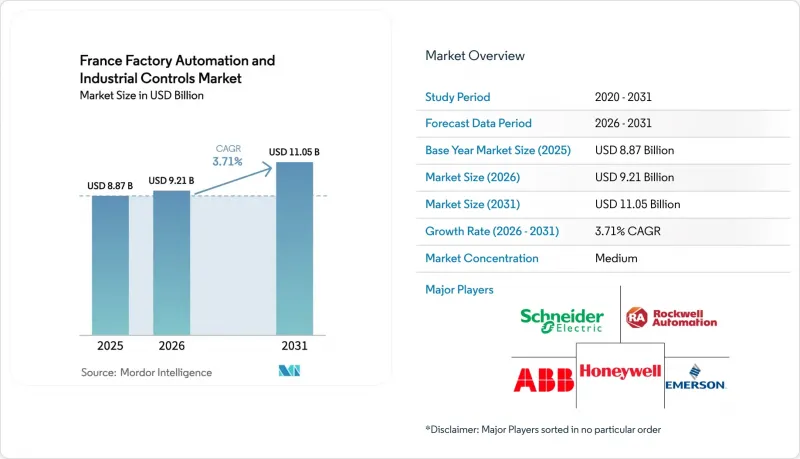
According to Mordor Intelligence, the France factory automation and industrial controls market size is expected to grow from USD 8.87 billion in 2025 to USD 9.21 billion in 2026 and is forecast to reach USD 11.05 billion by 2031 at 3.71% CAGR over 2026-2031.
This report is Segmented by Type (Industrial Control Systems, and Field Devices), Component (Hardware, Software, and Services), End-User Industry (Oil and Gas, Food and Beverage, and More), Deployment Mode (On-Premise, Cloud-Based, and Hybrid), and Sales Channel (Direct To End-User, System Integrators, and More). The Market Forecasts are Provided in Terms of Value (USD).
France Factory Automation And Industrial Controls Market Trends and Insights
Accelerating Industry 4.0 Adoption in Automotive and Aerospace
Automotive and aerospace producers are embedding real-time analytics, collaborative robots, and augmented-reality work instructions to compress cycle times and reduce defects, an approach demonstrated by Airbus at its Toulouse A321 final assembly line. Predictive-maintenance platforms deployed by Renault across 22 plants save EUR 80 million (USD 90 million) annually and validate digital twins in brownfield settings. Electric-vehicle platforms require precision torque control and thermal monitoring that legacy programmable-logic controllers cannot natively support, spurring demand for modular PLCs with high-speed vision add-ons. Although industrial-robot installations fell 24% to 4,900 units in 2024, renewed capital spending in 2026 is reviving backlogs. Regulatory frameworks such as ISO 9001 now insist on digital audit trails, anchoring the migration toward integrated manufacturing-execution software.
Rising Labor Cost and Skill Shortages in Manufacturing
Eighty-one percent of French manufacturers faced hiring difficulties in 2024, with wage levels above EUR 25 (USD 28) per hour in key regions and a looming retirement wave that removes experienced technicians. The cost crossover that makes collaborative robots less expensive than manual labour over five years has already arrived in Ile-de-France, accelerating robot uptake. Companies are digitizing tacit knowledge through AI-assisted troubleshooting before skilled workers exit, particularly in aerospace and defense clusters. Productivity growth slowed to 0.8% a year between 2019 and 2025, intensifying pressure to automate repetitive, hazardous, or precision tasks. ISO 45001 occupational-health standards further incentivize automated handling of chemicals and high-temperature welding to reduce employer liability.
High Initial Capital Expenditure for Full-Scale Automation
Even after subsidies, a comprehensive Industry 4.0 retrofit can cost EUR 500,000 - 2 million (USD 563,000 - 2.25 million) for a mid-size plant, exceeding annual capital budgets for 60% of French SMEs. Thin-margin sectors like food processing often defer investments despite labour shortages. European Central Bank rate hikes have raised borrowing costs, making lease-to-own and automation-as-a-service models attractive yet still limited to large suppliers. Many small firms still view automation as an all-or-nothing commitment, overlooking phased retrofits such as IoT modules on existing PLCs. ISO 9001 and ISO 14001 audits nonetheless increasingly favour automated data capture, pushing reluctant firms toward gradual adoption.
Other drivers and restraints analyzed in the detailed report include:
- Government Incentives for Energy-Efficient Upgrades in SMEs
- Expansion of Renewable-Hydrogen Projects Requiring Advanced Controls
- Integration Complexity with Legacy Brownfield Facilities
For complete list of drivers and restraints, kindly check the Table Of Contents.
Segment Analysis
Industrial Control Systems commanded 37.40% of the France factory automation and industrial controls market share in 2025, a position anchored in distributed control architectures across chemicals and programmable controllers in automotive plants. Field Devices, however, are growing faster, with Industrial Robotics slated for a 4.36% CAGR through 2031 despite a 24% installation dip in 2024. Machine-vision sales are rising 18% annually in food and beverage lines that must meet AGEC traceability rules. Motors and drives benefit from C3IV tax credits, enabling 15-20% electricity savings in cement kilns.
Sensors, especially wireless LoRaWAN variants, facilitate brownfield retrofits where cabling is prohibitive, though encryption gaps remain a hurdle in critical infrastructure. Safety systems tied to ISO 13849 regulations track robot adoption with a lag of about nine months. Supervisory systems are shifting to cloud hosting, cutting on-premises server spend by 30% following AVEVA's 2025 AWS validation. Human-machine interfaces increasingly use tablet-based augmented-reality overlays that shorten operator training cycles.
Hardware retained 46.20% of the France factory automation and industrial controls market size in 2025, yet the fastest expansion is in Software at a 4.38% CAGR. Renault's industrial metaverse exemplifies the shift, ingesting more than 3 billion data points daily from 15,000 assets and delivering EUR 700 million (USD 788 million) cumulative savings. Cloud-native MES platforms lower total cost of ownership by 30% against on-premises alternatives, spurring conversions, while open-source frameworks such as Eclipse 4diac commoditize base control logic.
Services evolve toward outcome-based contracts that guarantee uptime, aligning vendor incentives with manufacturer operating goals. Still, services growth is curbed in regions lacking certified integrators, a gap that marketplaces like EcoSpare address through standardized installation guides. Hardware demand remains resilient in hydrogen and battery gigafactories that require ruggedized gateways and redundant power supplies.
Complete Report Scope:
- By Type
- Industrial Control Systems
- Distributed Control System (DCS)
- Programmable Logic Controller (PLC)
- Supervisory Control and Data Acquisition (SCADA)
- Product Lifecycle Management (PLM)
- Manufacturing Execution System (MES)
- Human Machine Interface (HMI)
- Other Industrial Control Systems
- Field Devices
- Machine Vision
- Industrial Robotics
- Motors and Drives
- Safety Systems
- Sensors and Transmitters
- Other Field Devices
- Industrial Control Systems
- By Component
- Hardware
- Software
- Services
- By End-user Industry
- Oil and Gas
- Chemical and Petrochemical
- Power and Utilities
- Food and Beverage
- Automotive and Transportation
- Pharmaceutical
- Other End-user Industries
- By Deployment Mode
- On-premise
- Cloud-based
- Hybrid
- By Sales Channel
- Direct to End-user
- System Integrators
- Distributor / Reseller
- Online Industrial Marketplace
List of Companies Covered in this Report:
- Schneider Electric SE
- Siemens AG
- ABB Ltd.
- Rockwell Automation Inc.
- Honeywell International Inc.
- Emerson Electric Co.
- Mitsubishi Electric Corporation
- Omron Corporation
- Yokogawa Electric Corporation
- FANUC Corporation
- Bosch Rexroth AG
- Beckhoff Automation GmbH
- Phoenix Contact GmbH
- Festo SE and Co. KG
- SEW-EURODRIVE GmbH
- WAGO Kontakttechnik GmbH
- Parker Hannifin Corp.
- B&R Industrial Automation GmbH
- Yaskawa Electric Corp.
- Fuji Electric Co., Ltd.
Additional Benefits:
- The market estimate (ME) sheet in Excel format
- 3 months of analyst support
TABLE OF CONTENTS
1 INTRODUCTION
- 1.1 Study Assumptions and Market Definition
- 1.2 Scope of the Study
2 RESEARCH METHODOLOGY
3 EXECUTIVE SUMMARY
4 MARKET LANDSCAPE
- 4.1 Market Overview
- 4.2 Industry Value-Chain Analysis
- 4.3 Regulatory Landscape
- 4.4 Technological Outlook
- 4.5 Impact of Macroeconomic Factors on the Market
- 4.6 Porter's Five Forces Analysis
- 4.6.1 Threat of New Entrants
- 4.6.2 Bargaining Power of Suppliers
- 4.6.3 Bargaining Power of Buyers
- 4.6.4 Threat of Substitutes
- 4.6.5 Intensity of Competitive Rivalry
- 4.7 Market Drivers
- 4.7.1 Accelerating Industry 4.0 Adoption Across Automotive and Aerospace
- 4.7.2 Government Incentives for Energy-Efficient Upgrades in SMEs
- 4.7.3 Rising Labor Cost and Skill Shortages in Manufacturing
- 4.7.4 Expansion of Renewable-Hydrogen Projects Requiring Advanced Controls
- 4.7.5 National AI Strategy Driving Intelligent Edge Control Systems
- 4.7.6 Circular Economy Compliance Creating Need for Traceability Automation
- 4.8 Market Restraints
- 4.8.1 High Initial Capital Expenditure for Full-Scale Automation
- 4.8.2 Integration Complexity with Legacy Brownfield Facilities
- 4.8.3 Cybersecurity Concerns Around IT/OT Convergence in Mid-Cap Firms
- 4.8.4 Limited Availability of Certified System Integrators Outside Industrial Hubs
5 MARKET SIZE AND GROWTH FORECASTS (VALUE)
- 5.1 By Type
- 5.1.1 Industrial Control Systems
- 5.1.1.1 Distributed Control System (DCS)
- 5.1.1.2 Programmable Logic Controller (PLC)
- 5.1.1.3 Supervisory Control and Data Acquisition (SCADA)
- 5.1.1.4 Product Lifecycle Management (PLM)
- 5.1.1.5 Manufacturing Execution System (MES)
- 5.1.1.6 Human Machine Interface (HMI)
- 5.1.1.7 Other Industrial Control Systems
- 5.1.2 Field Devices
- 5.1.2.1 Machine Vision
- 5.1.2.2 Industrial Robotics
- 5.1.2.3 Motors and Drives
- 5.1.2.4 Safety Systems
- 5.1.2.5 Sensors and Transmitters
- 5.1.2.6 Other Field Devices
- 5.1.1 Industrial Control Systems
- 5.2 By Component
- 5.2.1 Hardware
- 5.2.2 Software
- 5.2.3 Services
- 5.3 By End-user Industry
- 5.3.1 Oil and Gas
- 5.3.2 Chemical and Petrochemical
- 5.3.3 Power and Utilities
- 5.3.4 Food and Beverage
- 5.3.5 Automotive and Transportation
- 5.3.6 Pharmaceutical
- 5.3.7 Other End-user Industries
- 5.4 By Deployment Mode
- 5.4.1 On-premise
- 5.4.2 Cloud-based
- 5.4.3 Hybrid
- 5.5 By Sales Channel
- 5.5.1 Direct to End-user
- 5.5.2 System Integrators
- 5.5.3 Distributor / Reseller
- 5.5.4 Online Industrial Marketplace
6 COMPETITIVE LANDSCAPE
- 6.1 Market Concentration
- 6.2 Strategic Moves
- 6.3 Market Share Analysis
- 6.4 Company Profiles (includes Global Level Overview, Market Level Overview, Core Segments, Financials as Available, Strategic Information, Market Rank/Share for Key Companies, Products and Services, and Recent Developments)
- 6.4.1 Schneider Electric SE
- 6.4.2 Siemens AG
- 6.4.3 ABB Ltd.
- 6.4.4 Rockwell Automation Inc.
- 6.4.5 Honeywell International Inc.
- 6.4.6 Emerson Electric Co.
- 6.4.7 Mitsubishi Electric Corporation
- 6.4.8 Omron Corporation
- 6.4.9 Yokogawa Electric Corporation
- 6.4.10 FANUC Corporation
- 6.4.11 Bosch Rexroth AG
- 6.4.12 Beckhoff Automation GmbH
- 6.4.13 Phoenix Contact GmbH
- 6.4.14 Festo SE and Co. KG
- 6.4.15 SEW-EURODRIVE GmbH
- 6.4.16 WAGO Kontakttechnik GmbH
- 6.4.17 Parker Hannifin Corp.
- 6.4.18 B&R Industrial Automation GmbH
- 6.4.19 Yaskawa Electric Corp.
- 6.4.20 Fuji Electric Co., Ltd.
7 MARKET OPPORTUNITIES AND FUTURE OUTLOOK
- 7.1 White-Space and Unmet-Need Assessment

