PUBLISHER: Mordor Intelligence | PRODUCT CODE: 2121827

PUBLISHER: Mordor Intelligence | PRODUCT CODE: 2121827
North America Factory Automation And Industrial Controls - Market Share Analysis, Industry Trends & Statistics, Growth Forecasts (2026 - 2031)
According to Mordor Intelligence, the North America factory automation and industrial controls market size was valued at USD 55.07 billion in 2025 and estimated to grow from USD 60.55 billion in 2026 to reach USD 97.27 billion by 2031, at a CAGR of 9.95% during the forecast period (2026-2031).
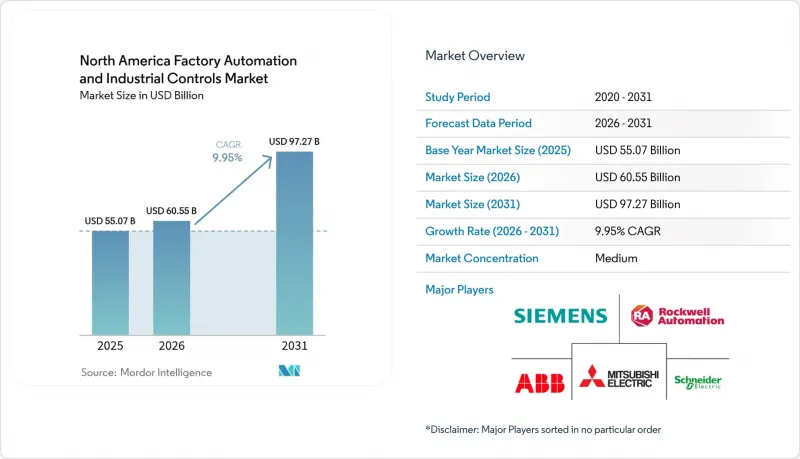
This report is Segmented by Type (Industrial Control Systems and Field Devices), Component (Hardware, Software, and Services), Deployment Mode (On-Premise, Cloud, and Edge), End-User Industry (Oil and Gas, Chemical and Petrochemical, Power and Utilities, and More), and Country. The Market Forecasts are Provided in Terms of Value (USD).
North America Factory Automation And Industrial Controls Market Trends and Insights
Surge in demand for energy-efficient manufacturing operations
Manufacturers across North America implement advanced control loops, load balancing, and real-time energy dashboards to meet strict state and provincial efficiency rules and to cut utility costs. Retrofitting variable-frequency drives and intelligent scheduling modules into legacy lines typically lowers total electricity consumption by 20% to 30%. Savings arrive faster than productivity-led paybacks, which accelerates board approval for additional automation projects. Facilities integrating on-site renewable power with smart controllers participate in grid-stabilization programs that offer new revenue streams. Vendors that package commissioning services with ISO 50001 advisory win contracts because plant teams need holistic road maps, not just hardware. As carbon pricing discussions resurface in Washington and Ottawa, early movers lock sustainable cost advantages that compound over time.
Rapid adoption of collaborative robots in SME factories
Small and mid-size enterprises adopt collaborative robots priced between USD 110,000 and USD 200,000 because the units require minimal guarding and can be re-tasked by existing technicians. Cobots handle repetitive pick-and-place, machine tending, and light assembly while employees focus on value-added inspection. Payback periods often fall below 18 months when overtime premiums and scrap reductions are considered. The flexibility to shift between SKUs without re-engineering entire lines aligns with the low-volume, high-variety production typical of North American SMEs. As success stories spread through regional manufacturing associations, peer endorsement accelerates wider deployments, further enlarging the North America factory automation and industrial controls market.
Cybersecurity vulnerabilities in legacy control systems
The Cybersecurity and Infrastructure Security Agency disclosed multiple remote-code-execution flaws in widely deployed PLC and HMI platforms during 2024. Plants that rushed to connect isolated networks for remote monitoring now face expanded attack surfaces. Patching often requires costly downtime or controller replacement, which stretches maintenance budgets. Insurance premiums climb as underwriters reassess operational-technology risk. Some facilities delay new digitization until zero-trust architectures mature, temporarily slowing the North America factory automation and industrial controls market.
Other drivers and restraints analyzed in the detailed report include:
- Federal incentives accelerating on-shoring of electronics production
- AI-driven predictive maintenance reducing unplanned downtime
- Supply-chain volatility for critical automation components
For complete list of drivers and restraints, kindly check the Table Of Contents.
Segment Analysis
Industrial control systems generated the largest revenue in 2025 with a 58.15% share of the North America factory automation and industrial controls market. Field devices displayed stronger momentum, recording an 10.85% CAGR that is lifting sensor and vision-system suppliers. Integration complexity between centralized controllers and proliferating edge devices motivates buyers to favor unified engineering suites. The North America factory automation and industrial controls market size attached to distributed control systems and PLC upgrades continues to rise as plants modernize legacy code and add contextual data layers.
Growth in field devices stems from collaborative robotics, advanced machine vision, and multi-axis motion kits that bolster quality assurance and throughput. Vendors offering out-of-the-box links to major control platforms shorten project cycles, a key factor for tier-one automotive lines targeting shorter model launches. Continuous streaming of device data into analytics hubs also feeds AI models that refine cycle timing and predictive maintenance rules. As a result, software libraries and protocol converters bundled with hardware now command premium margins across the North America factory automation and industrial controls market.
Hardware still contributed 60.05% of 2025 revenue, reflecting the physical assets installed across thousands of factories. Software, however, advances at an 10.98% CAGR as plants unlock latent data for productivity and sustainability gains. Cloud historians, AI toolkits, and digital twins increasingly ship alongside drives and sensors, proving that value creation has migrated toward code. The North America factory automation and industrial controls market size linked to industrial-software subscriptions is on track to rival discrete hardware outlays by 2031.
Edge-to-cloud architectures let plants collect high-frequency signals locally while pushing summarized insights to central dashboards. Simulation packages help engineers test recipe changes offline, reducing scrap at launch. Augmented-reality work instructions improve technician accuracy and shorten training curves. Integration of cybersecurity modules within standard licenses also answers board and insurer demands for risk mitigation, elevating software from an optional add-on to a strategic requirement.
Complete Report Scope:
- By Type
- Industrial Control Systems
- Distributed Control System (DCS)
- Programmable Logic Controller (PLC)
- Supervisory Control and Data Acquisition (SCADA)
- Product Lifecycle Management (PLM)
- Human Machine Interface (HMI)
- Manufacturing Execution System (MES)
- Field Devices
- Machine Vision Systems
- Robotics (Industrial)
- Sensors and Transmitters
- Motors and Drives
- Other Field Devices
- Industrial Control Systems
- By Component
- Hardware
- Software
- Services
- By Deployment Mode
- On-premise
- Cloud
- Edge
- By End-user Industry
- Oil and Gas
- Chemical and Petrochemical
- Power and Utilities
- Food and Beverages
- Automotive
- Metals and Mining
- Pharmaceuticals
- Other Industries
- By Country
- United States
- Canada
- Mexico
List of Companies Covered in this Report:
- Rockwell Automation Inc.
- Siemens AG
- Mitsubishi Electric Corporation
- ABB Ltd.
- Schneider Electric SE
- Honeywell International Inc.
- Emerson Electric Company
- Omron Corporation
- Yokogawa Electric Corporation
- Yaskawa Electric Corporation
- KUKA AG
- Fanuc Corporation
- Beckhoff Automation GmbH and Co. KG
- Schneider Electric Motion USA Inc.
- Regal Rexnord Corporation
- Nidec Motor Corporation
- Basler AG
- Cognex Corporation
- Bosch Rexroth AG
- Parker Hannifin Corporation
Additional Benefits:
- The market estimate (ME) sheet in Excel format
- 3 months of analyst support
TABLE OF CONTENTS
1 INTRODUCTION
- 1.1 Study Assumptions and Market Definition
- 1.2 Scope of the Study
2 RESEARCH METHODOLOGY
3 EXECUTIVE SUMMARY
4 MARKET LANDSCAPE
- 4.1 Market Overview
- 4.2 Market Drivers
- 4.2.1 Surge in demand for energy-efficient manufacturing operations
- 4.2.2 Rapid adoption of collaborative robots in SME factories
- 4.2.3 Federal incentives accelerating on-shoring of electronics production
- 4.2.4 Integration of 5G-enabled industrial IoT networks
- 4.2.5 Shortage of skilled labor spurring autonomous material handling
- 4.2.6 AI-driven predictive maintenance reducing unplanned downtime
- 4.3 Market Restraints
- 4.3.1 Cybersecurity vulnerabilities in legacy control systems
- 4.3.2 Capex freeze among mid-tier manufacturers amid high interest rates
- 4.3.3 Supply-chain volatility for critical automation components
- 4.3.4 Fragmented North American interoperability standards
- 4.4 Industry Value Chain Analysis
- 4.5 Regulatory Landscape
- 4.6 Technological Outlook
- 4.7 Impact of Macroeconomic Factors
- 4.8 Porter's Five Forces Analysis
- 4.8.1 Threat of New Entrants
- 4.8.2 Bargaining Power of Buyers
- 4.8.3 Bargaining Power of Suppliers
- 4.8.4 Threat of Substitute Products
- 4.8.5 Intensity of Competitive Rivalry
5 MARKET SIZE AND GROWTH FORECASTS (VALUES)
- 5.1 By Type
- 5.1.1 Industrial Control Systems
- 5.1.1.1 Distributed Control System (DCS)
- 5.1.1.2 Programmable Logic Controller (PLC)
- 5.1.1.3 Supervisory Control and Data Acquisition (SCADA)
- 5.1.1.4 Product Lifecycle Management (PLM)
- 5.1.1.5 Human Machine Interface (HMI)
- 5.1.1.6 Manufacturing Execution System (MES)
- 5.1.2 Field Devices
- 5.1.2.1 Machine Vision Systems
- 5.1.2.2 Robotics (Industrial)
- 5.1.2.3 Sensors and Transmitters
- 5.1.2.4 Motors and Drives
- 5.1.2.5 Other Field Devices
- 5.1.1 Industrial Control Systems
- 5.2 By Component
- 5.2.1 Hardware
- 5.2.2 Software
- 5.2.3 Services
- 5.3 By Deployment Mode
- 5.3.1 On-premise
- 5.3.2 Cloud
- 5.3.3 Edge
- 5.4 By End-user Industry
- 5.4.1 Oil and Gas
- 5.4.2 Chemical and Petrochemical
- 5.4.3 Power and Utilities
- 5.4.4 Food and Beverages
- 5.4.5 Automotive
- 5.4.6 Metals and Mining
- 5.4.7 Pharmaceuticals
- 5.4.8 Other Industries
- 5.5 By Country
- 5.5.1 United States
- 5.5.2 Canada
- 5.5.3 Mexico
6 COMPETITIVE LANDSCAPE
- 6.1 Market Concentration
- 6.2 Strategic Moves
- 6.3 Market Share Analysis
- 6.4 Company Profiles (includes Global level Overview, Market level overview, Core Segments, Financials as available, Strategic Information, Market Rank/Share for key companies, Products and Services, and Recent Developments)
- 6.4.1 Rockwell Automation Inc.
- 6.4.2 Siemens AG
- 6.4.3 Mitsubishi Electric Corporation
- 6.4.4 ABB Ltd.
- 6.4.5 Schneider Electric SE
- 6.4.6 Honeywell International Inc.
- 6.4.7 Emerson Electric Company
- 6.4.8 Omron Corporation
- 6.4.9 Yokogawa Electric Corporation
- 6.4.10 Yaskawa Electric Corporation
- 6.4.11 KUKA AG
- 6.4.12 Fanuc Corporation
- 6.4.13 Beckhoff Automation GmbH and Co. KG
- 6.4.14 Schneider Electric Motion USA Inc.
- 6.4.15 Regal Rexnord Corporation
- 6.4.16 Nidec Motor Corporation
- 6.4.17 Basler AG
- 6.4.18 Cognex Corporation
- 6.4.19 Bosch Rexroth AG
- 6.4.20 Parker Hannifin Corporation
7 MARKET OPPORTUNITIES AND FUTURE OUTLOOK
- 7.1 White-space and Unmet-need assessment

