PUBLISHER: Mordor Intelligence | PRODUCT CODE: 2121678

PUBLISHER: Mordor Intelligence | PRODUCT CODE: 2121678
Italy Oil And Gas - Market Share Analysis, Industry Trends & Statistics, Growth Forecasts (2026 - 2031)
According to Mordor Intelligence, the Italy oil and gas market size was valued at USD 0.94 billion in 2025 and estimated to grow from USD 0.97 billion in 2026 to reach USD 1.12 billion by 2031, at a CAGR of 2.98% during the forecast period (2026-2031).
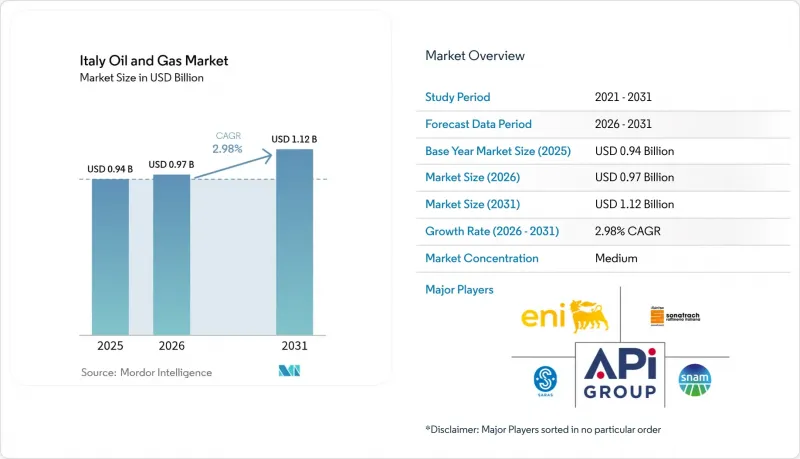
This report is Segmented by Sector (Upstream, Midstream, and Downstream), Location (Onshore and Offshore), and Service (Construction, Maintenance and Turn-Around, and Decommissioning). The Market Sizes and Forecasts are Provided in Terms of Value (USD).
Italy Oil And Gas Market Trends and Insights
Diversification Push After Russian-Gas Supply Crisis
Russia supplied 40% of Italy's gas in 2021, but this share fell to under 5% by 2024, as emergency legislation enabled the rapid approval of LNG terminal projects and alternative pipeline deals with Algeria and Azerbaijan. The EUR 4 billion national security package funded two FSRUs, which together add 10 billion m3 of annual capacity, thereby strengthening supply flexibility. Algerian pipeline flows rose to 32% of 2024 imports, while new U.S. and Qatari LNG cargoes reached Piombino and Ravenna, anchoring Italy's role as a Central European gas gateway. Storage fill rates above 90% ahead of winter 2025 underscore improved resiliency, and midstream contractors benefit from accelerated compression-station and metering upgrades. The structural reshaping of supply chains solidifies Italy's position as the Mediterranean conduit for diversified gas flows, extending well beyond the immediate crisis horizon.
Surging Natural-Gas Demand for Power Generation
Gas-fired plants accounted for 48% of national electricity in 2024, up from 43% in 2019, as coal closures and renewable energy intermittency necessitated the need for fast-ramping capacity. Efficiency gains in combined-cycle turbines lowered marginal costs, making gas the preferred balancing fuel, especially during winter peaks when industrial heating coincides with subdued solar output. Data-center investments in Apulia and Campania drive additional baseload requirements, and developers are increasingly signing long-term gas supply contracts to hedge against price volatility. These dynamics establish a medium-term demand floor that supports further growth in Italy's oil and gas market, despite long-term decarbonization targets.
Accelerating Renewable-Energy Competitiveness
Solar and wind capacity reached 60 GW in 2024, supplying 35% of generation and achieving EUR 40/MWh levelized costs in Sicily. Grid-scale battery deployments begin to smooth hourly volatility, trimming gas peaker dispatch during midday solar peaks. The National Recovery and Resilience Plan allocates EUR 15 billion for additional renewable energy sources through 2026, signaling an intensification of competition for gas in the power mix. Yet seasonal variability and the absence of long-duration storage maintain a reserve role for flexible gas plants, mitigating immediate displacement risks for the Italy oil and gas market.
Other drivers and restraints analyzed in the detailed report include:
- LNG Import Expansion (Piombino & Ravenna FSRUs)
- Refinery Upgrades & Bio-Refinery Conversions
- Mature Domestic Reserves and Declining Production
For complete list of drivers and restraints, kindly check the Table Of Contents.
Segment Analysis
Midstream activities are projected to account for a 4.27% CAGR to 2031, a faster pace than any other sector within the Italian oil and gas market. Snam's EUR 8.1 billion capital plan includes 1,200 kilometers of hydrogen-ready pipelines and 4 billion cubic meters of new storage, expanding Italy's oil and gas market size for midstream services alongside tariff-backed earnings. Cross-border interconnections such as the Adriatic Line enhance north-south flexibility, reinforce transit revenue, and create optionality for future hydrogen blends. Upstream remains the largest revenue source but faces plateauing production volumes, prompting service providers to shift toward maintenance and brownfield enhancement projects that generate predictable, albeit slower, revenue streams.
A robust downstream conversion trend also manifests. Bio-refineries supply premium fuels that fetch higher margins than traditional products, moderating the impact of tightening European fuel-spec standards. The sector therefore evolves from volume-driven processing to margin-driven specialty fuels, a shift that keeps Italy oil and gas market players engaged across the full value chain while meeting EU taxonomy criteria for sustainable operations.
Complete Report Scope:
- By Sector
- Upstream
- Midstream
- Downstream
- By Location
- Onshore
- Offshore
- By Service
- Construction
- Maintenance and Turn-around
- Decommissioning
List of Companies Covered in this Report:
- Eni SpA
- Snam SpA
- Saras SpA
- Sonatrach Raffineria Italiana Srl
- API Anonima Petroli Italiana SpA
- Edison SpA
- TotalEnergies SE
- Shell PLC
- BP PLC
- Saipem SpA
- Maire SpA
- Italgas SpA
- Engie SA (Italy)
- GOI Energy (ISAB Priolo)
- Raffineria di Milazzo ScpA
- SGS Italia SpA
- Zenith Energy Ltd
- Schlumberger NV
- Baker Hughes Italy Srl
- ERG SpA
Additional Benefits:
- The market estimate (ME) sheet in Excel format
- 3 months of analyst support
TABLE OF CONTENTS
1 Introduction
- 1.1 Study Assumptions & Market Definition
- 1.2 Scope of the Study
2 Research Methodology
3 Executive Summary
4 Market Landscape
- 4.1 Market Overview
- 4.2 Market Drivers
- 4.2.1 Surging natural-gas demand for power generation
- 4.2.2 Diversification push after Russian-gas supply crisis
- 4.2.3 Refinery upgrades & bio-refinery conversions
- 4.2.4 LNG import expansion (Piombino & Ravenna FSRUs)
- 4.2.5 Offshore CO?-storage hubs enabling blue-hydrogen clusters
- 4.2.6 Growth in small-scale LNG bunkering for Adriatic shipping
- 4.3 Market Restraints
- 4.3.1 Accelerating renewable-energy competitiveness
- 4.3.2 Mature domestic reserves & declining production
- 4.3.3 Strict offshore drilling moratoria & seismic rules
- 4.3.4 Slow permitting for midstream expansions
- 4.4 Supply-Chain Analysis
- 4.5 Regulatory Landscape
- 4.6 Technological Outlook
- 4.7 Crude-Oil Production & Consumption Outlook
- 4.8 Natural-Gas Production & Consumption Outlook
- 4.9 Installed Pipeline Capacity Analysis
- 4.10 Unconventional Resources CAPEX Outlook (tight oil, oil sands, deep-water)
- 4.11 Porter's Five Forces
- 4.11.1 Bargaining Power of Suppliers
- 4.11.2 Bargaining Power of Buyers
- 4.11.3 Threat of New Entrants
- 4.11.4 Threat of Substitutes
- 4.11.5 Industry Rivalry
- 4.12 PESTLE Analysis
5 Market Size & Growth Forecasts
- 5.1 By Sector
- 5.1.1 Upstream
- 5.1.2 Midstream
- 5.1.3 Downstream
- 5.2 By Location
- 5.2.1 Onshore
- 5.2.2 Offshore
- 5.3 By Service
- 5.3.1 Construction
- 5.3.2 Maintenance and Turn-around
- 5.3.3 Decommissioning
6 Competitive Landscape
- 6.1 Market Concentration
- 6.2 Strategic Moves (M&A, Partnerships, PPAs)
- 6.3 Market Share Analysis (Market Rank/Share for key companies)
- 6.4 Company Profiles (includes Global level Overview, Market level overview, Core Segments, Financials as available, Strategic Information, Products & Services, and Recent Developments)
- 6.4.1 Eni SpA
- 6.4.2 Snam SpA
- 6.4.3 Saras SpA
- 6.4.4 Sonatrach Raffineria Italiana Srl
- 6.4.5 API Anonima Petroli Italiana SpA
- 6.4.6 Edison SpA
- 6.4.7 TotalEnergies SE
- 6.4.8 Shell PLC
- 6.4.9 BP PLC
- 6.4.10 Saipem SpA
- 6.4.11 Maire SpA
- 6.4.12 Italgas SpA
- 6.4.13 Engie SA (Italy)
- 6.4.14 GOI Energy (ISAB Priolo)
- 6.4.15 Raffineria di Milazzo ScpA
- 6.4.16 SGS Italia SpA
- 6.4.17 Zenith Energy Ltd
- 6.4.18 Schlumberger NV
- 6.4.19 Baker Hughes Italy Srl
- 6.4.20 ERG SpA
7 Market Opportunities & Future Outlook
- 7.1 White-space & Unmet-need Assessment

