PUBLISHER: Mordor Intelligence | PRODUCT CODE: 2120402

PUBLISHER: Mordor Intelligence | PRODUCT CODE: 2120402
Southeast Asia Oil And Gas - Market Share Analysis, Industry Trends & Statistics, Growth Forecasts (2026 - 2031)
According to Mordor Intelligence, the Southeast Asia oil and gas market size was valued at USD 38.97 billion in 2025 and estimated to grow from USD 41.08 billion in 2026 to reach USD 53.44 billion by 2031, at a CAGR of 5.40% during the forecast period (2026-2031).
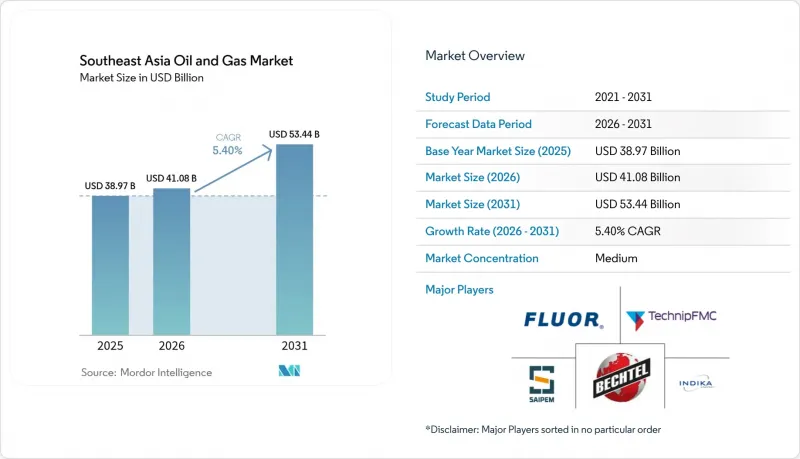
This report is Segmented by Sector (Upstream, Midstream, and Downstream), Location (Onshore and Offshore), Service (Construction, Maintenance and Turn-Around, and Decommissioning), and Geography (Indonesia, Malaysia, Thailand, Vietnam, Philippines, Singapore, Myanmar, and Rest of Southeast Asia). The Market Sizes and Forecasts are Provided in Terms of Value (USD).
Southeast Asia Oil And Gas Market Trends and Insights
Post-pandemic investment rebound accelerates upstream recovery
Capital spending on Southeast Asian upstream projects increased by 34% in 2024 to USD 28.5 billion, as operators reinstated delayed exploration and development programs. PETRONAS dedicated USD 8.2 billion to Malaysian offshore work, and PT Pertamina allocated USD 4.7 billion for Indonesian expansions, signaling restored confidence in demand growth. Approximately 40% of that is spent on targeted LNG supply chains, with Malaysia's floating LNG and Indonesia's onshore liquefaction benefiting most. The rapid outlays clear a project backlog dating from 2020-2022 deferrals and position the region as a swing LNG supplier for wider Asia. Real-time reservoir analytics and subsea tie-backs are compressing payback periods, further stimulating upstream commitments.
Energy-security imperatives drive domestic resource development
Governments are intensifying efforts to cut import dependence. The Philippines initiated a strategic petroleum reserve program in 2024, which provides 30 days of coverage, while Vietnam increased its gas storage capacity by 25%. Thailand's PTT boosted exploration spending 45% in the Gulf of Thailand to offset mature-field decline, and Myanmar awarded 12 new blocks despite political risks. Revised fiscal terms-higher cost-recovery ceilings and accelerated depreciation-have improved project economics, drawing both local and foreign capital. These actions align with broader ASEAN goals of supply resiliency amid volatile global markets.
Legacy field decline outpaces reserve-replacement efforts
Indonesian basins recorded 8-12% annual depletion in 2024, exceeding the global 5-7% norm.Malaysia's aging offshore assets need USD 2.3 billion of maintenance by 2026 to sustain plateau output, straining operator cash flow. The regional reserve-replacement ratio fell to 0.7 times, underscoring the insufficient number of discoveries. Infill drilling and enhanced recovery provide only tactical relief. Operators face steeper lift costs and heightened abandonment liabilities, which intensify capital discipline and can delay frontier exploration.
Other drivers and restraints analyzed in the detailed report include:
- LNG-terminal construction transforms regional gas infrastructure
- Biofuel integration pilots transform gas-network utilization
- Regulatory fragmentation creates investment uncertainty
For complete list of drivers and restraints, kindly check the Table Of Contents.
Segment Analysis
Upstream activities generated 72.15% of 2025 revenue, and the segment is projected to grow at a rate of 5.67% through 2031, maintaining its largest share of the Southeast Asia oil and gas market. Massive projects such as Indonesia's Abadi LNG and Malaysia's Kasawari gas development underpin spending, while midstream networks expand in tandem to evacuate new volumes. Downstream capacity growth lags because stricter emission standards curb new refinery builds.
Digital reservoir models and advanced subsea processing are elevating recovery factors, reinforcing upstream leadership. Governments favor domestic production to enhance energy security, and new fiscal incentives tend to direct capital toward exploration rather than refining upgrades. Enhanced oil recovery and unconventional resource pilots will keep the upstream segment at the forefront of the Southeast Asia oil and gas industry.
Complete Report Scope:
- By Sector
- Upstream
- Midstream
- Downstream
- By Location
- Onshore
- Offshore
- By Service
- Construction
- Maintenance and Turn-around
- Decommissioning
- By Geography
- Indonesia
- Malaysia
- Thailand
- Vietnam
- Philippines
- Singapore
- Myanmar
- Rest of Southeast Asia
List of Companies Covered in this Report:
- PETRONAS
- PT Pertamina Persero
- PTT Exploration & Production PLC
- ExxonMobil Corp.
- Shell PLC
- Chevron Corp.
- TotalEnergies SE
- Harbour Energy PLC
- ConocoPhillips
- BP PLC
- Sinopec Engineering Group
- TechnipFMC PLC
- Saipem SpA
- Bechtel Corp.
- Fluor Corp.
- John Wood Group PLC
- Petrofac Ltd.
- Samsung Engineering Co. Ltd.
- PT Indika Energy Tbk
- PT Rekayasa Industri
- PT Meindo Elang Indah
Additional Benefits:
- The market estimate (ME) sheet in Excel format
- 3 months of analyst support
TABLE OF CONTENTS
1 Introduction
- 1.1 Study Assumptions & Market Definition
- 1.2 Scope of the Study
2 Research Methodology
3 Executive Summary
4 Market Landscape
- 4.1 Market Overview
- 4.2 Market Drivers
- 4.2.1 Post-pandemic investment rebound in upstream & LNG supply chains
- 4.2.2 Energy-security push for domestic production & storage
- 4.2.3 Rapid build-out of LNG import terminals & regas capacity
- 4.2.4 CCS deployment unlocking high-CO2 gas fields
- 4.2.5 Biofuel / hydrogen blending pilots in existing gas networks
- 4.2.6 Digitalisation enabling marginal field commercialisation
- 4.3 Market Restraints
- 4.3.1 Declining legacy fields & reserve replacement gap
- 4.3.2 Regulatory & fiscal uncertainty across ASEAN members
- 4.3.3 ESG-driven capital flight from fossil assets
- 4.3.4 South China Sea maritime disputes delaying drilling
- 4.4 Supply-Chain Analysis
- 4.5 Regulatory Landscape
- 4.6 Technological Outlook
- 4.7 Crude-Oil Production & Consumption Outlook
- 4.8 Natural-Gas Production & Consumption Outlook
- 4.9 Installed Pipeline Capacity Analysis
- 4.10 Unconventional Resources CAPEX Outlook (tight oil, oil sands, deep-water)
- 4.11 Porters Five Forces
- 4.11.1 Bargaining Power of Suppliers
- 4.11.2 Bargaining Power of Buyers
- 4.11.3 Threat of New Entrants
- 4.11.4 Threat of Substitutes
- 4.11.5 Industry Rivalry
5 Market Size & Growth Forecasts
- 5.1 By Sector
- 5.1.1 Upstream
- 5.1.2 Midstream
- 5.1.3 Downstream
- 5.2 By Location
- 5.2.1 Onshore
- 5.2.2 Offshore
- 5.3 By Service
- 5.3.1 Construction
- 5.3.2 Maintenance and Turn-around
- 5.3.3 Decommissioning
- 5.4 By Geography
- 5.4.1 Indonesia
- 5.4.2 Malaysia
- 5.4.3 Thailand
- 5.4.4 Vietnam
- 5.4.5 Philippines
- 5.4.6 Singapore
- 5.4.7 Myanmar
- 5.4.8 Rest of Southeast Asia
6 Competitive Landscape
- 6.1 Market Concentration
- 6.2 Strategic Moves (M&A, Partnerships, PPAs)
- 6.3 Market Share Analysis (Market Rank/Share for key companies)
- 6.4 Company Profiles (includes Global level Overview, Market level overview, Core Segments, Financials as available, Strategic Information, Products & Services, and Recent Developments)
- 6.4.1 PETRONAS
- 6.4.2 PT Pertamina Persero
- 6.4.3 PTT Exploration & Production PLC
- 6.4.4 ExxonMobil Corp.
- 6.4.5 Shell PLC
- 6.4.6 Chevron Corp.
- 6.4.7 TotalEnergies SE
- 6.4.8 Harbour Energy PLC
- 6.4.9 ConocoPhillips
- 6.4.10 BP PLC
- 6.4.11 Sinopec Engineering Group
- 6.4.12 TechnipFMC PLC
- 6.4.13 Saipem SpA
- 6.4.14 Bechtel Corp.
- 6.4.15 Fluor Corp.
- 6.4.16 John Wood Group PLC
- 6.4.17 Petrofac Ltd.
- 6.4.18 Samsung Engineering Co. Ltd.
- 6.4.19 PT Indika Energy Tbk
- 6.4.20 PT Rekayasa Industri
- 6.4.21 PT Meindo Elang Indah
7 Market Opportunities & Future Outlook
- 7.1 White-space & Unmet-Need Assessment

