PUBLISHER: Mordor Intelligence | PRODUCT CODE: 2113286

PUBLISHER: Mordor Intelligence | PRODUCT CODE: 2113286
China Oil And Gas - Market Share Analysis, Industry Trends & Statistics, Growth Forecasts (2026 - 2031)
According to Mordor Intelligence, China oil and gas market size in 2026 is estimated at USD 114.21 billion, growing from 2025 value of USD 108.62 billion with 2031 projections showing USD 146.75 billion, growing at 5.15% CAGR over 2026-2031.
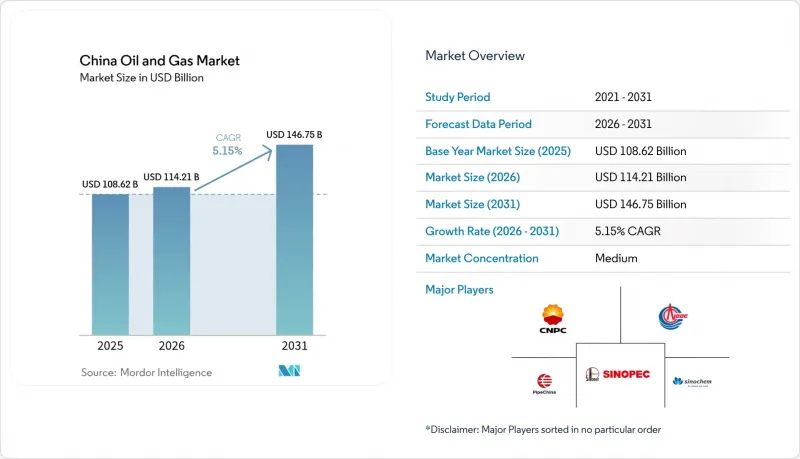
This report is Segmented by Sector (Upstream, Midstream, and Downstream), Location (Onshore and Offshore), and Service (Construction, Maintenance and Turn-Around, and Decommissioning). The Market Sizes and Forecasts are Provided in Terms of Value (USD).
China Oil And Gas Market Trends and Insights
Energy-security Push & Import-Substitution Mandates
Beijing requires crude oil output to remain above 200 million tons per year, thereby reducing reliance on imports, which currently account for 73% of demand. CNPC and Sinopec secure low-cost policy-bank financing for infill drilling, while CNOOC accelerates offshore exploration to diversify reserves. A larger strategic petroleum reserve insulates domestic supply, and mandated local-content rules spur procurement of Chinese-made rigs, pumps, and subsea umbilicals. Petrochemical producers increase off-take contracts for domestic naphtha and ethane, locking in baseline consumption even as gasoline sales flatten. Together, these policies underpin a security premium that cushions the Chinese oil and gas market against price shocks.
Petrochemical Feedstock Demand from Dual-Circulation Strategy
China's economic planners channel investment into integrated refinery-chemical complexes that convert more barrels of crude oil into aromatics and olefins, thereby boosting hydrocarbon demand beyond transport fuels. CNOOC's Daxie Island revamp lifts crude-run capacity 50% and doubles chemical yield, mirroring upgrades in Guangdong and Jiangsu. Domestic ethylene output climbed 12% in 2024, absorbing extra condensate and LPG flows from inland basins. Petrochemical feedstock contracts typically have five-year tenures, providing producers with predictable cash flow and anchoring the Chinese oil and gas market during shifts in the energy transition.
Windfall-Profit Tax on Upstream Majors
A tiered levy skims exceptional earnings during high-price cycles, trimming reinvestment budgets at CNPC, Sinopec, and CNOOC. Management prioritises core blocks with quick payback and delays marginal frontier wells. The tax coincides with rising CCS outlays, intensifying cash-flow pressure, and slightly tempering expansion inside the Chinese oil and gas market.
Other drivers and restraints analyzed in the detailed report include:
- Shale-Gas Commercialisation in Sichuan & Chongqing
- National Pipeline Network (PipeChina) Capacity Expansion
- Stringent Methane-Emission Regulations (2025 Action Plan)
For complete list of drivers and restraints, kindly check the Table Of Contents.
Segment Analysis
Upstream activities accounted for 70.88% of China's oil and gas market share in 2025, underpinned by aggressive state-funded exploration in the Bohai, South China Sea, and Ordos regions. Meanwhile, the downstream sector is projected to drive market growth with a CAGR of 5.44% through 2031. Integrated majors utilize AI-assisted seismic inversion, reducing exploration cycle times by 20% and reinforcing their upstream preeminence.
Upstream spend focuses on reservoir management tools that enhance recovery factors in mature blocks. Carbon-capture pilots in producing wells store CO2 in depleted formations, allowing incremental barrels under stricter emission norms. Although downstream gasoline cracks narrow with EV adoption, aromatics margins remain firm, propelling refinery utilization and sustaining chemical demand that ripples upstream.
Complete Report Scope:
- By Sector
- Upstream
- Midstream
- Downstream
- By Location
- Onshore
- Offshore
- By Service
- Construction
- Maintenance and Turn-around
- Decommissioning
List of Companies Covered in this Report:
- China National Petroleum Corporation (CNPC)
- China Petroleum & Chemical Corporation (Sinopec)
- China National Offshore Oil Corporation (CNOOC)
- PipeChina (China Oil & Gas Pipeline Network Corp)
- Sinochem Holdings
- Shaanxi Yanchang Petroleum Group
- Yanchang Petroleum International Ltd
- PetroChina Company Ltd
- China Gas Holdings
- ENN Energy Holdings
- China Resources Gas
- ExxonMobil Corp
- Chevron Corp
- BP plc
- Shell plc
- TotalEnergies SE
- QatarEnergy
- Rosneft PJSC
- Gazprom PJSC
- Equinor ASA
Additional Benefits:
- The market estimate (ME) sheet in Excel format
- 3 months of analyst support
TABLE OF CONTENTS
1 Introduction
- 1.1 Study Assumptions & Market Definition
- 1.2 Scope of the Study
2 Research Methodology
3 Executive Summary
4 Market Landscape
- 4.1 Market Overview
- 4.2 Market Dynamics
- 4.2.1 Drivers
- 4.2.1.1 Energy-security push & import-substitution mandates
- 4.2.1.2 Petrochemical feedstock demand from dual-circulation strategy
- 4.2.1.3 Shale-gas commercialisation in Sichuan & Chongqing
- 4.2.1.4 National pipeline network (PipeChina) capacity expansion
- 4.2.1.5 CCS-ready refinery upgrades (Net-zero 2060 compliance)
- 4.2.1.6 AI-optimised E&P to lower lifting costs in mature basins
- 4.2.2 Restraints
- 4.2.2.1 Windfall-profit tax on upstream majors
- 4.2.2.2 Stringent methane-emission regulations (2025 action plan)
- 4.2.2.3 Accelerated electrification of road transport
- 4.2.2.4 Water-stress limits on fracking in Tarim & Ordos
- 4.2.1 Drivers
- 4.3 Supply-Chain Analysis
- 4.4 Regulatory Landscape
- 4.5 Technological Outlook
- 4.6 Crude-Oil Production & Consumption Outlook
- 4.7 Natural-Gas Production & Consumption Outlook
- 4.8 Installed Pipeline Capacity Analysis
- 4.9 Unconventional Resources CAPEX Outlook (tight oil, oil sands, deep-water)
- 4.10 Porter's Five Forces
- 4.10.1 Threat of New Entrants
- 4.10.2 Bargaining Power of Suppliers
- 4.10.3 Bargaining Power of Buyers
- 4.10.4 Threat of Substitutes
- 4.10.5 Competitive Rivalry
- 4.11 PESTLE Analysis
5 Market Size & Growth Forecasts
- 5.1 By Sector
- 5.1.1 Upstream
- 5.1.2 Midstream
- 5.1.3 Downstream
- 5.2 By Location
- 5.2.1 Onshore
- 5.2.2 Offshore
- 5.3 By Service
- 5.3.1 Construction
- 5.3.2 Maintenance and Turn-around
- 5.3.3 Decommissioning
6 Competitive Landscape
- 6.1 Market Concentration
- 6.2 Strategic Moves (M&A, Partnerships, PPAs)
- 6.3 Market Share Analysis (Market Rank/Share for key companies)
- 6.4 Company Profiles (includes Global level Overview, Market level overview, Core Segments, Financials as available, Strategic Information, Products & Services, and Recent Developments)
- 6.4.1 China National Petroleum Corporation (CNPC)
- 6.4.2 China Petroleum & Chemical Corporation (Sinopec)
- 6.4.3 China National Offshore Oil Corporation (CNOOC)
- 6.4.4 PipeChina (China Oil & Gas Pipeline Network Corp)
- 6.4.5 Sinochem Holdings
- 6.4.6 Shaanxi Yanchang Petroleum Group
- 6.4.7 Yanchang Petroleum International Ltd
- 6.4.8 PetroChina Company Ltd
- 6.4.9 China Gas Holdings
- 6.4.10 ENN Energy Holdings
- 6.4.11 China Resources Gas
- 6.4.12 ExxonMobil Corp
- 6.4.13 Chevron Corp
- 6.4.14 BP plc
- 6.4.15 Shell plc
- 6.4.16 TotalEnergies SE
- 6.4.17 QatarEnergy
- 6.4.18 Rosneft PJSC
- 6.4.19 Gazprom PJSC
- 6.4.20 Equinor ASA
7 Market Opportunities & Future Outlook
- 7.1 White-space & Unmet-Need Assessment

