PUBLISHER: Mordor Intelligence | PRODUCT CODE: 2122391

PUBLISHER: Mordor Intelligence | PRODUCT CODE: 2122391
Gas Generator - Market Share Analysis, Industry Trends & Statistics, Growth Forecasts (2026 - 2031)
According to Mordor Intelligence, gas generator market size in 2026 is estimated at USD 5.9 billion, growing from 2025 value of USD 5.43 billion with 2031 projections showing USD 8.92 billion, growing at 8.64% CAGR over 2026-2031.
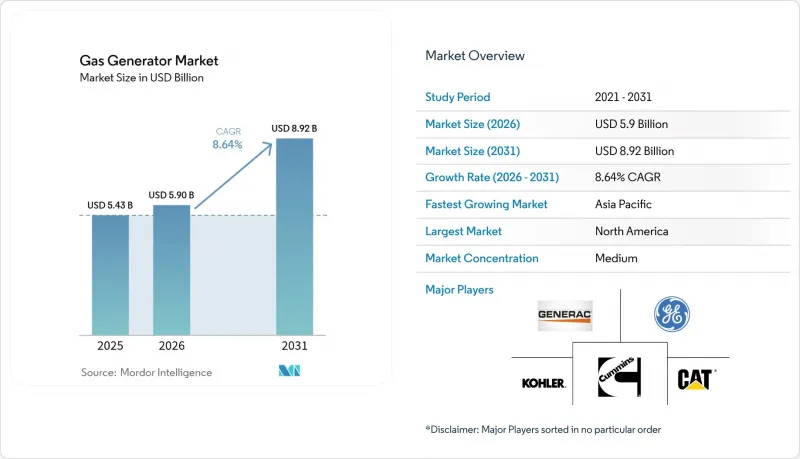
This report is Segmented by Power Rating (Below 75 KVA, 75 To 375 KVA, 375 To 750 KVA, and Above 750 KVA), Application (Standby, Peak Shaving, and Prime/Continuous), End-User (Industrial, Commercial, and Residential), and Geography (North America, Europe, Asia-Pacific, South America, and Middle East and Africa). The Market Sizes and Forecasts are Provided in Terms of Value (USD).
Global Gas Generator Market Trends and Insights
Rapid Expansion of Natural-Gas Pipeline Infrastructure
Widening pipeline networks cuts delivered fuel costs and expands siting flexibility for the gas generator market. The United States alone added 17.8 Bcf/d of new capacity in 2024 through projects such as Mountain Valley Pipeline and Permian takeaway lines, reinforcing supply security for distributed assets. India mirrors this trend as city-gas distribution grids expand to underserved districts, supporting a 60% rise in national demand by 2030. Consistent fuel availability, particularly for the 75-375 kVA class, benefits commercial and light-industrial loads, while also underpinning the economics of peak-shaving schemes that rely on predictable gas pricing. Continued investment-another 7.3 Bcf/d set to enter service from the Permian Basin-locks in a structural tailwind for the gas generator market across both mature and emerging economies.
Lower OPEX & Emissions Versus Diesel Gensets
Natural-gas units slash running costs by capitalizing on the global fuel-price gap and by minimizing oil changes, filter swaps, and after-treatment upkeep. Operators typically realize a 20-30% lower annual expenditure compared to comparable diesel sets, a saving that is amplified wherever carbon fees apply. California's Tier 5 off-road rules illustrate the regulatory swing: tougher NOx ceilings push buyers toward gas models that comply without urea injection or particulate filters. The cost-emissions advantage therefore accelerates adoption in industrial parks, shopping malls, and municipal facilities-settings where life-cycle economics and environmental scorecards now matter as much as initial purchase price.
Sparse Gas-Grid Access in Remote Areas
Extending pipelines to low-density territories remains uneconomical, limiting gas generator penetration in areas where mines, farms, or islands rely on diesel or LPG. A comprehensive Energies review shows that remote microgrid planners still prefer transportable fuels because the capital expenditure for pipe extensions cannot be recouped at modest load factors. Arctic operations face reliability challenges that favor on-site fuel storage over reliance on pipelines. Without virtual-pipeline or small-scale LNG logistics, adoption of below-75 kVA and 75-375 kVA stalls in these regions. Consequently, gas-set suppliers must pair offerings with LPG kits or hybrid PV-battery packages to stay relevant off-grid.
Other drivers and restraints analyzed in the detailed report include:
- Backup-Power Boom in Data-Centers & Hospitals
- Extreme-Weather Events Driving Standby Installations
- Volatile Natural-Gas Pricing
For complete list of drivers and restraints, kindly check the Table Of Contents.
Segment Analysis
The <75 kVA class claimed 47.10% of the gas generator market share in 2025, confirming its dominance in homes and small businesses, where modest loads and quick installation are most important. In contrast, the 75-375 kVA band is projected to post a 9.62% CAGR, the fastest pace among all ratings, as commercial buildings and light-industrial plants enhance resilience after recent outage spikes. The gas generator market size for units above 375 kVA is expanding as data center and hospital projects specify multi-megawatt blocks; however, those tiers together still trail the entry and mid-range segments in total value.
Manufacturers strengthen the 75-375 kVA offering through modular frames that parallel easily and through digital controllers that support peak-shaving cycles. Remote monitoring reduces service visits, improving lifetime economics compared to diesel sets. Meanwhile, models below 75 kVA are gaining traction in new-home construction programs that pre-wire for permanent backup, such as Generac's partnership with Texas builders. Across all ratings, fuel-flexible designs that can accept future hydrogen blends help protect asset life as decarbonization targets become tighter.
Complete Report Scope:
- By Power Rating
- Below 75 kVA
- 75 to 375 kVA
- 375 to 750 kVA
- Above 750 kVA
- By Application
- Standby
- Peak Shaving
- Prime/Continuous
- By End-User
- Industrial
- Commercial
- Residential
- By Geography
- North America
- United States
- Canada
- Mexico
- Europe
- Germany
- United Kingdom
- France
- Italy
- NORDIC Countries
- Russia
- Rest of Europe
- Asia Pacific
- China
- India
- Japan
- South Korea
- ASEAN Countries
- Rest of Asia-Pacific
- South America
- Brazil
- Argentina
- Rest of South America
- Middle East and Africa
- Saudi Arabia
- United Arab Emirates
- South Africa
- Egypt
- Rest of Middle East and Africa
- North America
Geography Analysis
North America accounted for 35.05% of the gas generator market share in 2025, driven by the world's largest pipeline grid and a policy shift away from diesel engines. The United States alone placed 17.8 Bcf per day of new pipe in service during 2024, ensuring ample fuel for behind-the-meter assets across the Gulf Coast and Appalachia. Data-center clusters in Virginia and Texas utilize multi-megawatt gas blocks that serve both standby and peak-shaving roles, while supermarkets and municipal pumps employ 150 kVA to 300 kVA frames for storm resilience. California regulations that phase out diesel gensets in non-attainment counties further channel spending toward cleaner spark-ignition models, cementing regional leadership.
The Asia Pacific is projected to post the fastest 9.31% CAGR through 2031, as pipeline build-out, LNG imports, and industrial modernization converge. India's natural-gas demand is set to climb 60% by 2030, and city-gas distribution schemes now reach secondary towns, unlocking a broad base for <375 kVA equipment. In China, factory automation drives tighter power-quality specs that favor on-site gas generation, while provincial incentive programs reimburse up to 20% of capital cost for high-efficiency CHP units. Japan and South Korea pair pilot hydrogen-ready engines, yet natural gas remains the primary fuel for backup and grid-support duties until the costs of reen hydrogen call.
Europe maintains gradual expansion despite high TTF prices that squeeze fuel-cost advantages. Energy-security policies in Germany and the Netherlands are driving combined heat and power retrofits, while silent enclosures that meet 65 dB(A) city limits open up opportunities in densely populated urban districts. Hybrid systems that combine gas engines with battery storage enable facilities to pass stringent grid-interconnection tests, sustaining demand in both the 75-375 kVA and 375-750 kVA ranges. South America and the Middle East & Africa register accelerating orders as new cross-border pipelines and LNG terminals unlock supply, though sparse rural grids still cap penetration in remote provinces.
- Generac Holdings Inc.
- Caterpillar Inc.
- Cummins Inc.
- Kohler Co.
- Mitsubishi Heavy Industries Ltd.
- Atlas Copco AB
- AKSA Power Generation
- Doosan Portable Power
- Briggs & Stratton LLC
- Wacker Neuson SE
- Himoinsa (Sumitomo)
- Yanmar Holdings Co.
- FG Wilson (Caterpillar UK)
- MTU America Inc.
- Pramac Generator S.p.A.
- Wartsila Corp.
- Honda Power Equipment
- Siemens Energy AG
Additional Benefits:
- The market estimate (ME) sheet in Excel format
- 3 months of analyst support
TABLE OF CONTENTS
1 Introduction
- 1.1 Study Assumptions & Market Definition
- 1.2 Scope of the Study
2 Research Methodology
3 Executive Summary
4 Market Landscape
- 4.1 Market Overview
- 4.2 Market Drivers
- 4.2.1 Rapid expansion of natural-gas pipeline infrastructure
- 4.2.2 Lower OPEX & emissions versus diesel gensets
- 4.2.3 Backup-power boom in data-centers & hospitals
- 4.2.4 Extreme-weather events driving standby installations
- 4.2.5 Growth of CHP-ready micro-gas generators
- 4.2.6 Diesel-genset phase-outs in air-quality non-attainment zones
- 4.3 Market Restraints
- 4.3.1 Sparse gas-grid access in remote areas
- 4.3.2 Volatile natural-gas pricing
- 4.3.3 Competition from hydrogen & fuel-cell solutions
- 4.3.4 Tightening urban noise & methane-slip rules
- 4.4 Supply-Chain Analysis
- 4.5 Regulatory Landscape
- 4.6 Technological Outlook
- 4.7 Porters Five Forces
- 4.7.1 Bargaining Power of Suppliers
- 4.7.2 Bargaining Power of Buyers
- 4.7.3 Threat of New Entrants
- 4.7.4 Threat of Substitute Products
- 4.7.5 Intensity of Competitive Rivalry
5 Market Size & Growth Forecasts
- 5.1 By Power Rating
- 5.1.1 Below 75 kVA
- 5.1.2 75 to 375 kVA
- 5.1.3 375 to 750 kVA
- 5.1.4 Above 750 kVA
- 5.2 By Application
- 5.2.1 Standby
- 5.2.2 Peak Shaving
- 5.2.3 Prime/Continuous
- 5.3 By End-User
- 5.3.1 Industrial
- 5.3.2 Commercial
- 5.3.3 Residential
- 5.4 By Geography
- 5.4.1 North America
- 5.4.1.1 United States
- 5.4.1.2 Canada
- 5.4.1.3 Mexico
- 5.4.2 Europe
- 5.4.2.1 Germany
- 5.4.2.2 United Kingdom
- 5.4.2.3 France
- 5.4.2.4 Italy
- 5.4.2.5 NORDIC Countries
- 5.4.2.6 Russia
- 5.4.2.7 Rest of Europe
- 5.4.3 Asia Pacific
- 5.4.3.1 China
- 5.4.3.2 India
- 5.4.3.3 Japan
- 5.4.3.4 South Korea
- 5.4.3.5 ASEAN Countries
- 5.4.3.6 Rest of Asia-Pacific
- 5.4.4 South America
- 5.4.4.1 Brazil
- 5.4.4.2 Argentina
- 5.4.4.3 Rest of South America
- 5.4.5 Middle East and Africa
- 5.4.5.1 Saudi Arabia
- 5.4.5.2 United Arab Emirates
- 5.4.5.3 South Africa
- 5.4.5.4 Egypt
- 5.4.5.5 Rest of Middle East and Africa
- 5.4.1 North America
6 Competitive Landscape
- 6.1 Market Concentration
- 6.2 Strategic Moves (M&A, Partnerships, PPAs)
- 6.3 Market Share Analysis (Market Rank/Share for key companies)
- 6.4 Company Profiles (includes Global level Overview, Market level overview, Core Segments, Financials as available, Strategic Information, Products & Services, and Recent Developments)
- 6.4.1 Generac Holdings Inc.
- 6.4.2 Caterpillar Inc.
- 6.4.3 Cummins Inc.
- 6.4.4 Kohler Co.
- 6.4.5 Mitsubishi Heavy Industries Ltd.
- 6.4.6 Atlas Copco AB
- 6.4.7 AKSA Power Generation
- 6.4.8 Doosan Portable Power
- 6.4.9 Briggs & Stratton LLC
- 6.4.10 Wacker Neuson SE
- 6.4.11 Himoinsa (Sumitomo)
- 6.4.12 Yanmar Holdings Co.
- 6.4.13 FG Wilson (Caterpillar UK)
- 6.4.14 MTU America Inc.
- 6.4.15 Pramac Generator S.p.A.
- 6.4.16 Wartsila Corp.
- 6.4.17 Honda Power Equipment
- 6.4.18 Siemens Energy AG
7 Market Opportunities & Future Outlook
- 7.1 White-space & Unmet-Need Assessment

