PUBLISHER: Mordor Intelligence | PRODUCT CODE: 2122900

PUBLISHER: Mordor Intelligence | PRODUCT CODE: 2122900
China Construction Equipment - Market Share Analysis, Industry Trends & Statistics, Growth Forecasts (2026 - 2031)
According to Mordor Intelligence, the China construction equipment market size is expected to increase from USD 56.18 billion in 2025 to USD 59.62 billion in 2026 and reach USD 80.24 billion by 2031, growing at a CAGR of 6.12% over 2026-2031.
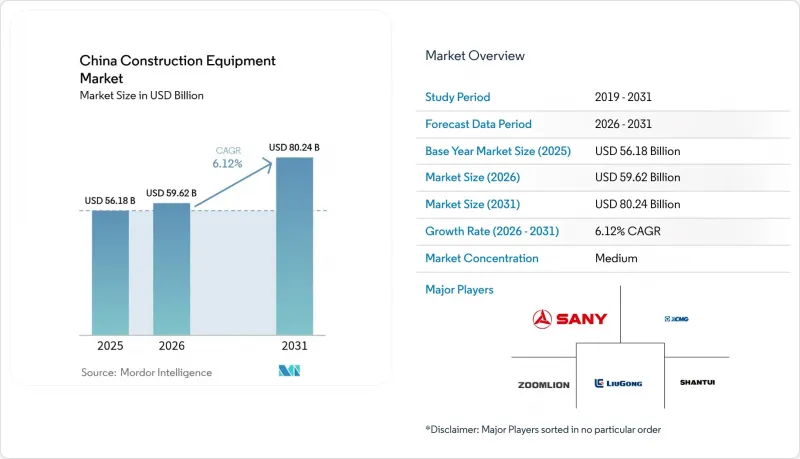
This report is Segmented by Machinery Type (Earth-Moving Machinery, Material-Handling Machinery, and More), Drive Type (Internal-Combustion Engine, Hybrid, and More), Sales Channel (OEM Direct Sales, and Authorized Dealer Sales), and Application (Building Construction, Infrastructure Construction, and More). The Market Forecasts are Provided in Terms of Value (USD) and Volume (Units).
China Construction Equipment Market Trends and Insights
Government 'New Infrastructure 2025-30' Pipeline
Central planners have placed transport links, water projects, and power-grid corridors at the heart of the next 5-year build-out. The early-batch project list has already accelerated tender activity for excavators, cranes, and road equipment. Contractors active in remote western provinces prefer domestic brands that can respond quickly to terrain and climate challenges. Equipment-rental demand is also rising as firms opt for asset-light participation in multi-year construction packages. Together, these shifts anchor a dependable stream of orders even as residential construction lags.
Carbon-Neutral Mandate Spurring Electric Machinery
China's emissions-trading scheme now prices carbon for heavy industry, forcing site managers to weigh lifetime fuel and compliance costs more carefully. Zero-emission models are therefore moving from demonstration fleets into regular procurement lists, especially for urban projects that face strict air-quality targets. Local governments in coastal provinces offer expedited permits and publicity benefits to contractors using electric fleets. Manufacturers respond by expanding battery and drivetrain capacity while refining after-sales support to reduce buyers' perceived risk. These non-price incentives accelerate adoption beyond what pure economics would dictate.
Prolonged Real-Estate Downturn
Weak apartment presales continue to undermine private developers' cash flow, curbing demand for concrete pumps, tower cranes, and other building-centric gear. Even state rescue measures have merely slowed, not reversed, the slide. Large rental companies are redeploying fleets from housing to infrastructure, but utilization gaps remain. Manufacturers with heavy exposure to concrete machinery now lean harder on parts and service revenue. Until household sentiment turns, equipment tied to vertical construction is likely to lag broader market growth.
Other drivers and restraints analyzed in the detailed report include:
- OEM Export Push Enables Domestic Economies of Scale
- Digital Equipment-Rental Platforms Unlocking SME Demand
- Domestic Price Wars from Over-Capacity
For complete list of drivers and restraints, kindly check the Table Of Contents.
Segment Analysis
Excavators captured 55.28% of the Chinese construction equipment market share in 2025, giving them a commanding influence over model development and supplier priorities. Their versatility in earthworks, mining, and demolition keeps demand resilient across cycles. Contractors value the growing range of attachments that convert one base machine into multiple task solutions. Meanwhile, rising labor costs elevate interest in semi-autonomous dig modes that reduce operator fatigue. Although full-electric excavators are currently limited, they are expected to achieve the segment's fastest growth, with a 12.15% CAGR projected through 2031, reflecting a gradual transition toward zero-emission solutions.
The rest of the machinery spectrum is adapting to this two-speed reality. Loaders and graders refine drivetrains for fuel savings, while dozers see early trials of hydrogen engines. Material-handling cranes stretch lifting capacities to serve offshore wind and modular housing. Concrete equipment, hit hardest by housing weakness, experiments with digital batching and predictive maintenance to stay relevant.
Diesel power retained 92.64% of the Chinese construction equipment market share in 2025, thanks to dense refueling infrastructure and proven uptime in remote areas. Fleet managers appreciate the familiar maintenance routines and broad availability of parts. However, tightening emissions caps and urban noise rules erode diesel's long-term appeal. Policy incentives, paired with falling battery costs, make the switch increasingly rational for lighter classes.
Full-electric systems, although starting from a low base, are projected to deliver a sector-leading 37.85% CAGR through 2031, underscoring the speed of change once tipping points are reached. Hybrids sit between these poles, offering fuel savings without range anxiety. Some provinces reward them with carbon credits, nudging skeptics toward partial electrification. Hydrogen pilots probe viability for heavy, continuous-duty tasks. Together, these alternatives sketch a future in which drivetrain choice aligns with specific site constraints rather than a one-size-fits-all diesel.
Complete Report Scope:
- By Machinery Type
- Earth-moving Machinery
- Excavators
- Loaders
- Dozers
- Material-Handling Machinery
- Cranes
- Fork-lifts
- Telescopic Handlers
- Road-Construction Machinery
- Motor Graders
- Rollers/Compactors
- Pavers
- Concrete Equipment
- Concrete Mixers
- Concrete Pumps
- Earth-moving Machinery
- By Drive Type
- Internal-Combustion Engine (Diesel)
- Hybrid
- Full-Electric
- By Sales Channel
- Original Equipment Manufacturer (OEM) Direct Sales
- Authorized Dealer Sales
- By Application
- Building Construction
- Infrastructure Construction
- Energy and Natural Resources
- Others
List of Companies Covered in this Report:
- Sany Group
- Xuzhou Construction Machinery Group Co., Ltd. (XCMG)
- Caterpillar Inc.
- Zoomlion Heavy Industry
- LiuGong Machinery
- Komatsu Ltd.
- Hitachi Construction Machinery
- AB Volvo (Volvo CE)
- Liebherr Group
- Shantui Construction Machinery
- Tadano Ltd.
- J.C. Bamford Excavators Limited
- Doosan Bobcat Ltd.
- Hyundai Construction Equipment Ltd.
- Yanmar Holdings Co. Ltd.
- Terex Corporation
- China Railway Construction Heavy Industry Co., Ltd.
Additional Benefits:
- The market estimate (ME) sheet in Excel format
- 3 months of analyst support
TABLE OF CONTENTS
1 Introduction
- 1.1 Study Assumptions and Market Definition
- 1.2 Scope of the Study
2 Research Methodology
3 Executive Summary
4 Market Landscape
- 4.1 Market Overview
- 4.2 Market Drivers
- 4.2.1 Government 'New Infrastructure 2025-30' Pipeline
- 4.2.2 Carbon-Neutral Mandate Spurring Electric Machinery
- 4.2.3 OEM Export Push Enables Domestic Economies of Scale
- 4.2.4 Digital Equipment-Rental Platforms Unlocking SME Demand
- 4.2.5 Belt And Road Back-Orders for Component Suppliers
- 4.2.6 Provincial Carbon-Credit Markets Favouring Hybrids
- 4.3 Market Restraints
- 4.3.1 Prolonged Real-Estate Downturn
- 4.3.2 Domestic Price Wars from Over-Capacity
- 4.3.3 Tight Credit to SME Contractors
- 4.3.4 Inverter and BMS Chip Shortages For E-Equipment
- 4.4 Value / Supply-Chain Analysis
- 4.5 Regulatory Landscape
- 4.6 Technological Outlook
- 4.7 Porter's Five Forces
- 4.7.1 Threat of New Entrants
- 4.7.2 Bargaining Power of Buyers
- 4.7.3 Bargaining Power of Suppliers
- 4.7.4 Threat of Substitutes
- 4.7.5 Competitive Rivalry
5 Market Size and Growth Forecasts (Value (USD) and Volume (Units))
- 5.1 By Machinery Type
- 5.1.1 Earth-moving Machinery
- 5.1.1.1 Excavators
- 5.1.1.2 Loaders
- 5.1.1.3 Dozers
- 5.1.2 Material-Handling Machinery
- 5.1.2.1 Cranes
- 5.1.2.2 Fork-lifts
- 5.1.2.3 Telescopic Handlers
- 5.1.3 Road-Construction Machinery
- 5.1.3.1 Motor Graders
- 5.1.3.2 Rollers/Compactors
- 5.1.3.3 Pavers
- 5.1.4 Concrete Equipment
- 5.1.4.1 Concrete Mixers
- 5.1.4.2 Concrete Pumps
- 5.1.1 Earth-moving Machinery
- 5.2 By Drive Type
- 5.2.1 Internal-Combustion Engine (Diesel)
- 5.2.2 Hybrid
- 5.2.3 Full-Electric
- 5.3 By Sales Channel
- 5.3.1 Original Equipment Manufacturer (OEM) Direct Sales
- 5.3.2 Authorized Dealer Sales
- 5.4 By Application
- 5.4.1 Building Construction
- 5.4.2 Infrastructure Construction
- 5.4.3 Energy and Natural Resources
- 5.4.4 Others
6 Competitive Landscape
- 6.1 Market Concentration
- 6.2 Strategic Moves
- 6.3 Market Share Analysis
- 6.4 Company Profiles (Includes Global level Overview, Market level overview, Core Segments, Financials as available, Strategic Information, Market Rank/Share for key companies, Products and Services, and Recent Developments)
- 6.4.1 Sany Group
- 6.4.2 Xuzhou Construction Machinery Group Co., Ltd. (XCMG)
- 6.4.3 Caterpillar Inc.
- 6.4.4 Zoomlion Heavy Industry
- 6.4.5 LiuGong Machinery
- 6.4.6 Komatsu Ltd.
- 6.4.7 Hitachi Construction Machinery
- 6.4.8 AB Volvo (Volvo CE)
- 6.4.9 Liebherr Group
- 6.4.10 Shantui Construction Machinery
- 6.4.11 Tadano Ltd.
- 6.4.12 J.C. Bamford Excavators Limited
- 6.4.13 Doosan Bobcat Ltd.
- 6.4.14 Hyundai Construction Equipment Ltd.
- 6.4.15 Yanmar Holdings Co. Ltd.
- 6.4.16 Terex Corporation
- 6.4.17 China Railway Construction Heavy Industry Co., Ltd.
7 Market Opportunities and Future Outlook
- 7.1 White-space and Unmet-Need Assessment

