PUBLISHER: Mordor Intelligence | PRODUCT CODE: 2123589

PUBLISHER: Mordor Intelligence | PRODUCT CODE: 2123589
Syringe Filling Machine - Market Share Analysis, Industry Trends & Statistics, Growth Forecasts (2026 - 2031)
According to Mordor Intelligence, the syringe filling machine market size was valued at USD 1.95 billion in 2025 and estimated to grow from USD 2.09 billion in 2026 to reach USD 2.99 billion by 2031, at a CAGR of 7.41% during the forecast period (2026-2031).
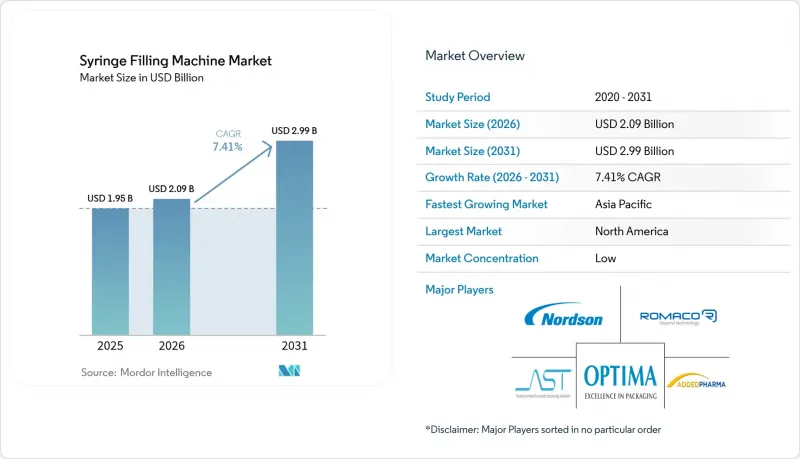
This report is Segmented by Technology (Servo-Driven Piston, Peristaltic Pump, and More), Output Capacity (Up To 6, 000 (Lab / Clinical), 6, 001 - 18, 000 (Mid-Scale)), End-User (Pharmaceutical Manufacturing Companies, Biotechnology Companies, and More), and by Geography. The Market Forecasts are Provided in Terms of Value (USD).
Global Syringe Filling Machine Market Trends and Insights
Rising Demand for Pre-filled Syringes
Elevated patient convenience, reduced contamination risk, and regulatory encouragement continue to shift injectable drug delivery toward pre-filled syringes. BD expanded Neopak XtraFlow glass syringe capacity sevenfold at Le Pont-de-Claix to support high-viscosity biologics, confirming soaring industrial uptake. Collaboration between BD and Ypsomed that marries XtraFlow syringes with autoinjectors underscores device-platform co-development. Equipment makers supplying servo-driven piston systems optimized for nested, pre-sterilized formats secure a meaningful advantage as manufacturers demand sterility assurance levels beyond traditional vial lines. The preference of hospital pharmacies for pre-filled units that simplify bedside administration further fuels the syringe filling machine market.
Shift Toward High-Speed Automated Fill-Finish Lines for Biologics
Biologics now represent one-fifth of pharmaceutical sales and require gentle, contamination-free handling. WuXi Biologics achieved 99.5% quality acceptance on Cytiva's SA25 robotic workcell that fills vials, syringes, and cartridges in closed conditions. The emergence of large-volume subcutaneous injections up to 20 mL places a premium on volumetric accuracy over prolonged cycles. With contract manufacturers projected to hold 54% of global biologics capacity by 2028, versatile high-throughput systems that traverse multiple jurisdictions gain traction.
High Capital Expenditure and Validation Costs
Modern syringe filling systems often exceed USD 2 million, and full validation can stretch 18 months, discouraging smaller firms. Argonaut Manufacturing Services allocated USD 45 million for a new Carlsbad aseptic facility, illustrating the financial weight of competitive entry. Rising raw-material prices-steel surpassing USD 800 per ton-and tariff impacts reported by West Pharmaceutical inflate project budgets. Cleanroom build-outs, personnel training, and digital documentation platforms further raise total cost of ownership.
Other drivers and restraints analyzed in the detailed report include:
- Adoption of Ready-to-Use (RTU) Nested Syringe Formats
- Stringent Regulatory Focus on Aseptic Accuracy
- Limited Flexibility of Legacy Equipment
For complete list of drivers and restraints, kindly check the Table Of Contents.
Segment Analysis
Automated platforms accounted for 63.92% of the syringe filling machine market in 2025, and the segment is rising at 9.29% CAGR toward 2031 as regulators promote contamination-free processes. The convergence of high market share and high growth positions automation as the dominant paradigm. Manual and semi-automated setups persist where batch flexibility trumps throughput, yet their relevance diminishes in cGMP environments that increasingly favor enclosed, robotic modules.
Automation's ascent is fueled by Annex 1 updates encouraging closed systems that curb human contact. Installations such as Cytiva's SA25 workcells at WuXi Biologics achieve 99.5% acceptance, validating productivity and compliance benefits. Hospital pharmacies extend the same logic, adopting IntelliFill IV robots that slash medication-prep errors. As these gains become industry expectations, automated units cement their role in the syringe filling machine market.
Servo-driven piston technology controlled 44.05% of the syringe filling machine market size in 2025 and is advancing at 9.78% CAGR. Superior volumetric control across viscosities, especially for protein-rich biologics, drives adoption. Peristaltic pumps still serve shear-sensitive formulations, while time-pressure and gravity systems remain in legacy niches.
Syntegon's MLD Advanced leverages servo precision to reach 400 syringes per minute and document every dispense for regulators. Nordson's PICO Nexμs couples servo jets with predictive analytics, exemplifying convergence of mechanical accuracy and digital oversight. Patent filings describing dual-stage force profiles attest to continuous gains in servo actuation finesse.
Complete Report Scope:
- By Type
- Automated
- Semi-Automated
- Manual / Benchtop
- By Technology
- Servo-driven Piston
- Peristaltic Pump
- Time-Pressure / Volumetric
- Vacuum / Gravity
- By Output Capacity (Syringes per hour)
- Up to 6,000 (Lab / Clinical)
- 6,001 - 18,000 (Mid-scale)
- Above 18,000 (Commercial High-speed)
- By End-user
- Pharmaceutical Manufacturing Companies
- Biotechnology Companies
- Contract Development and Manufacturing Organizations (CDMOs)
- Hospital and Compounding Pharmacies
- By Geography
- North America
- United States
- Canada
- Mexico
- Europe
- Germany
- France
- United Kingdom
- Italy
- Spain
- Russia
- Netherlands
- Switzerland
- Rest of Europe
- Asia-Pacific
- China
- Japan
- India
- South Korea
- Australia
- Indonesia
- Thailand
- Malaysia
- Rest of Asia-Pacific
- Middle East and Africa
- Middle East
- Saudi Arabia
- United Arab Emirates
- Turkey
- Rest of Middle East
- Africa
- South Africa
- Egypt
- Nigeria
- Kenya
- Rest of Africa
- Middle East
- South America
- Brazil
- Argentina
- Colombia
- Rest of South America
- North America
Geography Analysis
North America retained 42.35% syringe filling machine market share in 2025 on the back of domestic capacity expansions and regulatory vigilance that favors local sourcing. BD's boost to US syringe output responded directly to FDA warnings on imported devices, exemplifying policy-driven reshoring. Regional manufacturers such as Nordson pioneer predictive maintenance and Industry 4.0 features, embedding competitive technology advantages. Consolidation deals-Nordson's USD 800 million Atrion purchase-indicate available capital and strategic drive for portfolio depth.
Europe maintains significant presence through regulatory leadership. Annex 1 revisions guide global aseptic norms, and equipment makers like Syntegon tailor offerings to ready-to-use requirements, achieving 400-unit-per-minute outputs while satisfying no-touch imperatives. Nipro's investment in its Munnerstadt plant widens European PFS supply and emphasizes sustainable practices such as energy-efficient washing lines. Digital twin projects backed by ISPE and EU research grants illustrate the region's innovation ecosystem.
Asia-Pacific is the fastest-growing territory at 10.72% CAGR to 2031. China's NMPA standards YY 1001-2024 frame stringent syringe quality metrics, fostering domestic demand for compliant. WuXi Biologics achieved GMP release just 15 months after purchasing the SA25 workcell, underscoring regional execution speed. Samsung Biologics and Daiichi Sankyo headline multibillion-dollar expansions that will anchor 45% of global biologics capacity in Asia by 2028. Coupled with government incentives, these investments cement Asia-Pacific as a pivotal hub for the syringe filling machine market.
- Maquinaria Industrial Dara, S.L.
- Vanrx Pharmasystems (Cytiva)
- Nordson Corporation
- Musashi Engineering, Inc.
- I.M.A. Industria Macchine Automatiche S.p.A.
- Romaco Group
- Added Pharma B.V.
- Automated Systems of Tacoma (AST)
- Shenzhen Penglai Industrial Corp. Ltd.
- OPTIMA Packaging Group GmbH
- Prosys Innovative Packaging Equipment
- Syntegon Technology GmbH
- Becton, Dickinson & Company (BD)
- Groninger & Co. GmbH
- Marchesini Group S.p.A.
- Robert Bosch Manufacturing Solutions GmbH
- Steriline S.r.l.
- Coesia S.p.A.
- Staubli International AG
- Shenghi Machinery Co., Ltd.
- Datwyler Holding Inc.
- Accutek Packaging Equipment
- TurboFil Packaging Machines
- Vetter Pharma-Fertigung GmbH & Co. KG
Additional Benefits:
- The market estimate (ME) sheet in Excel format
- 3 months of analyst support
TABLE OF CONTENTS
1 INTRODUCTION
- 1.1 Study Assumptions and Market Definition
- 1.2 Scope of the Study
2 RESEARCH METHODOLOGY
3 EXECUTIVE SUMMARY
4 MARKET LANDSCAPE
- 4.1 Market Overview
- 4.2 Market Drivers
- 4.2.1 Rising demand for pre-filled syringes
- 4.2.2 Shift toward high-speed automated fill-finish lines for biologics
- 4.2.3 Adoption of ready-to-use (RTU) nested syringe formats
- 4.2.4 Stringent regulatory focus on aseptic accuracy
- 4.2.5 Growing CMO outsourcing among small biotech firms
- 4.2.6 AI-driven predictive maintenance to cut downtime
- 4.3 Market Restraints
- 4.3.1 High capital expenditure and validation costs
- 4.3.2 Limited flexibility of legacy equipment
- 4.3.3 Skilled-operator shortages in emerging markets
- 4.3.4 Sustainability pressure on single-use fluid paths
- 4.4 Supply-Chain Analysis
- 4.5 Regulatory Landscape
- 4.6 Technological Outlook
- 4.7 Porter's Five Forces Analysis
- 4.7.1 Threat of New Entrants
- 4.7.2 Bargaining Power of Buyers/Consumers
- 4.7.3 Bargaining Power of Suppliers
- 4.7.4 Threat of Substitute Products
- 4.7.5 Intensity of Competitive Rivalry
5 MARKET SIZE AND GROWTH FORECASTS (VALUE)
- 5.1 By Type
- 5.1.1 Automated
- 5.1.2 Semi-Automated
- 5.1.3 Manual / Benchtop
- 5.2 By Technology
- 5.2.1 Servo-driven Piston
- 5.2.2 Peristaltic Pump
- 5.2.3 Time-Pressure / Volumetric
- 5.2.4 Vacuum / Gravity
- 5.3 By Output Capacity (Syringes per hour)
- 5.3.1 Up to 6,000 (Lab / Clinical)
- 5.3.2 6,001 - 18,000 (Mid-scale)
- 5.3.3 Above 18,000 (Commercial High-speed)
- 5.4 By End-user
- 5.4.1 Pharmaceutical Manufacturing Companies
- 5.4.2 Biotechnology Companies
- 5.4.3 Contract Development and Manufacturing Organizations (CDMOs)
- 5.4.4 Hospital and Compounding Pharmacies
- 5.5 By Geography
- 5.5.1 North America
- 5.5.1.1 United States
- 5.5.1.2 Canada
- 5.5.1.3 Mexico
- 5.5.2 Europe
- 5.5.2.1 Germany
- 5.5.2.2 France
- 5.5.2.3 United Kingdom
- 5.5.2.4 Italy
- 5.5.2.5 Spain
- 5.5.2.6 Russia
- 5.5.2.7 Netherlands
- 5.5.2.8 Switzerland
- 5.5.2.9 Rest of Europe
- 5.5.3 Asia-Pacific
- 5.5.3.1 China
- 5.5.3.2 Japan
- 5.5.3.3 India
- 5.5.3.4 South Korea
- 5.5.3.5 Australia
- 5.5.3.6 Indonesia
- 5.5.3.7 Thailand
- 5.5.3.8 Malaysia
- 5.5.3.9 Rest of Asia-Pacific
- 5.5.4 Middle East and Africa
- 5.5.4.1 Middle East
- 5.5.4.1.1 Saudi Arabia
- 5.5.4.1.2 United Arab Emirates
- 5.5.4.1.3 Turkey
- 5.5.4.1.4 Rest of Middle East
- 5.5.4.2 Africa
- 5.5.4.2.1 South Africa
- 5.5.4.2.2 Egypt
- 5.5.4.2.3 Nigeria
- 5.5.4.2.4 Kenya
- 5.5.4.2.5 Rest of Africa
- 5.5.4.1 Middle East
- 5.5.5 South America
- 5.5.5.1 Brazil
- 5.5.5.2 Argentina
- 5.5.5.3 Colombia
- 5.5.5.4 Rest of South America
- 5.5.1 North America
6 COMPETITIVE LANDSCAPE
- 6.1 Market Concentration
- 6.2 Strategic Moves
- 6.3 Market Share Analysis
- 6.4 Company Profiles (includes Global level Overview, Market level overview, Core Segments, Financials as available, Strategic Information, Market Rank/Share for key companies, Products and Services, and Recent Developments)
- 6.4.1 Maquinaria Industrial Dara, S.L.
- 6.4.2 Vanrx Pharmasystems (Cytiva)
- 6.4.3 Nordson Corporation
- 6.4.4 Musashi Engineering, Inc.
- 6.4.5 I.M.A. Industria Macchine Automatiche S.p.A.
- 6.4.6 Romaco Group
- 6.4.7 Added Pharma B.V.
- 6.4.8 Automated Systems of Tacoma (AST)
- 6.4.9 Shenzhen Penglai Industrial Corp. Ltd.
- 6.4.10 OPTIMA Packaging Group GmbH
- 6.4.11 Prosys Innovative Packaging Equipment
- 6.4.12 Syntegon Technology GmbH
- 6.4.13 Becton, Dickinson & Company (BD)
- 6.4.14 Groninger & Co. GmbH
- 6.4.15 Marchesini Group S.p.A.
- 6.4.16 Robert Bosch Manufacturing Solutions GmbH
- 6.4.17 Steriline S.r.l.
- 6.4.18 Coesia S.p.A.
- 6.4.19 Staubli International AG
- 6.4.20 Shenghi Machinery Co., Ltd.
- 6.4.21 Datwyler Holding Inc.
- 6.4.22 Accutek Packaging Equipment
- 6.4.23 TurboFil Packaging Machines
- 6.4.24 Vetter Pharma-Fertigung GmbH & Co. KG
7 MARKET OPPORTUNITIES AND FUTURE OUTLOOK
- 7.1 White-space and Unmet-Need Assessment

