PUBLISHER: Mordor Intelligence | PRODUCT CODE: 2123738

PUBLISHER: Mordor Intelligence | PRODUCT CODE: 2123738
Thailand Commercial Real Estate - Market Share Analysis, Industry Trends & Statistics, Growth Forecasts (2026 - 2031)
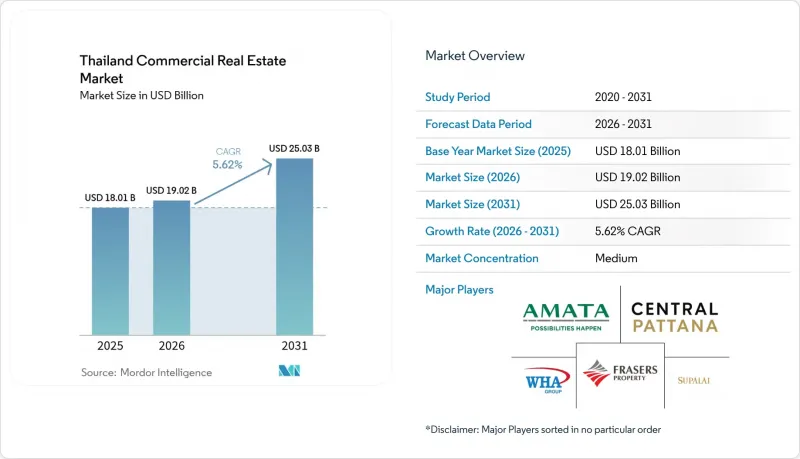
According to Mordor Intelligence, Thailand commercial real estate market size in 2026 is estimated at USD 19.02 billion, growing from 2025 value of USD 18.01 billion with 2031 projections showing USD 25.03 billion, growing at 5.62% CAGR over 2026-2031.
This report is Segmented by Property Type (Offices, Retail, Logistics, Others), by Business Model (Sales, Rental), by End-User (Individuals/Households, Corporates & SMEs, Others), and by Geography (Bangkok, Chiang Mai, Phuket, Hua Hin, Koh Samui, Rest of Thailand). The Market Forecasts are Provided in Terms of Value (USD).
Thailand Commercial Real Estate Market Trends and Insights
Eastern Economic Corridor incentives are Attracting Industrial FDI
The EEC Board of Investment approved USD 2.7 billion of data-center projects in the first five months of 2024, validating the special zone's pull for high-load digital infrastructure. A 10-year EEC Visa offering a flat 17% income tax eliminates a top talent barrier, while expressway and high-speed-rail links backed by USD 17.8 billion in public funding bind the corridor to Bangkok ports and airports. Industrial land values reached USD 169,000 per rai in H1 2024, up 17% year over year, signaling tightening supply. Relocation from China amid trade-war drag accelerated the trend; TCC Group's USD 545 million park outside Bangkok is designed expressly for such entrants.
Flight-to-Quality Demand for Grade-A Green Offices
Corporate occupiers are moving swiftly toward buildings that satisfy international ESG frameworks, and 90% of all new leases signed in 2024 landed in assets holding LEED Gold or comparable labels. The Clean Air Management Act adds regulatory urgency by linking operational emissions to tenant reporting obligations. Financing is following the same path: Central Pattana's USD 218 million sustainability-linked bond successfully priced below conventional debt, confirming robust investor appetite. Bangkok's stock is aging; 60% now exceeds 20 years, so landlords unable to fund retrofits face rising obsolescence risk. New towers such as Mitsubishi Estate's One City Centre capture the countertrend, booking blue-chip tenants at premium rents that outpace broader market declines.
Surplus Legacy Office Stock is Pressuring Effective Rents
Vacancy in Bangkok climbed to 27.8% by Q4 2024 as 300,000 m2 of new supply entered a market already softened by hybrid work. A bifurcation has emerged: ESG-certified towers achieve high take-up, while buildings from the late-1990s struggle to attract interest without major capex. Landlords delaying upgrades risk multi-year vacancies that undercut debt-service coverage.
Other drivers and restraints analyzed in the detailed report include:
- E-commerce Fulfillment Hubs are Expanding Logistics Take-Up
- Tourism-Led Rebound Boosting Hospitality & Retail Footfalls
- Cumbersome Land-Lease Tenure for Foreign Investors
For complete list of drivers and restraints, kindly check the Table Of Contents.
Segment Analysis
The office segment retained 38.22% of Thailand's commercial real estate market share in 2025, even as vacancies widened; premium ESG-ready towers kept occupancy near 90% and lifted blended rents by 4%. Lease renegotiations increasingly bundle coworking passes and hotel club memberships, indicating a broadening service envelope. Retail space is moving back into favor as tourism rebounds, and Central Pattana's USD 3.68 billion expansion program targets 200 sites by 2028 with entertainment-anchored designs. Logistics square footage is growing roughly 6% annually on the back of omni-channel fulfillment, with automated racking and mezzanine floors now standard for build-to-suit deals.
Others, industrial parks, data centers, and hospitality, represent the fastest-growing slice, logging a 8.74% CAGR outlook. Board-of-Investment incentives for cloud and semiconductor assembly are shifting land absorption further east into Chonburi and Rayong. Data-center approvals worth USD 2.7 billion illustrate how digital infrastructure has become a discrete asset class inside the Thailand commercial real estate market. Hotel RevPAR at Asset World Corp properties exceeded 2019 levels by 63%, underscoring resilience even as climate insurance costs mount for coastal holdings. The Board of Investment's push to host mega-events adds a new demand stream for MICE-capable hotels.
Complete Report Scope:
- By Property Type
- Offices
- Retail
- Logistics
- Others (industrial real estate, hospitality real estate, etc.)
- By Business Model
- Sales
- Rental
- By End-user
- Individuals / Households
- Corporates & SMEs
- Others
- By Geography
- Bangkok
- Chiang Mai
- Phuket
- Hua Hin
- Koh Samui
- Rest of Thailand
List of Companies Covered in this Report:
- Central Pattana PLC
- WHA Corporation PCL
- Amata Corp PLC
- Frasers Property Thailand
- Supalai PLC
- Pace Development Corp PLC
- Raimon Land PLC
- Asset World Corp
- Singha Estate PLC
- Origin Property PLC
- AP Thailand PLC
- Sansiri PLC
- Property Perfect PLC
- CBRE Thailand
- JLL Thailand
- Savills Thailand
- Colliers International Thailand
- Knight Frank Thailand
- RE/MAX Thailand
- Hipflat
Additional Benefits:
- The market estimate (ME) sheet in Excel format
- 3 months of analyst support
TABLE OF CONTENTS
1 Introduction
- 1.1 Study Assumptions & Market Definition
- 1.2 Scope of the Study
2 Research Methodology
3 Executive Summary
4 Market Landscape
- 4.1 Market Overview
- 4.2 Commercial Real Estate Buying Trends - Socio-economic & Demographic Insights
- 4.3 Rental Yield Analysis
- 4.4 Capital-Market Penetration & REIT Presence
- 4.5 Regulatory Outlook
- 4.6 Technological Outlook
- 4.7 Insights into Existing and Upcoming Projects
- 4.8 Market Drivers
- 4.8.1 Flight-to-quality demand for Grade-A green offices
- 4.8.2 Tourism-led rebound boosting hospitality & retail footfalls
- 4.8.3 E-commerce fulfilment hubs expanding logistics take-up
- 4.8.4 Eastern Economic Corridor incentives attracting industrial FDI
- 4.8.5 Hybrid-work space re-configuration services revenue stream
- 4.8.6 Data-centre localisation mandates spurring specialised assets
- 4.9 Market Restraints
- 4.9.1 Surplus legacy office stock pressuring effective rents
- 4.9.2 Cumbersome land-lease tenure for foreign investors
- 4.9.3 High household debt limiting retail-real-estate spending
- 4.9.4 Climate-risk insurance costs for coastal hospitality assets
- 4.10 Value / Supply-Chain Analysis
- 4.10.1 Overview
- 4.10.2 Real Estate Developers and Contractors - Key Quantitative and Qualitative Insights
- 4.10.3 Real Estate Brokers and Agents - Key Quantitative and Qualitative Insights
- 4.10.4 Property Management Companies - Key Quantitative and Qualitative Insights
- 4.10.5 Insights on Valuation Advisory and Other Real Estate Services
- 4.10.6 State of the Building Materials Industry and Partnerships with Key Developers
- 4.10.7 Insights on Key Strategic Real Estate Investors/Buyers in the Market
- 4.11 Industry Attractiveness - Porter's Five Force Analysis
- 4.11.1 Threat of New Entrants
- 4.11.2 Bargaining Power of Buyers/Occupiers
- 4.11.3 Bargaining Power of Suppliers (Developers/Builders)
- 4.11.4 Threat of Substitutes
- 4.11.5 Competitive Rivalry Intensity
5 Market Size & Growth Forecasts (Value, In USD Billion)
- 5.1 By Property Type
- 5.1.1 Offices
- 5.1.2 Retail
- 5.1.3 Logistics
- 5.1.4 Others (industrial real estate, hospitality real estate, etc.)
- 5.2 By Business Model
- 5.2.1 Sales
- 5.2.2 Rental
- 5.3 By End-user
- 5.3.1 Individuals / Households
- 5.3.2 Corporates & SMEs
- 5.3.3 Others
- 5.4 By Geography
- 5.4.1 Bangkok
- 5.4.2 Chiang Mai
- 5.4.3 Phuket
- 5.4.4 Hua Hin
- 5.4.5 Koh Samui
- 5.4.6 Rest of Thailand
6 Competitive Landscape
- 6.1 Market Concentration
- 6.2 Strategic Moves
- 6.3 Market Share Analysis
- 6.4 Company Profiles (includes Global level Overview, Market level overview, Core Segments, Financials as available, Strategic Information, Products & Services, and Recent Developments)
- 6.4.1 Central Pattana PLC
- 6.4.2 WHA Corporation PCL
- 6.4.3 Amata Corp PLC
- 6.4.4 Frasers Property Thailand
- 6.4.5 Supalai PLC
- 6.4.6 Pace Development Corp PLC
- 6.4.7 Raimon Land PLC
- 6.4.8 Asset World Corp
- 6.4.9 Singha Estate PLC
- 6.4.10 Origin Property PLC
- 6.4.11 AP Thailand PLC
- 6.4.12 Sansiri PLC
- 6.4.13 Property Perfect PLC
- 6.4.14 CBRE Thailand
- 6.4.15 JLL Thailand
- 6.4.16 Savills Thailand
- 6.4.17 Colliers International Thailand
- 6.4.18 Knight Frank Thailand
- 6.4.19 RE/MAX Thailand
- 6.4.20 Hipflat
7 Market Opportunities & Future Outlook
- 7.1 White-space & Unmet-need Assessment

