PUBLISHER: Mordor Intelligence | PRODUCT CODE: 2113560

PUBLISHER: Mordor Intelligence | PRODUCT CODE: 2113560
India Commercial Real Estate - Market Share Analysis, Industry Trends & Statistics, Growth Forecasts (2026 - 2031)
According to Mordor Intelligence, the India commercial real estate market size is estimated at USD 53.53 billion in 2026, and is expected to reach USD 116.26 billion by 2031, at a CAGR of 16.80% during the forecast period (2026-2031).
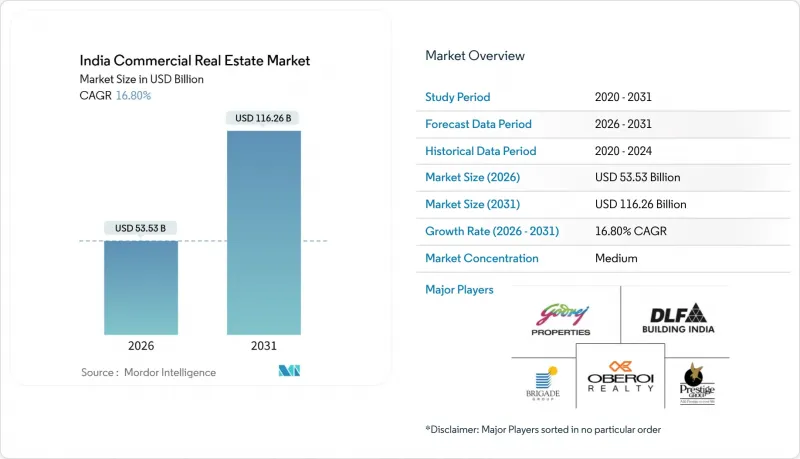
This report is Segmented by Property Type (Offices, Retail, Logistics, and Others), by Business Model (Sales and Rental), by End-User (Individuals/Households, Corporates & SMEs, and Others), and by Geography (West, South, North, and East). The Market Forecasts are Provided in Terms of Value (USD).
India Commercial Real Estate Market Trends and Insights
AI-Led GCC Expansion Driving Grade-A IT Office Demand
India hosted more than 1,700 Global Capability Centers by December 2025, employing 1.6 million professionals and absorbing nearly 60 million sq ft annually, a scale that anchors occupier demand for technologically advanced campuses. Rents in Bangalore's Outer Ring Road corridor climbed to INR 90-110 per sq ft per month in 2025, a 20% premium over suburban alternatives as multinationals race to secure talent pools. Pre-leasing is now commonplace 18-24 months ahead of completion, compressing future vacancy risk but limiting tenant negotiation latitude. Hyderabad's Knowledge City and Chennai's OMR corridor mirror the trend, while Tier-2 locations such as Kochi and Coimbatore are piloting GCC pilots that could capture about 10% of incremental demand once infrastructure matures. These moves consolidate South India's dominance yet create leasing spill-over into nearby corridors as core sub-markets approach saturation.
E-Commerce & Quick-Commerce Growth Fueling Large-Format Urban Logistics Hubs
Logistics absorption breached 45 million sq ft in 2025, and Grade-A warehouses in peri-urban Mumbai, NCR, and Bangalore rented for INR 25-35 per sq ft per month, reflecting tight supply. Third-party logistics providers and online retailers increasingly sign nine- to twelve-year contracts for 500,000 sq ft blocks, replacing the shorter three- to five-year terms typical before 2024. The central government's PM GatiShakti plan shortened freight times by upward of 10%, strengthening hub-and-spoke models. Delays in land aggregation, however, added up to twelve months to projects in Maharashtra and Uttar Pradesh, sustaining upward pressure on rents and cap rates. Operators able to navigate state-level approvals quickest are rewarded with near-full occupancy at handover.
Elevated Policy Rates & Tighter Bank Lending Standards Raising Refinancing Risk
The Reserve Bank of India left the repo rate at 6.50% in early 2026 and commercial banks priced developer loans at 9.5-11%, lifting weighted-average capital costs to 12-13%. Non-bank financiers trimmed loan-to-value ceilings to 60-65%, forcing sponsors to inject more equity or seek joint ventures. Margins for mid-sized players thinned as refinance spreads widened 150-200 basis points between 2024 and 2025, triggering selective land divestments in Mumbai and NCR corridors. Developers diversified into asset-light fee income property management and co-development to preserve cash flow. Firms with multi-asset portfolios, such as DLF and Prestige, weathered the squeeze better than single-asset owners that faced liquidity stress.
Other drivers and restraints analyzed in the detailed report include:
- REIT Pipeline Expansion & Relaxed FDI Caps Unlocking Institutional Capital
- Data-Center Colocation & Edge-Computing Campuses Repurposing Industrial Plots
- Hybrid/Remote Work Persistently Dampening Net Absorption in CBDs
For complete list of drivers and restraints, kindly check the Table Of Contents.
Segment Analysis
Logistics gross leasable area expanded by 45 million sq ft in 2025, and the segment is projected to post 18.60% CAGR from 2026-2031, the fastest trajectory among all property classes, as e-commerce and quick-commerce operators sign 9 to 12 year leases for mega-warehouses near consumption hubs. Offices retained 49.14% of the Indian commercial real estate market share in 2025, but rising hybrid adoption tempers incremental demand. Retail captured 21% of value when mall developers added experiential features that raise dwell time and justify 8-10% annual rent escalations. Hospitality and other specialty assets together accounted for roughly 11%, buoyed by leisure-travel recovery in Goa and Rajasthan.
The India commercial real estate market size for logistics is on track to surpass USD 30 billion by 2031, while offices are forecast to reach USD 55 billion as net absorption normalizes post-2028. Logistics capitalization rates compressed to 7.25-7.75% in 2025, just 25 basis points higher than comparable office yields, underscoring investor confidence in long-term e-commerce fundamentals. Offices still draw core capital due to deep tenant rosters and embedded 12-15% rent escalations every three years. Retail's pipeline remains selective, focusing on tier-1 and affluent tier-2 catchments where discretionary spending is resilient. Hotel transactions crossed USD 900 million in 2025 as international operators locked in management contracts amid rising occupancy.
Complete Report Scope:
- By Property Type
- Offices
- Retail
- Logistics
- Others (industrial real estate, hospitality real estate, etc.)
- By Business Model
- Sales
- Rental
- By End-user
- Individuals / Households
- Corporates & SMEs
- Others
- By Geography
- West
- South
- North
- East
List of Companies Covered in this Report:
- DLF Ltd
- Godrej Properties Ltd
- Oberoi Realty
- Prestige Estates Projects Ltd
- Brigade Enterprises Ltd
- Brookfield India REIT
- Mindspace Business Parks REIT
- Embassy Office Parks REIT
- Lodha Group (Macrotech Developers)
- Indiabulls Real Estate
- SOBHA Ltd
- K Raheja Corp
- Phoenix Mills Ltd
- RMZ Corp
- Tata Realty & Infrastructure Ltd
- Mahindra Lifespace Developers Ltd
- CBRE South Asia Pvt Ltd
- JLL India
- Colliers India
- Piramal Realty
- Hiranandani Group
- Unitech Ltd
- Awfis Space Solutions*
Additional Benefits:
- The market estimate (ME) sheet in Excel format
- 3 months of analyst support
TABLE OF CONTENTS
1 Introduction
- 1.1 Study Assumptions
- 1.2 Scope of the Study
2 Research Methodology
3 Executive Summary
4 Market Landscape
- 4.1 Market Overview
- 4.2 Commercial Real Estate Buying Trends - Socio-economic & Demographic Insights
- 4.3 Rental Yield Analysis
- 4.4 Capital-Market Penetration & REIT Presence
- 4.5 Regulatory Outlook
- 4.6 Technological Outlook
- 4.7 Insights into Existing and Upcoming Projects
- 4.8 Market Drivers
- 4.8.1 AI-led GCC expansion driving Grade-A IT office demand
- 4.8.2 E-commerce & quick-commerce growth fueling large-format urban logistics hubs
- 4.8.3 REIT pipeline expansion & relaxed FDI caps unlocking institutional capital
- 4.8.4 National infrastructure programs improving connectivity and land values
- 4.8.5 Data-centre colocation & edge-computing campuses repurposing industrial plots
- 4.8.6 Sustainability-linked leases & green-retrofit demand from ESG-minded occupiers
- 4.9 Market Restraints
- 4.9.1 Elevated policy rates & tighter bank lending standards raising refinancing risk
- 4.9.2 Hybrid/remote work persistently dampening net absorption in CBDs
- 4.9.3 Land acquisition delays & multi-agency approvals slowing project starts
- 4.9.4 Rising climate-risk insurance premia for coastal assets reducing investor IRRs
- 4.10 Value / Supply-Chain Analysis
- 4.10.1 Overview
- 4.10.2 Real Estate Developers and Contractors - Key Quantitative and Qualitative Insights
- 4.10.3 Real Estate Brokers and Agents - Key Quantitative and Qualitative Insights
- 4.10.4 Property Management Companies - Key Quantitative and Qualitative Insights
- 4.10.5 Insights on Valuation Advisory and Other Real Estate Services
- 4.10.6 State of the Building Materials Industry and Partnerships with Key Developers
- 4.10.7 Insights on Key Strategic Real Estate Investors/Buyers in the Market
- 4.11 Industry Attractiveness - Porter's Five Force Analysis
- 4.11.1 Threat of New Entrants
- 4.11.2 Bargaining Power of Buyers/Occupiers
- 4.11.3 Bargaining Power of Suppliers (Developers/Builders)
- 4.11.4 Threat of Substitutes
- 4.11.5 Competitive Rivalry Intensity
5 Market Size & Growth Forecasts (Value, In USD Billion)
- 5.1 By Property Type
- 5.1.1 Offices
- 5.1.2 Retail
- 5.1.3 Logistics
- 5.1.4 Others (industrial real estate, hospitality real estate, etc.)
- 5.2 By Business Model
- 5.2.1 Sales
- 5.2.2 Rental
- 5.3 By End-user
- 5.3.1 Individuals / Households
- 5.3.2 Corporates & SMEs
- 5.3.3 Others
- 5.4 By Geography
- 5.4.1 West
- 5.4.2 South
- 5.4.3 North
- 5.4.4 East
6 Competitive Landscape
- 6.1 Market Concentration Overview
- 6.2 Strategic Moves (M&A, JVs, REIT IPOs)
- 6.3 Market Share Analysis
- 6.4 Company Profiles (includes Global Level Overview, Market Level Overview, Core Segments, Financials as available, Strategic Information, Products & Services, and Recent Developments)
- 6.4.1 DLF Ltd
- 6.4.2 Godrej Properties Ltd
- 6.4.3 Oberoi Realty
- 6.4.4 Prestige Estates Projects Ltd
- 6.4.5 Brigade Enterprises Ltd
- 6.4.6 Brookfield India REIT
- 6.4.7 Mindspace Business Parks REIT
- 6.4.8 Embassy Office Parks REIT
- 6.4.9 Lodha Group (Macrotech Developers)
- 6.4.10 Indiabulls Real Estate
- 6.4.11 SOBHA Ltd
- 6.4.12 K Raheja Corp
- 6.4.13 Phoenix Mills Ltd
- 6.4.14 RMZ Corp
- 6.4.15 Tata Realty & Infrastructure Ltd
- 6.4.16 Mahindra Lifespace Developers Ltd
- 6.4.17 CBRE South Asia Pvt Ltd
- 6.4.18 JLL India
- 6.4.19 Colliers India
- 6.4.20 Piramal Realty
- 6.4.21 Hiranandani Group
- 6.4.22 Unitech Ltd
- 6.4.23 Awfis Space Solutions*
7 Market Opportunities & Future Outlook
- 7.1 White-space & Unmet-need Assessment (Flex-space in Tier-2, ESG retrofit demand, Data-centre campuses)

