PUBLISHER: Mordor Intelligence | PRODUCT CODE: 2113527

PUBLISHER: Mordor Intelligence | PRODUCT CODE: 2113527
Spain Commercial Real Estate - Market Share Analysis, Industry Trends & Statistics, Growth Forecasts (2026 - 2031)
According to Mordor Intelligence, the spain commercial real estate market size was valued at USD 83.33 billion in 2025 and estimated to grow from USD 88.14 billion in 2026 to reach USD 116.67 billion by 2031, at a CAGR of 5.77% during the forecast period (2026-2031).
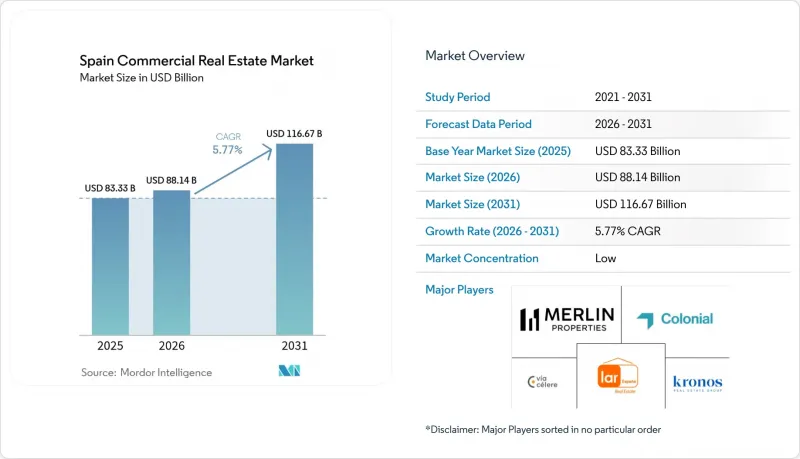
This report is Segmented by Property Type (Offices, Retail and More), by Business Model (Sales and Rental), by End-User (Individuals / Households, Corporates & SMEs and Others) and by Geography (Key City) (Madrid, Barcelona, Valencia and More). The Report Offers Market Size and Forecasts in Value (USD) for all the Above Segments.
Spain Commercial Real Estate Market Trends and Insights
Post-pandemic re-shoring driving logistics demand
Supply-chain vulnerabilities exposed in 2020 pushed manufacturers to relocate production closer to European consumers, raising the logistics share of Spain commercial real estate market investment from 15% in 2014 to 34% in 2024. Central Spain registered a 25% jump in annual take-up, helped by CBRE Investment Management's purchase of a 90,000 sqm complex in Pinto for last-mile delivery. Secondary hubs now attract 37% of total warehouse absorption, signalling cost-conscious occupiers' shift away from prime zones. Investment volumes could hit USD 1.9 billion in 2025, nearly doubling the country's 2019 share of European logistics allocations.
Tourism recovery lifting urban hospitality assets
Tourism generated USD 198 billion in 2023, supporting hotel real estate. Total hotel investment hit USD 4.7 billion in 2023, highlighted by Atom Hoteles' USD 121 million Tenerife exit, 83% above its 2019 purchase price. Mixed-use schemes combining rooms, retail and co-working are benefitting from the shift to experiential travel.
Rising construction costs from Iberian labour shortage
Construction permits fell 9% in 2024 as developers absorbed higher wages and volatile material prices, widening the gap between 1.53 million housing starts and 2.40 million household formations recorded since 2008. With 26% of residential stock stalled, contractors prioritise pre-leased assets to manage risk.
Other drivers and restraints analyzed in the detailed report include:
- EU Green-Taxonomy accelerating retrofit investments
- Near-shoring of LATAM tech firms to Spain
- Political uncertainty over housing-law spill-over to CRE
For complete list of drivers and restraints, kindly check the Table Of Contents.
Segment Analysis
Offices held 33.65% of Spain commercial real estate market share in 2025, reinforcing their status as the benchmark asset class despite evolving workplace habits. Prime rents in Madrid's CBD sit 12% above 2015, and Barcelona's leasing jumped 20% in 2024 as technology and finance occupiers hunted ESG-ready space. Yet logistics assets post the fastest 6.720% CAGR to 2031 as e-commerce and near-shoring stoke sustained warehouse demand. Investment in secondary industrial corridors rose to 37% of annual take-up, illustrating the pursuit of cost-efficient land.
Flight-to-quality differentiates performance: 76% of legacy office stock faces obsolescence without retrofit, whereas Grade-A towers record single-digit vacancy. Logistics expansion is equally two-speed, with last-mile hubs inside Madrid's third ring commanding rental premiums while mid-box facilities in Valencia offer yield spreads of 150 basis points. Retail parks add 850,000 sqm of gross leasable area via 44 new schemes by 2026, reflecting a pivot to convenience and leisure-anchored formats. Hospitality remains resilient: hotel investments touched USD 4.7 billion in 2023, underscoring tourism's comeback.
Complete Report Scope:
- By Property Type
- Offices
- Retail
- Logistics
- Others (Industrial, Hospitality, etc.)
- By Business Model
- Sales
- Rental
- By End-User
- Individuals / Households
- Corporates & SMEs
- Others
- By Geography (Key City)
- Madrid
- Barcelona
- Valencia
- Catalonia (ex-BCN)
- Malaga
- Other Cities
List of Companies Covered in this Report:
- MERLIN Properties SOCIMI
- Colonial Av.
- Lar Espana
- Via Celere
- Kronos Investment Group
- Acciona Inmobiliaria
- Neinor Homes
- Metrovacesa
- Hispania Activos Inmobiliarios
- GMP Property
- Realia Business
- Azora
- Klepierre
- Quabit Inmoviliaria
- Sareb
- Finques Garvi
- Lusa Realty
- Invertica-Irels
- Poligons de Barcelona
- Directo de Propietario
Additional Benefits:
- The market estimate (ME) sheet in Excel format
- 3 months of analyst support
TABLE OF CONTENTS
1 Introduction
- 1.1 Study Assumptions & Market Definition
- 1.2 Scope of the Study
2 Research Methodology
3 Executive Summary
4 Market Landscape
- 4.1 Market Overview
- 4.2 Commercial Real-Estate Buying Trends - Socio-economic & Demographic Insights
- 4.3 Rental-Yield Analysis
- 4.4 Capital-Market Penetration & REIT Presence
- 4.5 Regulatory Outlook
- 4.6 Technological Outlook
- 4.7 Insights into Real Estate Tech and Startups Active in the Real Estate Segment
- 4.8 Insights into Existing and Upcoming Projects
- 4.9 Market Drivers
- 4.9.1 Post-pandemic Re-shoring Driving Logistics Demand
- 4.9.2 Office Stock Flight-to-Quality in Madrid & Barcelona
- 4.9.3 Tourism Recovery Lifting Urban Hospitality Assets
- 4.9.4 EU Green-Taxonomy Accelerating Retrofit Investments
- 4.9.5 Near-shoring of LatAm Tech Firms to Spain
- 4.9.6 Institutional Capital Rotation from Bonds to Core CRE Yields
- 4.10 Market Restraints
- 4.10.1 Political Uncertainty over Housing-Law Spill-over to CRE
- 4.10.2 Rising Construction Costs from Iberian Labour Shortage
- 4.10.3 Interest Rate Volatility Compressing Valuations
- 4.11 Value / Supply-Chain Analysis
- 4.11.1 Overview
- 4.11.2 Real Estate Developers and Contractors - Key Quantitative and Qualitative Insights
- 4.11.3 Real Estate Brokers and Agents - Key Quantitative and Qualitative Insights
- 4.11.4 Property Management Companies - Key Quantitative and Qualitative Insights
- 4.11.5 Insights on Valuation Advisory and Other Real Estate Services
- 4.11.6 State of the Building Materials Industry and Partnerships with Key Developers
- 4.11.7 Insights on Key Strategic Real Estate Investors/Buyers in the Market
- 4.12 Porters Five Forces
- 4.12.1 Bargaining Power of Suppliers
- 4.12.2 Bargaining Power of Buyers
- 4.12.3 Threat of New Entrants
- 4.12.4 Threat of Substitutes
- 4.12.5 Intensity of Competitive Rivalry
5 Market Size & Growth Forecasts (Value, USD Billion)
- 5.1 By Property Type
- 5.1.1 Offices
- 5.1.2 Retail
- 5.1.3 Logistics
- 5.1.4 Others (Industrial, Hospitality, etc.)
- 5.2 By Business Model
- 5.2.1 Sales
- 5.2.2 Rental
- 5.3 By End-User
- 5.3.1 Individuals / Households
- 5.3.2 Corporates & SMEs
- 5.3.3 Others
- 5.4 By Geography (Key City)
- 5.4.1 Madrid
- 5.4.2 Barcelona
- 5.4.3 Valencia
- 5.4.4 Catalonia (ex-BCN)
- 5.4.5 Malaga
- 5.4.6 Other Cities
6 Competitive Landscape
- 6.1 Market Concentration
- 6.2 Strategic Moves
- 6.3 Company Profiles (includes Global level Overview, Market level overview, Core Segments, Financials as available, Strategic Information, Market Rank/Share for key companies, Products & Services, and Recent Developments)
- 6.3.1 MERLIN Properties SOCIMI
- 6.3.2 Colonial Av.
- 6.3.3 Lar Espana
- 6.3.4 Via Celere
- 6.3.5 Kronos Investment Group
- 6.3.6 Acciona Inmobiliaria
- 6.3.7 Neinor Homes
- 6.3.8 Metrovacesa
- 6.3.9 Hispania Activos Inmobiliarios
- 6.3.10 GMP Property
- 6.3.11 Realia Business
- 6.3.12 Azora
- 6.3.13 Klepierre
- 6.3.14 Quabit Inmoviliaria
- 6.3.15 Sareb
- 6.3.16 Finques Garvi
- 6.3.17 Lusa Realty
- 6.3.18 Invertica-Irels
- 6.3.19 Poligons de Barcelona
- 6.3.20 Directo de Propietario
7 Market Opportunities & Future Outlook

