PUBLISHER: Mordor Intelligence | PRODUCT CODE: 2123774

PUBLISHER: Mordor Intelligence | PRODUCT CODE: 2123774
Solar Tracker - Market Share Analysis, Industry Trends & Statistics, Growth Forecasts (2026 - 2031)
According to Mordor Intelligence, the solar tracker market size is estimated at USD 73.35 billion in 2026, and is expected to reach USD 193.89 billion by 2031, at a CAGR of 21.46% during the forecast period (2026-2031).
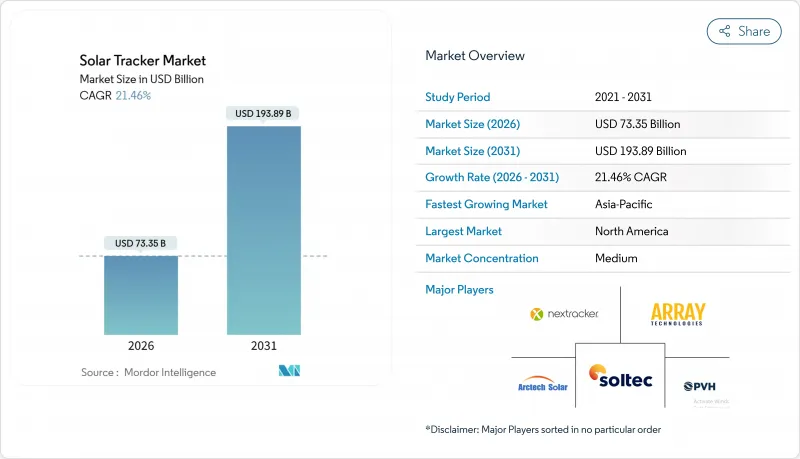
This report is Segmented by Axis Type (Single Axis and Dual Axis), Technology (Photovoltaic, Concentrated Solar Power, and Concentrated Photovoltaic), Drive Type (Electric Motor, Linear Actuator, and Hydraulic), Application (Utility-Scale, Commercial and Industrial, Residential and Micro-Grid, and Agrivoltaics), and Geography (North America, Europe, Asia-Pacific, South America, and Middle East and Africa).
Global Solar Tracker Market Trends and Insights
U.S. IRA-Fueled Utility-Scale PPAs Unlocking Multi-GW Tracker Contracts
Domestic-content bonus credits worth up to 10 percentage points on the investment tax credit have redrawn supply chains. NEXTracker and Array Technologies achieved 100% U.S. content by sourcing steel from Nucor and SDI and expanding New Mexico and California plants, lifting domestic orders 40% year over year. Lead times that once stretched nine months for imported steel now compress to ten weeks, letting developers monetize tax equity sooner. The 45X advanced-manufacturing credit further subsidizes steel inputs, lowering delivered cost per watt even as hot-rolled coil averages USD 750 per ton. Together, these mechanisms underpin a multi-gigawatt PPA wave that locks trackers into baseline project design rather than optional scope.
Diminishing Tracker CapEx/MW via 1P Modular Designs in India & MENA
Indian developers adopting single-row 1P architectures trimmed capital outlay 15%-20% per megawatt by reducing steel tonnage and foundation work, helping them clear record-low Solar Energy Corporation auction tariffs. Saudi Arabia's NEOM and the UAE's Phase V projects mirror the shift, citing faster erection on variable desert terrain. Because each row has its own actuator, fault isolation improves, and O&M visits fall, a key benefit where desert crews travel over 200 km to the site. The modular model is especially attractive in regions where labor is inexpensive relative to imported steel, letting builders trade higher row counts for lower per-watt hardware spend.
Elevated Structural Steel Prices & Section 232 Tariffs in North America
Hot-rolled coil averaged USD 700-800 per ton during 2024-2025, about 40% above pre-pandemic norms, while 25% tariffs on imported steel squeezed tracker gross margins by 320 basis points for Array Technologies. Section 232 exemption requests can take nine months, delaying procurement and triggering PPA penalties. Smaller suppliers exited North America, consolidating share among vertically integrated players with captive mill supply.
Other drivers and restraints analyzed in the detailed report include:
- Bifacial-Optimized Trackers Raising IRR in High-Albedo Regions
- Aggressive 24/7 Renewable Procurement by U.S. Cloud & Mining Firms
- Tracker Failure Risk on Frost-Heave Sites-Nordic & Alpine Utility Farms
For complete list of drivers and restraints, kindly check the Table Of Contents.
Segment Analysis
Dual-axis installations are forecast to expand at a 22.5% CAGR, while single-axis installations retained 52.7% of shipments in 2025. The solar tracker market share for single-axis designs is anchored by proven reliability, one-motor-per-row simplicity, and financing familiarity, features that delivered near-ubiquity in recent U.S. utility builds. Yet developers in Chile's Atacama and Australia's Pilbara accept 30%-40% higher hardware cost in exchange for 25%-35% more generation, where land and irradiance conditions reward energy density.
The dual-axis premium gains additional appeal in storage-paired projects because longer daylight capture reduces battery cycling depth. AllEarth Renewables and Deger Energie have carved niches on C&I rooftops where footprint limits trump capex. Looking forward, falling lithium-ion costs may temper dual-axis adoption in land-abundant geographies, but in rail-side, port, and island microgrids, the technology's compactness is likely to secure incremental solar tracker market growth.
Photovoltaic trackers commanded 85.5% of 2025 deployments thanks to crystalline-silicon cost declines and lender comfort. CPV trackers, while only a sliver today, are scaling at 26.6% CAGR as desalination plants and mines pursue 40%-47% module efficiency that shrinks land take. Soitec systems in Chile and Insolight arrays in Australia proved CPV viability in dust-controlled sites, though dual-axis precision and optical cleaning needs keep opex high.
Mainstream PV trackers retain the largest slice of the solar tracker market size because they integrate easily with bifacial panels and need no active cooling. CSP trackers remain concentrated in Morocco and the UAE, where thermal storage backs evening demand. Unless CPV reduces balance-of-system cost and shows 25-year durability, its role will remain a specialized add-on rather than a mass-market challenger.
Complete Report Scope:
- By Axis Type
- Single Axis
- Dual Axis
- By Technology
- Photovoltaic (PV)
- Concentrated Solar Power (CSP)
- Concentrated Photovoltaic (CPV)
- By Application
- Utility-Scale
- Commercial and Industrial
- Residential and Micro-grid
- Agrivoltaics/Agri-solar
- By Drive Type
- Electric Motor
- Linear Actuator
- Hydraulic
- By Geography
- North America
- United States
- Canada
- Mexico
- Europe
- United Kingdom
- Germany
- France
- Spain
- Nordic Countries
- Russia
- Rest of Europe
- Asia-Pacific
- China
- India
- Japan
- South Korea
- Malaysia
- Thailand
- Indonesia
- Vietnam
- Australia
- Rest of Asia-Pacific
- South America
- Brazil
- Argentina
- Colombia
- Rest of South America
- Middle East and Africa
- United Arab Emirates
- Saudi Arabia
- South Africa
- Egypt
- Rest of Middle East and Africa
- North America
Geography Analysis
North America's 73.0% 2025 share underscores IRA tailwinds. Utilities such as NextEra Energy and AES signed multi-gigawatt domestic-content tracker orders, locking in steel from Nucor and motors from U.S. suppliers to secure bonus credits. Section 232 tariffs and hot-rolled coil at USD 750 per ton, however, threaten margins for smaller EPCs, prompting consolidation. Canada inches forward under provincial storage-plus-solar RFPs, while Mexico leverages maquiladora capacity to avoid tariffs.
Asia-Pacific delivers the fastest 27.9% CAGR. India's 50 GW tender pipeline favors 1P modular trackers that cut capex 15%-20%. Australia's grid-forming rule drives dual-axis uptake at Western Downs and Wandoan South, where extended output improves battery round-trip efficiency. Chinese exporters dominate Southeast Asia but face IEC-62817 bankability barriers in Japan and Australia.
Europe accelerates under REPowerEU. Germany's premium tariff for agrivoltaics, France's 1.2 GW approvals, and Spain's bifacial-tracker pipeline anchor growth, while frost-heave risk slows Nordic installs. In the Middle East, NEOM and Dubai Phase V adopt 1P trackers to speed desert builds; South Africa's storage-linked tenders favor dual-axis precision. Sub-Saharan Africa lags due to O&M skill shortages, and Latin America concentrates demand in Chile's Atacama and Brazil's northeast, where direct irradiance and low land cost aid bankability.
- NEXTracker Inc.
- Array Technologies Inc.
- Arctech Solar Holdings Co. Ltd.
- Soltec Power Holdings S.A.
- PV Hardware Solutions S.L.U.
- Valmont Industries Inc. (Convert Italia)
- Trina Solar Co. Ltd. (TrinaTracker)
- GameChange Solar
- Ideematec Deutschland GmbH
- Meca Solar
- STI Norland
- Antai Solar
- SunPower Corporation
- FTC Solar
- Abengoa Solar S.A.
- AllEarth Renewables
- Deger energie GmbH
- Mahindra Susten
- Solar FlexRack
- Convert Italia S.p.A.
Additional Benefits:
- The market estimate (ME) sheet in Excel format
- 3 months of analyst support
TABLE OF CONTENTS
1 Introduction
- 1.1 Study Assumptions & Market Definition
- 1.2 Scope of the Study
2 Research Methodology
3 Executive Summary
4 Market Landscape
- 4.1 Market Drivers
- 4.1.1 U.S. IRA-fuelled Utility-Scale PPAs Unlocking Multi-GW Tracker Contracts
- 4.1.2 Diminishing Tracker Cap-Ex/ MW via 1P Modular Designs in India & MENA
- 4.1.3 Bifacial-Optimized Trackers Raising IRR in High-Albedo Regions (Atacama, Nordics)
- 4.1.4 Aggressive 24/7 Renewable Procurement by U.S. Cloud & Mining Firms
- 4.1.5 EU REPower Acceleration of Agrivoltaics - Slim-Row Trackers for Cropland
- 4.1.6 Grid-Forming Storage-Coupled Projects Pushing Dual-Axis Adoption in Australia
- 4.2 Market Restraints
- 4.2.1 Elevated Structural Steel Prices & Section 232 Tariffs in North America
- 4.2.2 Tracker Failure Risk on Frost-Heave Sites-Nordic & Alpine Utility Farms
- 4.2.3 Scarcity of Skilled O&M Crews for Decentralized Actuators in SSA
- 4.2.4 Bankability Concerns for New Chinese Entrants Without IEC 62817 Testing
- 4.3 Supply-Chain Analysis
- 4.4 Regulatory Outlook
- 4.5 Technological Outlook
- 4.6 Porter's Five Forces
- 4.6.1 Threat of New Entrants
- 4.6.2 Bargaining Power of Suppliers
- 4.6.3 Bargaining Power of Consumers
- 4.6.4 Threat of Substitutes
- 4.6.5 Intensity of Competitive Rivalry
5 Market Size & Growth Forecasts
- 5.1 By Axis Type
- 5.1.1 Single Axis
- 5.1.2 Dual Axis
- 5.2 By Technology
- 5.2.1 Photovoltaic (PV)
- 5.2.2 Concentrated Solar Power (CSP)
- 5.2.3 Concentrated Photovoltaic (CPV)
- 5.3 By Application
- 5.3.1 Utility-Scale
- 5.3.2 Commercial and Industrial
- 5.3.3 Residential and Micro-grid
- 5.3.4 Agrivoltaics/Agri-solar
- 5.4 By Drive Type
- 5.4.1 Electric Motor
- 5.4.2 Linear Actuator
- 5.4.3 Hydraulic
- 5.5 By Geography
- 5.5.1 North America
- 5.5.1.1 United States
- 5.5.1.2 Canada
- 5.5.1.3 Mexico
- 5.5.2 Europe
- 5.5.2.1 United Kingdom
- 5.5.2.2 Germany
- 5.5.2.3 France
- 5.5.2.4 Spain
- 5.5.2.5 Nordic Countries
- 5.5.2.6 Russia
- 5.5.2.7 Rest of Europe
- 5.5.3 Asia-Pacific
- 5.5.3.1 China
- 5.5.3.2 India
- 5.5.3.3 Japan
- 5.5.3.4 South Korea
- 5.5.3.5 Malaysia
- 5.5.3.6 Thailand
- 5.5.3.7 Indonesia
- 5.5.3.8 Vietnam
- 5.5.3.9 Australia
- 5.5.3.10 Rest of Asia-Pacific
- 5.5.4 South America
- 5.5.4.1 Brazil
- 5.5.4.2 Argentina
- 5.5.4.3 Colombia
- 5.5.4.4 Rest of South America
- 5.5.5 Middle East and Africa
- 5.5.5.1 United Arab Emirates
- 5.5.5.2 Saudi Arabia
- 5.5.5.3 South Africa
- 5.5.5.4 Egypt
- 5.5.5.5 Rest of Middle East and Africa
- 5.5.1 North America
6 Competitive Landscape
- 6.1 Market Concentration
- 6.2 Strategic Moves (M&A, Partnerships, PPAs)
- 6.3 Market Share Analysis (Market Rank/Share for key companies)
- 6.4 Company Profiles (includes Global-level Overview, Market-level Overview, Core Segments, Financials, Strategic Info, Products & Services, Recent Developments)
- 6.4.1 NEXTracker Inc.
- 6.4.2 Array Technologies Inc.
- 6.4.3 Arctech Solar Holdings Co. Ltd.
- 6.4.4 Soltec Power Holdings S.A.
- 6.4.5 PV Hardware Solutions S.L.U.
- 6.4.6 Valmont Industries Inc. (Convert Italia)
- 6.4.7 Trina Solar Co. Ltd. (TrinaTracker)
- 6.4.8 GameChange Solar
- 6.4.9 Ideematec Deutschland GmbH
- 6.4.10 Meca Solar
- 6.4.11 STI Norland
- 6.4.12 Antai Solar
- 6.4.13 SunPower Corporation
- 6.4.14 FTC Solar
- 6.4.15 Abengoa Solar S.A.
- 6.4.16 AllEarth Renewables
- 6.4.17 Deger energie GmbH
- 6.4.18 Mahindra Susten
- 6.4.19 Solar FlexRack
- 6.4.20 Convert Italia S.p.A.
7 Market Opportunities & Future Outlook
- 7.1 White-space & Unmet-Need Assessment

