PUBLISHER: Mordor Intelligence | PRODUCT CODE: 2125653

PUBLISHER: Mordor Intelligence | PRODUCT CODE: 2125653
Europe Solar Tracker - Market Share Analysis, Industry Trends & Statistics, Growth Forecasts (2026 - 2031)
According to Mordor Intelligence, the Europe solar tracker market size is projected to be USD 4.96 billion in 2025, USD 5.96 billion in 2026, and reach USD 16.08 billion by 2031, growing at a CAGR of 21.95% from 2026 to 2031.
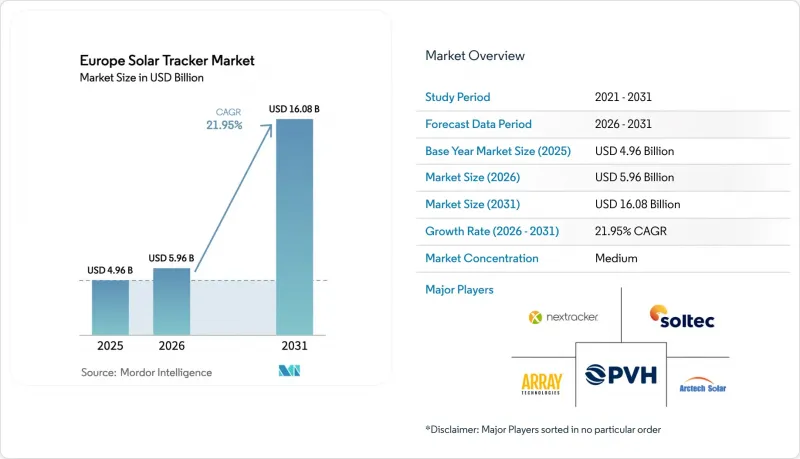
This report is Segmented by Axis Type (Single Axis and Dual Axis), Technology (Photovoltaic, Concentrated Solar Power, and Concentrated Photovoltaic), Drive Type (Electric Motor, Linear Actuator, and Hydraulic), Application (Utility-Scale, Commercial and Industrial, Residential and Micro-Grid, and Agrivoltaic/Agri-solar), and Geography (United Kingdom, Germany, France, Italy, Spain, Netherlands, and More)
Europe Solar Tracker Market Trends and Insights
Abundant Solar Irradiation Across Southern Europe
Annual irradiation above 1,800 kWh/m2 in Andalusia and Sicily lifts tracker energy yield 15-20% versus fixed-tilt and compresses payback to under two years. Spain added 9.4 GW of new solar capacity in 2024, spearheaded by the 590 MW Francisco Pizarro plant that employs single-axis trackers to harvest peak summer output. Italy's 5.3 GW of 2024 additions included multiple bifacial-with-tracker projects that maximize rear-side gain on light-colored soils. Greece is following suit: in June 2025, Nextracker won a 550 MW order for the Oricheio PPC Ptolemaida redevelopment, underscoring how trackers unlock value on reclaimed coal land. Northern Europe's lower irradiation and heavier snow loads moderate this driver's influence, but Southern Europe's isolation edge remains a long-term growth pillar.
EU Green Deal & REPowerEU Solar Targets
REPowerEU raises the bloc's cumulative solar objective to 700 GW by 2030, translating into an annual build-rate near 60 GW, double the 2023 pace. Permitting reforms in Germany trimmed approval cycles for >1 MW ground-mount arrays to nine months, unlocking sizable tracker-ready parcels. Spain cleared 3.8 GW of capacity in its June 2024 auction with winning bids averaging EUR 0.029/kWh, reinforcing trackers as the default choice to honor low-priced PPAs. France's CRE-7 tender allocated 3.7 GW but still battles local opposition, illustrating divergent national execution speeds. Fast-track "renewable acceleration areas" mandated by the revised Renewable Energy Directive are expected to release fresh land banks by 2027, sustaining demand for tracker systems that can maximize energy density.
High Upfront CAPEX vs. Fixed-Tilt
Single-axis trackers carry a 15-25% premium (USD 0.08-0.12/WDC) over fixed-tilt, extending payback by up to a year in lower-irradiation or higher-interest-rate markets. Polish and Romanian developers keep tracker penetration below 30% as they seek to minimize debt service costs. Germany's rooftop-heavy market likewise favors simpler fixed systems. A monetary-policy pivot by the European Central Bank would soften this drag by lowering discount rates, but near-term headwinds persist.
Other drivers and restraints analyzed in the detailed report include:
- Declining Tracker Hardware Costs & Improved Reliability
- Terrain-Following Trackers for Agrivoltaics/Brownfields
- Wind & Snow-Load Engineering in Northern Europe
For complete list of drivers and restraints, kindly check the Table Of Contents.
Segment Analysis
Dual-axis installations captured 42.5% of incremental revenue in 2025 and are poised to rise at a 23.0% CAGR, outpacing the overall European solar tracker market by roughly 1 percentage point. Single-axis systems nonetheless dominate headline volumes because they cost 15-20% less and offer simpler maintenance protocols. Spain deployed single-axis trackers on roughly 70% of its 9.4 GW 2024 build, leveraging flat terrain and high irradiation. Italy's agrivoltaic subsidies tilt the scales toward dual-axis, which can orient away from crops during sensitive growth stages.
Economies of scale still favor single-axis giants; Nextracker shipped 33.6 GW globally in fiscal 2025, while no dual-axis supplier breached 1 GW. Even so, terrain-adaptive hybrids are blurring classification: Greece's 550 MW Ptolemaida rehabilitation relies on articulated single-axis rows that contour subsidence zones, capturing many benefits of dual-axis without incurring full incremental cost. In lower-irradiation geographies such as Northern Germany, developers continue to prioritize fixed-tilt or basic single-axis to protect return profiles.
Standard PV dominated with 87.1% share in 2025, yet CPV is projected to post a 27.1% CAGR through 2031 by monetizing Southern Europe's >2,000 kWh/m2 DNI corridors. CPV's 30-35% module efficiency offsets its 40-50% CAPEX premium only in Spain, Greece, and parts of Italy. Iberdrola's Francisco Pizarro plant illustrates how bifacial PV trackers capture 8-10% rear-side gain, crowding out CPV in many bids.
The European solar tracker market size for CPV remains below USD 0.5 billion, but early-stage pilots by research institutes and EPCs signal a niche future for ultra-high-efficiency arrays where land is scarce. CSP trackers, in contrast, remain sidelined because their USD 0.10-0.15/kWh LCOE cannot match PV-plus-storage. As CPV supply chains mature and standardization improves, dual-axis tracking precision will be indispensable, anchoring their future expansion.
Complete Report Scope:
- By Axis Type
- Single Axis
- Dual Axis
- By Technology
- Photovoltaic (PV)
- Concentrated Solar Power (CSP)
- Concentrated Photovoltaic (CPV)
- By Drive Type
- Electric Motor
- Linear Actuator
- Hydraulic
- By Application
- Utility-Scale
- Commercial and Industrial (CandI)
- Residential and Micro-grid
- Agrivoltaics/Agri-solar
- By Geography
- United Kingdom
- Germany
- France
- Italy
- Spain
- NORDIC Countries
- Netherlands
- Russia
- Rest of Europe
List of Companies Covered in this Report:
- Nextracker Inc.
- Array Technologies Inc.
- Soltec Power Holdings SA
- PV Hardware (PVH)
- Arctech Solar Holding Co. Ltd.
- Ideematec Deutschland GmbH
- Convert Italia SpA
- Solar FlexRack
- Valmont Solar
- TrinaTracker (Trina Solar)
- Axial Structural Solutions
- Gonvarri Solar Steel
- FTC Solar Inc.
- GameChange Solar
- Optimum Tracker
- Mecasolar
- DEGERenergie GmbH
- SunPower Corporation
- Sun Action Trackers
- Antaisolar
Additional Benefits:
- The market estimate (ME) sheet in Excel format
- 3 months of analyst support
TABLE OF CONTENTS
1 Introduction
- 1.1 Study Assumptions & Market Definition
- 1.2 Scope of the Study
2 Research Methodology
3 Executive Summary
4 Market Landscape
- 4.1 Market Overview
- 4.2 Market Drivers
- 4.2.1 Abundant solar irradiation across Southern Europe
- 4.2.2 EU Green Deal & REPowerEU solar targets
- 4.2.3 Declining tracker hardware costs & improved reliability
- 4.2.4 Terrain-following trackers for agrivoltaics/brownfields
- 4.2.5 AI-enabled predictive maintenance lowering LCOE
- 4.2.6 EU Net-Zero Industry Act incentives for local production
- 4.3 Market Restraints
- 4.3.1 High upfront CAPEX vs. fixed-tilt
- 4.3.2 Wind & snow-load engineering in Northern Europe
- 4.3.3 Steel-price volatility inflating BoM costs
- 4.3.4 Grid-curtailment risk reducing yield economics
- 4.4 Supply-Chain Analysis
- 4.5 Regulatory Landscape
- 4.6 Technological Outlook
- 4.7 Porter's Five Forces
- 4.7.1 Bargaining Power of Suppliers
- 4.7.2 Bargaining Power of Buyers
- 4.7.3 Threat of New Entrants
- 4.7.4 Threat of Substitutes
- 4.7.5 Intensity of Competitive Rivalry
5 Market Size & Growth Forecasts
- 5.1 By Axis Type
- 5.1.1 Single Axis
- 5.1.2 Dual Axis
- 5.2 By Technology
- 5.2.1 Photovoltaic (PV)
- 5.2.2 Concentrated Solar Power (CSP)
- 5.2.3 Concentrated Photovoltaic (CPV)
- 5.3 By Drive Type
- 5.3.1 Electric Motor
- 5.3.2 Linear Actuator
- 5.3.3 Hydraulic
- 5.4 By Application
- 5.4.1 Utility-Scale
- 5.4.2 Commercial and Industrial (CandI)
- 5.4.3 Residential and Micro-grid
- 5.4.4 Agrivoltaics/Agri-solar
- 5.5 By Geography
- 5.5.1 United Kingdom
- 5.5.2 Germany
- 5.5.3 France
- 5.5.4 Italy
- 5.5.5 Spain
- 5.5.6 NORDIC Countries
- 5.5.7 Netherlands
- 5.5.8 Russia
- 5.5.9 Rest of Europe
6 Competitive Landscape
- 6.1 Market Concentration
- 6.2 Strategic Moves (M&A, Partnerships, PPAs)
- 6.3 Market Share Analysis (Market Rank/Share for key companies)
- 6.4 Company Profiles (includes Global-level Overview, Market-level Overview, Core Segments, Financials, Strategic Info, Products & Services, Recent Developments)
- 6.4.1 Nextracker Inc.
- 6.4.2 Array Technologies Inc.
- 6.4.3 Soltec Power Holdings SA
- 6.4.4 PV Hardware (PVH)
- 6.4.5 Arctech Solar Holding Co. Ltd.
- 6.4.6 Ideematec Deutschland GmbH
- 6.4.7 Convert Italia SpA
- 6.4.8 Solar FlexRack
- 6.4.9 Valmont Solar
- 6.4.10 TrinaTracker (Trina Solar)
- 6.4.11 Axial Structural Solutions
- 6.4.12 Gonvarri Solar Steel
- 6.4.13 FTC Solar Inc.
- 6.4.14 GameChange Solar
- 6.4.15 Optimum Tracker
- 6.4.16 Mecasolar
- 6.4.17 DEGERenergie GmbH
- 6.4.18 SunPower Corporation
- 6.4.19 Sun Action Trackers
- 6.4.20 Antaisolar
7 Market Opportunities & Future Outlook
- 7.1 White-space & Unmet-Need Assessment
- 7.2 Emerging Agrivoltaic Tracker Solutions
- 7.3 Repowering & Retrofitting Fixed-Tilt Plants
- 7.4 Hybrid PV+Storage Tracker Synergies

