PUBLISHER: Mordor Intelligence | PRODUCT CODE: 2124010

PUBLISHER: Mordor Intelligence | PRODUCT CODE: 2124010
United Kingdom Contract Logistics - Market Share Analysis, Industry Trends & Statistics, Growth Forecasts (2026 - 2031)
According to Mordor Intelligence, the United Kingdom contract logistics market size market size in 2026 is estimated at USD 21.83 billion, growing from 2025 value of USD 21.16 billion with 2031 projections showing USD 25.51 billion, growing at 3.17% CAGR over 2026-2031.
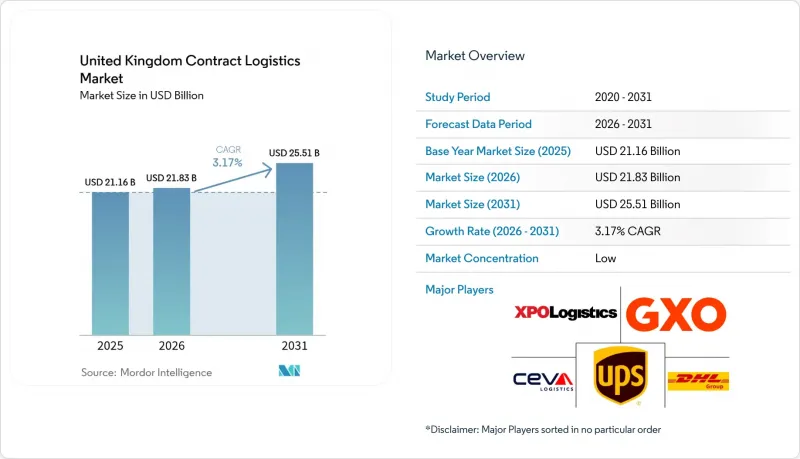
This report is Segmented by Service Type (Transportation, Warehousing & Distribution, and Value-Added Services), Contract Duration (1-3 Years and Above 3 Years), End-User Industry (Manufacturing & Automotive, Retail & E-Commerce, Healthcare & Pharmaceuticals, and More), and Region (England, Scotland, Wales, and Northern Ireland). The Market Forecasts are Provided in Terms of Value (USD).
United Kingdom Contract Logistics Market Trends and Insights
E-commerce Parcel Surge Accelerates Fulfilment Infrastructure Demand
Online retail volumes have pushed parcel networks to add urban microhubs and larger automated fulfillment centers. Amazon's announced USD 50 billion UK investment through 2027 funds four new regional facilities that shorten last-mile distances. Pilot microhubs in London removed up to 12 diesel vans per day and cut 4,186 kg CO2 in nine months, proving both commercial and environmental value. Localized fulfillment spending could top USD 5.5 billion by 2030 as grocery and fashion chains outsource the task to 3PL specialists. Faster cycle times are becoming a decisive service benchmark, prompting contract logistics providers to expand same-day capabilities. As parcel density grows, the United Kingdom contract logistics market responds by optimizing urban routes and investing in electric delivery fleets to meet city emission rules.
Warehouse Automation Integration Transforms Operational Efficiency
Robotics, AI, and digital twins are now central to warehouse design. Ocado's Luton site illustrates the shift, with robotic arms already handling 15% of items and targeting 70% within a few years. Government AI grants averaging USD 38,315 per logistics firm underscore national priorities for automation. Digital-twin platforms allow continuous monitoring of space utilization and process flows, cutting commissioning time for new facilities. Robotics-as-a-Service subscriptions lower upfront capital outlays, bringing advanced automation within reach of mid-sized operators. Predictive analytics improves labor scheduling, a critical advantage amid driver and picker shortages. These investments reinforce the value proposition of long-term contracts and push the United Kingdom contract logistics market toward data-driven service models.
Acute Driver and Warehouse Labor Shortages Constrain Operational Capacity
Heavy-goods-vehicle driver vacancies reached 19% in Q1 2024, driven by retirements and pay competition from other sectors. Brexit curtailed EU driver inflows while the pandemic prompted early retirements, cutting available skills just as parcel volumes surged. Grant Thornton notes additional headwinds, such as high fuel prices and inflation, that limit wage headroom. Logistics employs 8% of the national workforce, yet critical hands-on roles remain hard to fill despite apprenticeships and upskilling schemes. Automation eases some strain, but adoption takes time and capital. In the near term, limited labor availability caps throughput and increases operating costs in the United Kingdom contract logistics market.
Other drivers and restraints analyzed in the detailed report include:
- Post-Brexit Customs Brokerage Integration Elevates Service Complexity
- Cold-Chain Infrastructure Expansion Supports Pharmaceutical Growth
- Aging Infrastructure Capacity Limits Growth Potential
For complete list of drivers and restraints, kindly check the Table Of Contents.
Segment Analysis
Transportation services generated 60.45% of 2025 revenue, reflecting the enduring need for reliable multimodal links in the United Kingdom contract logistics market. Sea freight tonnage grew 4% to 60.7 million tons in 2024, boosted by deep-sea imports from China, while DP World's USD 1.3 billion London Gateway expansion adds berth capacity and full-electric cranes. Road remains the backbone, yet urban emission rules and driver shortages push operators toward alternative fuels and route optimization platforms. Rail capacity suffers after Royal Mail's withdrawal, adding pressure on highways and warehousing near ports.
Value-added services, though smaller, post a 3.28% CAGR as brands outsource packaging, kitting, and customization. GXO manages end-of-line assembly and cold-chain packing for grocery and e-commerce clients, illustrating how integrated solutions lighten shipper workloads. Robotics enables late-stage customization, meeting marketing needs without slowing throughput. As ESG reporting grows stricter, providers bundle packaging redesign with waste reduction analytics, offering differentiated value. This momentum positions value-added operations to capture incremental share in the United Kingdom contract logistics market over the forecast horizon.
Complete Report Scope:
- By Service Type
- Transportation
- Road
- Rail
- Air
- Sea
- Warehousing & Distribution
- Value-added Services (Assembly, Labelling, Kitting)
- Transportation
- By Contract Duration
- 1 - 3 Years
- Above 3 years
- By End-user Industry
- Manufacturing & Automotive
- Food & Beverage
- Retail & E-commerce
- Healthcare & Pharmaceuticals
- Chemicals
- Other Industries
- By Region
- England
- Scotland
- Wales
- Northern Ireland
List of Companies Covered in this Report:
- DHL Supply Chain
- XPO Logistics
- UPS SCS
- GXO Logistics
- CEVA Logistics
- DSV
- Kuehne + Nagel
- FedEx Supply Chain
- Rhenus Logistics
- EV Cargo
- Eddie Stobart Logistics
- Yusen Logistics
- Howard Tenens
- Great Bear Distribution
- Kinaxia Logistics
- Hellmann Worldwide Logistics
- Savino Del Bene
- Rohlig Logistics
- Premier Logistics
- Noatum Logistics
Additional Benefits:
- The market estimate (ME) sheet in Excel format
- 3 months of analyst support
TABLE OF CONTENTS
1 Introduction
- 1.1 Study Assumptions & Market Definition
- 1.2 Scope of the Study
2 Research Methodology
3 Executive Summary
4 Market Landscape
- 4.1 Market Overview
- 4.2 Market Drivers
- 4.2.1 E-commerce parcel surge
- 4.2.2 Warehouse automation & digital twins
- 4.2.3 End-to-end supply-chain visibility demand
- 4.2.4 Post-Brexit customs brokerage integration
- 4.2.5 Retailer micro-fulfilment outsourcing amid soaring urban real-estate costs
- 4.2.6 Cold-chain expansion for pharma & food
- 4.3 Market Restraints
- 4.3.1 Acute driver & warehouse-labour shortages
- 4.3.2 Ageing road & rail infrastructure capacity
- 4.3.3 Urban congestion-charge escalation
- 4.3.4 Rising ESG-compliance cost burden
- 4.4 Value / Supply-Chain Analysis
- 4.5 Regulatory Landscape
- 4.6 Technological Outlook
- 4.7 Porter's Five Forces
- 4.7.1 Bargaining Power of Suppliers
- 4.7.2 Bargaining Power of Buyers
- 4.7.3 Threat of New Entrants
- 4.7.4 Threat of Substitutes
- 4.7.5 Intensity of Competitive Rivalry
- 4.8 Insights: E-commerce (Domestic & Cross-border)
- 4.9 Insights on Reverse Logistics
- 4.10 Impact of Brexit on the Logistics
- 4.11 Impact of COVID-19 and Geo-Political Events
5 Market Size & Growth Forecasts
- 5.1 By Service Type
- 5.1.1 Transportation
- 5.1.1.1 Road
- 5.1.1.2 Rail
- 5.1.1.3 Air
- 5.1.1.4 Sea
- 5.1.2 Warehousing & Distribution
- 5.1.3 Value-added Services (Assembly, Labelling, Kitting)
- 5.1.1 Transportation
- 5.2 By Contract Duration
- 5.2.1 1 - 3 Years
- 5.2.2 Above 3 years
- 5.3 By End-user Industry
- 5.3.1 Manufacturing & Automotive
- 5.3.2 Food & Beverage
- 5.3.3 Retail & E-commerce
- 5.3.4 Healthcare & Pharmaceuticals
- 5.3.5 Chemicals
- 5.3.6 Other Industries
- 5.4 By Region
- 5.4.1 England
- 5.4.2 Scotland
- 5.4.3 Wales
- 5.4.4 Northern Ireland
6 Competitive Landscape
- 6.1 Market Concentration
- 6.2 Strategic Moves
- 6.3 Market Share Analysis
- 6.4 Company Profiles (includes Global level Overview, Market level overview, Core Segments, Financials as available, Strategic Information, Market Rank/Share for key companies, Products & Services, and Recent Developments)
- 6.4.1 DHL Supply Chain
- 6.4.2 XPO Logistics
- 6.4.3 UPS SCS
- 6.4.4 GXO Logistics
- 6.4.5 CEVA Logistics
- 6.4.6 DSV
- 6.4.7 Kuehne + Nagel
- 6.4.8 FedEx Supply Chain
- 6.4.9 Rhenus Logistics
- 6.4.10 EV Cargo
- 6.4.11 Eddie Stobart Logistics
- 6.4.12 Yusen Logistics
- 6.4.13 Howard Tenens
- 6.4.14 Great Bear Distribution
- 6.4.15 Kinaxia Logistics
- 6.4.16 Hellmann Worldwide Logistics
- 6.4.17 Savino Del Bene
- 6.4.18 Rohlig Logistics
- 6.4.19 Premier Logistics
- 6.4.20 Noatum Logistics
7 Market Opportunities & Future Outlook
- 7.1 White-space & Unmet-need Assessment

